A hot night is stressful when a baby is involved. You want the nursery cool enough for safe, comfortable sleep, but you also do not want to blast the AC all night or guess whether a fan is helping or hurting. The two options work in very different ways, and the right choice depends on your room temperature, humidity, and your climate.
Here is the key fact that clears up most of the confusion: a fan does not cool the air. It moves air across skin, which helps sweat evaporate and makes an adult feel cooler. Babies sweat far less efficiently than adults, so a fan helps them less than you might expect once the room gets truly warm. An air conditioner, by contrast, actually lowers the room temperature and removes humidity, which is what matters when the nursery is stuck above the comfortable range.
This post walks you through how to measure what your nursery really needs, when a fan is enough, when AC is worth the cost, and how to run either one efficiently. We will also cover what pediatric guidance says about room temperature and airflow, with real numbers on cost so you can decide with confidence.
What You’ll Need
Click on an item below to shop for the recommended items for this recipe on Amazon.
As an Amazon Associate, we earn from qualifying purchases.
How to Do It
- Place an inexpensive digital thermometer and hygrometer in the nursery at crib height (not near the window or the fan) and check it at bedtime and again around 2 a.m.
- If the room sits between 68 and 74 degrees F with humidity under 55%, a fan is usually enough. If it is above 75 degrees F or feels clammy, plan to use AC instead.
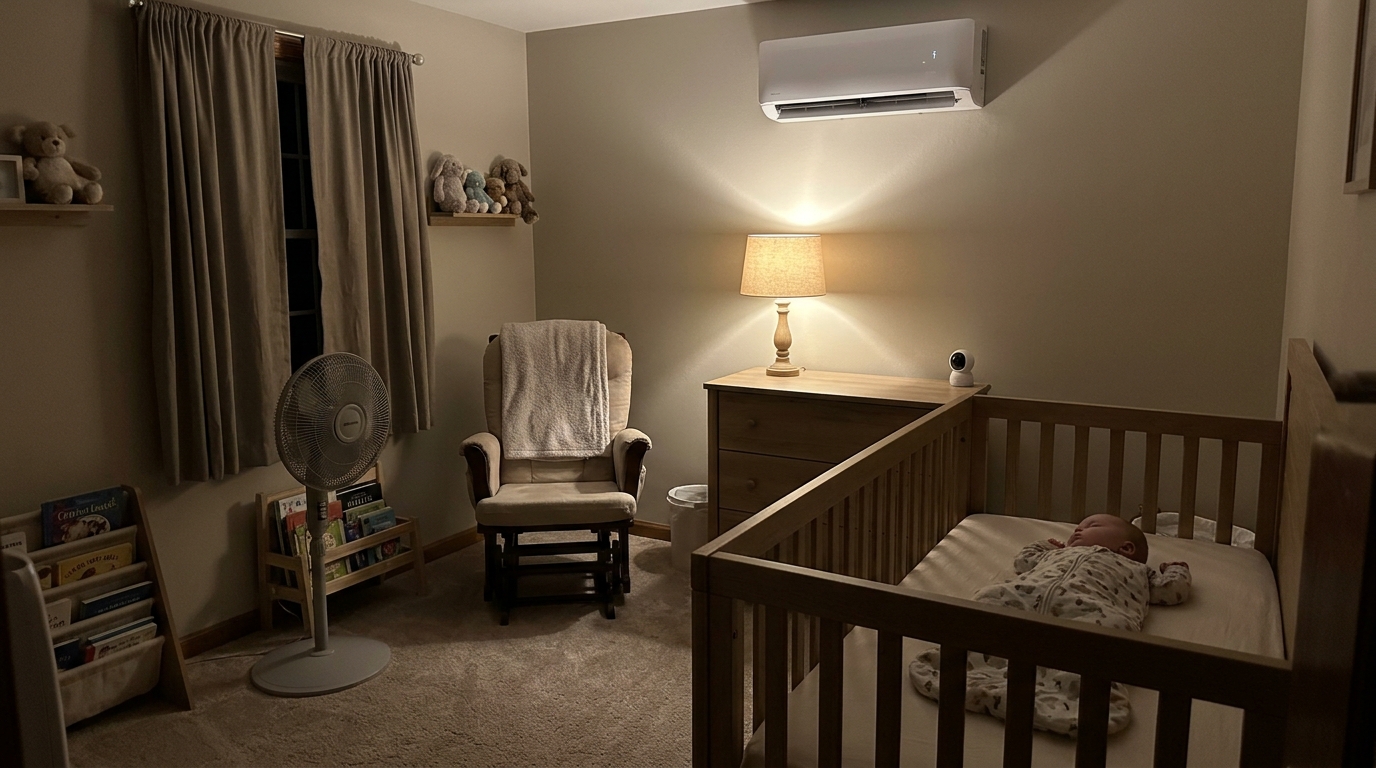
- Set the fan so it moves air across the room indirectly, aimed at a wall, ceiling, or open doorway, never blowing straight onto the crib. Keep the fan and its cord well out of the baby’s reach.
- Use the lowest speed that keeps air gently moving. A ceiling fan on low spinning counterclockwise in summer is ideal, since it adds circulation without a direct draft.
- Close blinds or curtains during the day on sun-facing windows so the room does not store up heat before bedtime.
- Measure the nursery. A typical 10 by 12 foot room (120 sq ft) needs about 5,000 BTU of cooling. Pick an ENERGY STAR window or portable unit in the 5,000 to 6,000 BTU range.
- Install a window unit snugly using the included side panels and foam seals, or vent a portable unit with a sealed window kit so hot air does not leak back in.
- Set the AC to 70 to 72 degrees F and use the sleep or eco mode so it cycles rather than running flat out. Point the louvers up and away from the crib.
- Start the AC about 30 to 45 minutes before bedtime to pre-cool the room, then let it maintain temperature. Pre-cooling is more efficient than fighting a hot room all night.
- Add blackout curtains or reflective window film on sun-facing glass, and seal gaps around the door with weatherstripping so cooled air stays in the room.
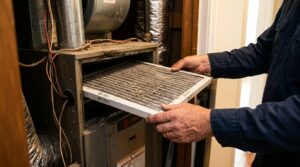
- Ask an HVAC contractor to check the nursery’s supply and return airflow, since weak airflow is a common reason one room runs hot.
- Consider adding a damper, a booster, or a small ductless mini-split head for the nursery, which cools one room at a time very efficiently.
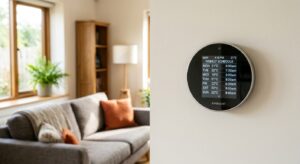
- Install a smart or zoned thermostat setting so the nursery can hold 70 to 72 degrees F overnight without overcooling the rest of the house.
- Have the contractor inspect attic insulation above the room, since adding R-38 or more can cut heat gain significantly.
Why It Works: The Benefits
Keeping the nursery in the 68 to 72 degree F range reduces overheating risk, which is a known concern for infant sleep safety.
Running a 40 watt fan for 8 hours uses about 0.32 kWh, roughly 5 cents a night at 15 cents per kWh, or about $1.50 a month.
Cooling one 120 square foot nursery with a small AC unit can cut nighttime cooling energy by 30 to 60% compared with dropping the whole-house thermostat to chill one room.
AC pulls moisture from the air, which can drop a muggy 70% room closer to 50%. That makes the same temperature feel noticeably more comfortable.
A steady low hum from a fan or AC can double as white noise, and a stable temperature means fewer wake-ups from being too hot or too cold.
💰 Savings Impact by Action
Cooling only the nursery instead of the whole house at night can cut nighttime cooling energy by 30 to 60%.
A 40 watt fan uses roughly 90% less electricity than a 5,000 BTU room AC over an 8 hour night.
Blackout curtains or reflective film block 30 to 50% of solar heat gain through sun-facing windows.
Sealing gaps around the door and window keeps cooled air in and reduces cooling load by about 10 to 20%.
Starting AC before bedtime and using eco mode cuts overnight run time by roughly 10%.
🏠 Key Concepts Explained
The Science Behind It
A fan creates a breeze that speeds up evaporation of moisture from skin, which carries heat away. That is why a fan makes you feel several degrees cooler even though the room temperature does not change. Because the benefit depends on sweating, it works best when a person can actually sweat efficiently and the air is not already saturated with moisture. Infants have underdeveloped sweating and a high ratio of skin surface to body mass, so they gain far less comfort from a fan once the room is genuinely warm.
An air conditioner works on a different principle. It pulls heat out of the room air using refrigerant and a coil, then dumps that heat outdoors. The cold coil also condenses water vapor out of the air, which lowers humidity. Lower temperature and lower humidity together reduce heat stress far more than airflow alone, which is why AC is the better tool when the nursery sits above the comfortable range.
Energy use follows the same logic. Moving air takes very little power, while removing heat takes a lot. That is why the smartest strategy is usually layered: block heat at the source with shades and sealing, use a fan for gentle circulation when the room is already in range, and bring in a small AC only when you need real cooling. Sizing matters too, since an oversized AC short-cycles, cools unevenly, and removes less humidity than a properly sized one.
Frequently Asked Questions
▼ Why is the nursery still hot even though the AC runs all night?
The unit may be undersized for the room, leaking air around the window, or fighting heavy sun and attic heat. Seal gaps with foam strips, add blackout curtains, and confirm the unit is rated for the room’s square footage (about 5,000 BTU for 120 sq ft). If it still cannot hold 72 degrees F, ask an HVAC pro to check airflow and insulation.
▼ Can renters do this without landlord permission?
Yes. A portable AC with a window vent kit, a freestanding fan, blackout curtains, and removable foam weatherstripping need no permanent changes. Window units usually do not require approval but check your lease, and avoid drilling or modifying the window frame.
▼ How long before I notice savings on my bill?
A fan costs about $1.50 a month to run, so the savings versus AC show up on your very next bill. If you switch from cooling the whole house to cooling only the nursery with a small AC, expect to see roughly 30 to 60% lower nighttime cooling cost within one billing cycle.
▼ What if my home is older than 30 years?
Older homes often have leaky windows and thin attic insulation, so rooms heat up faster and hold less cool air. Start with weatherstripping, window film, and attic insulation toward R-38, then add a small AC only if the room still runs warm. These steps usually pay back within 1 to 3 summers.
▼ Is it safe to run a fan all night in a baby’s room?
A fan on a stable surface, with the cord out of reach and air moving indirectly in the room, is generally considered fine and may help circulation. Avoid blowing air directly on the baby, and follow your pediatrician’s advice on safe sleep and room temperature.
Quick Tips
- Put the thermometer at crib height, not on a dresser near a window, so you read the temperature your baby actually experiences.
- Use a fan to circulate air in the room, aimed at a wall or ceiling, rather than pointing it at the crib.
- Pre-cool the room 30 to 45 minutes before bedtime and use a sleep or eco mode to save energy overnight.
- Block afternoon sun with blackout curtains or window film to cut nursery heat gain by up to 30 to 50%.
Variations for Your Situation
- Apartment/Rental: Use a freestanding fan plus a portable AC with a window vent kit ($250 to $400) and removable foam weatherstripping ($10 to $20). Add blackout curtains with a tension rod, which need no drilling and leave no damage.
- Tight Budget (under $50): Buy a digital thermometer and hygrometer ($10 to $15), close blinds during the day, use a fan aimed at a wall for circulation, and dress baby in light layers. This free-to-cheap combination handles rooms that stay under about 75 degrees F.
- Older Home (pre-1980): Expect higher air leakage and weaker insulation. Seal door and window gaps with weatherstripping ($15 to $30), add window film ($20 to $40), and boost attic insulation toward R-38 before buying a bigger AC, since a leaky room wastes cooled air.