Community solar sounds simple: you subscribe to a share of an off-site solar farm, and your utility sends you credits that reduce your bill. No roof, no panels, no installation. But many subscribers open their bill and feel confused. The solar farm produced plenty of power, yet they still owe money, especially in winter and on months with heavy evening use.
The confusion comes from a basic mismatch. Solar farms generate electricity during daylight hours, but most households use the most power in the early morning and the evening, when the sun is low or gone. Your home still pulls from the grid at night at the regular rate. The credits you earn are applied on paper, not delivered to your outlets at 8 PM.
This post explains how community solar credits actually work, why your nighttime usage determines how much of your bill gets offset, and what you can do about it. Whether you want a no-cost habit change or a battery-backed setup, you will find numbers and steps you can use this month.
What You’ll Need
Click on an item below to shop for the recommended items for this recipe on Amazon.
As an Amazon Associate, we earn from qualifying purchases.
How to Do It
- Log into your utility account and download 12 months of usage data (many utilities offer hourly or daily data via Green Button). Note your monthly kWh and the credit amount applied each month.
- Compare your annual kWh to your subscription’s estimated annual production share. If you use more than you are credited for, you have a sizing gap to close with efficiency or a larger share.
- Check your rate plan. If you are on time-of-use pricing, identify the peak window (often 4 to 9 PM) and move dishwasher, laundry, and EV charging outside it, ideally to midday or after 9 PM.
- Set a timer or use the delay-start feature on your dishwasher, washer, and dryer so they run during off-peak or daylight hours.
- Hunt down nighttime baseload: unplug or put on a power strip any devices that draw standby power, and check for an old second refrigerator or freezer running in the garage.
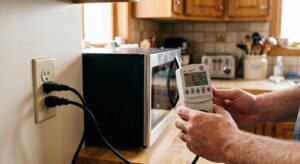
- Install a smart plug energy monitor ($15 to $25 each) on your refrigerator, entertainment center, and home office to measure real nighttime draw in watts.
- Install a programmable or smart thermostat ($25 to $150) and set a gentle evening setback of 2 to 3 degrees during peak rate hours, pre-conditioning the house during midday when solar is strongest.
- Set your EV charger or the car’s built-in scheduler to start after peak hours or during the solar-heavy window if you charge at home during the day. Many Level 2 chargers and cars offer this for free.
- Add a timer or smart switch ($20 to $50) to your electric water heater so it heats mostly in off-peak hours, and lower the tank setpoint to 120 degrees F to cut standby loss.
- Review your next two bills to confirm the shift. Track kWh used during peak versus off-peak so you can see exactly where the savings landed.
- Ask your utility and community solar provider whether battery storage is allowed alongside your subscription and whether any storage rebates or demand-response programs apply in your area.
- Get 2 to 3 quotes from licensed installers, sizing the battery to cover your typical 4 to 9 PM load (often 8 to 13 kWh for an average home).
- Verify the federal residential clean energy credit eligibility for your setup, which can reduce cost by up to 30 percent for qualifying storage, and check state incentives.
- Program the battery to charge from the grid in cheap off-peak hours and discharge during the peak window, since you do not have rooftop solar to charge it directly.
- Compare your projected annual savings against the net installed cost before signing. If payback exceeds 10 to 12 years, keep to the cheaper approaches.
Why It Works: The Benefits
Shifting 15 to 25 percent of evening usage to daytime or off-peak hours can cut your remaining bill by 10 to 20 percent, since peak-rate kWh are the most expensive ones left after credits apply.
Matching your usage to your subscription size prevents credits from piling up unused in summer and expiring before winter, which can waste $50 to $200 per year.
Eliminating phantom loads and inefficient always-on devices typically saves 5 to 10 percent of total household electricity, about 500 to 1,000 kWh per year.
Choosing a rate plan that matches your solar credit structure can save an additional $100 to $300 annually, especially if your credits are valued at the full retail rate.
Understanding your nighttime load profile tells you exactly how big a battery you would need, preventing a $3,000 to $6,000 oversizing mistake.
💰 Savings Impact by Action
Moving flexible loads out of peak hours can cut your post-credit bill by about 12 percent on time-of-use plans.
Eliminating phantom loads and old always-on appliances saves roughly 8 percent of total household electricity.
A 2 to 3 degree evening setback during peak hours reduces heating and cooling use by about 7 percent.
Heating water off-peak and lowering the setpoint to 120 degrees F cuts water heating costs by around 10 percent.
🏠 Key Concepts Explained
The Science Behind It
Electricity on the grid is a shared pool. When the solar farm feeds power in at noon, it displaces other generation, and your utility records your share of that output as a credit. At 9 PM your home draws power from whatever is on the grid at that moment, which is usually natural gas, hydro, wind, or nuclear. The credit simply offsets the dollar amount, so the physics and the accounting are separate things.
This is why timing matters economically even though credits are virtual. Under flat rates, a kWh costs the same whenever you use it, so total usage is what counts. Under time-of-use rates, a peak-hour kWh can cost 2 to 3 times more than an off-peak one, and if your credits are valued at a flat or average rate, they will not fully cover peak-priced usage. The remaining balance on your bill is therefore concentrated in your most expensive hours.
Solar output also follows the seasons. In the northern United States, a solar farm in December may produce only 25 to 35 percent of what it makes in June, while winter heating and lighting push household use up. Credit rollover smooths this out, but only if you have banked enough surplus in summer. Reducing your nighttime baseload and shifting flexible loads lowers the total kWh you need credits to cover, which keeps your annual credit balance from running dry.
Frequently Asked Questions
▼ Why do I still owe money even though my community solar farm is producing plenty of power?
Your credits only cover your subscribed share, and they are applied as a dollar or kWh offset, not as physical power. If your usage exceeds your share, or your credits are valued below your peak-hour rate, you will owe the difference. Compare your annual kWh to your subscription allocation to find the gap.
▼ Do I get credit for solar power I use at night?
Not directly. At night you pull grid power, but your account is credited for the solar farm’s daytime output, and those credits are then applied to your total bill. As long as your total credits cover your total usage over the billing period, the timing does not matter on a flat rate. On time-of-use rates, it does matter.
▼ Will my credits expire if I do not use them?
In many programs, unused credits roll over month to month and expire after 12 months, though rules vary by state and provider. Check your subscription agreement and utility tariff, and avoid oversizing your share beyond your actual annual usage.
▼ Is a home battery worth it with community solar?
Usually only if your utility has a large peak versus off-peak price gap, typically 15 cents per kWh or more, or offers strong incentives. Without rooftop panels, the battery charges from the grid, so savings come purely from rate arbitrage. For most homeowners, scheduling loads gives 70 to 80 percent of the benefit at no cost.
▼ What if my usage went up after I subscribed, like from an EV or heat pump?
Contact your provider about increasing your subscription share, since many allow adjustments if capacity is available. In the meantime, schedule EV charging off-peak and use a smart thermostat to keep the heat pump efficient.
Quick Tips
- Run your dishwasher, washer, and dryer on delay start so they finish during off-peak or midday hours.
- Check your credit balance on every bill and watch for months where credits roll over versus expire.
- Lower your water heater to 120 degrees F and insulate the first 6 feet of hot water pipe to cut nighttime standby loss.
- Unplug or switch off entertainment centers and chargers overnight, since standby draw can add 50 to 100 watts around the clock.
Variations for Your Situation
- Apartment/Rental: You can still subscribe to community solar in many states without owning your home, and your credits transfer on your own utility account. Focus on plug-in tools like smart plugs ($15 to $25 each), a smart power strip, and delay-start appliances, none of which require landlord approval.
- Tight Budget (under $50): Skip the hardware and focus on zero-cost habits: shift laundry and dishwasher use off-peak, unplug standby devices, lower your water heater to 120 degrees F, and review your bill each month for credit rollover. A single $20 smart plug monitor helps you find your worst energy hogs.
- Older Home (pre-1980): Older homes often have higher baseload from inefficient appliances, a second refrigerator, or an old electric water heater, so start with an appliance audit. Replacing a 15-year-old refrigerator can cut 300 to 500 kWh per year, and air sealing reduces nighttime heating and cooling demand.