Your windows are beautiful, but in summer they can act like miniature greenhouses. A single south- or west-facing window without proper covering can add hundreds of BTUs of heat to a room every hour, which means your air conditioner has to run longer and harder just to keep up. The Department of Energy estimates that heat gain through windows is responsible for about 30% of unwanted heat in the average home during cooling season.
Blackout curtains sound simple, but most homeowners hang them wrong, choose the wrong color, or miss opportunities to layer them with other window treatments for maximum effect. The difference between a curtain that looks the part and one that actually blocks heat comes down to fabric weight, mounting method, and what you pair it with. Get the combination right and you can reduce solar heat gain by up to 77%, according to DOE research on interior window coverings.
This guide covers the best blackout curtain combinations for every room type, from bedrooms and living rooms to east-facing kitchens and sun-drenched home offices. You will find quick no-cost adjustments, budget DIY upgrades, and a breakdown of the building science that explains why some combinations work so much better than others.
What You’ll Need
Click on an item below to shop for the recommended items for this recipe on Amazon.
As an Amazon Associate, we earn from qualifying purchases.
How to Do It
- Identify your highest-gain windows by standing inside at 2 PM on a sunny day and noting which rooms feel noticeably warmer or have direct sun hitting the floor. South and west-facing rooms are almost always the priority.
- Close all existing curtains or blinds on those windows before 10 AM each morning before the sun angle peaks. This single habit change can cut heat gain by 30 to 40% compared to leaving them open until the room heats up.
- If you have curtains with light-colored or white backings, rotate them so the lighter side faces the glass, not the room. The reflective side does the work of bouncing heat back out.
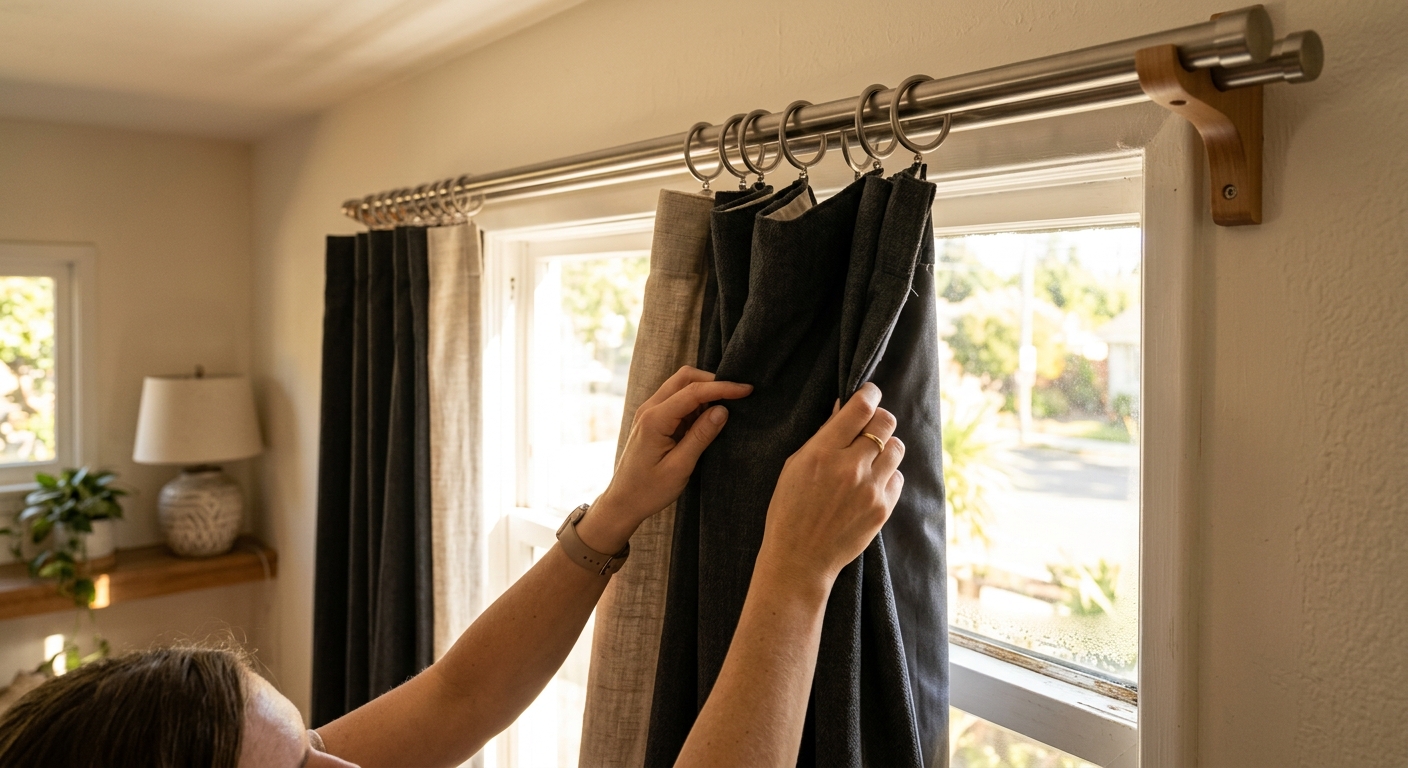
- Pull curtain panels fully to the edges of the window frame rather than letting them hang centered. Gaps at the sides allow convection loops to draw hot air off the glass and into the room. Use clips or tuck panels behind furniture if needed.
- In rooms with both curtains and blinds, close the blinds first then pull the curtains over them. The double layer creates a dead air space that slows heat transfer significantly more than either layer alone.
- Choose a blackout curtain with a white or cream foam-backed or triple-weave fabric. Avoid charcoal or dark-backed options on the window-facing side as they absorb rather than reflect solar heat. Look for curtains labeled 99% light blocking with a light-colored reverse side.
- Mount the curtain rod as close to the ceiling as possible, ideally within 1 to 2 inches of the ceiling or crown molding. This reduces the gap at the top where hot air escapes, and makes the room feel taller as a bonus.
- Extend the rod 4 to 6 inches beyond the window frame on each side. This lets the curtain panels fully cover the wall beside the window when closed, eliminating side gaps that allow convection to pull heat into the room.
- For maximum performance, add a cordless cellular (honeycomb) shade mounted inside the window frame as the first layer. A single-cell cellular shade in a light filtering or room-darkening color adds R-3 to R-4 of insulating value between the glass and the curtain.
- If budget allows, apply a strip of adhesive magnetic tape or hook-and-loop fastener tape along the wall at the curtain edge returns. This seals the side gap between the curtain and wall, completing the thermal barrier and eliminating the convection loop off the glass.
- After installation, test coverage by darkening the room at midday and looking for light bleed at the top, sides, and bottom. Adjust rod height or add a fabric valance at the top to close any remaining gap.
- Start with a solar shade (5% to 10% openness factor) mounted inside the window frame. Solar shades block 70 to 95% of solar heat gain while preserving some outward visibility when you want it, and they work even when the outer curtain is open.
- Layer a full blackout curtain on a ceiling-mounted return rod over the solar shade. The rod should have a projection of at least 3 to 4 inches from the wall so the curtain hangs clear of the shade stack without bunching.
- Use floor-length panels that puddle or break at the floor by 1 to 2 inches to seal the bottom gap. A curtain that stops 2 inches above the floor allows a convection channel to form, reducing effectiveness by 15 to 20%.
- For rooms with wide windows or sliding glass doors, use a center-split panel design and add a thin tension rod at the bottom of each panel threaded through a bottom pocket hem. This keeps panels pressed against the wall on each side and eliminates billowing that breaks the seal.
- Add a fabric cornice board or ceiling-mounted track at the top of the window to fully enclose the top of the curtain stack. This eliminates the last significant heat pathway, the warm air pocket that forms at the top of the window behind open curtains.
- Consider pairing this system with low-emissivity (low-E) window film applied directly to the glass. At $0.50 to $2.00 per square foot, window film reduces solar heat gain by 40 to 60% at the glass level before any curtain treatment, and the two systems together can exceed 80% solar heat gain reduction.
Why It Works: The Benefits
Properly installed blackout curtains on south and west windows can reduce cooling energy use by 5 to 15% per season. In a home spending $200 per month on summer electricity, that translates to $10 to $30 in monthly savings during peak months.
Blocking solar heat gain means your thermostat sees a lower load and your AC cycles off sooner. Homeowners often report their compressor running 20 to 30 minutes less per hour on hot afternoons after treating high-gain windows.
Eliminating radiant heat from a sunny window can lower the perceived temperature in a room by 5 to 10 degrees, making the space comfortable at a higher thermostat setpoint and reducing the need to overcool the whole house.
Blackout curtains in bedrooms block early morning light that triggers waking and disrupt circadian rhythms. Paired rooms with full blackout coverage consistently maintain temperatures 3 to 5 degrees cooler overnight than untreated rooms.
UV radiation from unblocked sunlight fades hardwood floors, rugs, and upholstery over time. True blackout curtains block nearly 100% of UV, extending the life of furnishings and reducing the long-term cost of replacement.
💰 Savings Impact by Action
Properly installed blackout curtains with sealed edges reduce solar heat gain through windows by up to 33% compared to untreated glass, according to DOE data on interior window treatments.
Adding a single-cell cellular shade as an inner layer contributes R-3 to R-4 of insulating value and reduces total window heat gain by an additional 15 to 20% beyond the curtain alone.
A solar shade with a 5% openness factor blocks 70 to 90% of solar radiation at the glass surface, reducing solar heat gain by 40 to 45% before any curtain layer is added.
Combining a solar shade, cellular shade, and sealed blackout curtain reduces total solar heat gain by up to 77%, the maximum performance range cited in DOE window treatment research.
Treating all south and west-facing windows with blackout curtain combinations can reduce total household cooling energy use by 5 to 15% per season depending on climate and window area.
🏠 Key Concepts Explained
The Science Behind It
The physics behind why curtains reduce heat gain comes down to three mechanisms working together: reflection, absorption, and convection interruption. When sunlight hits an untreated window, roughly 87% of that solar energy passes through standard clear glass and converts to infrared heat once it strikes interior surfaces. A white or foam-backed blackout curtain intercepts that radiation before it hits the floor or furniture. The light-colored surface reflects a significant portion back toward the glass, and the dense fabric absorbs and slowly dissipates the rest, preventing the rapid temperature spike that occurs when sunlight hits dark surfaces directly.
The dead air gap between the curtain and the glass is doing more work than most homeowners realize. Still air is a surprisingly good insulator, with a thermal resistance of roughly R-1 per inch. A 3-inch gap between a curtain and a window creates a meaningful thermal buffer, slowing the rate at which heat from the hot glass surface conducts into the room. This is why ceiling-mounted rods with deep wall projections outperform rods mounted close to the window frame. The larger the enclosed air space, the better the insulating effect. Adding a cellular shade inside the frame creates a second sealed air pocket, effectively doubling that resistance.
Convection loops are the often-overlooked heat pathway that undermines poorly installed curtains. Hot glass heats the air directly in front of it, causing that air to rise. Cool room air slides in along the floor to replace it, gets heated, rises again, and circulates warm air throughout the room continuously. A curtain with open sides and a gap at the top or bottom simply acts as a radiator fin, accelerating this loop. Sealing the sides, top, and bottom of the curtain breaks this cycle entirely and keeps the hot air trapped near the glass where it is isolated from the living space. This is the primary reason a properly sealed $60 curtain can outperform a $200 curtain hung with standard wall brackets and open sides.
Frequently Asked Questions
▼ My blackout curtains are closed all day but the room is still hot. What am I doing wrong?
The most common cause is gaps at the sides, top, or bottom that allow convection to circulate hot air off the glass into the room. Stand in the room with curtains closed and look for any light bleed at the edges. Extend your rod further past the frame, move it closer to the ceiling, and consider adding magnetic tape or hook-and-loop strips to seal the side edges. If the room is still warm, the heat may be coming through the ceiling from a hot attic rather than the windows.
▼ Do blackout curtains actually save money or is the payback period too long?
On south and west-facing windows in hot climates, quality blackout curtain combinations typically pay back their cost in 1 to 2 cooling seasons through reduced AC runtime. A $120 curtain installation that saves $5 to $10 per month during a 4-month cooling season pays back in 3 to 6 summers at the low end, but rooms with high solar gain often see faster payback. The savings are most meaningful when you can raise your thermostat setpoint by 2 to 3 degrees without losing comfort.
▼ Can I use blackout curtains in a room with a ceiling fan and still get the benefit?
Yes, ceiling fans and blackout curtains work well together. The fan does not compromise the thermal barrier of the curtain because the air movement it creates is horizontal circulation within the room rather than drawing air from outside or through the curtain. Run the fan counterclockwise in summer at low speed to create a wind chill effect, and keep the curtains fully closed during peak sun hours. This combination can make a room feel 4 to 6 degrees cooler at the same thermostat setting.
▼ What is the best blackout curtain color for keeping heat out?
The color that faces the room is mostly an aesthetic choice, but the color of the backing that faces the glass matters significantly. Choose curtains with white, cream, or silver backing regardless of the room-facing color. Dark-backed curtains absorb solar radiation and re-radiate it into the room as heat, which is the opposite of what you want. Many curtains are sold as triple-weave or foam-backed in decorative colors with a built-in white backing layer, and those are ideal.
▼ How do I handle a large sliding glass door where curtains are hard to seal?
Sliding glass doors are one of the hardest high-gain openings to treat because they require operational access. The best approach is a combination of a solar shade on a track inside the frame for daytime use, paired with a panel track blind or a wide traverse rod curtain for full coverage when the door is not in active use. Adding a bottom-weighted hem or floor guide track to panel curtains keeps them pressed against the wall and reduces the convection gap significantly. For maximum performance, look for insulated cellular shades designed specifically for sliding door widths.
Quick Tips
- Hang curtains before summer begins. Retrofitting window treatments mid-July is harder and more expensive than planning during spring.
- For renters who cannot drill into walls, use tension rods with extension curtain panels and add temporary hook-and-loop tape at the sides. No tools, no damage, and it still blocks most solar heat gain.
- Dark exterior colors absorb more heat before it even reaches the glass. If your home exterior or window trim is dark, exterior solar shades or awnings can reduce heat gain by up to 65% before any interior treatment is applied.
- Wash blackout curtains once or twice per season. Dust and dirt accumulation on the fabric surface reduces reflectivity and can degrade foam backing over time, reducing effectiveness by 10 to 15% in just a year or two without cleaning.
Variations for Your Situation
- Apartment/Rental: Renters who cannot drill into walls can use heavy-duty tension rods rated for 20 to 30 pounds, available for $15 to $40, paired with blackout curtain panels. Add temporary hook-and-loop fastener tape (Command strips work well) along the wall edge of the curtain returns to seal the sides without damage. This setup blocks 60 to 70% of solar heat gain with zero permanent modifications and costs under $80 per window.
- Tight Budget (under $50): Skip the hardware store and start with a $5 can of temporary window film or reflective mylar cut to fit inside the window frame. Pair it with whatever curtains you already own, making sure they are pulled fully to the edges and closed by 9 AM on sunny days. Reflective mylar alone reduces solar heat gain by 35 to 50% and can be removed at the end of the season. Add inexpensive foam weather strip tape along curtain edges to seal convection gaps at no cost.
- Older Home (pre-1980): Homes built before 1980 typically have single-pane windows or early double-pane glass with no low-E coating, meaning solar heat gain is dramatically higher than in modern homes. In these cases, blackout curtains alone are only part of the solution. Prioritize adding low-E window film to the glass first ($0.50 to $1.50 per square foot at home improvement stores), then layer a cellular shade and blackout curtain over it. This three-layer approach can reduce solar heat gain by 75 to 85% even through aging single-pane glass, and the film pays back in under two seasons in most climates.