Walk down any hardware store aisle and you will find air filters ranging from $1 fiberglass pads to $30 premium filters claiming to remove everything from dust to odors. The packaging uses terms like MERV, MPR, and FPR, and most homeowners either ignore them entirely or assume higher always means better. Neither approach is correct, and the consequences show up directly on your energy bill and in your AC’s lifespan.
Your HVAC filter does two jobs: it protects your system’s blower, coil, and ductwork from debris buildup, and it cleans the air circulating through your home. The tension between those two goals is where most people go wrong. A filter that is too restrictive for your system starves the blower of airflow, forcing it to work harder, reducing cooling capacity, and in some cases causing the evaporator coil to freeze solid. A filter that is too loose lets dust coat your coil and drop system efficiency by 5 to 15% over a single season.
This post breaks down exactly what MERV ratings mean in practice, which range works for most residential systems, and how to match your filter choice to your specific setup. You will get two clear approaches, real numbers on the efficiency impact, and answers to the questions homeowners most commonly get wrong at the store.
What You’ll Need
Click on an item below to shop for the recommended items for this recipe on Amazon.
As an Amazon Associate, we earn from qualifying purchases.
How to Do It
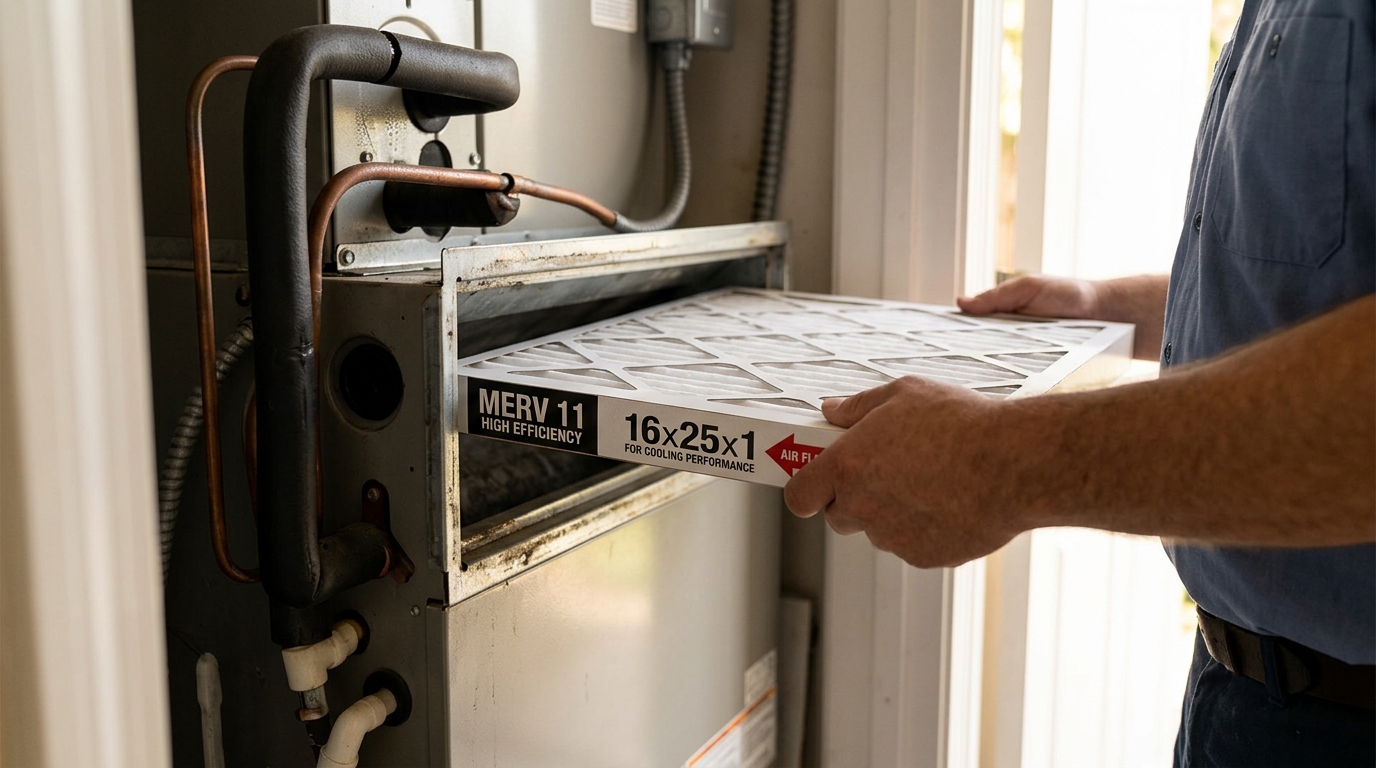
- Locate your current filter at the air handler or return air grille and note the exact size printed on the cardboard frame (example: 16x25x1). Write this down before going to the store.
- Check your existing filter rating. If it is a MERV 1 to 4 fiberglass panel or unlabeled blue fiberglass, it is protecting almost nothing. If it is MERV 13 or higher and your system is a standard residential unit, it may be over-restricting airflow.
- Purchase a pleated MERV 8 filter in your exact size. This rating captures pollen, mold spores, and pet dander while staying within the static pressure limits of virtually all residential systems. It is the safest general-purpose choice.
- Install the new filter with the airflow arrow on the frame pointing toward the blower and away from the return duct. An arrow pointing the wrong direction cuts filtration efficiency by half.
- Set a phone reminder to check the filter every 30 days. Hold it up to a light source. If you cannot see light through the media, replace it immediately rather than waiting for the scheduled date.
- Write the installation date on the filter frame with a marker so you always know how long it has been in service.
- Find your air handler’s specifications. Look for a label on the unit or pull up the model number online. Search for the manufacturer’s recommended filter MERV range and maximum static pressure rating (typically listed in the installation manual as external static pressure).
- Start with a MERV 8 filter installed correctly and run the system for 15 minutes. Then hold your hand near the supply registers. You should feel strong, consistent airflow from every vent. Note this as your baseline.
- Install a MERV 11 pleated filter of the same size. Run the system again for 15 minutes and compare airflow at the same registers. If airflow feels noticeably weaker or the system runs longer to reach the set temperature, your system prefers MERV 8.
- Inspect the filter slot for gaps around the edges. If you can see light around the filter frame, seal the gap with foam weather stripping tape applied to the slot edges. This prevents bypass leakage that defeats the filter entirely.
- For homes with pets or allergies, consider a 4-inch thick media filter cabinet upgrade (installed once, accepts standard 4-inch MERV 11 filters). Thicker media has lower pressure drop at the same MERV rating and lasts 6 to 12 months between changes. These units cost $50 to $150 installed as a DIY project.
- Create a seasonal filter log: date installed, filter brand and MERV, and a condition note when removed. After two to three changes, you will know exactly how fast your home loads up a filter and can calibrate your change interval precisely.
Why It Works: The Benefits
Matching your filter rating to your system and changing it on schedule prevents coil fouling and airflow restriction, reducing cooling energy use by 5 to 15% compared to a neglected or mismatched filter setup.
Dirty or overly restrictive filters are the leading cause of evaporator coil freezing and compressor short-cycling. Preventing these failures can save $150 to $600 per service call and extend compressor life by several years.
Proper airflow means the system can maintain set temperatures without running continuously. Homeowners often report more even room-to-room temperatures after correcting filter choice and change intervals.
A MERV 8 to 11 filter captures pollen, mold spores, pet dander, and fine dust without choking airflow, providing meaningful air cleaning without the tradeoffs of ultra-high-MERV filters in systems not designed for them.
Keeping the coil clean and the blower running within its design parameters reduces wear on the compressor and motor, potentially adding 3 to 5 years to the system’s serviceable life.
💰 Savings Impact by Action
Switching from a too-high or too-low filter to the correct MERV range for your system restores design airflow and reduces cooling energy use by up to 10%.
Replacing a clogged filter before it reaches maximum loading prevents the airflow restriction that causes blower motors to consume 5 to 10% more electricity.
Consistent proper filtration prevents dust buildup on the evaporator coil, preserving heat transfer efficiency and avoiding a 5 to 15% loss in cooling capacity over a season.
Sealing gaps around the filter frame eliminates bypass leakage that allows unfiltered air to foul the coil, recovering up to 5% of filtration effectiveness at zero equipment cost.
🏠 Key Concepts Explained
The Science Behind It
Your air conditioner removes heat from your home by moving large volumes of air across a very cold evaporator coil. The coil operates at around 40 degrees Fahrenheit, and warm room air passing over it gives up its heat before returning to the living space as cooled air. This process depends entirely on adequate airflow. When a filter restricts that flow, less air contacts the coil per minute, the coil gets colder than intended, and eventually the moisture condensing on its surface freezes rather than draining away. The result is a block of ice where your coil should be, and zero cooling capacity until it thaws.
The MERV scale quantifies how effectively a filter captures particles in specific size ranges. MERV 8 captures at least 70% of particles between 3 and 10 microns, including pollen and mold spores, which covers most common household allergens. MERV 11 extends capture efficiency to smaller particles like pet dander and fine dust. MERV 13, the level now used in many commercial buildings, captures particles down to 0.3 microns, including some bacteria and smoke. Each step up requires a denser filter media, which by definition creates more resistance to airflow. The engineering tradeoff is real and unavoidable: better filtration requires either more restriction, more filter surface area (thicker media), or a more powerful blower.
Filter fouling follows a predictable curve. A new filter actually becomes slightly more efficient in its first week as captured dust fills small gaps in the media and creates a finer mesh. After that point, resistance increases rapidly without additional filtration benefit. The Department of Energy estimates that a dirty filter can increase HVAC energy consumption by 5 to 15%, and a fouled coil (the result of years of poor filtration) reduces system efficiency by an additional 5 to 10%. Together these losses can push a system that should achieve a seasonal energy efficiency ratio of 14 down toward the performance of a 10 SEER unit, a significant and entirely preventable efficiency penalty.
Frequently Asked Questions
▼ My AC is barely blowing air from the vents. Could the filter be causing this?
Yes, a severely clogged filter is one of the most common causes of weak airflow at supply vents. Go to your air handler or return grille immediately and pull the filter out. If it is gray or dark brown and you cannot see light through it, replace it and run the system for 20 minutes. If airflow improves, the filter was the problem. If airflow is still weak after installing a fresh filter, the coil may have frozen or the blower motor may need service.
▼ Why does my AC keep freezing up even though I just changed the filter?
Coil freezing after a fresh filter change usually points to one of three issues: the new filter is a higher MERV rating than the system can handle, the filter is installed backward, or refrigerant is low. Check the filter direction first (arrow toward the blower) and confirm the MERV rating is 11 or lower for a standard residential system. If the problem continues, have an HVAC technician check refrigerant charge, since low refrigerant drops coil temperature below the freezing point regardless of airflow.
▼ Is a MERV 13 filter safe for my home system if I change it more often?
Changing a MERV 13 filter frequently helps with particle loading but does not solve the fundamental static pressure problem. Even a brand-new MERV 13 filter creates higher resistance than a MERV 8 or 11, and if your blower was not designed for that resistance level, shorter change intervals will not compensate. If you need MERV 13 filtration, have an HVAC contractor add a 4-inch or 5-inch thick media cabinet, which provides equivalent filtration at much lower static pressure.
▼ Can I use the same filter rating year-round or should I change it for winter?
The same MERV rating works year-round, but your change interval may differ seasonally. During summer cooling season, your system runs more hours per day, loading the filter faster. During mild spring or fall months when the system runs infrequently, a filter may last 60 to 90 days. Let actual filter condition drive your change timing rather than a fixed calendar schedule.
▼ My filter size is listed as 16x25x1 but the filters I buy never fit perfectly. What is going on?
Filter sizes are nominal, not actual. A filter labeled 16x25x1 typically measures about 15.5 by 24.5 inches. This is normal and expected. The issue arises when the gap between the filter and the slot edges is large enough to allow bypass air. If you can slide a finger around the filter edge, apply foam weather stripping tape to the slot frame to create a tighter seal. This small fix can dramatically improve filtration effectiveness.
Quick Tips
- Set a recurring calendar reminder every 30 days during cooling season to physically inspect your filter, not just remember it exists.
- If you have multiple return air vents in different rooms, each one may have its own filter. Check every grille in your home, not just the one at the air handler.
- During wildfire smoke events or high outdoor pollen days, check your filter every two weeks rather than monthly. Outdoor air quality spikes can load a filter in days.
- If your energy bill spikes unexpectedly in summer and the thermostat setting has not changed, check the filter before calling an HVAC tech. A clogged filter is the most common cause of sudden efficiency drops and is a free fix.
Variations for Your Situation
- Apartment/Rental: Renters can almost always change their own air filter without landlord permission since it is routine maintenance, not a modification. Focus on MERV 8 pleated filters in the exact size of the existing filter. If the return grille is in the ceiling or wall, the filter is behind that grille, not at the air handler. Spend $10 to $15 per filter and set a 30-day reminder during summer. If your landlord is responsible for filter changes but neglects them, document the dirty filter with photos and request service in writing, since a fouled coil can cause mold and is a habitability issue.
- Tight Budget (under $50): Skip the premium brands and buy store-brand MERV 8 pleated filters in bulk online. A six-pack of standard pleated MERV 8 filters typically costs $20 to $30 and covers an entire cooling season. This alone delivers the majority of the efficiency benefit. Zero-cost steps include checking filter direction (airflow arrow pointing toward blower), inspecting the filter slot for bypass gaps and sealing them with tape, and simply committing to monthly checks. These no-cost habits prevent the coil fouling that quietly wastes 5 to 10% of cooling energy all season.
- Older Home (pre-1980): Homes built before 1980 often have oversized return air ducts, undersized blowers by modern standards, or non-standard filter slot sizes. Start by measuring the actual opening, not trusting the label on the existing filter frame, since previous owners may have installed the wrong size for years. These older systems often perform better with MERV 8 rather than MERV 11, since the blowers were designed for low-resistance fiberglass panels. If the duct system is leaky (common in older homes), fixing duct leaks will deliver more savings than any filter upgrade, so consider a duct inspection alongside your filter optimization.