Few things are more frustrating than losing power to part of your home without warning. A tripped circuit breaker cuts power as a safety response, protecting your wiring from overheating and your home from a potential fire. But if you just flip it back on without understanding why it tripped, you could be setting yourself up for a repeat event or worse, ignoring a wiring problem that needs professional attention.
Circuit breakers trip for three main reasons: circuit overloads (too many devices drawing power at once), short circuits (a direct fault in wiring or an appliance), or ground faults (current leaking to ground through an unintended path). Each cause has a different fix, and knowing which one you are dealing with changes everything about how you respond. The good news is that most homeowner-level breaker trips are caused by simple overloads and are easy to prevent with a few habit changes and low-cost upgrades.
In this post, you will learn how to safely reset a tripped breaker step by step, identify warning signs that point to a bigger problem, and take practical steps to prevent future trips without spending a lot of money. Whether you are dealing with a kitchen circuit that keeps tripping during holiday cooking or a bathroom breaker that flips every time you run the hair dryer, this guide covers you.
What You’ll Need
Click on an item below to shop for the recommended items for this recipe on Amazon.
As an Amazon Associate, we earn from qualifying purchases.
How to Do It
- Turn off or unplug every device on the affected circuit before touching the panel. This removes the load so the breaker is not immediately stressed when you reset it.
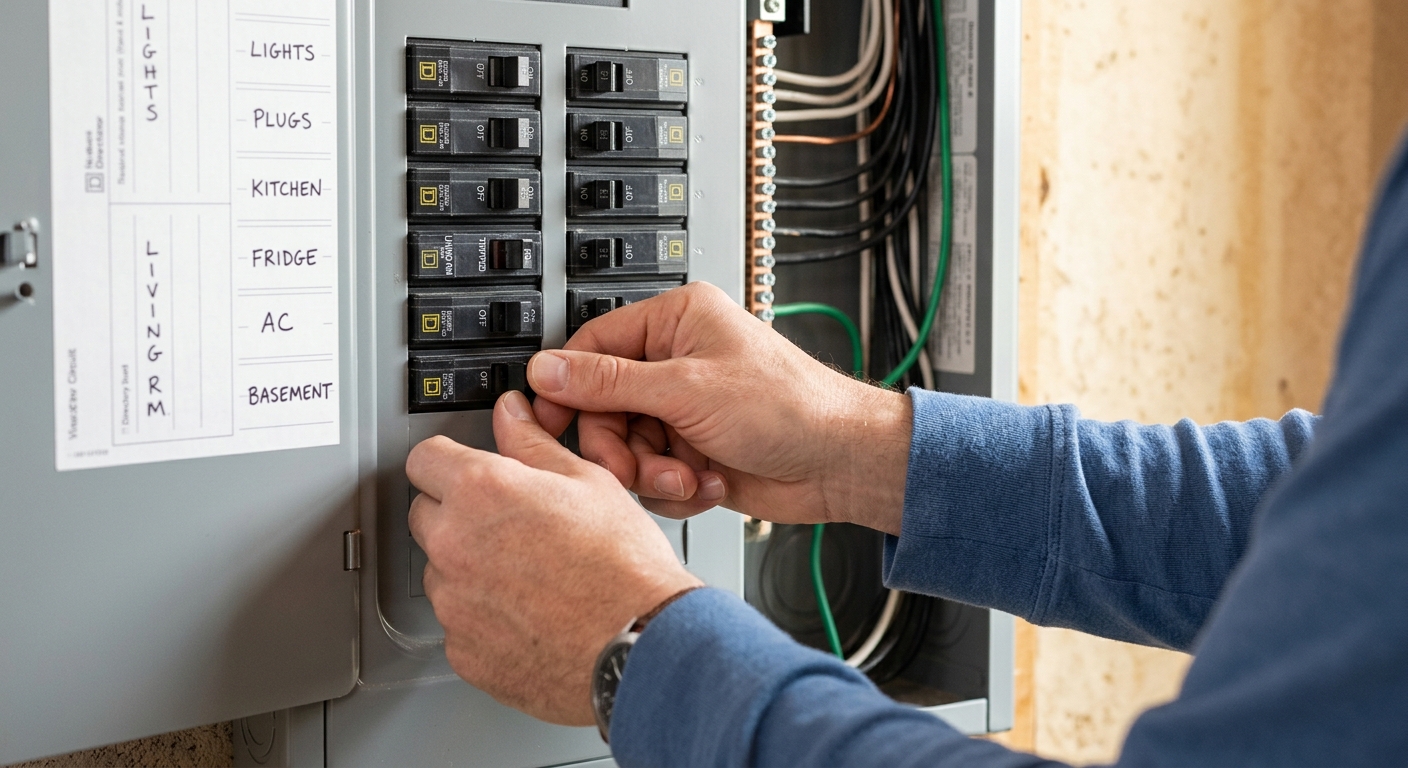
- Open your electrical panel door. Locate the tripped breaker. It will be in the middle position (not fully on or fully off), or may have a red or orange indicator window depending on the brand.
- Firmly push the breaker handle all the way to the OFF position first. You must fully reset the internal mechanism before flipping it back on. Skipping this step is the most common reset mistake.
- Now flip the breaker handle firmly to the ON position. You should feel a solid click. The indicator window (if present) should return to showing solid black or green.
- Return to the room and plug devices back in one at a time, waiting 30 seconds between each. This tells you exactly which device or combination of devices caused the overload.
- If the breaker trips again immediately with nothing plugged in, do not reset it again. This indicates a short circuit or wiring fault that requires a licensed electrician.
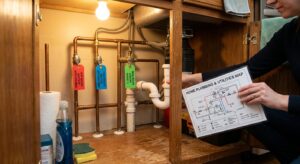
- Map your circuits using a plug-in circuit tracer tool ($20 to $35) or the manual method: plug a lamp into each outlet, then trip breakers one at a time to see which outlets go dark. Label your panel with each circuit’s coverage. This takes 45 to 60 minutes but is invaluable.
- Calculate the load on any circuit that has been tripping. Add up the wattage of every device on that circuit. A 15-amp circuit at 120 volts has a safe continuous capacity of about 1,440 watts (80% of 1,800-watt maximum). A 20-amp circuit tops out at 1,920 watts continuous.
- Move high-draw appliances to different circuits where possible. Plug the microwave and toaster into outlets on different circuits. In home offices, spread monitors, computers, and space heaters across two or more circuits.
- Install a smart plug with energy monitoring ($15 to $25) on circuits that have tripped before. These show real-time wattage draw and let you identify which device is the actual overload culprit.
- Inspect the breaker itself for signs of wear: discoloration, a burning smell near the panel, visible corrosion, or a handle that feels loose or wobbly. A breaker that trips at loads well below its rating and is more than 20 years old likely needs replacement by an electrician.
- Install power strips with built-in overload protection ($20 to $40) at entertainment centers and desk setups to add a secondary layer of protection and make it easier to manage loads by zone.
- Schedule an electrical inspection with a licensed electrician if your breaker trips more than twice on the same circuit within a month, if you see scorch marks or smell burning near the panel, or if your home still has a fuse box or known recalled panel brands like Federal Pacific Stab-Lok or Zinsco.
- Ask the electrician to measure your actual panel load versus capacity. Many homes built before 1990 have 100-amp service panels that are now undersized for modern loads including EV chargers, heat pumps, and added home office equipment. A 200-amp upgrade runs $1,500 to $4,000 but pays for itself in safety and eliminates constant tripping.
- Request a dedicated 20-amp circuit for any appliance rated over 1,000 watts that runs continuously, including window air conditioners, space heaters, chest freezers, and dishwashers. Dedicated circuit installation typically costs $150 to $300 per circuit.
- Have the electrician check for aluminum branch-circuit wiring if your home was built between 1965 and 1973. Aluminum wiring requires special outlets and connections to prevent dangerous oxidation at connection points, which causes heat buildup and tripped breakers.
- After any panel or wiring work, request a copy of the permit and inspection certificate. This protects your homeowner’s insurance coverage and documents the upgrade for future resale.
Why It Works: The Benefits
The U.S. Fire Administration attributes roughly 24,000 residential electrical fires per year to wiring and equipment faults. Properly functioning breakers and correct load management are your first line of defense against heat buildup in walls and junction boxes.
An emergency electrician call costs $150 to $400 per hour after hours. Catching a chronic overload or failing breaker early and addressing it during a scheduled visit can save $300 to $800 compared to waiting until the problem escalates to a panel issue or wiring replacement.
Frequent trips and the power surges that accompany them can shorten the life of sensitive electronics, motors in appliances, and HVAC equipment. Stable, properly protected circuits extend the usable life of devices by reducing voltage stress.
Identifying overloaded circuits often leads homeowners to audit their plug-in devices, and that audit typically reveals 5 to 10% in phantom load savings from unplugging idle electronics and replacing outdated high-draw appliances.
A modern, properly loaded electrical panel is a selling point in home inspections. Homes with outdated 60-amp or 100-amp panels or recalled breaker brands often receive requests for $2,000 to $5,000 in concessions from buyers.
💰 Savings Impact by Action
Redistributing appliances across circuits costs nothing and eliminates most overload trips immediately, preventing $200 to $800 in repeat service calls.
Identifying overloaded circuits typically reveals idle phantom loads that, when eliminated, reduce electricity consumption by 5 to 10% on average.
A modern 200-amp panel with properly sized breakers improves distribution efficiency and supports high-efficiency appliances, reducing wasted energy from older oversized loads by roughly 10 to 15%.
Installing dedicated circuits for high-draw appliances reduces voltage drop and motor stress, extending appliance life and reducing energy waste by 3 to 7% for those devices.
🏠 Key Concepts Explained
The Science Behind It
A circuit breaker is essentially a controlled switch that opens automatically when current exceeds a safe threshold. Inside every standard breaker is a bimetallic strip, two metals bonded together that expand at different rates when heated. When sustained overcurrent flows through the strip, it bends enough to release the trip latch, opening the circuit. This thermal response is intentionally slow to allow brief current spikes (like a motor starting) without nuisance tripping, but it catches sustained overloads that would otherwise heat wiring insulation to dangerous temperatures.
Short circuits trigger a different mechanism. When a hot wire contacts a neutral or ground wire directly, resistance drops nearly to zero and current spikes to many times the breaker’s rating in milliseconds. This massive current surge creates a strong magnetic field around an electromagnet inside the breaker, which pulls the trip latch open almost instantly, usually fast enough to prevent damage. The loud pop or arc flash you sometimes see or hear during a hard short is the electricity jumping the gap as the circuit opens. This is normal breaker behavior, but it is a signal that a wiring fault needs investigation before restoring power.
Ground faults follow the same electrical principles but travel through an unintended path, sometimes through a person, a damp floor, or a faulty appliance chassis. Standard circuit breakers do not react quickly enough to protect humans from ground fault injuries, which is why GFCI (Ground Fault Circuit Interrupter) receptacles and breakers are required in bathrooms, kitchens, garages, and outdoor circuits. A GFCI device monitors the difference in current between the hot and neutral conductors and trips in about 1/40th of a second when it detects a difference as small as 5 milliamps, fast enough to prevent serious injury. If your GFCI outlets are tripping frequently, they are doing their job, but the underlying appliance or wiring fault causing the leakage still needs to be found and fixed.
Frequently Asked Questions
▼ Why does my breaker keep tripping even after I unplug everything?
If the breaker trips with no load connected, you almost certainly have a short circuit or ground fault somewhere in the wiring of that circuit, not an overload problem. Do not continue resetting it. Turn it off, label it, and call a licensed electrician to trace the fault. Continuing to reset a breaker with a wiring fault can cause internal wiring damage or, in the worst case, a fire inside a wall cavity.
▼ My breaker does not look tripped but I have no power to the outlets. What is happening?
Some breakers trip internally without the handle visibly moving to the middle position. This is common in certain older breaker brands. Try pushing the breaker firmly all the way to OFF and then firmly back to ON even if it looks like it is already on. If that does not restore power and you have confirmed the outlet is not controlled by a GFCI elsewhere on the circuit, the breaker may have failed internally and needs replacement by an electrician.
▼ Can I replace a tripped breaker myself?
Replacing an individual branch circuit breaker is a task some experienced DIYers handle, but it requires turning off the main breaker and working inside the panel where exposed wiring and bus bars still carry risk. In most jurisdictions this work is legal to do yourself on your own home, but if you are not comfortable identifying live versus dead components inside a panel, hire a licensed electrician. A breaker replacement typically costs $75 to $200 including labor, and it is worth the cost for the safety assurance.
▼ How do I know if my problem is the breaker itself or the wiring?
If the breaker trips at loads well below its amperage rating (for example, a 20-amp breaker tripping when you run a single 800-watt microwave), the breaker is likely faulty and needs replacement. If the breaker trips at normal loads or trips with nothing connected, suspect the wiring. A licensed electrician can use a clamp meter and insulation resistance tester to distinguish between the two within about 30 minutes.
▼ Is it safe to run an extension cord as a permanent fix to avoid tripping?
No. Extension cords are designed for temporary use only and are not rated for the continuous current draw that a permanently connected appliance requires. Using an extension cord long-term can cause the cord to overheat and creates a fire and trip hazard. The correct fix is to either redistribute load to a different circuit or have a dedicated circuit installed by an electrician, which typically costs $150 to $300.
Quick Tips
- Label your electrical panel thoroughly the first time you map circuits. A well-labeled panel saves significant time during every future troubleshooting session and is valuable to electricians and home inspectors.
- Never replace a 15-amp breaker with a 20-amp breaker to stop tripping. The breaker rating must match the wire gauge, and swapping to a larger breaker allows more current than the wiring can safely carry.
- Test GFCI outlets in bathrooms, kitchens, garages, and outdoors every six months using the test button. A GFCI that does not trip and reset properly needs to be replaced, typically a $15 to $25 DIY job.
- Space heaters and window air conditioners are the most common causes of tripped breakers in rental apartments. Plug these into circuits that do not also serve a refrigerator, microwave, or other high-draw appliance.
Variations for Your Situation
- Apartment/Rental: Renters usually cannot modify wiring or replace breakers, but you can prevent overloads entirely through load management. Identify which outlets share a circuit by using a $15 outlet tester and the lamp-tripping method, then redistribute high-draw appliances like space heaters and air conditioners accordingly. Notify your landlord in writing if the breaker trips repeatedly, as they are responsible for maintaining safe electrical systems. Document your notification for your records.
- Tight Budget (under $50): Start with the free steps: map your circuits using a lamp and the breaker panel, calculate wattage loads by reading appliance labels, and redistribute devices to balance the load. Spend $15 to $20 on a smart plug with energy monitoring for the one circuit that has been tripping to get real-time wattage data. Add a $20 power strip with overload protection at high-use areas. These three steps address the majority of overload-based trips at minimal cost.
- Older Home (pre-1980): Homes of this era often have 60-amp or 100-amp panels that are undersized for modern electrical loads, and some contain recalled breaker brands or aluminum branch wiring. Prioritize an electrical inspection ($100 to $200) before doing any DIY work, as the safety risks are higher and the solutions are more often professional-level. If your panel has not been evaluated in more than 10 years, budget $1,500 to $4,000 for a possible 200-amp service upgrade, which will eliminate chronic tripping and significantly reduce fire risk.