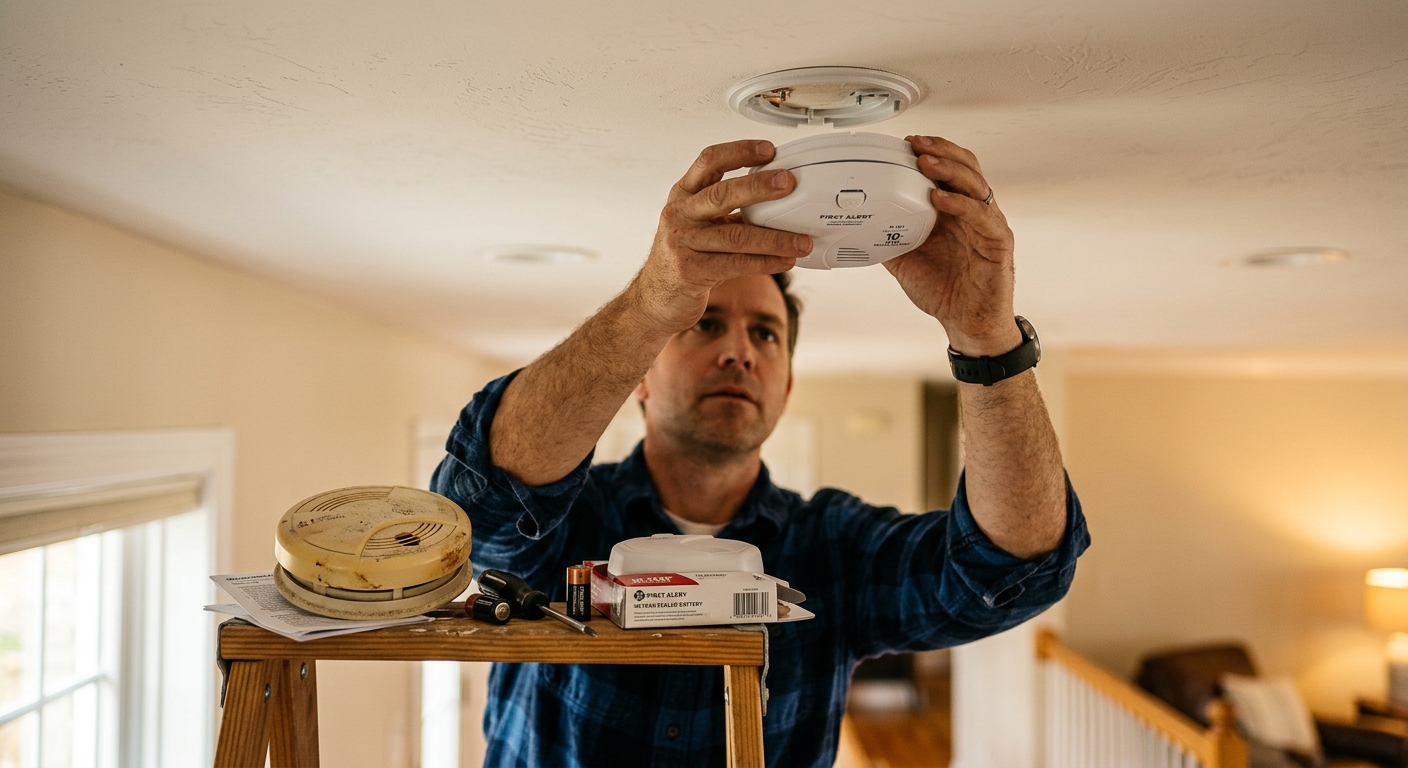
Every year, homeowners dutifully press the test button on their smoke detectors, hear the beep, and move on feeling safe. The problem is that test button only checks the horn and battery, not the actual smoke-sensing chamber. Ionization and photoelectric sensors degrade over time due to dust accumulation, humidity, and natural material decay, meaning a detector can pass its button test and still fail to detect a real fire.
The National Fire Protection Association (NFPA) and every major detector manufacturer recommend replacing smoke detectors every 10 years, yet surveys consistently show that more than half of American homes have at least one detector that is past its replacement date. In homes where fatal fires occurred, nearly two-thirds of detectors either had missing batteries, dead batteries, or units that were simply too old to function. That is not a battery problem. That is a replacement problem.
This post walks you through how to audit every detector in your home, understand the difference between sensor types, replace outdated units correctly, and build a simple maintenance schedule so you never have to guess whether your family is protected. The good news: replacing all the detectors in a typical home costs between $60 and $150 and takes less than two hours.
What You’ll Need
Click on an item below to shop for the recommended items for this recipe on Amazon.
As an Amazon Associate, we earn from qualifying purchases.
How to Do It
- Walk every floor of your home and locate each smoke detector. Write down the room and count the total number of units.
- Twist or slide each detector off its mounting bracket and flip it over. Find the manufacture date printed on the label on the back of the unit.
- If the manufacture date is more than 10 years ago, mark that unit for immediate replacement with a piece of tape. If no date is visible, treat the unit as expired.
- Press the test button on each unit you are keeping. A weak or absent alarm tone means the battery and horn need attention right now, independent of age.
- Verify placement: there should be a detector inside every bedroom, in the hallway outside sleeping areas, on every floor, and in the basement. Note any gaps.
- Create a simple list of which units to replace and their locations before purchasing replacements.
- Purchase replacement detectors. For most rooms, choose a dual-sensor (ionization plus photoelectric) combination smoke and CO unit. For bedrooms, a detector with a 10-year sealed battery eliminates annual battery changes.
- Turn off the circuit breaker for hardwired detectors before removing the old units. Battery-only detectors require no power shutoff.
- Remove the old detector by twisting counterclockwise off the mounting bracket. For hardwired units, unplug the wire harness connector. Note the connector type before buying replacements so you purchase a compatible model.
- Install the new mounting bracket using the existing screws or the new screws provided. For hardwired units, plug in the wire harness before snapping the detector onto the bracket.
- For battery units, insert the included battery, then mount the detector onto the existing bracket. Most modern detectors are cross-compatible with standard twist-lock brackets.
- Test every newly installed detector using the test button. For interconnected hardwired systems, triggering one should activate all units. Write the installation date in permanent marker on the back of each new unit so the next replacement is obvious.
- Choose a smart detector ecosystem such as Nest Protect, First Alert Onelink, or a Z-Wave compatible model that matches your existing smart home platform if you have one.
- Map your home layout and confirm you have coverage in every required location: inside each bedroom, outside each sleeping area, every floor, and the basement.
- Turn off the circuit breaker for any hardwired locations. Remove old detectors and note the wiring configuration. Most smart hardwired detectors use a standard 3-wire (120V, neutral, interconnect) connection compatible with existing household wiring.
- Install the smart detectors following manufacturer instructions, connecting the wire harness for hardwired locations or inserting the sealed long-life battery for battery locations.
- Download the companion app and connect each detector to your home Wi-Fi network. Register the detectors and enable mobile notifications, including low-battery alerts and self-test reminders.
- Configure automations if your platform supports them, such as turning on all smart lights when an alarm triggers at night to illuminate evacuation paths. Test the full system and confirm phone notifications are working.
Why It Works: The Benefits
A functioning detector alerts occupants an average of 3 minutes earlier than a degraded or absent unit, providing critical evacuation time. Working detectors cut fire fatality risk by 55% compared to homes with non-functioning units, according to NFPA data.
Many insurers offer a 2 to 10% discount on homeowners insurance for homes with properly installed and documented smoke and CO detector systems. On a $1,500 annual premium that is $30 to $150 back per year.
Modern dual-sensor detectors with adaptive algorithms produce up to 85% fewer false alarms than units more than 10 years old. Fewer false alarms mean residents stop disabling detectors, keeping protection intact.
Combination smoke and CO detectors cost only $5 to $15 more than smoke-only units. Carbon monoxide poisoning causes more than 400 accidental deaths annually in the US, and combination units address both hazards in a single replacement.
Many municipalities now require smoke detectors inside every bedroom per updated building codes. Replacing old units brings your home into current compliance, which matters for home sales, rentals, and insurance claims.
💰 Savings Impact by Action
Homes with working smoke detectors reduce fire fatality risk by 55% compared to homes with non-functioning or absent detectors, per NFPA research.
Modern dual-sensor detectors with adaptive algorithms produce up to 85% fewer nuisance alarms than units more than 10 years old, preventing residents from disabling units.
Many homeowners insurers offer up to 10% premium discount for homes with properly maintained smoke and CO detector systems, saving $30 to $150 per year.
Early detection from properly functioning detectors reduces average property damage per residential fire by roughly 40% because fires are caught at a smaller stage.
🏠 Key Concepts Explained
The Science Behind It
Ionization smoke detectors work by passing a tiny electrical current through a small chamber of ionized air. When smoke particles enter the chamber, they attach to the ionized molecules and reduce current flow, triggering the alarm. The problem is that over time, dust and airborne particles also accumulate in the chamber and partially block the ion flow, reducing the detector’s sensitivity even when no smoke is present. After 8 to 10 years, the chamber’s response time to actual smoke can double or triple compared to a new unit.
Photoelectric detectors work on a different principle. A light beam is aimed away from a sensor inside a small chamber. When smoke enters, particles scatter the light in all directions, some of which hits the sensor and triggers the alarm. The light-emitting diode and receiver both degrade with age and temperature cycling, and the sensor can drift out of its designed sensitivity range over the same 10-year window. A unit that was factory-calibrated to detect 2 to 4 percent obscuration per foot may require 8 to 10 percent obscuration by year 12, a significant reduction in early-warning capability.
The reason most homeowners do not notice this degradation is that the test button bypasses the sensor entirely. It directly triggers the horn circuit, confirming only that the electronics and speaker still function. The only true field test of a smoke sensor chamber is using actual smoke or a calibrated aerosol, which is why professional fire safety inspectors use smoke aerosol spray rather than the test button. For homeowners, the practical solution is simply to replace units on the 10-year schedule rather than trying to test actual sensor sensitivity at home.
Frequently Asked Questions
▼ My smoke detector keeps beeping every 30 seconds even with a new battery. What is wrong?
A chirp every 30 to 60 seconds after a new battery is installed usually means the detector has reached end of life and is signaling that it needs to be replaced entirely, not just given a fresh battery. Check the manufacture date on the back of the unit. If it is more than 10 years old, replacement is the correct fix. If it is newer, try removing the battery, pressing the test button to drain residual charge, then reinserting the battery and reseating the unit on its bracket.
▼ How do I know if my detectors are hardwired or battery only?
Remove the detector from its mounting bracket by twisting counterclockwise. If you see a wire harness plugging into the back of the unit, it is hardwired. If there is no wiring and only a battery compartment, it is battery powered. Hardwired units almost always have a backup battery as well, but the primary power comes from your home’s electrical system.
▼ Can I replace a hardwired smoke detector with a battery-only unit to avoid dealing with wiring?
Technically yes, but this is not recommended and may violate local building codes. Hardwired interconnected systems provide the critical feature of whole-home simultaneous alarming. If you replace one hardwired unit with a battery unit, you break the interconnect chain and occupants in other parts of the home may not hear an alarm from that location. Stick with hardwired replacements for previously hardwired locations.
▼ My detector is only 6 years old. Does it really need to be replaced soon?
Not yet, but start planning. Detectors between 7 and 9 years old are in the final portion of their reliable service life. Set a calendar reminder for the 10-year manufacture date, not your installation date. If the unit was manufactured 8 years ago and sat in a warehouse or store for a year before you installed it, it may already be 9 years into its useful life. Always check the manufacture date label on the back.
▼ Do I need a smoke detector in the kitchen?
Not directly in the kitchen. The NFPA recommends keeping detectors at least 10 feet from cooking appliances to reduce nuisance alarms. Place a detector in the hallway adjacent to the kitchen rather than above the stove or near the oven. If your kitchen is open-plan and far from a hallway, choose a photoelectric model with a cooking sensitivity mode, which is less reactive to steam and minor cooking smoke while still detecting real fire conditions.
Quick Tips
- Buy detectors in multipacks. A 6-pack of combination smoke and CO detectors typically costs 25 to 30% less per unit than buying individually.
- Choose detectors with a 10-year sealed battery for bedroom installations. You will never wake up to a low-battery chirp at 2am, and the sealed battery lasts the full life of the unit.
- Replace all detectors in your home at the same time rather than one by one. This keeps your entire system on the same replacement schedule and eliminates guesswork about which units are old.
- Take a photo of the manufacture date label on each old detector before removing it. This gives you a record of how long you went without replacing and confirms the new units are starting fresh.
Variations for Your Situation
- Apartment/Rental: Renters generally cannot replace building-installed smoke detectors without landlord approval, but you can and should test them monthly and notify your landlord in writing if any unit is over 10 years old or fails a test. You can legally add battery-powered supplemental detectors in your bedroom without landlord permission in most states. Look for a combination smoke and CO detector with a 10-year sealed battery (around $30 to $45) that requires no tools or wall modifications.
- Tight Budget (under $50): A basic ionization detector costs as little as $8 to $12, and you can protect a 3-bedroom home for under $50 if you prioritize the bedroom and hallway locations first. Look for store-brand or First Alert value packs at big-box retailers. A smoke-only ionization unit is far better than an expired dual-sensor unit. Add CO protection later when budget allows, starting with the bedroom nearest your furnace or attached garage.
- Older Home (pre-1980): Homes built before 1980 may have no interconnected wiring between detectors, meaning each unit operates independently. If your home has no hardwired detectors, you are relying entirely on battery units heard from one room at a time. Consider upgrading to a wireless interconnected system such as the First Alert Z-Wave or Kidde RF-interconnect series, which links battery-powered detectors wirelessly so all units alarm together. This upgrade costs $150 to $300 for a whole home and requires no electrical work.