Every January, the same frustrating scene plays out: you check your energy bill and it’s $80 to $150 higher than December, even though you swore you kept the thermostat at the same 68 degrees. You haven’t changed your habits, so why does winter’s coldest month cost so much more to heat? The answer lies not in your thermostat setting but in the physics of how heat escapes your home and how hard your heating system has to work when outdoor temperatures drop into the single digits.
Your heating bill is driven by something called the temperature differential, which is the gap between the inside and outside air. When it’s 20 degrees outside instead of 40, your furnace runs nearly twice as long to maintain the same indoor temperature. On top of that, January’s cold snaps expose every hidden air leak, poorly insulated wall, and drafty window your home has been hiding since fall. Heat loss through these weak points accelerates sharply as temperatures plunge, compounding the problem even more.
This post breaks down exactly why January is so expensive, identifies the specific culprits in a typical home, and gives you two practical approaches to cut that spike by 15 to 35%. Whether you have 20 minutes or a free weekend, there are meaningful steps you can take right now to stop overpaying every winter.
What You’ll Need
Click on an item below to shop for the recommended items for this recipe on Amazon.
As an Amazon Associate, we earn from qualifying purchases.
How to Do It
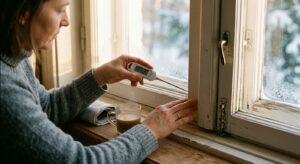
- Walk through your home on a cold windy day and feel for drafts around exterior door frames, window sills, fireplace dampers, and the bottoms of exterior doors. Use a stick of incense or a candle to identify subtle air movement.
- Close your fireplace damper completely if you are not using it. An open damper is equivalent to a 48-square-inch hole in your ceiling and can cost $200 or more per heating season in lost heat.
- Roll up a towel or use an inexpensive door draft stopper ($8 to $15) at the base of any exterior door where you feel cold air. This is especially effective for attached garage doors leading into living space.
- Switch your ceiling fans to run clockwise on the lowest speed. This pushes warm air that has risen to the ceiling back down along the walls without creating a wind-chill effect, improving comfort at the same thermostat setting.
- Set your thermostat 7 to 10 degrees lower for the 8 hours you sleep or are away from home. The DOE estimates this single habit saves about 10% annually on heating costs.
- Purchase one tube of paintable latex caulk, one can of expanding spray foam (minimal-expanding for windows and doors), foam outlet gaskets, and self-adhesive weatherstripping. Total cost is typically $40 to $70 at any hardware store.
- Install foam gaskets behind the cover plates of all electrical outlets and light switches on exterior walls. These gaskets cost about $3 for a pack of 10 and take 2 minutes each. A typical home has 8 to 15 exterior-wall outlets.
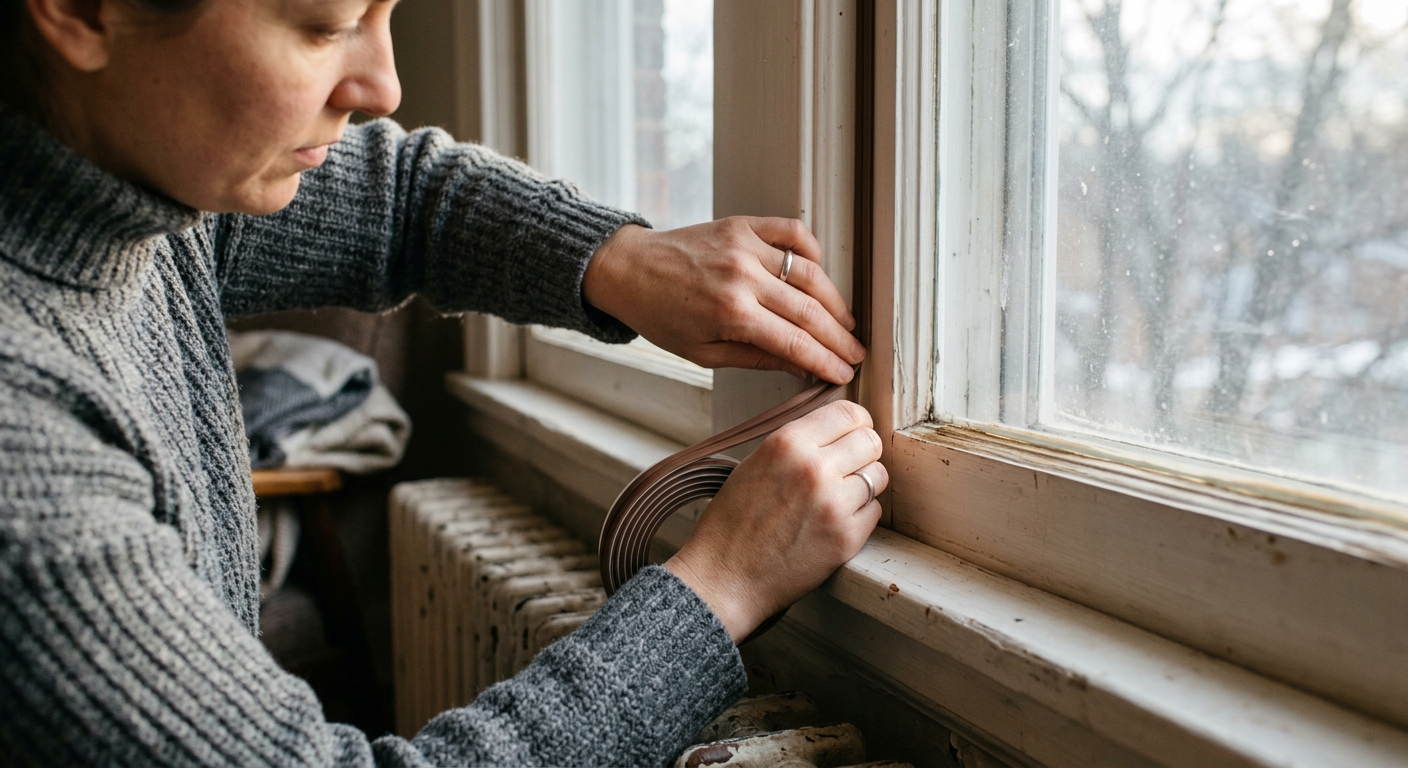
- Apply weatherstripping to any exterior door that shows daylight around the frame or where you felt drafts in the quick-fix step. Choose a compression style for door stops and a door sweep for the bottom threshold.
- Apply a bead of caulk along the interior joint where your window trim meets the drywall on any window that feels cold to the touch. This seals a commonly missed gap between the rough framing and the window frame.
- Inspect your attic hatch or pull-down attic stairs. These are almost never insulated from the factory. Add self-adhesive weatherstripping around the perimeter and cut a piece of rigid foam insulation ($8 to $12) to sit on top of the hatch from the attic side, targeting R-15 or better.
- Check where pipes and wires enter from the basement or crawl space into the living area. Fill any gaps larger than a quarter inch with expanding spray foam. These bypasses allow cold air to travel up through wall cavities and are a major driver of the stack effect.
Why It Works: The Benefits
Combining air sealing and thermostat scheduling typically reduces January heating costs by 15 to 35%, which translates to $40 to $120 in savings on a typical $300 to $350 January gas bill.
Sealing attic bypasses and adding door sweeps eliminates the cold drafts and cold floors that make certain rooms feel uncomfortable even when the thermostat reads 68 degrees.
Every hour your furnace doesn’t run is an hour of wear it doesn’t experience. Reducing heat loss means shorter run cycles, which can extend furnace lifespan and reduce the chance of a midwinter breakdown.
Basic air sealing materials cost $20 to $80 and can pay for themselves within a single heating season, making this one of the highest return-on-investment home efficiency projects available.
💰 Savings Impact by Action
Sealing attic bypasses, rim joists, and penetrations reduces infiltration-driven heat loss by up to 20% in a typical home.
Setting back the thermostat 7 to 10 degrees for 8 hours per day saves approximately 10% annually on heating costs per the U.S. Department of Energy.
Upgrading attic insulation to R-49 reduces heating load by 15 to 25% by cutting the largest conductive heat loss pathway in most homes.
Insulated or thermal curtains closed at night reduce window heat loss by up to 25%, contributing roughly 5 to 8% total heating savings.
Replacing a severely clogged furnace filter restores proper airflow and can recover 5 to 10% of heating efficiency with a $5 to $15 fix.
🏠 Key Concepts Explained
The Science Behind It
The core physics behind your January bill spike is Fourier’s Law of Heat Conduction, which states that the rate of heat flow through any material is directly proportional to the temperature difference across it. In plain terms, if it’s 30 degrees colder outside in January than it was in November, heat is escaping through your walls, roof, and windows 30 units faster for every degree of difference. Your furnace has to run proportionally longer to replace that lost heat, and that is the fundamental reason your bill rises even when the thermostat stays constant.
Air infiltration makes this worse through a separate mechanism called the stack effect. Warm air is less dense than cold air, so it rises and accumulates at the top of your home, creating slight positive pressure near the ceiling and negative pressure near the floor. In January, when the temperature differential is greatest, this pressure difference is strongest, actively pulling frigid outdoor air through every low crack and gap while simultaneously pushing warm air out through every high gap. Research from Lawrence Berkeley National Laboratory found that air infiltration accounts for 25 to 40% of heating energy loss in typical U.S. homes, making it a bigger factor than most homeowners realize.
Radiant comfort is the third layer of the problem. Human comfort is not determined solely by air temperature but also by the mean radiant temperature of surrounding surfaces. A single-pane window in January can reach surface temperatures of 15 to 25 degrees on the interior side. Your body radiates heat toward that cold surface, making you feel cold even when the air thermometer reads 68 degrees. The predictable result is that occupants nudge the thermostat up to 70 or 72 to feel comfortable, adding 4 to 6% to the heating bill for every 2-degree increase. Reducing radiant heat loss through window insulation film or heavy curtains directly improves perceived comfort without raising air temperature.
Frequently Asked Questions
▼ Why is my heating bill so high even though I have a newer thermostat?
A smart thermostat optimizes when you heat, but it cannot compensate for heat escaping through poorly sealed or insulated building components. If your bill is still high, the problem is almost certainly in the building envelope, specifically air leaks, under-insulated attic, or older windows. Start by checking your attic insulation depth. If it’s less than 10 to 12 inches of fiberglass or 8 inches of blown cellulose, adding insulation to reach R-38 or R-49 will have a bigger impact than any thermostat adjustment.
▼ My house feels cold near the floor even with the heat running. What is causing that?
Cold floors are a classic sign of air infiltration through the bottom of the home, either from a basement, crawl space, or slab. Air is entering through rim joists, plumbing penetrations, or gaps in the subfloor and flowing across the floor before the furnace can warm it. Inspect the rim joist area in your basement or crawl space and seal any visible gaps with spray foam, then add cut-and-cobble rigid foam insulation for R-10 to R-15 coverage along the rim.
▼ Can renters do anything to lower their January heating bill without modifying the apartment?
Yes, several no-damage steps make a real difference. Hang heavy thermal curtains over windows (available for $25 to $50 per panel) to reduce both radiant heat loss and cold air infiltration around the frame. Place draft stoppers at exterior door bases and ask your landlord about weatherstripping repairs, since most lease agreements require landlords to maintain habitable temperature conditions. Reversing ceiling fans to clockwise rotation is also free and renter-safe.
▼ How much can I actually save by sealing my attic hatch?
A typical unsealed attic hatch loses roughly 2 to 4% of total heating energy on its own, which sounds small but translates to $15 to $40 on a $350 January bill. More importantly, fixing it takes 20 minutes and costs under $20 in materials, making the first-year return on investment over 100%. It is consistently one of the highest dollar-per-hour improvements you can make.
▼ My furnace seems to run constantly in January. Is something wrong with it?
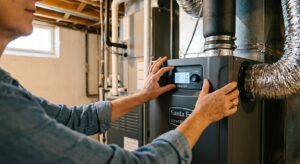
Continuous runtime in extreme cold is often normal because your furnace is sized for design-day conditions, meaning the coldest typical day in your climate zone. If it runs constantly only when temperatures are below 10 to 15 degrees and maintains your setpoint temperature, the equipment is likely fine. However, if it runs constantly and still cannot reach the setpoint, check the filter first, then have a technician inspect for duct leaks, which can waste 20 to 30% of heated air before it reaches living space.
Quick Tips
- Open south-facing curtains and blinds during daylight hours on sunny January days. Passive solar gain through a typical window can add 1,000 to 2,000 BTUs of free heat per hour, reducing furnace runtime noticeably.
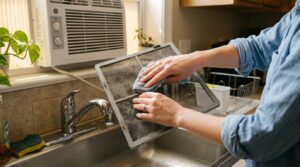
- Check your furnace filter. A clogged filter forces the blower to work harder and reduces airflow, which makes heat exchangers overheat and cycle off early. A $5 to $15 filter replacement can restore 5 to 10% of heating efficiency immediately.
- If you have a programmable or smart thermostat, add an extra setback period during morning hours between 2 a.m. and 5 a.m. when outdoor temperatures typically hit their lowest point. Allowing the house to drop to 65 degrees during those hours and ramping back up by 6 a.m. cuts peak heating demand with minimal comfort impact.
- Seal behind your bathroom exhaust fan housing in the attic if you have attic access. Bath fans create a direct hole through the ceiling and many are not properly sealed at the attic side, allowing constant stack-effect air exchange all winter.
Variations for Your Situation
- Apartment/Rental: Renters cannot modify the HVAC system or seal wall penetrations permanently, but thermal curtains ($25 to $50 per panel) are the single most impactful renter-safe upgrade. Look for curtains rated with a thermal liner or insulated backing. Pair these with removable rope caulk (press-in, pulls off in spring without damage) to seal around drafty window frames and you can reduce heat loss at windows by 25 to 35% without any landlord permission.
- Tight Budget (under $50): Focus entirely on zero-cost and near-zero-cost steps. Reversing ceiling fans, closing the fireplace damper, and using rolled towels at door bases cost nothing. A $6 pack of outlet foam gaskets, one tube of caulk at $5, and a door sweep at $12 cover the three highest-impact purchases. Done in one afternoon, these steps typically save $30 to $60 on a single January bill.
- Older Home (pre-1980): Homes built before 1980 often have little or no attic insulation by modern standards, uninsulated rim joists, and aluminum single-pane windows with no weatherstripping. The stack effect in these homes is severe and air sealing alone can reduce heating bills by 20 to 30%. Prioritize a professional blower door test ($300 to $500) to locate the worst leaks systematically, then address attic air sealing and rim joist insulation before adding more attic insulation on top. Many utility companies offer free or subsidized energy audits for older homes.