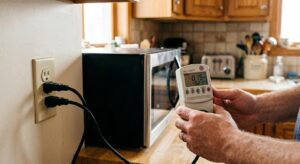
Every winter, heat pours out of your home through your windows like water through a sieve. According to the U.S. Department of Energy, windows account for 25 to 30% of residential heating energy loss. In a home with a $200 monthly heating bill, that means $50 to $60 worth of warmth is escaping through the glass every single month. The frustrating part is that most homeowners already have curtains or blinds and still feel cold drafts near their windows.
The problem is not just having window treatments, it is having the right combination in the right order. A single sheer curtain does almost nothing to stop heat loss. But when you layer cellular shades, thermal curtains, and draft-blocking accessories correctly, you create a system of insulating air pockets and radiant barriers that can reduce window heat loss by 40% or more. That is the difference between a drafty bedroom that never feels warm and a room that holds heat through the night.
This guide covers the building science behind why windows lose so much heat, how different treatment layers work together, and exactly how to set up a layered system in your own home on a range of budgets. Whether you rent and cannot modify your windows or own and want to invest in a proper upgrade, there is an approach here that will make a measurable difference on your next heating bill.
What You’ll Need
Click on an item below to shop for the recommended items for this recipe on Amazon.
As an Amazon Associate, we earn from qualifying purchases.
How to Do It
- Check that all existing curtain rods extend to within 2 inches of the wall on each side and that curtains hang as close to the ceiling as possible to minimize the gap where warm air escapes over the top.
- Ensure curtains touch or slightly puddle on the floor, closing the convective loop at the bottom where cold air most commonly enters.
- Roll a tightly-packed draft snake or a folded towel against the sill at the base of any window where you feel cold air, targeting north-facing and single-pane windows first.
- During daylight hours, open treatments fully on south and west-facing windows to capture solar heat gain. Close all window treatments at sunset to trap that warmth inside.
- On any window with a gap between the back of existing curtains and the wall, add a strip of hook-and-loop tape (about $5 at a hardware store) to press the curtain edge against the wall, sealing convective bypass.
- Install a cellular (honeycomb) shade as the first layer, mounted inside the window frame. Single-cell shades provide R-3 to R-4 and double-cell shades reach R-4 to R-5. Look for shades rated by the Attachment Energy Rating Council (AERC). Cost is $40 to $120 per window.
- Mount a curtain rod that extends at least 6 inches beyond the window frame on each side and positions the rod 4 to 6 inches above the top of the frame. This prevents warm air from escaping around the treatment edges.
- Hang thermal-lined or blackout curtains as the outer layer. Look for curtains with a thick acrylic foam or flannel lining. These add R-1 to R-2 on their own, but more importantly, they create a sealed dead-air pocket between the curtain and the shade, which amplifies the insulating value of both.
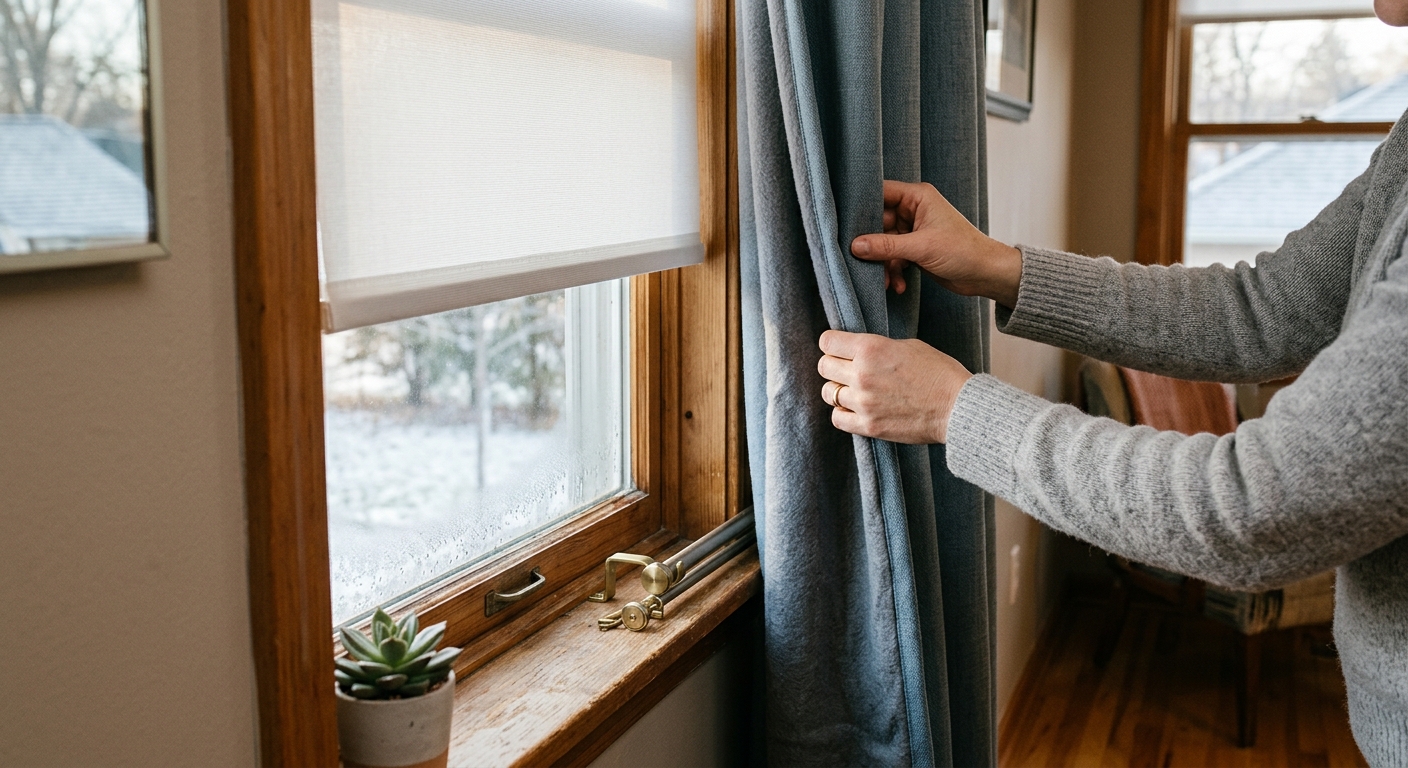
- Use curtain clips or brackets to mount the curtain edges against the wall on both sides when closed. This is the most overlooked step and it makes a dramatic difference by preventing warm room air from circulating behind the curtains and contacting the cold glass.
- Install a cornice board or valance box above the rod to block the top gap where warm air rises and escapes over the curtain rod. A simple foam board cornice costs under $20 to build and seals the top convective bypass completely.
- Test your completed system with a stick of incense held near the edges of the closed treatment. If smoke pulls toward the window, seal those spots with rope caulk (removable in spring) or additional weatherstripping around the frame.
- Contact an interior window insert company for an in-home measurement. Inserts must be custom fitted to your exact window dimensions to create the compression seal that gives them their insulating value.
- Choose your insert grade: standard compression inserts for most windows, or acoustic-grade inserts (3/8-inch acrylic) for windows facing streets or noisy areas, which provide both thermal and sound insulation.
- Have the installer fit the inserts, which press into the window frame using a compression tube gasket. No screws, glue, or permanent modification is required, making this option viable for renters with landlord approval.
- Layer standard thermal curtains over the inserts for an additional R-1 to R-2, bringing your total window assembly to R-5 to R-8, which approaches the performance of new triple-pane windows at a fraction of the cost.
- Remove and store inserts in warm months. Most inserts stack flat and can be stored in a closet or garage until the following heating season.
Why It Works: The Benefits
Properly layered window treatments can reduce window-related heat loss by 25 to 40%, and since windows account for 25 to 30% of total heating loss, homeowners can realistically see 8 to 12% reductions in overall heating costs, translating to $100 to $300 or more in savings over a full heating season.
Cold convective loops near windows create uncomfortable cold spots and drafts even when the thermostat reads 70 degrees. Layered treatments eliminate these loops, making rooms feel 2 to 4 degrees warmer at the same thermostat setting.
When windows stop acting as heat sinks, your furnace or heat pump cycles less frequently, reducing mechanical wear and extending system life. Homes with well-insulated windows can often lower their thermostat by 1 to 2 degrees and still feel equally comfortable.
Heavy layered curtains also act as acoustic insulation, dampening outside noise by 4 to 8 decibels, which is a meaningful improvement in street-facing rooms of urban and suburban homes.
Unlike window replacements that cost $400 to $1,000 per window, a fully layered window treatment system for a standard window costs $80 to $200 and can be installed in under an hour with basic tools, making it one of the highest return-on-investment improvements available to homeowners and renters alike.
💰 Savings Impact by Action
Double-cell honeycomb shades reduce window heat loss by up to 30% by trapping still air in sealed honeycomb cells directly against the glass.
Thermal-lined curtains sealed at edges and top reduce window radiant and convective heat loss by 25% compared to unlined curtains.
Pressing curtain edges against the wall eliminates convective bypass and adds 15% more effectiveness to any treatment layer already installed.
Actively opening south-facing treatments during daylight and closing all treatments at sunset reduces net heating demand by up to 10% through passive solar gain.
Sealing infiltration gaps around window frames with rope caulk or weatherstripping reduces cold air infiltration by up to 18%, independent of treatment layers.
🏠 Key Concepts Explained
The Science Behind It
Windows lose heat through four simultaneous mechanisms, and understanding them explains why a single layer of curtains underperforms. Conduction transfers heat directly through the glass pane, which has an R-value of 1 for single-pane and about 2 for standard double-pane glass. Radiation moves heat energy from warm interior surfaces toward the cold glass. Convection creates a continuous loop where air cooled by the glass sinks, drawing more warm room air into contact with the cold surface. And infiltration brings cold outside air directly through gaps around the frame. A single curtain partially addresses radiation but does almost nothing about convection, conduction, or infiltration because it allows air to circulate freely behind it.
Layering treatments works because each layer introduces a sealed, still-air buffer that interrupts all four loss mechanisms simultaneously. Still air is one of the best insulating materials available, with an R-value of approximately R-4 per inch when completely motionless. A cellular shade creates a sealed honeycomb of still air against the glass, blocking conductive loss. A thermal curtain mounted tight to the wall creates a second sealed air buffer between the shade and the room, blocking radiant exchange and preventing the convective loop from forming. The combination of these two layers, properly sealed at the edges and top, can boost a standard double-pane window assembly from R-2 to R-6 or higher without touching the glass itself.
The solar heat gain dimension is equally important. On a clear winter day, south-facing double-pane windows can deliver 25,000 to 50,000 BTUs of free solar heat between 9 a.m. and 3 p.m. That is equivalent to running a space heater for several hours at no cost. The optimal winter window strategy captures this gain during the day by keeping south and west-facing treatments fully open in sunlight, then closes all treatments before sunset to trap the stored heat. Homes that actively manage this cycle, rather than leaving treatments in a fixed position, consistently outperform those that simply install better treatments and forget them.
Frequently Asked Questions
▼ I installed thermal curtains but my room still feels cold near the windows. What am I doing wrong?
The most common mistake is curtains that do not seal at the edges. If warm room air can circulate behind the curtain and contact the cold glass, the curtain creates almost no insulating benefit. Check that the curtain rod extends at least 4 to 6 inches beyond the frame on each side, that the curtains press against the wall when closed, and that there is no gap at the top above the rod. Adding hook-and-loop tape at the curtain edges to seal them to the wall and a cornice board at the top typically resolves persistent cold spots.
▼ Will blackout curtains and thermal curtains do the same thing?
Not exactly. Blackout curtains block light and often have a tight weave that reduces some drafts, but they are not the same as thermal-lined curtains. True thermal curtains have an insulating layer, usually acrylic foam or thick flannel, bonded to the back fabric that adds R-1 to R-2 of actual insulating value. Look for curtains specifically labeled as thermal-lined or check for an AERC rating. Using a blackout curtain as the outer layer over a cellular shade is still effective, since the cellular shade provides the primary insulation and the curtain seals the air buffer.
▼ Can this approach replace getting new windows?
For many homes, yes, it is the more cost-effective choice. A new double-pane window costs $400 to $1,000 installed and improves window R-value from R-1 to R-2. A cellular shade plus thermal curtain system costs $100 to $200 and can bring the same window to R-5 or R-6. Professional interior insulation inserts can match or exceed the performance of replacement windows at lower cost, especially in historic homes where window replacement is restricted. Window replacement makes more sense when frames are rotting, seals are broken creating fogging, or windows no longer operate correctly.
▼ How long before I see the savings on my actual utility bill?
You will feel the difference in room comfort almost immediately, typically within the first cold night after installation. Utility bill savings will show up within one billing cycle if you implement across multiple windows in the same month, though separating the savings from weather variation is easiest by comparing year-over-year bills for the same month. Most homeowners recoup the cost of a full layered treatment system within one to two full heating seasons.
▼ My windows are old and drafty around the frame. Will curtains even help?
Curtains help, but you should also address the frame infiltration first for maximum results. Apply rope caulk (a removable putty-like product available for about $5) around the interior window frame where it meets the wall, and use V-strip weatherstripping on operable sashes where you feel air movement. These two steps can reduce infiltration by 15 to 20% on their own and make your curtain layers significantly more effective by eliminating the cold air that bypasses them at the frame level.
Quick Tips
- Start with your largest north-facing windows, which receive no solar gain and lose heat all day. These have the fastest payback on any treatment investment.
- Use a non-contact thermometer to measure the surface temperature of your window glass from 6 inches away. Anything below 55 degrees Fahrenheit on the interior glass surface indicates significant heat loss and a high-priority window.
- Wash thermal curtain linings gently and air-dry them. Machine drying can delaminate the acrylic foam backing, reducing its insulating value significantly.
- In rental homes, removable cellular shades using tension mounts require no drilling and no landlord permission, and they still provide R-3 to R-4 insulation at the window.
Variations for Your Situation
- Apartment/Rental: Renters can achieve 25 to 35% heat loss reduction without drilling a single hole. Use tension-mounted cellular shades (brands like Achim or Bali offer no-drill options in standard sizes for $30 to $60 each) as the primary insulating layer. Add a curtain rod with no-drill adhesive or tension brackets and hang thermal curtains. Seal curtain edges to the wall with removable hook-and-loop tape. Interior window insulation inserts like Indow require no modification and are landlord-friendly, though you should get written approval before purchasing custom-fitted units.
- Tight Budget (under $50): Focus on sealing convective gaps first for the highest return per dollar. Buy rope caulk ($5) for frame gaps, fashion a draft snake from a rolled towel for the sill, and add hook-and-loop tape ($5) to press existing curtains tight against the wall. For $15 to $20, a tension-mounted reflective insulating shade (sold at hardware stores) provides R-2 to R-3 at the glass with no tools. These steps alone can reduce window heat loss by 15 to 20%, delivering meaningful savings before you invest in a full treatment upgrade.
- Older Home (pre-1980): Homes built before 1980 almost certainly have single-pane windows with R-1 glass and significant frame infiltration. Your priority order should be: first apply rope caulk and weatherstripping around the frame ($10 to $20 per window), then install double-cell cellular shades for maximum R-value at the glass, then add heavy thermal curtains sealed at all edges. For critical rooms, seriously evaluate interior insulation inserts, which can bring a single-pane window to R-4 to R-5, offering performance comparable to a double-pane replacement at about one-third the cost.