The average American household spends about $1,500 per year on electricity, and a surprising chunk of that goes to waste through idle devices, inefficient habits, and easy-to-fix air leaks. Before you budget for a new refrigerator or HVAC system, there is a smarter path: squeeze far more efficiency out of the equipment you already have. The savings are real, they are measurable, and most of them cost nothing or close to it.
The problem is that energy waste in a home is largely invisible. Your lights are on, your fridge is humming, your water heater is quietly cycling all night, and nothing seems obviously wrong. But DOE research shows that the average home wastes 25 to 30% of the electricity it pays for through phantom loads, poor thermostat habits, inefficient water heating schedules, and uncontrolled air leakage. That is money leaving your wallet every single month.
This guide covers exactly how to stop that bleeding without replacing a single appliance. You will learn which changes deliver the biggest bang for zero dollars, which low-cost upgrades pay back in weeks rather than years, and how to tackle the work in a logical order so you see results on your very next bill.
What You’ll Need
Click on an item below to shop for the recommended items for this recipe on Amazon.
As an Amazon Associate, we earn from qualifying purchases.
How to Do It
- Raise your thermostat to 78°F when home and 85°F when away during summer, and lower it to 68°F when home and 62°F when sleeping or away in winter. Each degree of adjustment saves 2 to 3% on your HVAC costs.
- Unplug chargers, game consoles, TVs, and small kitchen appliances when not in use. Walk room by room and pull any plug that serves a device used less than daily. This alone typically eliminates $10 to $20 per month in phantom load.
- Check your utility account online or call your provider to find out if you are on a time-of-use rate plan. If so, shift your dishwasher, washing machine, and dryer use to before 4 PM or after 9 PM on weekdays.
- Turn your water heater thermostat down to 120°F. Most are shipped set to 140°F from the factory. This single change saves 6 to 10% on water heating costs and reduces scalding risk.
- Close blinds and curtains on south- and west-facing windows during afternoon hours in summer to block radiant heat gain. Open them in winter mornings to capture free solar heating. This reduces cooling load by 5 to 10% with zero cost.
- Run your dishwasher and washing machine only with full loads, and switch to cold water for laundry. About 90% of the energy a washing machine uses goes to heating water, so cold washing saves roughly $60 per year for an average household.
- Install a programmable or smart thermostat ($25 to $100). Set a schedule that automatically raises cooling setpoints during work hours and overnight. DOE data shows this saves about 10% on annual heating and cooling costs, or roughly $150 per year for an average home.
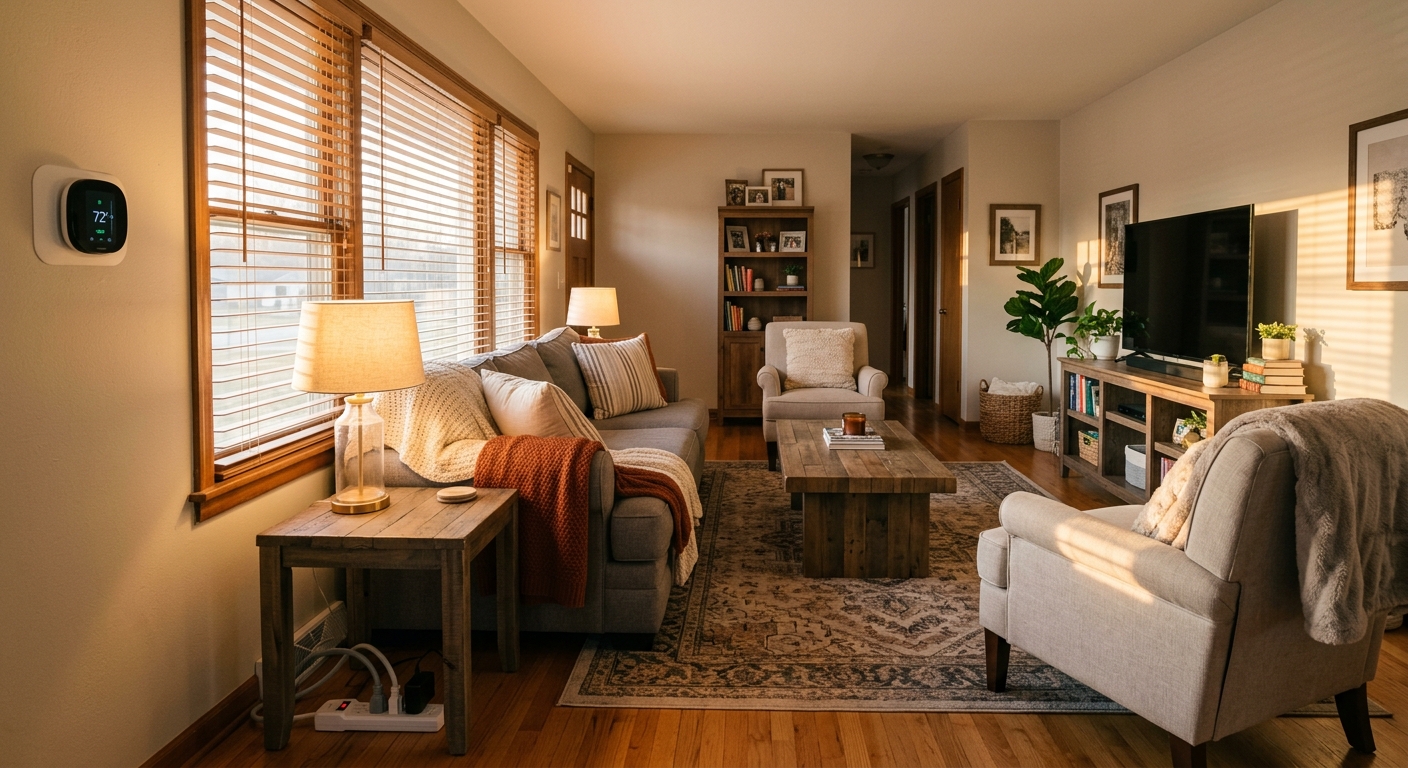
- Buy 3 to 4 smart power strips ($25 to $40 each) and place them behind your TV entertainment center, home office desk, and any room with multiple always-on electronics. These automatically cut power to peripherals when a control device (like the TV) is switched off.
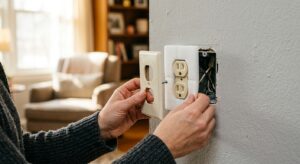
- Seal air leaks around electrical outlets and switch plates on exterior walls using foam gaskets ($5 for a pack of 10). Also caulk any visible gaps around window frames, door frames, and baseboards with a $5 tube of paintable latex caulk.
- Add weather stripping to the bottom and sides of exterior doors if you can see light around them when closed ($10 to $25 per door). Drafty doors can account for 5 to 10% of total air leakage in a typical home.
- Replace any remaining incandescent bulbs with LED equivalents ($2 to $5 each). LEDs use 75% less energy and last 15 to 25 times longer. If you still have 10 incandescent bulbs, switching them saves roughly $80 per year in electricity alone.
- Install a water heater timer or insulation blanket on an older electric tank water heater ($20 to $40). Setting the heater to run only during off-peak hours and cutting overnight standby can save 5 to 12% on water heating costs.
- Order a DIY energy audit kit or schedule a professional blower door test through your utility (many offer them free or subsidized). A blower door test pinpoints exactly where your home leaks air so you target the right spots instead of guessing.
- Seal attic bypasses first, as these are the highest-impact leak locations in most homes. Use canned spray foam ($8 to $12 per can) to seal around attic hatch frames, top plates, plumbing penetrations, and recessed light fixtures from above.
- Add attic insulation if your current depth is under 10 inches (roughly R-30). Blowing in fiberglass or cellulose insulation to R-49 costs $800 to $2,000 for a typical attic but delivers 15 to 25% reductions in heating and cooling costs and qualifies for a 30% federal tax credit.
- Insulate accessible crawlspace walls or basement rim joists using rigid foam board cut to fit ($25 to $50 per sheet). Rim joists are a major cold-air infiltration point in homes with basements and are often completely uninsulated.
- Check and seal HVAC duct connections in unconditioned spaces like attics or crawlspaces using mastic sealant or metal-backed tape. Leaky ducts waste 20 to 30% of heating and cooling energy before it ever reaches your living space.
Why It Works: The Benefits
Zero-cost behavior changes like thermostat adjustments, unplugging idle devices, and shifting laundry to off-peak hours can cut your bill by 10 to 15% starting with your very next billing cycle, with no waiting for equipment to pay back.
Simple upgrades like smart power strips and programmable thermostats cost $20 to $50 each and typically pay for themselves within 1 to 3 months, compared to 7 to 12 years for a new refrigerator.
Sealing air leaks and using window coverings strategically reduces the amount of work your existing HVAC system must do, cutting heating and cooling energy by up to 20% and extending the life of your equipment.
The average home wastes $100 to $200 per year on standby power alone. Smart power strips and deliberate unplugging habits eliminate most of this cost with no change in comfort or convenience.
Electric rates in the US rose an average of 5% per year between 2020 and 2024. Every kilowatt-hour you eliminate through efficiency is one you will never pay an inflated rate on, compounding your savings over time.
💰 Savings Impact by Action
Eliminating standby power from TVs, consoles, and chargers cuts total household electricity use by 5 to 10% with no change in comfort.
Programming 8-degree setbacks when away and sleeping saves approximately 10% on annual heating and cooling costs per DOE data.
Caulking and foam sealing gaps in the building envelope reduces conditioned air loss by up to 20% of heating and cooling energy.
Replacing all incandescent bulbs with LEDs cuts lighting energy by 75%, which represents 5 to 8% of total household electricity use.
Lowering water heater setpoint to 120°F and running only full loads of cold-water laundry reduces water heating costs by 8 to 12% annually.
🏠 Key Concepts Explained
The Science Behind It
Electricity costs are driven by two things: how much energy your devices consume (watts) and how long they run (hours). The product of those two is watt-hours, and your bill is measured in kilowatt-hours (kWh), which is 1,000 watt-hours. A 1,500-watt space heater running for 8 hours consumes 12 kWh, which at the US average rate of about $0.16 per kWh costs nearly $2 for a single night. Multiply that across a season and you see why behavioral changes with no hardware changes can move the needle significantly.
Heat transfer is the physics underpinning most of the savings in this guide. Your home constantly exchanges heat with the outdoors through three mechanisms: conduction (through walls, windows, and roofs), convection (through air leaks), and radiation (through windows and surfaces). Air sealing attacks convective losses, which the DOE estimates account for 25 to 40% of heating and cooling energy in a typical house. Insulation attacks conductive losses. Window coverings reduce radiant gain. Each strategy works on a different pathway, which is why layering them delivers compounding savings rather than diminishing returns.
Phantom load exists because modern electronics maintain microprocessors, remote receivers, and network connections at all times to enable instant-on functionality. A typical cable box uses 15 to 25 watts continuously, whether or not the TV is on, adding up to 130 to 220 kWh per year just for that one device. Multiply this across a home with a gaming console (70 to 150 watts in standby), a desktop computer left sleeping (5 to 10 watts), and a collection of phone chargers (0.5 to 2 watts each), and the standby load of a typical American home reaches 500 to 1,000 kWh per year. That is 5 to 10% of total residential electricity consumption going to devices that are not doing anything useful.
Frequently Asked Questions
▼ I tried these tips but my bill barely changed. What am I missing?
Start by pulling your actual kWh usage from your bill rather than just the dollar amount, since rate changes can mask real consumption shifts. If your kWh is genuinely unchanged, use a smart plug to measure your largest appliances individually and find the hidden draw. Older refrigerators and electric water heaters are the most common culprits in homes where obvious fixes have already been made.
▼ Can renters do any of this without landlord permission?
Yes, most of the highest-impact changes require no landlord approval at all. Thermostat scheduling, unplugging phantom loads, shifting laundry to off-peak hours, switching to cold wash cycles, and closing window coverings are completely renter-safe. Smart plugs and power strips are also removable and non-permanent. For weather stripping and caulking, most landlords will say yes if you ask, since those improvements protect their property.
▼ How long before these changes show up on my bill?
Behavior changes like thermostat setbacks and unplugging devices start saving electricity immediately, but your bill reflects a billing period (usually 30 days), so the full effect appears on your next statement. Low-cost hardware upgrades installed partway through a billing cycle will show partial savings that month and full savings the month after. Track kWh rather than dollars to see a clean before-and-after comparison.
▼ My home is older than 30 years. Will these tips still work?
They will work even better, because older homes typically have more air leakage and less insulation than newer construction, meaning there is more waste to recover. Prioritize air sealing first since it delivers the biggest return in leaky older homes. Attic insulation is often the single highest-impact upgrade for pre-1980 homes, and it qualifies for a 30% federal tax credit under the Inflation Reduction Act, which significantly shortens the payback period.
▼ Is it worth adjusting my water heater if it is already fairly new?
Yes. Lowering the setpoint from 140°F to 120°F saves energy regardless of the heater’s age, since standby losses are a function of the temperature difference between the tank and the surrounding air. A newer tank is better insulated and will show smaller absolute savings, but the adjustment still costs nothing and reduces scalding risk as a secondary benefit. On a newer unit the annual savings are typically $30 to $60 rather than the $60 to $90 you might see on an older model.
Quick Tips
- Check your utility’s website for rebates on smart thermostats and LED bulbs before buying. Many offer $10 to $50 back per device, making the payback period even shorter.
- Put a sticky note on your thermostat for two weeks as a visual reminder to check it before leaving the house. Most people waste 4 to 8 hours of peak cooling or heating daily simply by forgetting to adjust the setpoint.
- Use a $15 smart plug with energy monitoring on your biggest suspects (window AC units, space heaters, old freezers) to measure their actual watt draw. The real numbers often surprise homeowners and clarify where to focus.
- When running the dishwasher or dryer, use the shortest effective cycle and skip the heated dry setting on the dishwasher. Air drying dishes saves about $25 to $40 per year on a machine used five times per week.
Variations for Your Situation
- Apartment/Rental: Renters cannot modify central HVAC or add insulation, but the highest-impact steps are still available. Focus on smart plugs with energy monitoring ($15 to $25 each on Amazon), smart power strips for the entertainment center and office, thermostat scheduling if you have individual unit control, and cold-water laundry if in-unit machines are available. Switching to LED bulbs in fixtures you own and using blackout curtains on south-facing windows can together cut 10 to 15% off a typical apartment bill with no landlord interaction required.
- Tight Budget (under $50): Start entirely with zero-cost behavior changes: thermostat setbacks, peak-hour shifting, cold laundry, and unplugging phantom loads. If you have $15 to $20, a single smart plug with energy monitoring on your highest-suspect appliance will pay for itself within weeks and tell you exactly where your biggest losses are. Add a $5 pack of foam outlet gaskets for exterior walls and a $5 tube of caulk for window frames and you have addressed the three biggest savings categories for under $30 total.
- Older Home (pre-1980): Homes built before 1980 often have little or no wall insulation, single-pane windows, and significant attic air bypasses, making the baseline waste much higher than in newer homes. In these homes, air sealing attic penetrations with spray foam is the single highest-leverage action and can be done for $30 to $60 in materials. Follow that with adding blown-in attic insulation to R-49 if current depth is under 6 inches, which may qualify for utility rebates plus the 30% federal tax credit. Check for knob-and-tube wiring before adding any insulation, as covering it is a fire hazard that requires an electrician to address first.