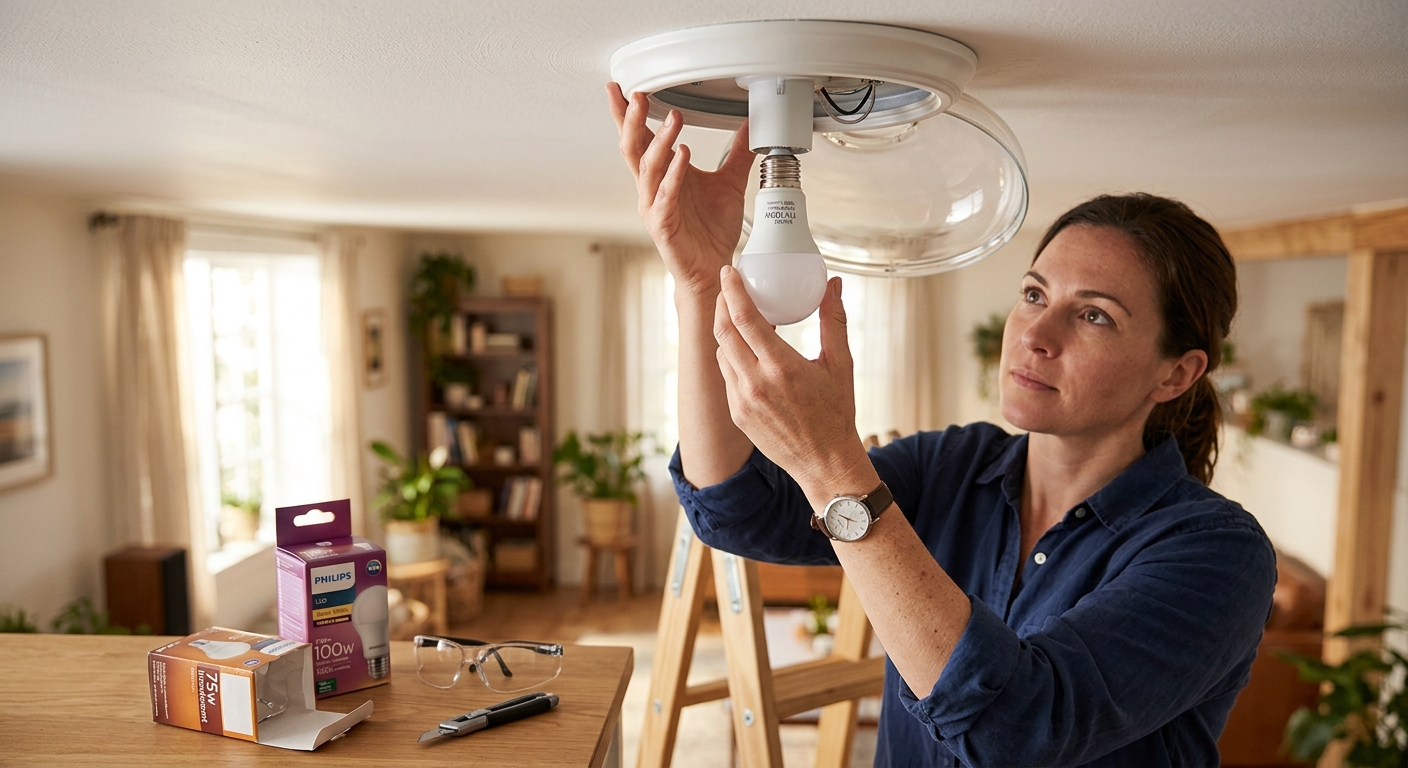
If you haven’t fully switched to LED lighting yet, you’re likely spending two to three times more than necessary every time you flip a switch. The average American household spends roughly $200 to $300 per year on lighting, and a large chunk of that is wasted as heat from inefficient incandescent or CFL bulbs. Even homes that made a partial switch years ago often have stragglers: the recessed can in the hallway, the vanity strip in the bathroom, the outdoor floodlight that gets forgotten because it still works.
This isn’t just about swapping bulbs. A truly efficient lighting system layers the right bulb technology, smart controls, and fixture choices to minimize waste at every level. Done correctly, you can expect to cut your lighting electricity consumption by 50 to 75%, reduce your HVAC load (because inefficient bulbs generate real heat that your AC has to fight), and extend the time between replacements from 1,000 hours for incandescents to 15,000 to 25,000 hours for quality LEDs.
This guide walks you through every level of lighting efficiency, from a zero-cost audit you can do in 15 minutes, to a full smart-lighting DIY upgrade, to knowing when a licensed electrician can unlock savings that aren’t possible with plug-in solutions alone. Whether you rent or own, have a $20 budget or a $500 budget, there’s a meaningful efficiency gain available to you right now.
What You’ll Need
Click on an item below to shop for the recommended items for this recipe on Amazon.
As an Amazon Associate, we earn from qualifying purchases.
How to Do It
- Walk every room and identify all bulb types currently in use. Look for incandescent bulbs (warm, glass, and you can feel heat radiating from them within seconds) and older CFL spiral bulbs. These are your priority targets.
- Check wattage on each bulb you plan to replace. A 60-watt incandescent should be replaced with an 800-lumen LED rated 8 to 10 watts. A 75-watt incandescent needs a 1,100-lumen LED at 10 to 12 watts. Match lumens, not watts.
- Choose your replacement bulbs. For living spaces and bedrooms, select 2700K to 3000K LEDs with a CRI of 90 or higher. For kitchens, bathrooms, and workspaces, use 3000K to 4000K. Avoid no-name brands; stick with ENERGY STAR certified options from Cree, Philips, GE, or Sylvania.
- Replace bulbs in your highest-use fixtures first: kitchen overhead lights, living room lamps, bathroom vanity strips, and outdoor porch lights. These run the most hours and give you the fastest payback.
- After replacing, verify dimmer compatibility if applicable. Not all LED bulbs dim smoothly on older dimmer switches. If you see flickering or the bulb won’t dim below 30%, note the fixture for the DIY upgrade step where you replace the dimmer switch.
- Complete the bulb swap from the quick fix approach first if you haven’t already. Then audit your dimmer switches: identify every dimmer in your home and check if it is rated for LED loads. Older dimmers designed for incandescent bulbs cause LED flicker and shorten bulb life. Replace them with LED-compatible dimmers such as the Lutron Caseta or Leviton Decora Smart for $20 to $50 each.
- Install occupancy sensors in low-use rooms. Replace standard switches in bathrooms, closets, laundry rooms, and garages with occupancy sensor switches (Lutron, Leviton, or Eaton options run $15 to $35 each). These automatically shut off lights after 5 to 15 minutes of no motion, cutting run-time in those rooms by 30 to 60%.
- Address recessed can lights. If you have older recessed fixtures in the ceiling, check whether they are IC-rated and airtight. If not, the safest and most efficient upgrade is to install LED retrofit kits or airtight LED wafer lights directly into the existing housing. These eliminate air leakage into the attic and run at 6 to 12 watts versus 50 to 75 watts for old incandescent PAR bulbs.
- Install a programmable or smart plug-in timer on exterior lights and any indoor lights that are frequently left on. Smart plugs with energy monitoring (such as Kasa EP25 or Wemo) allow you to set schedules and see actual watt usage for each fixture, helping you identify any remaining inefficiencies.
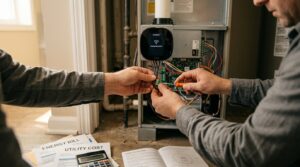
- For living rooms and bedrooms where you want scene control, consider replacing one or two key switches with smart dimmers (Lutron Caseta or Kasa KS230 are reliable and do not require a neutral wire on older wiring). This gives you scheduling, remote control, and the ability to run lights at reduced output during evening hours, saving 20 to 30% on those fixtures’ runtime energy.
- After completing the full upgrade, check your next electric bill against the same month last year. Most households see a 10 to 20% reduction in total electricity use from lighting alone, with the full payback on parts typically reached in 12 to 18 months.
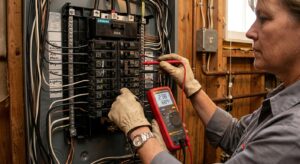
- Schedule a consultation with a licensed electrician who has experience with residential lighting upgrades. Ask specifically about replacing non-IC recessed cans, upgrading older two-wire systems for smart switch compatibility, and consolidating circuits if you have an unusually high number of fixtures.
- Request a whole-home lighting plan. A good electrician or lighting designer will map fixture placements to eliminate over-lit areas (a major source of wasted energy) and recommend appropriate lumen levels per room using the standard of 20 lumens per square foot for general ambient light and 50 to 75 lumens per square foot for task areas.
- Have the electrician install a whole-home smart lighting system if your budget allows. Systems like Lutron RadioRA 3 or Savant centralize scheduling, scene control, and occupancy-based automation across every fixture in the home, with documented energy savings of 15 to 40% over manual switching.
- Ask about replacing any remaining fluorescent tube fixtures, common in garages, basements, and kitchens, with direct-wire LED tube replacements or new LED wraparound fixtures. This eliminates the ballast (which wastes 10 to 20% of the fixture’s energy and fails more often than the tubes themselves).
- After installation, request documentation of each circuit and fixture for your records, and verify that all smart controls are properly programmed with schedules before the electrician leaves. Most whole-home systems have a mobile app setup that the installer should walk you through.
Why It Works: The Benefits
Replacing 30 incandescent 60-watt bulbs with 9-watt LEDs saves roughly 1,530 watts of capacity. Running those lights an average of 3 hours per day at $0.13 per kWh saves approximately $65 to $80 per year on lighting alone, with some households saving over $150 annually.
Eliminating heat-generating incandescent bulbs can reduce your cooling load by 5 to 10% in heavily lit rooms, because your AC no longer has to work to remove that waste heat. This effect is most significant in kitchens, living rooms, and spaces with many recessed lights.
Quality LED bulbs are rated for 15,000 to 25,000 hours, versus 1,000 hours for incandescents and 8,000 to 10,000 hours for CFLs. At 3 hours of daily use, a good LED lasts 13 to 22 years, eliminating the ongoing cost and hassle of frequent replacements.
Modern LEDs offer a Color Rendering Index (CRI) of 90 or higher, meaning colors look more natural and accurate than under older bulb types. Choosing the right color temperature for each room improves comfort and reduces eye fatigue.
Replacing old non-IC-rated recessed fixtures with airtight LED wafer lights eliminates a common source of conditioned air loss into the attic and removes a potential fire risk from improper insulation contact, a two-for-one safety and efficiency improvement.
💰 Savings Impact by Action
Replacing incandescent bulbs with quality LEDs reduces lighting electricity consumption by up to 75% by eliminating the 90% heat waste of resistive filament technology.
Installing occupancy sensor switches in bathrooms, closets, and hallways reduces those fixtures’ annual run-time by 30 to 60%, delivering an average lighting energy reduction of around 35% in those zones.
Programmed on and off schedules for outdoor lights and high-use interior circuits reduce unnecessary run-time by 15 to 25% compared to manual switching habits.
Running dimmable LEDs at 70 to 80% output via compatible dimmer switches reduces per-fixture energy use by 20 to 30% while also extending bulb lifespan.
Replacing fluorescent tube fixtures with direct-wire LED tubes eliminates the ballast, which wastes 10 to 20% of fixture energy, and reduces total fixture wattage by 25 to 35%.
🏠 Key Concepts Explained
The Science Behind It
The core physics of lighting efficiency comes down to one number: luminous efficacy, measured in lumens per watt. An incandescent bulb works by running electricity through a tungsten filament until it glows, a process that converts roughly 90% of input energy into infrared radiation (heat) and only about 5 to 10% into visible light. A 60-watt incandescent might produce 800 lumens, giving it an efficacy of about 13 lumens per watt. A quality LED achieves the same 800 lumens at 9 watts through electroluminescence, a direct quantum process where electrons recombine with electron holes in a semiconductor to emit photons. This gives modern LEDs an efficacy of 88 to 100 lumens per watt, roughly seven times more efficient.
The heat generation difference has a compounding effect in your home. Incandescent bulbs in a kitchen with twelve 65-watt recessed lights emit 780 watts of heat continuously. In summer, your air conditioner must remove that heat at an efficiency ratio of roughly 1.2 to 1.5 (COP), meaning you’re spending an additional 520 to 650 watts of electricity just to remove the heat produced by your lights. Switch to 9-watt LED replacements and that kitchen now emits only 108 watts of heat, saving you energy on both your lighting circuit and your HVAC system simultaneously.
Smart lighting controls layer behavioral science on top of the hardware gains. Studies by the Lighting Research Center show that occupancy-based controls in residential spaces reduce lighting energy use by 24 to 38% in spaces like bathrooms and hallways where lights are routinely left on unnecessarily. Daylight harvesting, where sensors dim artificial lights automatically when natural light is sufficient, can reduce daytime lighting energy by an additional 20 to 30% in rooms with good window exposure. Combined, the technology and control layers can push total lighting electricity savings well above 75% compared to a pre-upgrade all-incandescent home.
Frequently Asked Questions
▼ Why are my new LED bulbs flickering on my dimmer switch?
Your dimmer switch is almost certainly designed for incandescent bulbs, which have a different electrical load profile than LEDs. The fix is to replace the dimmer with an LED-compatible model such as the Lutron Caseta or Leviton DSL06 ($20 to $35). Also confirm the LED bulb itself is labeled as dimmable, since non-dimmable LEDs will always flicker or fail on a dimmer circuit regardless of which dimmer you use.
▼ I replaced all my bulbs with LEDs but my electric bill barely changed. What went wrong?
Lighting upgrades affect only the 10 to 15% of your bill attributable to lighting, so if your bill dropped by only $5 to $10 per month, that may actually be correct. If you expected larger savings, check whether you have older fluorescent fixtures in the garage or basement that were not included in the swap, high-wattage outdoor flood lights still running on old PAR bulbs, or dimmer switches that are not compatible and are causing your LEDs to run at a higher wattage than intended. Also verify the old bulb wattages matched what you estimated: many decorative and specialty fixtures use 40 to 25 watt bulbs with lower savings potential.
▼ Can renters upgrade lighting without landlord permission?
In most cases, yes, with limitations. Swapping bulbs is universally acceptable and requires no permission since it is fully reversible. Replacing a switch with a smart switch or occupancy sensor is more of a gray area: it requires turning off the breaker and basic electrical work, and many leases prohibit electrical modifications. A safer renter approach is to use smart bulbs (like Philips Hue or Kasa) controlled by plug-in smart switches or voice assistants rather than hardwired controls. Just keep the original bulbs to reinstall when you move out.
▼ My LED bulbs are burning out faster than they should. What is causing this?
Premature LED failure is almost always caused by one of three things: incompatible dimmers that stress the driver circuit, enclosed fixtures without adequate ventilation that cause the LED to overheat (check the bulb packaging for an ‘enclosed fixture rated’ label if you’re using a globe, pendant, or recessed can with a trim cover), or very cheap off-brand bulbs with low-quality drivers. Replace incompatible dimmers, switch to enclosed-fixture-rated LEDs where needed, and choose ENERGY STAR certified bulbs from established brands to solve all three causes.
▼ Are smart bulbs worth the extra cost compared to regular LEDs?
Smart bulbs make the most sense in fixtures you use for more than 3 hours daily and where scheduling or dimming would genuinely change your behavior, such as living room lamps, bedroom overhead lights, and exterior lights. The added cost of $8 to $20 per smart bulb versus $2 to $5 for a standard LED pays off through scheduled shutoffs and dimming over 2 to 4 years. In closets, utility rooms, and other low-use spaces, a standard LED with an occupancy sensor switch is more cost-effective than a smart bulb.
Quick Tips
- Buy ENERGY STAR certified LEDs. They meet minimum efficacy, color quality, and lifespan standards, and some utility companies offer instant rebates on ENERGY STAR bulbs that drop the price to near zero.
- Don’t overbuy brightness. Most rooms are over-lit. Use an online lumen calculator (search ‘room lumen calculator’) to find the right brightness level before purchasing, and you’ll avoid wasting money on higher-wattage bulbs than you need.
- Group your smart bulb purchases by ecosystem. Mixing Philips Hue, LIFX, and Wyze smart bulbs in the same home creates a fragmented experience and higher standby load. Pick one platform and standardize to simplify schedules and reduce total vampire draw.
- Check for utility rebates before buying anything. Many electric utilities offer $1 to $5 instant rebates per LED bulb or free bulb giveaway programs. Search your utility’s name plus ‘LED rebate’ to find current offers before you spend full retail price.
Variations for Your Situation
- Apartment or Rental: Focus entirely on bulb swaps and smart bulbs rather than hardwired controls. Replace all existing bulbs with ENERGY STAR LEDs at 2700K to 3000K for living spaces (spend $2 to $5 per bulb). Add plug-in smart outlets with scheduling (Kasa EP25 or Amazon Smart Plug, around $15 to $20 each) to lamps and bathroom lighting circuits you control. Keep the original bulbs in a bag to reinstall at move-out. Total cost can be under $60 for a typical apartment and savings of 50% on your lighting costs are still fully achievable.
- Tight Budget (under $50): Prioritize ruthlessly. Identify the three to five fixtures in your home that run the most hours per day, typically the kitchen overhead, bathroom vanity, living room lamp, and porch light. Replace only those first, using ENERGY STAR LED bulbs purchased in multipacks ($8 to $15 for a four-pack at most hardware stores). Even replacing just five high-use fixtures can capture 60 to 70% of the total savings available from a full home upgrade, because a small number of fixtures account for most of your lighting hours.
- Older Home (pre-1980): Focus first on identifying non-IC-rated recessed cans, which are a fire and air-sealing hazard common in homes of this era. Do not simply swap bulbs in these fixtures without verifying their rating (look for an IC label inside the housing). Instead, replace non-IC fixtures with airtight LED wafer lights ($15 to $30 each) or hire an electrician to install proper IC-rated housings. Also expect that many older switch boxes lack a neutral wire, meaning you should choose Lutron Caseta smart switches (which work without a neutral wire) rather than most other smart switch brands if you pursue smart controls.