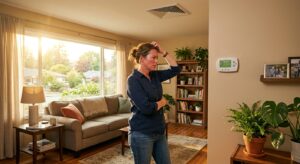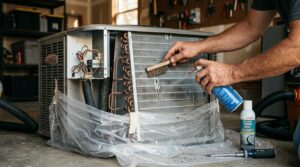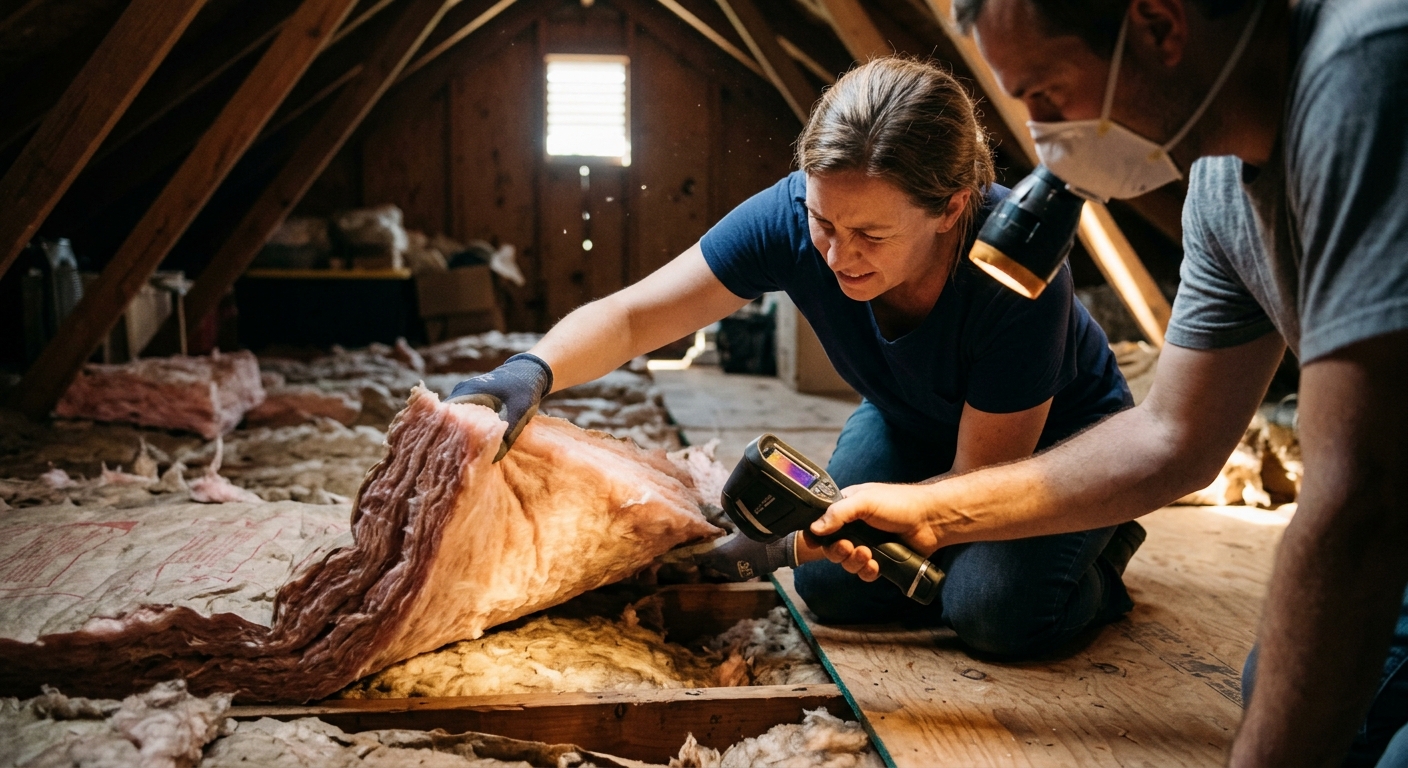
Every summer, millions of homeowners crank up their air conditioning and watch their electricity bills climb into the hundreds of dollars, often without realizing the real culprit is not the heat outside but the insulation failure inside. When your home lacks proper insulation, your attic can reach 150 degrees Fahrenheit or more, and that heat radiates directly into your living spaces, forcing your AC to run nearly nonstop just to keep up.
The good news is that you do not need a professional energy auditor to get a solid read on whether your insulation is working. A few simple checks, a thermal imaging app on your phone, and a Saturday morning can reveal gaps that are costing you real money every month. The U.S. Department of Energy estimates that air sealing and insulation improvements can cut heating and cooling costs by 15 to 25 percent annually, which adds up to hundreds of dollars per year for the average household.
This post walks you through exactly how to assess your insulation before the summer heat peaks, what warning signs to look for, which fixes you can handle yourself, and when it makes sense to call in a professional. Whether you are in a newer build or a home from the 1970s, there are actionable steps here that will make a measurable difference in your comfort and your cooling bill.
What You’ll Need
Click on an item below to shop for the recommended items for this recipe on Amazon.
As an Amazon Associate, we earn from qualifying purchases.
How to Do It
- Check your attic insulation depth with a ruler or tape measure. If you have fiberglass batts, measure the total thickness. If you have blown-in insulation, stick a ruler in and note the depth. Less than 10 inches of fiberglass or less than 12 inches of cellulose almost certainly means you are under-insulated for most U.S. climate zones.
- Look for your attic hatch or pull-down stairs and feel around the edges on a hot afternoon. If you feel warm air seeping out or the hatch surface itself is warm to the touch, it is uninsulated and acting as a major heat bypass.
- Walk your home on a hot sunny day with bare feet. Noticeably warm floors above a garage or crawl space, and hot ceilings on the top floor, are strong indicators of inadequate insulation below or above those surfaces.
- Download a free thermal imaging app like Seek Thermal or use a handheld infrared thermometer (available for $15 to $25) and scan your ceilings, walls, and floors on a hot afternoon. Temperature variations of more than 3 to 4 degrees Fahrenheit across a flat surface point to insulation voids or gaps.
- Check around recessed light fixtures in your ceiling by turning off the lights and looking up into the fixture housing from the attic side. Uninsulated, non-IC-rated recessed lights are one of the most common and costly air leakage points in older homes.
- Note your HVAC runtime by observing how often your system cycles on a day when outdoor temps are 90 degrees Fahrenheit or higher. If your AC runs more than 75 percent of the time trying to maintain 75 degrees indoors, poor insulation or air sealing is likely a major contributing factor.
- Seal attic air leaks before adding insulation. Use fire-rated caulk or acoustical sealant around plumbing pipes, wiring penetrations, and top plates of interior walls. Use rigid foam board cut to size and sealed with fire-rated foam for larger openings like around chimneys or dropped soffits. Skipping this step and adding insulation on top of leaks is one of the most common DIY mistakes.
- Install an insulated attic hatch cover. A simple insulated cover kit costs $30 to $80 and can be installed in under an hour. These covers add R-10 to R-14 over what is typically an uninsulated hatch, eliminating one of the worst performing spots in most attics.
- Add blown-in insulation to your attic floor if depth is below the target for your climate zone. Hardware stores like Home Depot and Lowes rent blowing machines for free when you purchase bags of cellulose or blown fiberglass. Plan for R-49 to R-60 in climate zones 4 through 8 and R-38 in zones 2 through 3. A 1,500 square foot attic typically requires 20 to 30 bags of blown cellulose at roughly $8 to $12 per bag.
- Add an insulated cover to your pull-down attic stairs. Pre-made covers are available for $50 to $120 and fold over the stair opening from inside the attic, adding significant R-value to an assembly that is otherwise often uninsulated.
- Insulate and seal around recessed light fixtures using IC-rated recessed light covers, which create an air barrier around the fixture housing in the attic. These cost $10 to $20 each and can be installed in minutes from the attic side without any electrical work.
- Check and replace weatherstripping on all doors leading to unconditioned spaces including garages, attic stairways, and basements. Self-adhesive foam or V-strip weatherstripping costs $5 to $15 per door and takes less than 20 minutes to install.
- Schedule a certified home energy auditor (look for BPI or RESNET certification) to perform a blower door test, which depressurizes your home and precisely measures total air leakage. This test identifies exactly where air is escaping and quantifies the problem in a way visual inspection cannot.
- Request a thermal imaging scan as part of the audit. A calibrated infrared camera used during the blower door test will reveal insulation voids, moisture intrusion, and thermal bridges invisible to the naked eye, giving contractors a specific map of problems to fix.
- Review the auditor’s priority list and get quotes from at least two insulation contractors. Ask specifically about dense-pack blown-in insulation for walls, which can bring wall cavities from R-0 to R-13 without opening walls, and spray foam for rim joists and difficult penetrations.
- Request that contractors document R-values achieved after the job is complete, and verify attic insulation depth yourself with a ruler in three to four locations. This protects you and qualifies you for many utility rebates that require documentation.
- Ask your utility company about available rebates before work begins. Many programs rebate $0.10 to $0.25 per square foot of attic insulation added, and some offer additional credits for achieving specific air sealing targets measured by a post-work blower door test.
Why It Works: The Benefits
Bringing attic insulation up to the recommended R-38 to R-49 level can reduce cooling costs by 15 to 25 percent annually. For a home spending $180 per month on electricity during summer, that is a savings of $27 to $45 every single month.
Properly insulated homes eliminate the hot spots that make upstairs bedrooms or sun-facing rooms uncomfortable. Homeowners frequently report a 5 to 10 degree Fahrenheit improvement in room-to-room temperature consistency after addressing insulation gaps.
When your home holds conditioned air better, your AC cycles less frequently. This can extend the life of your compressor and air handler by several years, delaying a $4,000 to $8,000 replacement cost.
Air leaks carry humid outdoor air into your home along with heat. Sealing those leaks reduces the moisture load on your AC, which lets it dehumidify more effectively and makes 78 degrees feel genuinely comfortable rather than muggy.
Energy-efficient homes with documented insulation improvements sell faster and command premiums of 2 to 6 percent over comparable homes, according to studies from the Lawrence Berkeley National Laboratory.
💰 Savings Impact by Action
Upgrading attic insulation to recommended R-value levels reduces cooling-related energy use by up to 25 percent in homes that are currently under-insulated.
Sealing attic floor penetrations and bypasses can reduce overall air leakage by 20 percent or more, directly cutting the cooling load on your AC system.
Insulating and weatherstripping an uninsulated attic hatch eliminates a surprisingly large bypass that can account for up to 8 percent of total attic heat gain.
Sealing leaky HVAC ducts in unconditioned attic space can recover up to 20 percent of conditioned air that would otherwise be dumped into the attic.
Adding dense-pack insulation to empty wall cavities in pre-1980 homes can reduce wall heat gain by 15 percent and noticeably improve comfort in west and south-facing rooms.
🏠 Key Concepts Explained
The Science Behind It
Heat moves in three ways: conduction, convection, and radiation. Insulation primarily slows conduction, which is heat transferring through solid materials. When your attic floor has R-19 worth of insulation but your attic is at 150 degrees Fahrenheit and your living space is at 75 degrees, there is a 75-degree temperature difference driving heat steadily downward. Doubling your insulation to R-38 cuts the rate of that conductive heat transfer roughly in half, which directly reduces how hard your air conditioner has to work.
What insulation cannot do is stop air movement. Air carries heat with it, and a gap as small as one square inch around a recessed light or plumbing penetration can allow as much heat transfer as removing a square foot of insulation entirely. This is why building scientists consistently find that air sealing delivers better dollar-for-dollar returns than adding more insulation in a leaky home. The two work together: insulation slows conduction, air sealing stops convection, and together they create a genuine thermal barrier.
The attic is the highest priority in most homes because it sits directly below the roof, which absorbs intense solar radiation all day. A dark asphalt shingle roof on a 90-degree day can reach surface temperatures of 160 to 190 degrees Fahrenheit, and that heat radiates from the roof deck into the attic air. A well-insulated attic floor with proper depth acts as the primary defense against this heat reaching your living space, which is why the DOE recommends R-49 to R-60 for most of the continental United States and why even going from R-11 to R-38 can reduce ceiling heat gain by over 60 percent.
Frequently Asked Questions
▼ My attic has plenty of insulation but my upstairs is still brutally hot. What is going on?
Adequate insulation depth does not rule out air leakage, which bypasses insulation entirely. Check for gaps around recessed lights, attic hatch edges, and plumbing or wiring penetrations. Also inspect your HVAC ducts in the attic since leaky supply ducts can dump conditioned air into the attic instead of your living spaces, a problem that accounts for up to 30 percent of cooling energy loss in many homes.
▼ How do I know what R-value my home actually needs?
The DOE’s ZIP Code insulation calculator at energystar.gov lets you enter your location and home type to get the recommended R-value for your specific climate zone. For most of the U.S., attic insulation targets range from R-38 in warmer southern zones to R-60 in colder northern zones. For walls, R-13 to R-21 is standard for new construction but many older homes have little to none.
▼ Can I just add new insulation on top of my old insulation?
Yes, in most cases you can add blown-in insulation directly over existing batts as long as the existing insulation is dry, not compressed, and does not contain asbestos or vermiculite. Before adding anything, seal all air leaks at the attic floor level since covering them with insulation will reduce but not eliminate the leakage. If the existing insulation is moldy, wet, or damaged, it needs to be removed first.
▼ What if I rent and cannot make permanent changes?
Focus on interior fixes that do not require structural changes. Draft snake door sweeps, removable window insulation film, and cellular shades can meaningfully reduce heat gain. You can also document the issue for your landlord in writing since landlords in most states are responsible for maintaining habitable temperatures. A formal energy audit report can serve as useful documentation in that conversation.
▼ How long until I see the savings on my electric bill after improving insulation?
Most homeowners see measurable bill reductions within the first full billing cycle after improvements are made, especially if work is done before peak summer heat. Savings are most visible when you compare bills month-over-month to the prior year during similar temperature periods. Keep in mind that rebate paperwork from your utility can take 4 to 12 weeks to process, so submit it promptly after the work is complete.
Quick Tips
- Check your insulation depth in multiple spots including corners and eaves, not just the center of the attic, where depth is often artificially high.
- If your home has cathedral ceilings or a finished attic, wall cavities may be the weakest link since they are impossible to inspect visually without thermal imaging.
- Insulating your attic hatch is one of the highest-return fixes you can make, often improving R-value at that spot from R-0 to R-14 for under $60.
- Utility bills from the same months in prior years are useful data. A significant jump in cooling costs without a change in behavior or rates often points to insulation or duct leakage degradation.
Variations for Your Situation
- Apartment or Rental: Renters cannot access the attic or modify insulation, but can make real improvements with removable window insulation film ($20 to $50 per window), thick cellular blackout shades ($30 to $80 each), and draft-sealing door sweeps ($10 to $20 each). Document any extreme temperature problems in writing and request an HVAC inspection from your landlord, as inadequate insulation may violate habitability standards in many states.
- Tight Budget (under $50): Start with the highest-impact free actions: seal visible gaps around outlets and switch plates on exterior walls using foam gaskets ($5 for a 10-pack), add a pre-cut foam attic hatch cover if you have attic access ($30 to $50), and use a rolled towel or inexpensive door draft stopper on doors leading to garages or unconditioned basements. These steps alone can reduce air infiltration by 10 to 15 percent with zero skilled labor.
- Older Home (pre-1980): Homes built before 1980 were constructed before modern energy codes and frequently have R-0 wall cavities, minimal attic insulation, and significant air leakage rates two to three times higher than newer construction. Before assuming standard DIY fixes will be enough, invest in a professional blower door test and thermal scan since the scope of work in older homes often justifies contractor-installed dense-pack wall insulation and professional air sealing, which can deliver 25 to 40 percent energy savings and qualify for significant utility and federal tax credits.