Your heating system is probably working harder than it needs to, and you are still not as warm as you could be. Homes lose 20 to 30 percent of heated air before it ever reaches a living space, according to the U.S. Department of Energy. That means a significant chunk of your monthly heating bill is warming your attic, crawl space, or the gap behind your walls instead of the rooms where you actually live.
The good news is that most of the fixes that let your furnace, heat pump, or boiler do more with the same fuel cost between $0 and $300 and can be done on a weekend afternoon. This is not about upgrading your entire system. It is about removing the hidden obstacles that force your heating equipment to run longer, cycle more often, and wear out faster than it should.
In this post, you will learn the six building science factors that quietly drain your heating efficiency, the best low-cost and DIY upgrades to address them, and how to prioritize them so you get the fastest payback first.
What You’ll Need
Click on an item below to shop for the recommended items for this recipe on Amazon.
As an Amazon Associate, we earn from qualifying purchases.
How to Do It
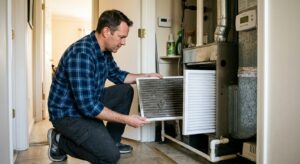
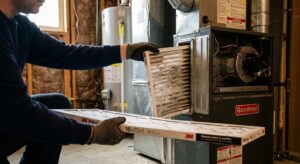
- Check your air filter. Hold it up to a light source. If you cannot see light through it, replace it immediately. A clogged filter is the single most common cause of reduced heating output and costs nothing to fix if you already have a spare.
- Walk every supply and return vent in your home. Make sure none are blocked by furniture, rugs, or curtains. Move any obstruction so at least 18 inches of clearance exists in front of each vent.
- Set your thermostat to drop 7 to 10 degrees Fahrenheit overnight and when the home is empty for 8 or more hours. Do this manually if you have a basic thermostat. This alone saves roughly 10% on your annual heating bill according to DOE data.
- Check that all interior doors on the main living level are either open or have at least a half-inch gap at the bottom. Closed doors block return air paths and create pressure imbalances that reduce furnace output.
- Verify your furnace vents and intake pipes (if visible) are not obstructed by leaves, debris, or ice. A blocked flue or intake causes the furnace to lock out or run inefficiently.
- Purchase a can of mastic sealant and a brush, or use foil-backed HVAC tape (not standard duct tape). Go into your basement, crawl space, or attic and inspect every accessible duct joint, seam, and connection point. Look for gaps, disconnected flex duct, or joints sealed only with old gray duct tape that has dried out.
- Apply mastic sealant generously over every leaky joint with a brush, or wrap each seam tightly with foil tape. Pay special attention to the plenum connections at the furnace, any flex duct connections, and where ducts pass through unconditioned spaces. Sealing ducts in unconditioned spaces can recover 20 to 30% of previously lost heat.
- Buy a box of foam outlet gaskets (about $5 for 10) and install them behind every electrical outlet and switch plate on exterior walls. These tiny air leaks add up to the equivalent of leaving a window cracked open all winter.
- Apply weatherstripping around every exterior door that has a visible light gap or feels drafty. Use V-strip weatherstripping for door sides and a door sweep for the bottom gap. A properly sealed door saves 5 to 10% on infiltration losses.
- Caulk around window frames, pipe penetrations, and any gap where a wall meets the floor or ceiling on exterior walls. Use paintable latex caulk indoors and silicone or polyurethane caulk for areas exposed to moisture or temperature extremes.
- Upgrade to a programmable or smart thermostat if you have a basic manual model. Models from Honeywell or Ecobee cost $25 to $150 and can be installed in 30 minutes. Program a setback of 7 to 10 degrees at night and during work hours to capture the full 10% annual savings without any comfort sacrifice.
- Schedule an annual furnace or boiler tune-up with a licensed HVAC technician. They will clean the heat exchanger, check combustion efficiency with a flue gas analyzer, test the heat exchanger for cracks, and verify ignition components. A well-tuned gas furnace operates at 95 to 98% of its rated AFUE versus potentially 80 to 85% when neglected.
- Request a duct leakage test (also called a duct blaster test) from an energy auditor or HVAC contractor. This pressurizes the duct system to measure exactly how much air is escaping. Homes with duct leakage above 15% of system flow are strong candidates for professional duct sealing, which can cost $300 to $700 but often delivers a payback period of 2 to 4 years.
- Ask about Aeroseal duct sealing if your ducts are in inaccessible locations like inside finished walls. This process injects aerosolized sealant particles into the duct system that bond to leak edges from the inside, sealing gaps up to 5/8 inch wide without tearing out walls.
- Consider a whole-home energy audit that includes a blower door test. This diagnostic costs $150 to $400 and creates a prioritized roadmap of every air leakage point in your home ranked by impact and cost. Many utility companies offer rebates that cover 50 to 100% of audit costs.
Why It Works: The Benefits
Combining duct sealing, air sealing, and thermostat scheduling can reduce heating costs by 15 to 30%, which translates to $150 to $450 per year for a home with a $1,500 annual heating bill.
Balancing airflow and sealing duct leaks eliminates cold spots and temperature swings between rooms, improving comfort without turning up the thermostat.
A furnace that is not fighting restricted airflow, dirty filters, or pressure imbalances runs fewer cycles and at lower operating temperatures, which can add 3 to 5 years to its service life.
Sealing duct leaks in unconditioned spaces prevents dust, mold spores, and combustion gases from being pulled into your living areas through negative pressure zones.
Using 15 to 30% less fuel directly reduces your home’s carbon emissions by the same proportion, which is roughly 400 to 800 pounds of CO2 per heating season for a typical gas-heated home.
💰 Savings Impact by Action
Sealing leaky ducts in unconditioned spaces can recover 20 to 30% of heated air that would otherwise be lost before reaching living areas.
Sealing infiltration points around outlets, doors, and penetrations reduces the volume of cold air the furnace must reheat, cutting heating loads by 10 to 20%.
Scheduling a 7 to 10 degree setback for 8 hours per day saves approximately 10% on annual heating bills according to DOE data.
Keeping a clean filter maintains rated airflow and prevents the high-limit cycling that can reduce effective furnace output by 5 to 10%.
Annual combustion tuning restores a gas furnace to near its rated AFUE, recovering 5 to 8% efficiency lost to dirty burners, misaligned components, and degraded ignition.
🏠 Key Concepts Explained
The Science Behind It
Your furnace or heat pump does not heat your home directly. It heats air or water, which is then distributed through a system. Every time that medium loses energy before reaching you, your equipment must run longer to compensate. This is why duct leakage is so costly: a 25% duct leakage rate does not just waste 25% of your fuel. It also forces your blower to run longer, which increases electricity consumption, and it creates negative pressure in your living space that draws cold outside air in to replace what leaked out. You are paying twice for the same problem.
The stack effect explains why air sealing around outlets and penetrations on exterior walls matters more in winter than summer. Warm air is less dense than cold air, so it rises and exits through high points in your home (attic hatches, top-floor light fixtures, gaps around chimneys). This upward movement creates a negative pressure zone at the bottom of your home that actively pulls cold outside air in through every low crack and gap it can find. Sealing both the high and low points interrupts this pressure-driven loop and dramatically reduces the volume of cold air your furnace must reheat throughout the day.
Thermostat setback works because heat loss is proportional to the temperature difference between inside and outside, a relationship described by Fourier’s Law of Heat Conduction. When you lower your indoor temperature by 10 degrees Fahrenheit, you reduce the driving force for heat loss through walls, windows, and the ceiling by roughly 20 to 30% during those hours, depending on your climate. This is why the DOE’s 10% annual savings estimate for setback is conservative for very cold climates, where the indoor-outdoor temperature gap is largest and the proportional reduction from setback is greatest.
Frequently Asked Questions
▼ Why does my house still have cold spots even after I sealed the ducts and weatherstripped the doors?
Cold spots are most often caused by inadequate insulation in the wall or ceiling cavity adjacent to that area, or by a duct branch that is undersized or partially blocked. Check the register in the cold room with your hand to confirm airflow is reaching it. If airflow feels weak, the duct serving that room may be kinked (common with flex duct) or the damper inside the duct may be partially closed.
▼ My heating bill went up this year but I did not change anything. What is going on?
Three common causes are a deteriorating air filter that was left too long, a furnace blower motor or heat exchanger that needs service, and increased infiltration from a new gap caused by house settling or a failed window seal. Start by replacing the filter and scheduling a furnace tune-up. If bills are more than 15% higher than the same month last year, request a combustion efficiency test from an HVAC technician.
▼ Can renters make these improvements without landlord permission?
Renters can freely do everything that is fully reversible: replacing filters, adding outlet gaskets (they peel off), installing a removable door sweep, using removable weatherstripping tape, and adjusting thermostat schedules. For anything that involves caulk, duct sealant, or a thermostat replacement, get written permission from your landlord first. Many landlords will approve or even pay for these improvements since they protect the property.
▼ I have a heat pump instead of a furnace. Do these same tips apply?
Yes, and duct sealing and air sealing are even more critical for heat pumps because they deliver lower-temperature air than furnaces, meaning any heat lost in distribution has a proportionally larger impact on comfort. Additionally, make sure your heat pump filter is clean and that the outdoor unit is clear of snow, ice, and debris, since restricted airflow across the outdoor coil directly reduces heating capacity in cold weather.
▼ How do I know if my duct leakage is bad enough to warrant professional sealing?
A simple indicator is to hold a stick of incense or a smoke pencil near duct joints, seams, and boots in your basement or attic while the system is running. Smoke that moves sideways indicates air escaping or being drawn in. If you see movement at many joints, professional duct testing is worth the investment. Homes built before 1990 that have never had duct work done average 25 to 35% leakage rates, which almost always justifies professional sealing on a cost-benefit basis.
Quick Tips
- Change your furnace filter every 60 to 90 days during heating season, not just once a year. A filter that is only 25% loaded still reduces airflow measurably compared to a clean one.
- Keep supply and return vents clear and balanced. Closing vents in unused rooms does not save energy in a central forced-air system. It increases duct pressure, causes leakage to worsen, and can stress the heat exchanger.
- Add insulation to your attic access hatch or pull-down stairs. These are often completely uninsulated and act like a hole in your ceiling. A foam cover kit costs $30 to $50 and can recover 5 to 8% of attic heat loss.
- Check your water heater temperature if you have a hot water baseboard or boiler system. The distribution water temperature should be set to match outdoor temperature (a process called outdoor reset). Lowering it by 10 degrees on mild days can cut boiler fuel use by 3 to 5% with no comfort penalty.
Variations for Your Situation
- Apartment/Rental: Renters cannot modify central HVAC systems but can still capture meaningful savings. Install a smart plug-in thermostat for electric baseboard heaters (such as the Mysa or Stelpro models, around $100 to $130 each) to enable scheduling. Use draft snakes or removable door sweeps at entry doors, apply removable rope caulk around drafty windows (it peels off cleanly in spring), and add foam gaskets behind outlet covers. Combined, these steps can save 8 to 12% on heating with no permanent modifications.
- Tight Budget (under $50): Focus on filter replacement ($8 to $15), foam outlet gaskets for all exterior wall outlets ($5 to $10), one roll of V-strip weatherstripping for your leakiest door ($10 to $15), and manual thermostat setback at bedtime and when leaving. These four steps cost under $40 total and can deliver 10 to 15% savings. The thermostat setback alone costs nothing and is responsible for roughly half of that total.
- Older Home (pre-1980): Homes built before modern energy codes have 3 to 5 times more air leakage than newer construction and often have uninsulated or poorly insulated ducts running through unconditioned basements or crawl spaces. Prioritize a professional blower door test ($150 to $400) to identify the biggest leakage points, since visual inspection alone misses most of the air loss in older construction. Attic air sealing before adding insulation is critical in these homes, as bypasses around interior partition walls can make added insulation nearly useless without sealing the gaps beneath it first.