If you have a room that bakes in the afternoon sun, you already know the frustration: the AC runs constantly, the space feels uncomfortable no matter what you set the thermostat to, and your energy bill climbs every summer. The culprit is solar heat gain through your windows. Standard single-pane glass blocks almost no infrared radiation, and even double-pane windows without a low-e coating let in a significant portion of the sun’s heat energy. That heat loads directly into your living space, forcing your cooling system to compensate.
Solar control window film is one of the most cost-effective upgrades a homeowner or renter can make. A roll costs between $15 and $60 depending on quality and square footage, and installation takes an afternoon with no special tools. Independent testing and DOE data show that window films can reduce solar heat gain through glass by 40 to 79%, translating to room temperature drops of 5 to 10 degrees in sun-exposed spaces and cooling bill reductions of 10 to 25% in heavily glazed homes.
This guide covers exactly how window film works, how to choose the right product, two installation approaches for different skill levels, and honest numbers on what you can expect to save. Whether you are a renter looking for a no-damage option or a homeowner ready to do a whole-house upgrade, there is a strategy here that fits your situation.
What You’ll Need
Click on an item below to shop for the recommended items for this recipe on Amazon.
As an Amazon Associate, we earn from qualifying purchases.
How to Do It
- Measure your window glass pane dimensions and purchase a static cling solar film roll with at least 5% more width and height than your measurements. Look for films rated with an SHGC of 0.45 or lower and VLT of 35% or higher for a good heat-to-light balance.
- Clean the window glass thoroughly with a 50/50 solution of water and isopropyl alcohol, then dry with a lint-free cloth. Any dust or residue will create bubbles that are impossible to remove without reapplication.
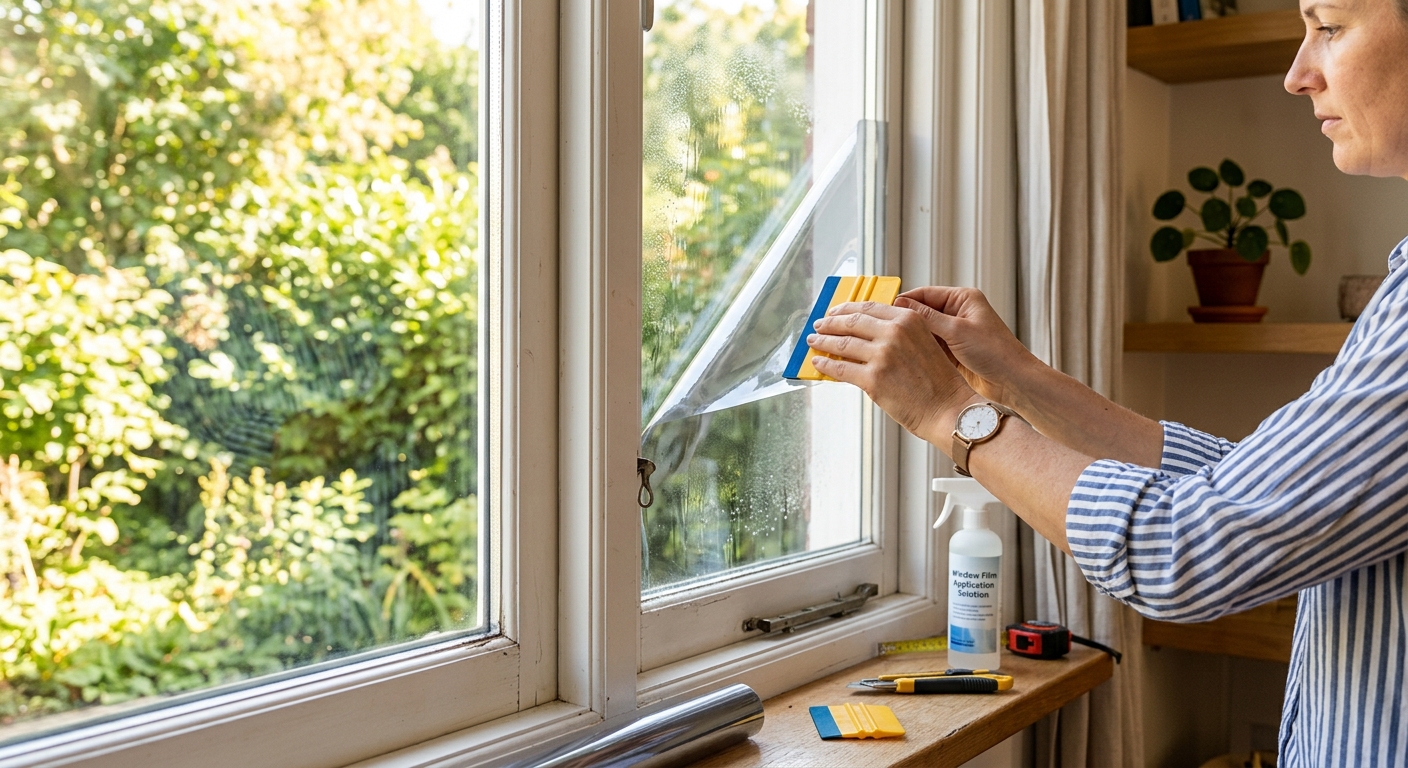
- Fill a spray bottle with distilled water and add two drops of dish soap. Mist the cleaned glass surface generously before applying the film. This slip solution lets you reposition the film during installation.
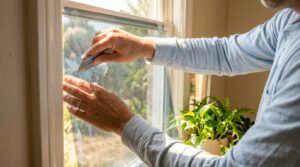
- Cut the film 1 inch larger than your pane on all sides. Peel the backing, mist the adhesive side lightly, and apply to the wet glass starting from the top corner. Use a credit card or squeegee to push air and water outward from the center toward the edges.
- Trim the excess film along the edges using a straight edge and a sharp utility knife or scissors. Leave a 1/16-inch gap at all edges to prevent peeling.
- Squeegee firmly one final time from center outward. Small water bubbles will disappear within 2 to 4 days as the film cures. Do not apply in direct sunlight or when glass temperature is above 90 degrees Fahrenheit.
- Audit your windows by direction. Prioritize west-facing windows first since they receive peak solar gain in the late afternoon heat, then south-facing. East-facing windows are lower priority. Measure all target panes and calculate total square footage before purchasing film.
- Select a ceramic or nano-ceramic film rather than dyed or basic metallic film. Ceramic films reject 50 to 70% of solar heat, do not interfere with cell signals, and do not develop a purple tint over time. Expect to pay $0.75 to $1.50 per square foot for quality products from brands like Gila, Madico, or 3M.
- Prepare the glass surface by cleaning with a razor blade film scraper to remove any paint splatters, sticker residue, or mineral deposits, then follow with the alcohol-water solution and a microfiber cloth. This step is critical for adhesive film because contamination causes permanent bubbles.
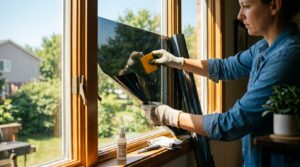
- Work in a low-dust environment with windows closed. Cut the film approximately 2 inches larger than the pane on all sides. Apply a generous mist of the slip solution to the glass, then peel the film liner and apply the adhesive side to the wet glass, starting from the top and working downward to avoid trapping large air pockets.
- Use a hard squeegee with a firm overlapping pattern from the center outward, applying real pressure to push the slip solution out from behind the film. Water channels will appear at the edges. Work methodically in horizontal passes from top to bottom.
- Trim the film precisely to the glass edge using a straight edge and a new utility knife blade. Press the edges firmly with the squeegee. Allow 5 to 7 days of curing time before cleaning the film. Expect minor haze or small water pockets to clear completely within the first week.
- Get at least two quotes from licensed window film installers. Ask each contractor for the specific film product name, its SHGC rating, VLT, and manufacturer warranty terms. Do not accept quotes that only reference brand names without product specifications.
- Request references from at least two residential jobs completed in the prior 12 months and inspect the finished work in person if possible. Look for clean edge cuts, zero visible bubbles, and consistent appearance across panes.
- Discuss your goals clearly. If you want maximum heat rejection, ask for ceramic or spectrally selective films with SHGC below 0.25. If maintaining a clear view is important, spectrally selective films can reject heat while keeping VLT above 60%, though they cost more.
- Confirm the warranty covers both the film and the labor, and that the contractor is certified by the film manufacturer. Many manufacturer warranties are void if the film is not installed by a certified professional.
- After installation, ask for the product data sheet for each film used on your home. Document the SHGC and VLT values per window orientation so you can calculate actual energy savings against your baseline bills over the next two cooling seasons.
Why It Works: The Benefits
DOE and Lawrence Berkeley National Laboratory data indicate that solar control films on south and west windows reduce residential cooling energy use by 10 to 25%, with the highest savings in climates with long, sunny summers and in homes with large or unshaded window areas.
In direct sun exposure tests, quality solar films reduce room air temperature by 5 to 10 degrees Fahrenheit in the affected space by mid-afternoon, and lower window glass surface temperatures by 10 to 20 degrees, which improves comfort even when the thermostat reading stays the same.
Most window films block 99% of ultraviolet radiation, which is the primary cause of fading in floors, furniture, and fabrics. The Skin Cancer Foundation notes that UV-blocking window film also provides meaningful protection for occupants sitting near windows for extended periods.
Static cling and removable adhesive films require no tools, no permanent alterations, and no landlord approval, making this the only window efficiency upgrade that is fully renter-safe and reversible. Even permanent adhesive films can be removed with a razor blade and film remover solution.
Films in the 35 to 50% VLT range reduce screen glare and eye strain for home office and living spaces while still admitting enough light to avoid a dark or institutional feel, improving daytime usability of sun-exposed rooms.
💰 Savings Impact by Action
A quality ceramic window film reduces solar heat gain through treated glass by up to 65% compared to untreated single-pane glass, directly cutting the cooling load in sun-exposed rooms.
Homes with significant south and west window area see whole-house cooling energy reductions of 10 to 25%, averaging around 15% in DOE and LBNL field studies on residential window film.
Most solar control films block 99% of UV-A and UV-B radiation, eliminating the primary cause of fading in flooring, furniture, and window treatments.
Applied film reduces inner window surface temperature by up to 18 to 20 degrees Fahrenheit, cutting radiant heat felt by occupants sitting near windows even before air temperature changes.
🏠 Key Concepts Explained
The Science Behind It
Solar radiation arriving at your window carries energy across three wavelength bands: ultraviolet (about 3%), visible light (44%), and near-infrared (53%). Standard clear glass transmits most of the visible and near-infrared bands directly into the room, where they are absorbed by floors, walls, and furniture and converted to heat. This is the greenhouse effect operating at the room scale. The glass itself is largely transparent to the incoming radiation but opaque to the longer-wavelength infrared re-emitted by warm interior surfaces, trapping heat inside.
Solar control films interrupt this process in two ways. Metallic and ceramic coatings in the film reflect a portion of incoming solar radiation back out before it enters the glass, reducing the total energy flux. A secondary mechanism is absorption: the film captures some of the solar energy as heat within its own thin coating layer, which is then dissipated back to the outside by convection from the outer glass surface rather than radiating into the room. The ratio of reflection to absorption varies by film type. Reflective metallic films rely more heavily on reflection, which is highly effective but gives windows a mirror-like appearance. Ceramic and spectrally selective films use nano-particle technology to target the infrared wavelength band specifically, rejecting heat while transmitting a higher proportion of visible light.
The measurable result is a lower Solar Heat Gain Coefficient for the window assembly. An untreated single-pane window with an SHGC of 0.86 allows 86% of incident solar energy to enter as heat. A quality film bringing that to 0.30 represents a 65% reduction in solar heat load through that window. In a room where windows represent a significant fraction of the wall area, this directly reduces the peak cooling load the air conditioner must overcome, shortening run times and lowering energy consumption during the hottest hours of the day.
Frequently Asked Questions
▼ My window film has bubbles that did not go away after a week. What do I do?
Small water bubbles under 1/4 inch in diameter will typically dissipate within 5 to 10 days as the moisture evaporates through the film. Larger bubbles or bubbles that persist beyond two weeks are caused by trapped air or a contamination particle beneath the film. These will not self-resolve. You can attempt to pierce a large air bubble at the edge with a pin and re-squeegee, but significant bubbling usually means the section needs to be peeled back and reapplied after re-cleaning the glass.
▼ Will window film make my rooms too dark?
It depends entirely on the film you choose. Films with a Visible Light Transmittance of 40% or higher maintain a bright, natural appearance that most people find comfortable. Go below 20% VLT and the room will feel noticeably dim on overcast days. Check the VLT spec on the product label before purchasing and avoid any film marketed solely by darkness level rather than heat rejection performance.
▼ Can I apply window film to double-pane windows?
Yes, with one important caveat. Most interior-applied solar films are safe for standard double-pane windows, but very dark or high-absorption films can raise the inner pane temperature enough to stress the edge seal on older units. Stick to films with a light-to-solar-gain ratio above 1.0 and check the manufacturer’s documentation for double-pane compatibility. If your sealed unit is already showing fogging between the panes, the seal is compromised and the window should be replaced before you add film.
▼ How long will the film actually last before it needs replacing?
Quality adhesive films installed on interior surfaces last 10 to 15 years before the adhesive yellows or the film develops haze. Static cling films typically last 3 to 7 years before losing their cling or developing creases. Both types degrade faster if cleaned with ammonia-based products like standard glass cleaner. Use a mild soap-and-water solution or a film-safe cleaner from the film manufacturer to extend service life.
▼ I installed film but my room does not feel any cooler. What went wrong?
First, confirm the film is on the correct windows. Film on a north-facing window will have almost no effect on summer cooling. If the film is on south or west panes, check whether there is significant air leakage around window frames or from attic bypasses that may be overwhelming the reduced solar gain. Also verify the film SHGC rating on the product packaging. Some low-cost tinting films are sold primarily for privacy and may only reduce solar heat gain by 15 to 20%, which may not be enough to produce a noticeable temperature change in a heavily glazed room.
Quick Tips
- Target west-facing windows first. They receive direct sun during the hottest part of the day (2 PM to 6 PM) when outdoor temperatures are already at their peak, compounding the heat gain effect.
- Check your window frames for a small etched or printed code before buying film. The code tells you whether the glass is tempered, laminated, or has an existing low-e coating, all of which affect which films are compatible.
- Store unused film rolls horizontally in a cool space. Storing vertically or in heat can cause the adhesive to shift or the film to develop a set curl that makes installation harder.
- On large panes wider than 36 inches, have a second person help hold the film during application. Adhesive film that folds onto itself during installation is very difficult to separate without damage.
Variations for Your Situation
- Apartment/Rental: Static cling solar films are the only option that leaves zero marks on glass, making them fully renter-safe and removable when you move out. Look for products specifically labeled as static cling rather than adhesive, from brands like Rabbitgoo or Bloss, available for $15 to $30 per roll at major retailers. Performance is slightly lower than adhesive films at roughly 40 to 55% heat rejection, but the installation is easier and the film can be reused if it is removed carefully and stored flat.
- Tight Budget (under $50): Focus your entire budget on one or two west-facing windows in the room where you spend the most time in the afternoon. A single west-facing window in a bedroom or home office is responsible for a disproportionate share of discomfort. A $15 to $20 roll of static cling or basic adhesive film on one or two panes can produce a meaningful temperature drop in that specific space without requiring a whole-house investment.
- Older Home (pre-1980): Homes of this era typically have single-pane windows with aluminum frames that conduct heat readily and often have gaps at the glazing compound where glass meets frame. Before applying film, inspect the glazing compound around each pane and replace any that is cracked or missing using a tube of DAP 33 window glazing compound ($6 to $8). Air sealing these gaps first ensures that the film’s heat rejection benefit is not undermined by hot air infiltrating directly around the glass. On single-pane glass, even a basic film can reduce solar heat gain by 50 to 60%, which is among the largest percentage improvements achievable in an older home at this price point.