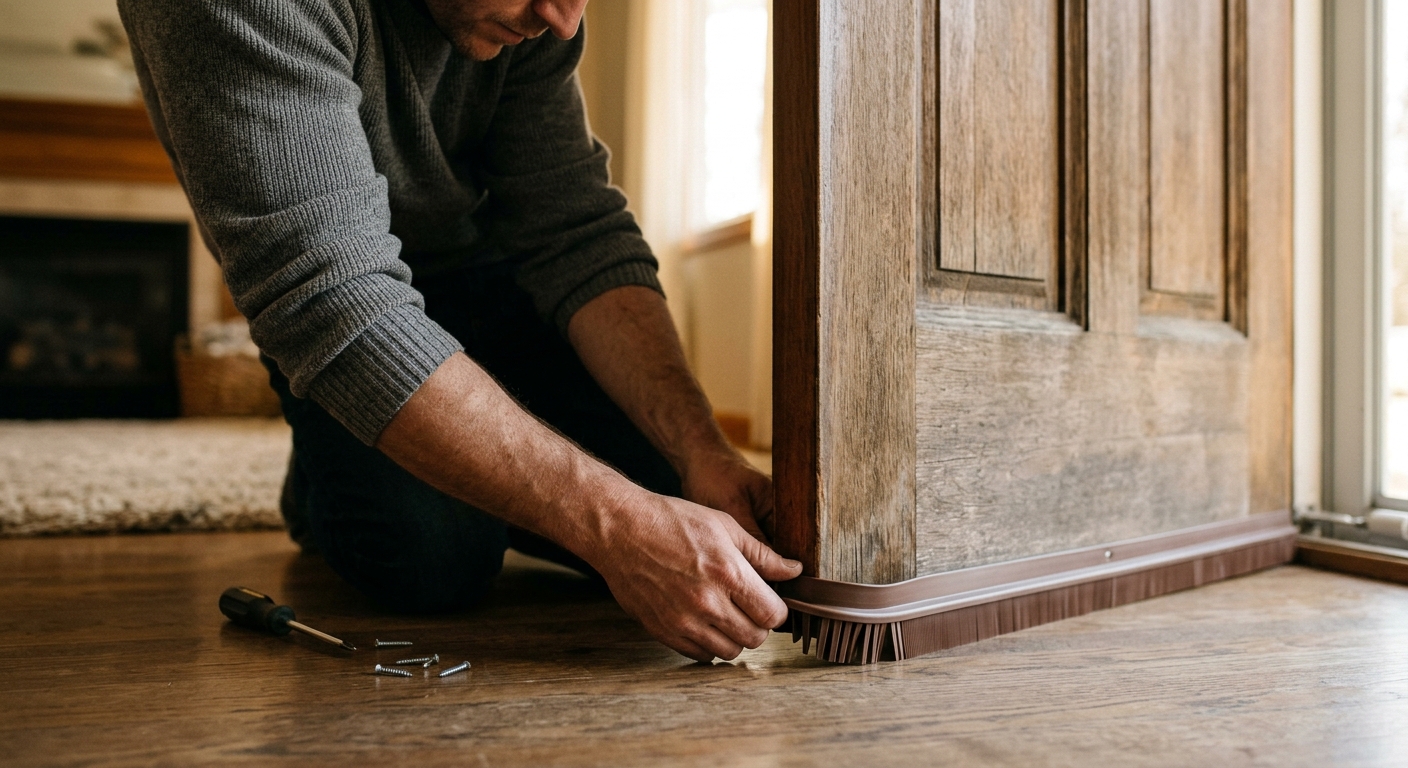
If you have noticed cold drafts rolling across your floor near exterior doors, or if certain rooms never seem to warm up no matter how high you crank the thermostat, the culprit is often hiding in plain sight. The gap between the bottom of your door and the threshold can be anywhere from 1/8 inch to nearly 1/2 inch wide. That may sound small, but it is the equivalent of leaving a small window cracked open all winter long, letting conditioned air escape and cold outside air flood in.
According to the U.S. Department of Energy, air leakage through gaps, cracks, and openings in a typical home accounts for 25 to 40 percent of heating and cooling energy loss. Exterior door gaps are among the easiest and cheapest of these leaks to fix. A quality door sweep costs between $10 and $25 and requires no special skills to install. The payback, in most climates, comes within the first heating season.
In this post, you will learn exactly how to identify a leaky door bottom, choose the right type of door sweep for your situation, and install it yourself in two different ways depending on your budget and skill level. We will also cover the building science behind why this small fix makes such a big difference, common mistakes to avoid, and what to do if a door sweep alone does not solve the problem.
What You’ll Need
Click on an item below to shop for the recommended items for this recipe on Amazon.
As an Amazon Associate, we earn from qualifying purchases.
How to Do It
- Close the door and slide a piece of paper under it at several points across the width. Where the paper slides through easily, you have a gap that needs sealing.
- Purchase a self-adhesive foam or rubber door bottom seal sized to your door width. Look for a product with a flexible vinyl or rubber lip rated for exterior use.
- Clean the bottom edge of the door with a dry cloth to remove dust and debris. Do not use wet cleaners, as moisture prevents the adhesive from bonding properly.
- Peel the backing and press the strip firmly along the full width of the door bottom, starting from the latch side. Hold it in place for 30 to 60 seconds per section.
- Close the door slowly and check that the seal makes light contact with the threshold across the full width without causing the door to drag or stick.
- Re-do the paper test. If the paper no longer slides freely at any point, the seal is working. Allow 24 hours before heavy use so the adhesive fully cures.
- Measure the full interior width of your door at the bottom edge. Standard exterior doors are 32 or 36 inches wide. Buy a door sweep that matches or can be trimmed to your exact width.
- Open the door and mark a light pencil line across the interior face of the door, 1/4 inch up from the bottom edge. This is your alignment guide for the sweep mounting bracket.
- Hold the sweep against the door with the flexible rubber or vinyl blade pointing down toward the threshold. The top of the mounting plate should align with your pencil line.
- Use a pencil to mark the screw hole locations through the mounting plate onto the door face. Pre-drill pilot holes using a 1/16-inch bit to prevent the door from splitting.
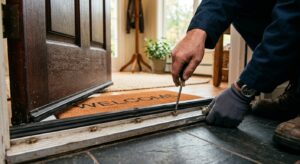
- Attach the sweep with the provided screws, tightening firmly but not over-torquing. Close the door to check that the blade makes consistent contact with the threshold without causing the door to bind.
- If the door drags noticeably, loosen the screws and raise the sweep by 1/16 inch, then re-test. The goal is firm but smooth contact. Re-do the paper test to confirm the gap is sealed across the full width.
- Remove the existing door sweep if one is present by unscrewing the mounting plate and pulling it away from the door bottom.
- Measure door width and door thickness. Automatic door bottoms mortise into the door edge or surface-mount depending on the model. Purchase the correct style for your door type.
- For a surface-mount automatic model, hold the unit against the interior door face with the plunger end touching the door stop on the latch side. Mark and pre-drill all mounting holes.
- Screw the unit into place and test the mechanism by slowly closing the door. The plunger should contact the door stop and push the seal blade downward just as the door reaches the closed position.
- Adjust the plunger contact point and seal blade height using the set screws or adjustment slots on the unit until the blade seals the full width of the threshold without binding.
- Test with the paper slip method and also open and close the door 10 times to confirm smooth operation. Apply a small amount of silicone lubricant to the plunger mechanism if it feels stiff.
Why It Works: The Benefits
Sealing exterior door gaps can reduce air leakage-related heating costs by 10 to 20 percent annually. In a home spending $150 per month on winter heating, that translates to $15 to $30 saved every month during the heating season.
Eliminating the cold air stream at floor level raises the perceived temperature near the door by 3 to 8 degrees Fahrenheit, making entryways and adjacent rooms noticeably more comfortable without touching the thermostat.
The same gap that admits cold air also lets in outdoor dust, pollen, and insects. A door sweep acts as a physical barrier that improves indoor air quality and reduces the entry points for pests year-round.
With less cold air entering, your heating system reaches and holds setpoint temperature faster after a setback period, meaning the house warms up more quickly in the morning and after you return home.
Shorter run cycles caused by reduced infiltration mean less cumulative wear on the furnace blower motor, heat exchanger, and controls, which can meaningfully extend the service life of equipment that costs $3,000 to $10,000 to replace.
💰 Savings Impact by Action
Sealing the gap under exterior doors eliminates a direct infiltration pathway that can account for up to 15 percent of a home’s air leakage-driven heating loss.
Combining a door sweep with perimeter weatherstripping on the door stop can reduce door-related air leakage by up to 20 percent compared to an unsealed door.
The DOE estimates that comprehensive air sealing throughout a home reduces heating and cooling costs by an average of 11 percent annually.
Pairing air sealing improvements with a 7 to 10 degree overnight thermostat setback saves an additional 10 percent on annual heating costs according to ENERGY STAR data.
🏠 Key Concepts Explained
The Science Behind It
The physics behind why a small gap under a door causes such an outsized heating problem comes down to the stack effect. In winter, warm indoor air is less dense than cold outdoor air. This causes it to rise and escape through any gaps near the ceiling or upper floors, while simultaneously creating a zone of lower air pressure near the floor. That pressure difference actively draws cold outdoor air inward through the lowest available opening, which is almost always the gap at the door bottom. The bigger the temperature difference between inside and outside, the stronger this suction force becomes.
Heat transfer through that gap happens in two ways at once. First, infiltration carries cold air molecules directly into the living space (convective heat loss), which your furnace must then heat. Second, the metal or wood threshold conducts cold from the outdoor surface into the floor near the door (conductive heat loss). A door sweep with a vinyl or rubber sealing lip addresses both by stopping airflow at the gap and by reducing the contact area between the cold threshold and the indoor floor surface.
Building scientists measure the tightness of a home using a blower door test, which pressurizes the house and measures how quickly air leaks out. The results are expressed as air changes per hour (ACH). A typical older home without air sealing may have an ACH of 5 to 10, meaning the entire volume of indoor air is replaced by outdoor air five to ten times every hour. The DOE target for an efficient home is below 3 ACH. Each individual seal you install, including door sweeps, contributes to lowering that number. Unlike insulation, which slows heat conduction, air sealing physically stops the movement of air and delivers results that are immediate and measurable on your energy bill.
Frequently Asked Questions
▼ I installed a door sweep but cold air is still coming in. What am I missing?
The sweep may not be making full contact across the entire door width, especially if the threshold is uneven or the door is slightly warped. Try the paper test at several points to find where the gap remains, then adjust the sweep height at that location. If the door itself is warped, an automatic door bottom with an adjustable drop mechanism will conform better than a fixed-blade sweep.
▼ My door is dragging on the floor after I installed the sweep. How do I fix it?
The sweep is set too low. Loosen the mounting screws and raise the sweep by 1/16 inch at a time until the door swings freely. The blade should brush the threshold lightly under compression, not press down hard enough to resist the door swing. If the door drags on carpet rather than a threshold, consider an automatic door bottom that lifts when the door opens.
▼ Can my renter install a door sweep without the landlord’s permission?
Adhesive foam or rubber strip sweeps require no drilling and leave no permanent marks, making them appropriate for most rental situations without needing landlord approval. Avoid screw-mounted sweeps unless you get written permission first. When you move out, remove the adhesive strip carefully and any residue can be cleaned with rubbing alcohol or Goo Gone.
▼ How long will a door sweep actually last before I need to replace it?
A quality screw-mounted sweep with a reinforced rubber or silicone blade typically lasts 3 to 5 years on an actively used exterior door before the blade wears down and loses its sealing ability. Adhesive foam strips usually last 1 to 2 seasons. Inspect the blade each fall at the start of heating season by doing the paper test, and replace the sweep if the paper slides through easily anywhere.
▼ Will a door sweep help with noise as well as drafts?
Yes, sealing the gap under a door also reduces sound transmission because air gaps are a primary path for both heat and sound waves. A door sweep alone will not make a room soundproof, but combined with perimeter weatherstripping it can noticeably reduce traffic noise, wind noise, and sounds traveling between rooms when used on interior doors as well.
Quick Tips
- Check all exterior doors in the home, not just the front entry. Side doors, garage entry doors, and basement walkout doors are frequently overlooked and often have larger gaps.
- In summer, the same door sweep that blocks cold winter air also blocks hot humid air from entering, providing a year-round benefit to both heating and cooling costs.
- If your door threshold itself is cracked, warped, or missing the rubber insert strip, replace the threshold insert (a $5 to $15 part) at the same time for a complete seal.
- For sliding glass doors, a door sweep will not work. Instead, use a foam backer rod or sliding door seal kit along the bottom track, which costs $10 to $20 and dramatically reduces cold air infiltration.
Variations for Your Situation
- Apartment or Rental: Use a self-adhesive foam door seal strip or a draft snake (a fabric tube filled with sand or batting) placed against the door base. Both cost under $15, require no tools or drilling, and are completely removable. Adhesive foam strips from brands like M-D Building Products or Frost King are widely available and provide a genuine air seal rather than just a visual barrier.
- Tight Budget (under $20): A rolled bath towel or a DIY draft snake made from a stuffed leg of denim can provide immediate relief at zero cost while you source a permanent solution. For the lowest-cost permanent fix, a $8 to $12 self-adhesive foam strip from a hardware store is the best value. Focus on the worst-offending door first, typically the one facing the prevailing wind, and you will capture most of the savings from a single purchase.
- Older Home (pre-1980): Doors in older homes often have non-standard widths (30 or 28 inches), uneven or damaged thresholds, and door bottoms that are not perfectly square due to decades of settling. Buy a door sweep that can be trimmed to length with a hacksaw and that has a flexible blade at least 1 inch wide to accommodate threshold irregularities. Also inspect the door frame itself for gaps between the frame and rough opening, which are common in older construction and can be sealed with low-expansion spray foam ($6 to $10) before installing the sweep.