That slight clicking noise when you close your dishwasher door, or the way you have to push it just a little harder than you used to, is your dishwasher sending an early warning. The door latch is a small but critical component: it signals the control board that the door is sealed and safe to run, and it keeps hot water and steam contained during the wash cycle. When it starts to fail, you may notice the dishwasher not starting, stopping mid-cycle, or leaving the door seal loose enough to allow moisture to seep onto your floor.
The good news is that a failing door latch is one of the most beginner-friendly dishwasher repairs you can tackle. Most latches cost between $10 and $30 in parts, and the replacement process requires basic hand tools and about 30 to 45 minutes. Ignoring the problem, on the other hand, can lead to water damage to your cabinets and flooring, mold growth behind the kickplate, or a completely dead dishwasher that needs full replacement. The average dishwasher replacement runs $600 to $1,200 installed, making a $20 latch repair one of the best investments in your home.
This guide walks you through diagnosing a failing latch, a quick adjustment fix you can try in minutes, and a full DIY replacement if the latch mechanism itself is worn out. You will also find troubleshooting answers for the most common door latch frustrations, plus tips on when the problem is actually something else entirely.
What You’ll Need
Click on an item below to shop for the recommended items for this recipe on Amazon.
As an Amazon Associate, we earn from qualifying purchases.
How to Do It
- Unplug the dishwasher from the wall outlet or flip its dedicated circuit breaker off before touching any components.
- Open the door fully and locate the strike plate, which is the small plastic or metal tab mounted to the inner top edge of the dishwasher tub frame that the latch hook grabs onto.
- Check whether the strike plate screws are loose by pressing on the plate and trying to wiggle it. If it moves, tighten the screws with a Phillips screwdriver until snug.
- If the screws are tight but the latch still does not engage cleanly, loosen them slightly, shift the strike plate inward or outward by 1 to 2 millimeters in the direction the latch is missing, and re-tighten.
- Close the door firmly and listen for a solid double-click indicating both the mechanical latch and the door switch have engaged. If you only hear one click, the strike plate needs further adjustment.
- Restore power and run a short rinse cycle while watching the door edge for any steam or water escaping. If the door holds and the cycle completes, the adjustment was successful.
- Unplug the dishwasher or turn off the circuit breaker. Have a towel ready since the door panel will be partially disassembled.
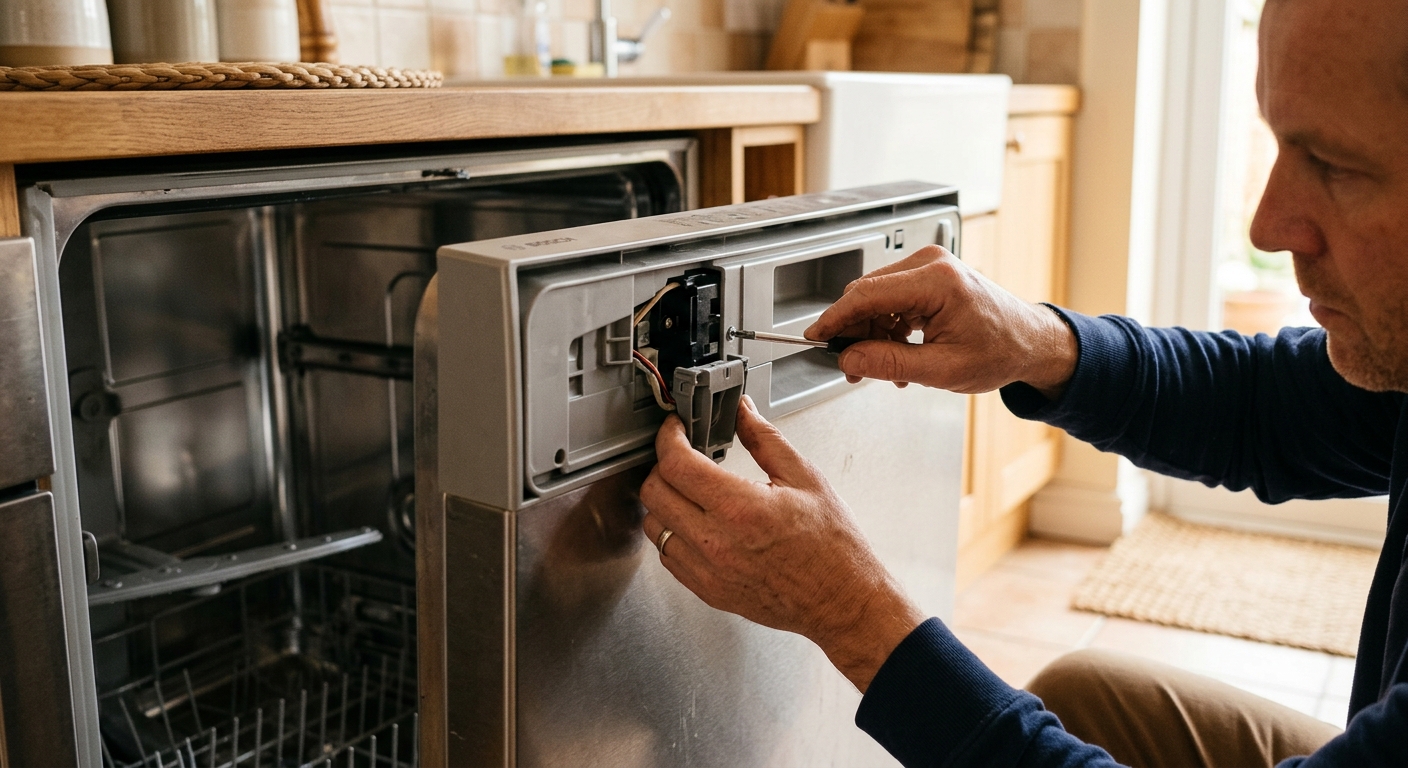
- Open the door to the horizontal position and remove the screws along the inner perimeter of the door panel, typically 6 to 8 Torx T20 or Phillips screws depending on the brand.
- Carefully separate the outer door panel from the inner panel by lifting it straight up and setting it aside. The latch assembly is mounted at the top center of the inner door panel.
- Disconnect the wire harness connectors from the latch assembly by pressing the release tabs and pulling straight back. Take a phone photo of the wiring arrangement before disconnecting anything.
- Remove the 2 to 3 screws securing the latch assembly to the door frame, slide out the old latch, and compare it to the new part to confirm a match.
- Install the new latch assembly, reconnect the wire harness connectors until they click, reassemble the door panel by pressing the outer panel down onto the clips and re-driving the perimeter screws, then restore power and run a full test cycle.
- Call an appliance repair service and provide your dishwasher brand, model number, and a description of the symptom such as ‘door does not latch consistently’ or ‘dishwasher stops mid-cycle’.
- Ask the technician to diagnose whether the issue is the latch assembly alone or whether the door switch, control board, or hinge assembly is also involved, since those repairs require different parts.
- Request an itemized estimate before authorizing any work. A latch-only repair should be $150 to $250 total. If the estimate exceeds $350, compare it against the cost of a new appliance before proceeding.
- After the repair, ask the technician to demonstrate the proper latch engagement sound and confirm the door gasket seal is intact so you know what normal operation looks and sounds like going forward.
Why It Works: The Benefits
Even minor latch-related leaks can cause cabinet and flooring damage averaging $1,000 to $4,000 to repair. Fixing the latch while it is still intermittent prevents moisture from ever reaching the surrounding structure.
A properly latched door maintains the correct internal pressure and temperature throughout the cycle, ensuring dishes come out clean and dry on the first run rather than requiring a second cycle.
An appliance technician charges $75 to $150 per hour plus parts for a latch repair. Doing it yourself brings the total cost to $10 to $30 in parts only, paying back immediately on the first repair.
Replacing a single worn component early prevents cascading failures. A latch that forces the door open slightly during cycles stresses the door gasket, hinge arms, and control board over time, shortening the overall appliance life by years.
A dishwasher that stops mid-cycle due to latch drop-out wastes the full energy and water of a partial cycle, typically 3 to 6 gallons of hot water per interrupted run. Fixing the latch stops that waste immediately.
💰 Savings Impact by Action
A $20 DIY latch repair saves 97% of the $600 to $1,200 cost of replacing the dishwasher entirely.
Fixing a latch that causes mid-cycle stops eliminates the wasted water and energy of re-running cycles, cutting per-load utility cost by up to 50%.
DIY latch replacement eliminates $130 to $320 in labor charges, saving 85% of a typical technician visit cost.
Addressing a failing latch before it causes cabinet leaks avoids $1,000 to $4,000 in remediation costs, a 100% avoidance of that expense category.
🏠 Key Concepts Explained
The Science Behind It
A dishwasher door latch does two jobs simultaneously: it applies mechanical clamping force to compress the door gasket into a watertight seal, and it closes a small microswitch that completes the safety interlock circuit in the control board. Both functions must work correctly for the machine to run properly. The door gasket is made of flexible rubber or silicone that deforms slightly under pressure to fill any microscopic gaps between the door and tub opening. When the latch weakens, the clamping force drops below the threshold needed to compress the gasket fully, and steam finds the path of least resistance out through that gap.
The door switch is a normally-open microswitch, meaning current cannot flow through the safety circuit until the latch physically depresses the switch plunger. If the latch is worn or misaligned by even 2 to 3 millimeters, the plunger may not travel far enough to close the contacts. From the control board’s perspective, the door is still open, and it will refuse to energize the pump motor regardless of what you press on the control panel. This is why a dishwasher with a failing latch often appears completely dead rather than simply leaking.
The plastic fatigue factor is real and measurable. Most residential dishwasher latch assemblies are rated for 10,000 to 20,000 open-close cycles. At one load per day, that is 27 to 55 years of theoretical life. However, the constant exposure to steam at 140 to 160 degrees Fahrenheit accelerates polymer degradation significantly, and real-world latch failures typically occur at 7 to 15 years of service. This is why a latch can look visually intact but no longer deliver enough spring force to fully engage the strike plate or close the switch contacts reliably.
Frequently Asked Questions
▼ My dishwasher won’t start at all. Could this really just be the door latch?
Yes, a failed door latch switch is one of the top three reasons a dishwasher appears completely dead. Before assuming a control board or motor failure, close the door firmly and listen for two distinct clicks. If you only hear one or none, the latch is not engaging the safety interlock. Try the strike plate adjustment first, and if the problem persists, replace the latch assembly before spending money on more expensive diagnostics.
▼ I replaced the latch but the dishwasher still stops mid-cycle. What else could it be?
If a new latch does not resolve mid-cycle stopping, the issue is likely the door latch switch itself rather than the mechanical latch body. On some models these are separate components. The switch can be tested with a multimeter set to continuity mode: it should show continuity when pressed and none when released. A failed thermal fuse, which is a separate small component on the control board harness, can also cause identical symptoms and costs under $10 to replace.
▼ There is water pooling under my dishwasher. Is the door latch definitely the cause?
A failing door latch is one possible cause, but water under the dishwasher can also come from a leaking door gasket, a cracked door tub seal, a loose hose connection at the pump, or a failing water inlet valve. Do a visual inspection with the kickplate removed while the dishwasher runs a short rinse cycle to identify exactly where the water is originating. If it is running down the front of the tub interior, the latch and gasket are the first things to address.
▼ Can I temporarily fix the latch with tape or a bungee cord to get through the week?
This is not recommended. Holding the door shut with tape or external force bypasses the door switch interlock, which means the control board receives no signal that the door is actually sealed. Some models will refuse to run regardless, while others may start but run with the door under inadequate pressure, guaranteeing a leak. A replacement latch ships in one to three days from most parts suppliers for under $30, making the temporary fix not worth the risk of water damage.
▼ How do I find the right replacement latch for my specific dishwasher?
Open the dishwasher door and look at the inner door edge or the door frame for a sticker or stamped label with the model number, typically a 10 to 15 character alphanumeric code. Enter that model number on RepairClinic.com, PartSelect.com, or the manufacturer’s parts site. Filter for ‘door latch assembly’ and confirm the part image matches your existing hardware before purchasing. OEM parts are ideal but often cost 20 to 40 percent more than compatible aftermarket versions that work equally well.
Quick Tips
- Check the door gasket while you have the latch apart. A cracked or flattened gasket combined with a marginal latch is a double source of leaks and costs $15 to $40 to replace yourself.
- Write your dishwasher model number on a piece of masking tape inside the under-sink cabinet so you always have it handy when ordering parts without pulling the appliance out.
- If your dishwasher is between 10 and 15 years old and needs a latch plus one other component, compare total repair costs against a new ENERGY STAR model, which uses 3 to 5 gallons less water per cycle and roughly $35 less in energy annually.
- Run your finger along the door gasket after every few months and press gently to feel for hardened or cracked sections. Replacing the gasket proactively before it fails completely is far cheaper than dealing with water damage.
Variations for Your Situation
- Apartment/Rental: Renters should not replace appliance components without written landlord approval since this can create liability disputes if anything goes wrong. Instead, document the latch problem with a dated photo and submit a written maintenance request to your landlord or property manager. If the landlord delays beyond a reasonable period (7 to 14 days in most states), check your local tenant rights code since appliance failures that create water damage risk are often classified as habitability issues requiring prompt repair.
- Tight Budget (under $50): Start with the zero-cost strike plate adjustment described in the quick fix approach. If that does not resolve the issue, clean the latch mechanism thoroughly with isopropyl alcohol and a cotton swab before purchasing anything. If parts are needed, search for your model number on eBay where used latch assemblies pulled from donor appliances often sell for $5 to $12, about half the price of new aftermarket parts, and work perfectly well for this type of low-stress component.
- Older Home (pre-1980 appliances or vintage dishwashers): Dishwashers from the 1970s and early 1980s used simpler mechanical latches without electronic door switches, making alignment adjustments easier but parts harder to find. Search appliance salvage yards and vintage appliance parts forums like ApplianceBoard.com before assuming the part is unavailable. If your unit is that old and experiencing any latch issues, also inspect the door hinge springs since they commonly weaken with age and cause the door to hang at a slight angle, making any latch adjustment temporary at best.