That doorknob-sized hole in the hallway or the nail pops scattered across your living room wall might seem like purely cosmetic problems. But small holes and gaps in interior drywall can connect to wall cavities that bleed conditioned air, allow drafts near exterior walls, and even let moisture sneak into places it does not belong. According to the U.S. Department of Energy, air leakage through walls, ceilings, and floors accounts for 25 to 40% of the energy used for heating and cooling in a typical home. Not every drywall hole is a major culprit, but collectively they add up faster than most homeowners expect.
The good news is that patching a small hole – anything up to about 4 inches in diameter – requires no special skills, no expensive tools, and less time than you might think. Whether you are prepping a house to sell, fixing damage from a doorstop, or just tired of looking at a screw anchor that left a crater, this guide walks you through two practical approaches: a no-fuss 5-minute fix for tiny holes and a clean, durable DIY patch for holes up to 4 inches that will hold up for years.
This post covers the right materials for each hole size, step-by-step instructions for both approaches, how to blend your patch so it is nearly invisible, and the building science behind why sealing wall penetrations actually matters for your energy bill. No experience required.
What You’ll Need
Click on an item below to shop for the recommended items for this recipe on Amazon.
As an Amazon Associate, we earn from qualifying purchases.
How to Do It
- Clean the hole: Remove any loose paper facing or crumbled drywall with your fingernail or a putty knife. The edges should be firm, not crumbly.
- Apply spackling: Scoop a small amount of lightweight spackling compound onto your putty knife and press it firmly into the hole, slightly overfilling so it mounds just above the wall surface.
- Scrape flush: Drag the putty knife flat across the patch at a low angle to remove the excess and leave the compound level with the wall. One smooth pass works better than multiple short strokes.
- Let it dry completely: Lightweight spackling dries white when fully cured. Pink-tinted formulas (like DAP DryDex) change from pink to white to signal when they are ready – typically 30 to 120 minutes depending on humidity.
- Sand lightly: Use 120-grit sandpaper folded over your fingertip and sand the dried patch in a circular motion until it is perfectly flush. Wipe away dust with a damp cloth.
- Prime and paint: Apply a thin coat of primer or primer-paint combo, let it dry, then apply your finish paint. Skipping primer often leaves a dull spot called flashing even if the color matches.
- Clean and prep the hole: Remove any loose drywall, torn paper, or protruding fasteners. If there are sharp edges or the hole has an irregular shape, use a utility knife to clean up the perimeter slightly so the edges are stable.
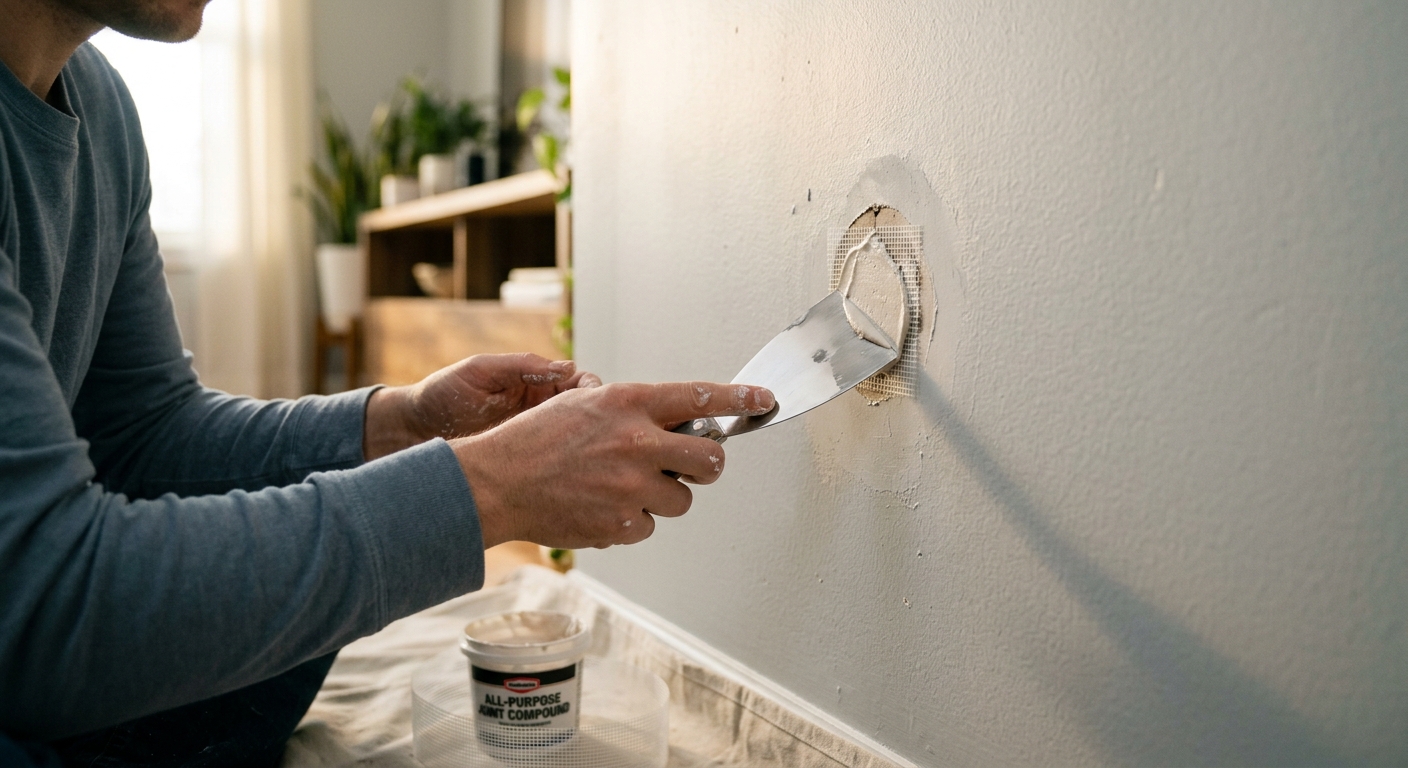
- Cut and apply the mesh patch: Self-adhesive aluminum or fiberglass mesh patches come in 4-inch and 6-inch squares. Peel the backing and press the patch firmly and centered over the hole, smoothing out any bubbles from the center outward.
- Apply the first coat of joint compound: Use a 6-inch putty knife to spread a thin, even layer of lightweight joint compound over the entire mesh patch, working it into the mesh weave. Feather the edges outward 2 to 3 inches beyond the patch to blend with the wall. This first coat fills the mesh – do not try to make it perfect.
- Let it dry completely and sand: Allow the first coat to dry fully (2 to 4 hours in normal conditions, or overnight to be safe). Sand with 120-grit sandpaper until smooth, then wipe with a damp cloth. You will likely see low spots or the mesh texture through the first coat – that is expected.
- Apply a second skim coat: Apply a second thin coat of joint compound, extending the feathered edges another inch or two beyond the first coat. This coat should be thinner and smoother than the first. Let it dry fully and sand again with 150-grit sandpaper.
- Prime and paint: Apply a quality drywall primer or PVA primer over the patch before painting. This seals the joint compound so it does not absorb paint unevenly. Once the primer is dry, apply your finish coat, feathering it slightly beyond the patch edges to blend texture and sheen.
Why It Works: The Benefits
Sealing small holes throughout a home can reduce overall air leakage by 5 to 15%, contributing meaningfully to lower heating and cooling costs, especially in homes that have never had professional air sealing done.
Eliminating draft pathways through wall penetrations reduces cold spots in winter and stuffy pockets in summer, making rooms feel more evenly comfortable without adjusting the thermostat.
Sealing holes in exterior-adjacent walls stops humid interior air from entering wall cavities, reducing the risk of condensation, mold growth, and wood rot that can cost thousands of dollars to remediate.
Patched, painted walls signal to buyers that a home has been well maintained. Visible holes or poor patch jobs are a common trigger for inspection concerns and price negotiation in home sales.
A quality patch kit costs $8 to $20 at any hardware store, and the repair takes under 30 minutes. Compare that to the $75 to $150 a handyman typically charges for the same small repair.
💰 Savings Impact by Action
Patching interior wall holes as part of a whole-home air sealing effort can reduce conditioned air loss by up to 15%, directly lowering heating and cooling costs.
Doing the repair yourself costs $8 to $25 in materials versus $75 to $150 for a handyman, saving 75 to 85% of the total repair cost.
Sealing wall penetrations reduces humid air intrusion into wall cavities, cutting condensation risk by an estimated 20% and helping prevent costly mold remediation.
Closing air bypass paths through drywall restores insulation to its rated R-value, improving wall thermal resistance by up to 10% in leaky older homes.
🏠 Key Concepts Explained
The Science Behind It
Drywall is not just a cosmetic surface. It functions as the interior air barrier in most American homes, working together with housewrap or sheathing on the exterior to create a continuous boundary around the conditioned space. When that barrier has holes, even small ones, it creates low-resistance pathways for air to move between the living space and the wall cavity. Because wall cavities are typically connected to the attic, basement, or exterior assembly, conditioned air can find its way out – and unconditioned air in – through these gaps in a process driven by pressure differences, wind, and the stack effect.
The stack effect is particularly important to understand. In winter, warm indoor air is buoyant and naturally rises toward the ceiling and upper floors. As it escapes through high openings, it creates a slight negative pressure at lower levels that draws cold exterior air inward through any available gap. A cluster of small holes near baseboards or in lower walls can function as persistent intake points, forcing your heating system to work harder to replace the lost warmth. The reverse happens in summer: air-conditioned interior air is denser and tends to escape at lower levels while hot attic air is drawn in at the top. Either way, unpatched holes are part of the leakage network your HVAC system is fighting against all year.
The mesh patch and joint compound system works because fiberglass or aluminum mesh distributes mechanical load across the surrounding drywall, preventing the patch from punching back through under impact. Joint compound, when applied in thin coats and fully dried, bonds chemically to the paper facing of the drywall and creates a monolithic surface that accepts primer and paint identically to the original wall. Priming is not optional – raw joint compound is highly porous and will absorb paint unevenly, creating a visible dull spot called flashing even when the color is a perfect match. A single coat of PVA primer seals the compound and allows the topcoat to behave consistently across the entire repaired surface.
Frequently Asked Questions
▼ My patch cracked after it dried. What went wrong?
Cracking almost always means the compound was applied too thickly in a single coat. Joint compound and spackling both shrink as water evaporates during drying, and thick applications crack under that stress. Scrape out the cracked material, let the area dry completely, and redo the patch in two or three thin coats, allowing full drying between each one.
▼ The patch looks fine but I can still see it after painting. Why?
This is almost certainly a flashing issue caused by skipping primer. Unpainted joint compound is very porous and absorbs the first coat of paint deeply, leaving a dull, flat spot that reflects light differently from the surrounding painted wall. Lightly sand the area, apply a coat of PVA drywall primer, let it dry fully, then repaint. One primed recoat usually fixes it completely.
▼ Can I patch drywall if there is a slight flex or give when I press on the wall around the hole?
A little flex is normal for drywall. But if the area around the hole feels soft, crumbles, or shows any discoloration or staining, stop and investigate before patching. Softness usually means moisture has been in the wall, which can indicate a leak or condensation problem. Patching over moisture-damaged drywall hides the symptom and allows mold to grow behind the repair.
▼ How long should I wait before painting over the patch?
At minimum, wait until the compound is completely white or matches the color indicator on the product label – never paint over pink or gray compound. For the mesh patch approach, overnight drying before your final prime and paint is the safest option. In humid conditions, allow 24 to 48 hours. Painting over compound that is still damp traps moisture and causes the patch to crack or bubble later.
▼ The hole I need to patch is in a rented apartment. Am I allowed to do this?
Most leases allow minor repairs like filling nail holes, and some landlords actually appreciate tenants handling minor touch-ups. Review your lease and check with your landlord before patching anything larger than a nail hole, especially if it requires joint compound or painting. Using a white toothpaste or nail hole filler stick is a removable, renter-friendly option for very small holes that you can easily reverse at move-out.
Quick Tips
- Store leftover spackling and joint compound with a piece of plastic wrap pressed directly onto the surface before replacing the lid – this prevents a hard crust from forming and extends shelf life significantly.
- If your wall has an orange peel or knockdown texture, a light mist of water from a spray bottle on fresh joint compound, followed by a gentle stipple with a sponge or crumpled plastic bag, can recreate a rough texture before it fully sets.
- Always sand between coats, not just after the final one. Sanding the first coat removes high ridges that would telegraph through the second coat and create a wavy surface.
- When painting the patch, use the same sheen level as the surrounding wall. Matching color but using flat paint over a satin wall will still be visible – the difference in sheen is just as obvious as a color mismatch.
Variations for Your Situation
- Apartment/Rental: Renters should use removable or minimal-impact solutions for nail holes. White non-shrink spackling pressed in flush and left unpainted often blends well enough for white or off-white walls. For slightly larger holes, a pre-mixed spackling pen or toothpaste-consistency filler works without needing painting. Always photograph the repair and get written landlord approval before using joint compound or repainting, as color mismatches can be deducted from your security deposit.
- Tight Budget (Under $10): A single small tub of lightweight spackling ($5 to $7 at any hardware store) handles all holes under 1 inch. For holes up to 3 inches, a California patch using a scrap of drywall and paper joint tape costs virtually nothing if you have leftover drywall. Skip the mesh patch kit entirely and use this method: cut the hole into a clean square, cut a drywall scrap slightly larger, score the back gypsum away leaving a 1-inch paper border, glue the gypsum plug into the hole, and tape the paper border flat with joint compound.
- Older Home (Pre-1980): Homes built before 1980 may have plaster walls rather than drywall. Plaster is harder, heavier, and cracks differently than gypsum drywall. Self-adhesive mesh patches still work on plaster for holes up to 3 inches, but use setting-type joint compound (like Durabond) rather than lightweight compound – it bonds better to plaster and does not shrink. For plaster walls that show wide cracks radiating from the hole, the underlying wood or metal lath may be damaged and professional replastering may be the better option.