You flip on the range hood, hear the fan humming along, and still end up with a smoke-filled kitchen and grease coating your cabinets. Sound familiar? A surprising number of homeowners assume their exhaust fan is working just because it makes noise, but airflow is what actually matters. A fan moving 50 CFM (cubic feet per minute) instead of its rated 200 CFM is doing almost nothing to protect your air quality or remove heat from your kitchen.
Poor kitchen ventilation does more than just leave lingering odors. Cooking releases moisture, carbon monoxide from gas burners, nitrogen dioxide, and fine particulate matter. Without proper exhaust, these pollutants build up indoors. The EPA estimates indoor air can be two to five times more polluted than outdoor air, and an underperforming range hood is a major contributor in most homes. Beyond health, a struggling exhaust fan forces your HVAC system to work harder to remove heat and humidity, quietly inflating your cooling bills.
This post walks you through the most common reasons kitchen exhaust fans stop working effectively, a quick diagnostic you can do in five minutes, and step-by-step fixes ranging from a free filter cleaning today to a DIY duct inspection this weekend. Most homeowners can restore full airflow performance without calling anyone.
What You’ll Need
Click on an item below to shop for the recommended items for this recipe on Amazon.
As an Amazon Associate, we earn from qualifying purchases.
How to Do It
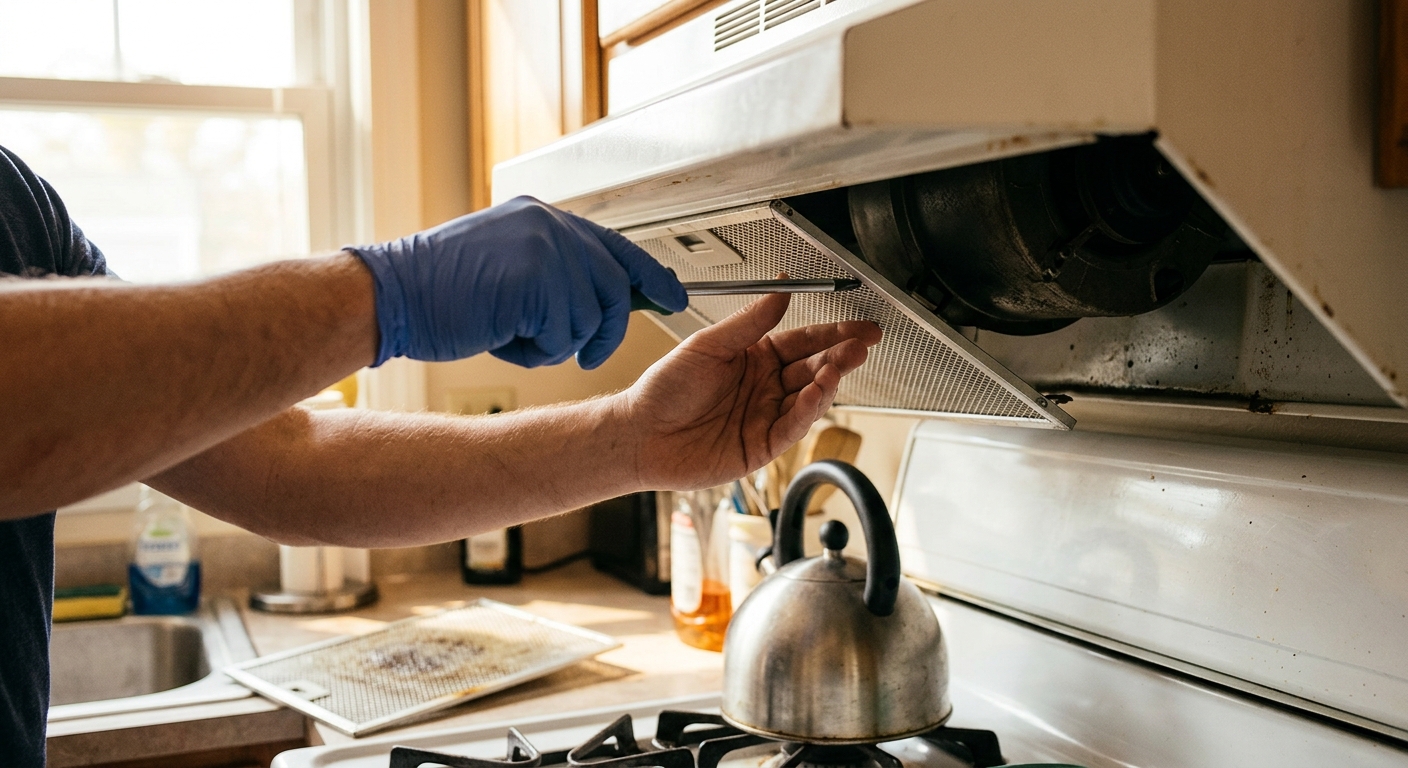
- Turn off the range hood and let it cool for 5 minutes. Remove the grease filter by pressing the release tab or sliding it out. Most mesh filters slide or pop out without tools.
- Fill your sink with hot water and add a generous squirt of dish soap plus two tablespoons of baking soda. Submerge the filter and let it soak for 10 minutes, then scrub with a stiff brush. Rinse thoroughly and let it air dry.
- While the filter dries, shine a flashlight up into the filter opening and locate the backdraft damper, which looks like a small hinged flap. Push it gently with a finger or pencil. It should open freely and close under its own weight. If it is stuck, wipe the hinge and flap edge with a degreaser-soaked rag.
- Check that the fan blades (visible once the filter is out) are not coated in thick grease. Wipe them down with a degreaser cloth to restore balance and efficiency.
- Reinstall the dry filter and turn the fan on high. Hold a single sheet of paper towel near the filter opening. It should pull firmly toward the hood. If it barely moves, the duct itself may be the issue and the DIY approach below is your next step.
- Turn off power to the range hood at the breaker. Remove the grease filter and the hood’s top panel or chase cover (usually 2 to 4 screws) to access where the duct connects to the fan housing.
- Inspect the duct connection at the hood. Flex duct (the silver accordion-style hose) is a common source of restriction. Look for kinks, sagging sections, or sharp bends. Flex duct should run as straight and short as possible. Straighten any kinks by hand and use duct strap or cable ties to support sagging sections from above.
- Follow the duct run to the exterior wall or roof cap. If accessible, remove the exterior cap (usually 2 to 4 screws) and check for grease buildup, bird nests, or a damper stuck shut by debris. Clean with a degreaser spray and a long-handled brush.
- If the duct interior is heavily coated with grease, clean it using a flexible dryer vent cleaning brush kit ($15 to $25 at hardware stores). Work from both the hood end and the exterior cap end, rotating the brush to dislodge buildup.
- Reconnect everything and seal any duct joints with foil HVAC tape (not standard duct tape, which fails over time). Do not use screws on flex duct as they can catch grease and restrict airflow.
- Restore power and retest with the paper towel method. A properly functioning ducted hood rated at 200 CFM should hold a paper towel firmly against the filter opening at high speed.
- Call an HVAC technician or appliance repair specialist to measure actual airflow output with an anemometer. This confirms whether the problem is the motor, the duct, or both.
- If the motor is underperforming, request a replacement motor or fan assembly. Many range hood motors are available as OEM parts for $50 to $150, with labor bringing the total to $150 to $300.
- If duct routing is the issue, have the technician replace flexible duct with rigid metal duct (round or rectangular). Rigid duct reduces resistance by 20 to 30% compared to equivalent flex duct runs.
- For homes with powerful hoods above 400 CFM, ask about a passive or active make-up air solution. A passive makeup air duct with a motorized damper typically costs $200 to $400 installed and prevents negative pressure problems.
Why It Works: The Benefits
A properly functioning exhaust fan removes cooking pollutants including NO2, CO, and fine particulates before they circulate through your home. Studies from Lawrence Berkeley National Laboratory link improved kitchen ventilation to measurable reductions in indoor pollutant levels.
Cooking on a gas or electric range adds 3,000 to 12,000 BTUs of heat to your kitchen. A working exhaust fan removes that heat directly rather than forcing your AC to compensate, reducing kitchen cooling load by 10 to 20% during cooking hours.
When exhaust airflow is poor, aerosolized grease settles on cabinets, walls, and ceilings. Restoring proper ventilation reduces this accumulation dramatically, cutting cleaning time and protecting your kitchen finishes.
Boiling and simmering releases significant moisture. Without proper exhaust, humidity can raise kitchen moisture levels by 10 to 15%, promoting mold growth on walls, grout, and inside cabinets over time.
💰 Savings Impact by Action
Cleaning a heavily clogged grease filter can restore up to 60% of lost airflow immediately at zero cost.
Clearing a blocked or kinked duct run restores 20 to 30% additional airflow beyond what filter cleaning alone achieves.
A properly venting range hood removes cooking heat directly, reducing kitchen cooling load by 10 to 20% during cooking hours.
Replacing flex duct with smooth rigid metal duct reduces airflow resistance by 20 to 30% and cuts grease accumulation rates significantly.
🏠 Key Concepts Explained
The Science Behind It
At its core, a range hood works by creating a zone of low pressure above your cooking surface that pulls air (along with heat, moisture, smoke, and combustion byproducts) up through the filter and into the duct. The fan’s ability to do this depends on two things working together: the fan’s static pressure capability and the total resistance of the system. Resistance is created by filters, duct length, elbows, and the exterior termination cap. When any of these components become blocked or restricted, the fan hits its resistance limit at a lower airflow rate, and actual CFM drops well below the nameplate rating.
Grease filters work by creating a tortuous path that causes grease particles to impinge on the mesh and stick rather than passing into the duct. This is highly effective when the filter is clean, but the same physical structure that traps grease also progressively restricts airflow as it loads up. A filter that was designed to add 0.05 inches of water column of resistance when clean might add 0.20 or more when heavily coated, which can cut airflow by more than half on a standard residential fan.
The backdraft damper deserves special attention from a building science perspective. Homes built after 2000 are often tight enough that running a kitchen exhaust fan creates measurable negative pressure relative to outdoors. This negative pressure works against the fan, effectively reducing its net airflow. If your home is well-sealed and you notice the fan seems less effective in winter when the house is buttoned up, this make-up air deficit is likely the cause. Opening a nearby window by one inch while cooking can restore full fan performance and confirms whether this is your issue.
Frequently Asked Questions
▼ My range hood fan runs but there is almost no suction at all. What is wrong?
The most likely causes in order of probability are: a severely clogged grease filter, a backdraft damper stuck in the closed position, or a kinked or disconnected duct run. Start with the quick fix approach above to clean the filter and check the damper. If suction is still absent, remove the filter and shine a light up into the duct while a helper watches the exterior cap. If the cap flap does not open when the fan runs, the duct is blocked or disconnected somewhere along its run.
▼ Why does my kitchen still smell after running the exhaust fan?
If odors linger, your fan is likely moving far less air than it should. Use the paper towel test: hold a sheet near the filter opening at high speed. Strong suction should hold it in place. If it falls, return to Step 1 of the quick fix above. Also confirm your hood is sized correctly for your cooktop. The general guideline is 100 CFM per 10,000 BTU for gas ranges, meaning a 40,000 BTU gas range needs at least 400 CFM, which many builder-grade hoods cannot deliver.
▼ Can I convert my recirculating (ductless) hood to a ducted one?
Yes in most cases, but it requires running new ductwork to an exterior wall or roof, which is a moderate to significant renovation. The payoff is meaningful: ducted hoods remove 100% of pollutants, while recirculating hoods only filter particulates and odors through charcoal, leaving heat and moisture behind. Get quotes from two HVAC contractors and budget $300 to $800 for the conversion depending on duct run complexity.
▼ How do I know if my range hood motor is failing versus just clogged?
Clean the filter and damper first, since these account for the majority of airflow complaints. If suction is still weak with a clean filter and a clear duct, listen for a change in fan pitch when you push lightly on the blades (with power off, then restore and listen). A motor running at reduced RPM due to capacitor failure will often sound lower-pitched than it once did. An appliance repair tech can confirm this with a clamp meter for around $75 to $100 as a diagnostic fee.
▼ My range hood makes a loud rattling noise. Is that related to airflow?
Rattling is usually a loose filter that has not been seated fully, a loose fan blade caused by grease accumulation unbalancing it, or a vibrating damper flap at high speed. Remove the filter, reseat it firmly, and check that the blade has no heavy grease buildup on one side. If the rattle persists, the motor mount screws may have vibrated loose over time and can be tightened with a screwdriver after cutting power at the breaker.
Quick Tips
- Clean grease filters monthly if you cook daily, or at minimum every 3 months. Set a recurring phone reminder so it does not slip through the cracks.
- Always run the exhaust fan for 5 minutes after you finish cooking. Heat, steam, and combustion gases continue rising from hot cookware even after the burners are off.
- Use the highest fan speed for the first 2 minutes of high-heat cooking like searing or stir-frying, then drop to medium. This captures the initial burst of smoke and grease before it spreads.
- Check your exterior duct cap seasonally. Birds build nests in exhaust terminations surprisingly often, and a fully blocked cap will make even a powerful hood useless.
Variations for Your Situation
- Apartment/Rental: Most apartment range hoods are low-power recirculating units that the landlord is responsible for maintaining. You can request a filter replacement or cleaning from your landlord in writing. In the meantime, replace the charcoal filter yourself if it is accessible (typically a $15 to $25 part, sold by hood brand). Document the poor performance with photos before requesting repairs to protect your rights as a tenant.
- Tight Budget (under $50): The free filter cleaning in the quick fix approach above restores most of the lost airflow at zero cost. If your duct needs attention, a flexible dryer vent brush kit costs around $20 and handles most residential duct runs. Skip the professional service and focus entirely on the filter and damper since these two components cause 80% of range hood performance problems.
- Older Home (pre-1980): Homes built before 1980 often have range hoods vented into the wall cavity, a soffit, or even just recirculating without any exterior duct at all. Before cleaning anything, use a flashlight to verify your hood actually vents outside. If you discover it terminates inside the wall or attic, this is a serious moisture and fire code issue and you should have a contractor add proper exterior termination. Old metal duct in these homes may also be held together with standard duct tape that has long since failed, so re-sealing all joints with foil HVAC tape during your inspection is strongly recommended.