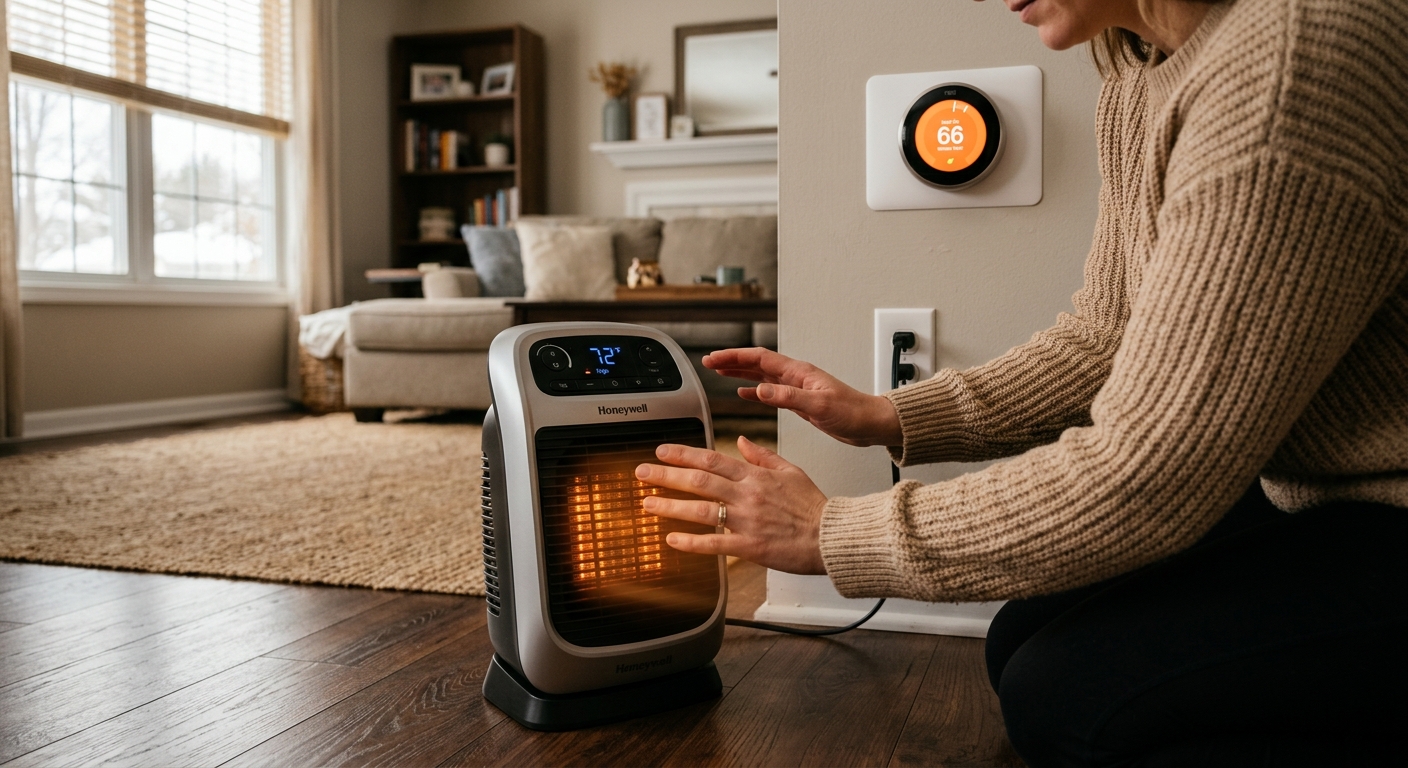
Every winter, millions of homeowners face the same dilemma: the house feels chilly, and you’re debating whether to nudge the thermostat up a couple of degrees or plug in that space heater sitting in the closet. The instinct to use a space heater feels frugal, but is it actually cheaper? The honest answer is: it depends, and the details matter a lot.
A standard 1,500-watt electric space heater costs roughly $0.18 to $0.25 per hour to run at the national average electricity rate of about $0.12 to $0.16 per kWh. Meanwhile, raising your central thermostat by just 2 degrees Fahrenheit increases your heating bill by roughly 3 to 5 percent. Whether the space heater wins that comparison depends entirely on your home’s size, how many rooms you’re heating, and what fuel your central system uses. Get this wrong, and you could be spending significantly more without realizing it.
This post walks you through the actual math, explains when space heaters make economic sense versus when they quietly drain your budget, and gives you a practical framework to make the right call for your specific home and heating setup.
What You’ll Need
Click on an item below to shop for the recommended items for this recipe on Amazon.
As an Amazon Associate, we earn from qualifying purchases.
How to Do It
- Find your electricity rate on your utility bill (look for cents per kWh) and calculate your space heater’s hourly cost: watts divided by 1,000, multiplied by your rate. Example: 1,500W divided by 1,000 equals 1.5 kWh, times $0.14 equals $0.21 per hour.
- Estimate how many hours per day you would run the space heater, then multiply to get your monthly cost. Eight hours per day at $0.21 per hour equals $1.68 per day or about $50 per month.
- Check your heating fuel. If you heat with natural gas, your furnace almost certainly delivers cheaper heat per BTU. The space heater only wins if you also lower the central thermostat significantly.
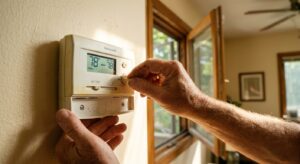
- Lower your central thermostat to 62 to 65 degrees Fahrenheit. Every degree you lower saves about 1 to 3% on your heating bill. Dropping from 70 to 62 degrees saves roughly 8 to 24% on central heating costs.
- Place the space heater in the single room where you spend the most time during the day. Keep that room’s door closed to retain the warm air and reduce the volume your heater must maintain.
- Track your next month’s utility bills and compare them to the same month last year, adjusting for any unusually cold or warm stretches. This real-world comparison is the only reliable way to confirm you are saving money.
- Install a programmable or smart thermostat if you do not already have one. Set it to drop to 62 degrees during the hours you are stationary in one room, and to recover to 68 degrees before you move around the house. This setback alone saves 10% annually according to ENERGY STAR data.
- Identify and seal the room you plan to zone heat. Use a stick of incense or a lit candle near the door frame, window edges, and baseboards to find drafts. Seal gaps with foam weatherstripping on the door and rope caulk or removable caulk strips on window frames.
- Add a door draft stopper to the bottom of the door in your target room. Gaps under interior doors can account for significant air exchange between rooms, undermining the zone heating effect.
- Choose a space heater with a built-in thermostat and timer rather than running it at full blast continuously. Set the heater’s thermostat to your comfort target (typically 68 to 70 degrees) so it cycles on and off rather than running at 1,500 watts continuously, reducing actual energy consumption by 30 to 60%.
- Close HVAC vents in the room you are zone heating if your system uses forced air. This reduces the central system’s workload for that zone, though avoid closing more than 20 to 25% of total vents in the home to prevent pressure imbalance in the ductwork.
- After two billing cycles, compare your combined electricity and gas or oil bills to the prior year for the same months. If your total energy cost is not lower, you may be heating too many rooms with the space heater or the central thermostat setback is insufficient.
- Get two to three quotes from HVAC contractors for a single-zone ductless mini-split sized for your most-used room. A 9,000 to 12,000 BTU unit covers most bedrooms or living rooms up to about 500 square feet.
- Check for federal and state incentives. The Inflation Reduction Act provides a 30% federal tax credit up to $2,000 for heat pump installations, and many utilities offer additional rebates of $200 to $800.
- Compare your current annual space heater or electric baseboard costs. A household spending $600 per year on electric resistance space heaters could drop to $150 to $200 per year with a heat pump at a COP of 3.0, saving $400 or more annually.
- Confirm your electrical panel has capacity for the mini-split circuit, typically 15 to 20 amps at 240 volts. Your HVAC contractor can advise, and an electrician can add a circuit for $150 to $400 if needed.
- After installation, use the mini-split as your primary heat source in the target zone and set the central thermostat lower for the rest of the house during hours when that room is the focus of activity.
Why It Works: The Benefits
A single occupant who lowers the central thermostat to 62 degrees and uses a space heater in one room can save $30 to $80 per month on gas heating bills in a cold climate, depending on home size and local energy rates.
Space heaters reach their target output within minutes, versus 15 to 20 minutes for a central forced-air system to distribute warmth through ductwork to distant rooms.
Rooms over garages, at the end of long duct runs, or in older additions often run 5 to 10 degrees colder than the rest of the house. A targeted space heater solves this without forcing the whole system to overheat other areas.
A quality 1,500-watt space heater costs $30 to $80 and requires no professional installation, making it one of the lowest-barrier comfort upgrades available to homeowners and renters alike.
When your furnace needs service or goes down in winter, a space heater provides immediate warmth in the most critical room without the expense of emergency HVAC service for mild cold snaps.
💰 Savings Impact by Action
Lowering your central thermostat by 7 to 10 degrees for 8 hours daily saves approximately 10% on annual heating costs according to ENERGY STAR.
Heating one room to comfort level while keeping the rest of the house at 62 degrees can reduce total heating energy use by 15 to 30% in a one or two person household.
Sealing gaps around the door and windows in a zone-heated room reduces heat loss from that room by up to 15%, letting the space heater cycle less frequently.
Replacing electric resistance space heaters with a ductless mini-split heat pump reduces electricity used for that heating zone by 50 to 75% due to the heat pump’s COP of 2.5 to 4.0.
🏠 Key Concepts Explained
The Science Behind It
Heat always flows from warmer areas to cooler ones, never the other way around. Your home is constantly losing heat through walls, windows, ceilings, and floors to the colder outdoors. The rate of that heat loss is governed by the temperature difference between inside and outside and by the thermal resistance (R-value) of your building envelope. When you heat your entire home to 70 degrees in 20-degree outdoor weather, every square foot of that envelope is working against a 50-degree temperature gradient, and your furnace must continuously replace the escaping heat.
Zone heating works by reducing the volume and surface area you are fighting to keep warm. If you lower the whole house to 62 degrees and only heat one 200-square-foot room to 70 degrees, the total heat loss from your building envelope drops because 62 degrees versus 20 degrees outside is a smaller gradient than 70 degrees versus 20 degrees. You also stop paying to heat rooms that are not being used. This is the core thermodynamic argument in favor of zone heating, and it is real, but it only holds if the central thermostat setback is large enough to offset the cost of the electric resistance heat you are adding in the one occupied room.
The fuel cost math is where many homeowners go wrong. Natural gas delivers about 100,000 BTUs per therm, and at a typical rate of $1.20 per therm, that is roughly $0.012 per 1,000 BTUs. Electricity at $0.14 per kWh delivers about 3,412 BTUs per kWh, costing about $0.041 per 1,000 BTUs. Electric resistance heating costs approximately 3.4 times more per BTU than gas heat at these national averages. A heat pump sidesteps this by moving heat rather than generating it, achieving effective efficiencies of 200 to 400%, which is why mini-splits are the long-term answer for anyone who currently relies on electric resistance heating as a primary source.
Frequently Asked Questions
▼ I’ve been running a space heater all month but my energy bill is higher, not lower. What went wrong?
The most common culprit is forgetting to lower the central thermostat. If you added a space heater without reducing your furnace’s setpoint, you simply added load on top of your existing heating cost. Lower your thermostat to 62 to 64 degrees in the areas you are not zone heating and make sure the target room’s door stays closed so the heater is not trying to warm the whole house.
▼ Does it matter whether my home is heated by gas, electric, oil, or a heat pump?
Yes, it matters enormously. Space heaters are most likely to save money in oil-heated or propane-heated homes where the central fuel cost is very high per BTU. In gas-heated homes, the savings are narrower and depend on strong thermostat setbacks. If you already have an electric heat pump as your central system, running a resistance space heater is almost certainly less efficient than your heat pump and will increase your bill.
▼ Can I run two space heaters in different rooms to save money instead of using the furnace?
Two 1,500-watt heaters running simultaneously draw 3,000 watts, costing about $0.42 per hour or over $100 per month at 8 hours per day. Unless your central heating bill for those two zones is higher than that, you will spend more with the heaters. Multiple simultaneous space heaters rarely beat a central gas furnace on cost.
▼ Is it safe to run a space heater all day while I work from home?
It is safe if you follow the manufacturer’s guidelines: keep it at least 3 feet from any flammable material, plug it directly into a wall outlet (not a power strip), and choose a model with tip-over and overheat protection. Do not leave it running in a room you are not physically present in, and never run it while you sleep in a room with the door fully closed.
▼ My bedroom is always cold compared to the rest of the house. Should I use a space heater instead of fixing the duct issue?
A space heater is a reasonable short-term fix for a chronically cold room, but it is worth diagnosing the duct issue first. Have an HVAC technician check for a closed damper, a disconnected duct run, or an undersized supply register. Fixing a disconnected duct costs $150 to $400 and solves the problem permanently without adding to your electricity bill every month.
Quick Tips
- If you heat with electricity already (baseboard heat or electric furnace), space heaters offer no efficiency advantage over your central system. The only benefit is zone control.
- Oil-heated homes pay some of the highest per-BTU costs in the country, making the switch to zone heating with a space heater more likely to produce real savings than in gas-heated homes.
- A 750-watt setting on a dual-wattage space heater costs half as much to run as the 1,500-watt setting and is often sufficient for a small, well-sealed room that has already reached target temperature.
- Pair your space heater use with a smart plug that has energy monitoring. Devices like the Kasa EP25 or Emporia Vue plug report actual watt-hours consumed so you know your real daily cost, not just the theoretical maximum.
Variations for Your Situation
- Apartment/Rental: Renters who pay their own electricity but heat with electric baseboard heat get the most value from a space heater strategy. Lower the baseboard thermostat in unused rooms to the minimum setting (around 55 degrees) and use a $40 to $60 space heater with a thermostat in the main living area. Since baseboard heat and resistance space heaters are equally efficient per BTU, the savings come purely from not heating unoccupied rooms. Look for the Lasko 754200 or similar compact 1,500-watt units with thermostat control.
- Tight Budget (under $50): Focus on the free step first: lower your central thermostat to 62 degrees while at home in one room. Then buy a budget space heater with a thermostat dial (available at Walmart or Target for $25 to $40). Use the 750-watt setting whenever the room has already warmed up. This combination costs under $40 upfront and can produce $20 to $40 in monthly savings in a gas-heated home when the setback is consistent.
- Older Home (pre-1980): Older homes typically have higher air leakage rates (10 to 20 air changes per hour versus 3 to 5 for modern construction), which makes zone heating harder because the target room loses heat faster. Before relying on a space heater in an older home, spend $20 to $30 on foam weatherstripping and door draft stoppers to seal the zone room as well as possible. Without this step, the space heater will run near continuously and your savings will be minimal. Older homes also often have knob-and-tube or aluminum wiring that should be inspected before adding high-draw appliances to any circuit.