The ’90-day filter change’ rule is printed on nearly every filter package sold in America, and millions of homeowners follow it faithfully. The problem is that rule was written for an average household that may look nothing like yours. If you have pets, live in a dusty climate, run your system year-round, or have family members with allergies or asthma, that filter is likely clogged and straining your system long before the 90-day mark.
A clogged HVAC filter does two damaging things at once: it restricts airflow so your system works harder and uses more electricity, and it stops capturing new particles so pollutants like pet dander, dust mites, mold spores, and fine particulate matter recirculate through your living space. The U.S. Department of Energy estimates that a dirty filter can increase HVAC energy consumption by 5 to 15%, and the EPA consistently ranks indoor air quality among the top five environmental health risks for Americans.
This post will show you exactly how to find the right replacement schedule for your home, which filter ratings actually matter, and how to set up a maintenance routine that protects both your family’s lungs and your monthly energy bill. Whether you want a quick fix today or a smarter long-term system, there is a practical approach here for you.
What You’ll Need
Click on an item below to shop for the recommended items for this recipe on Amazon.
As an Amazon Associate, we earn from qualifying purchases.
How to Do It
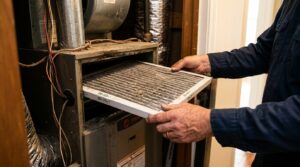
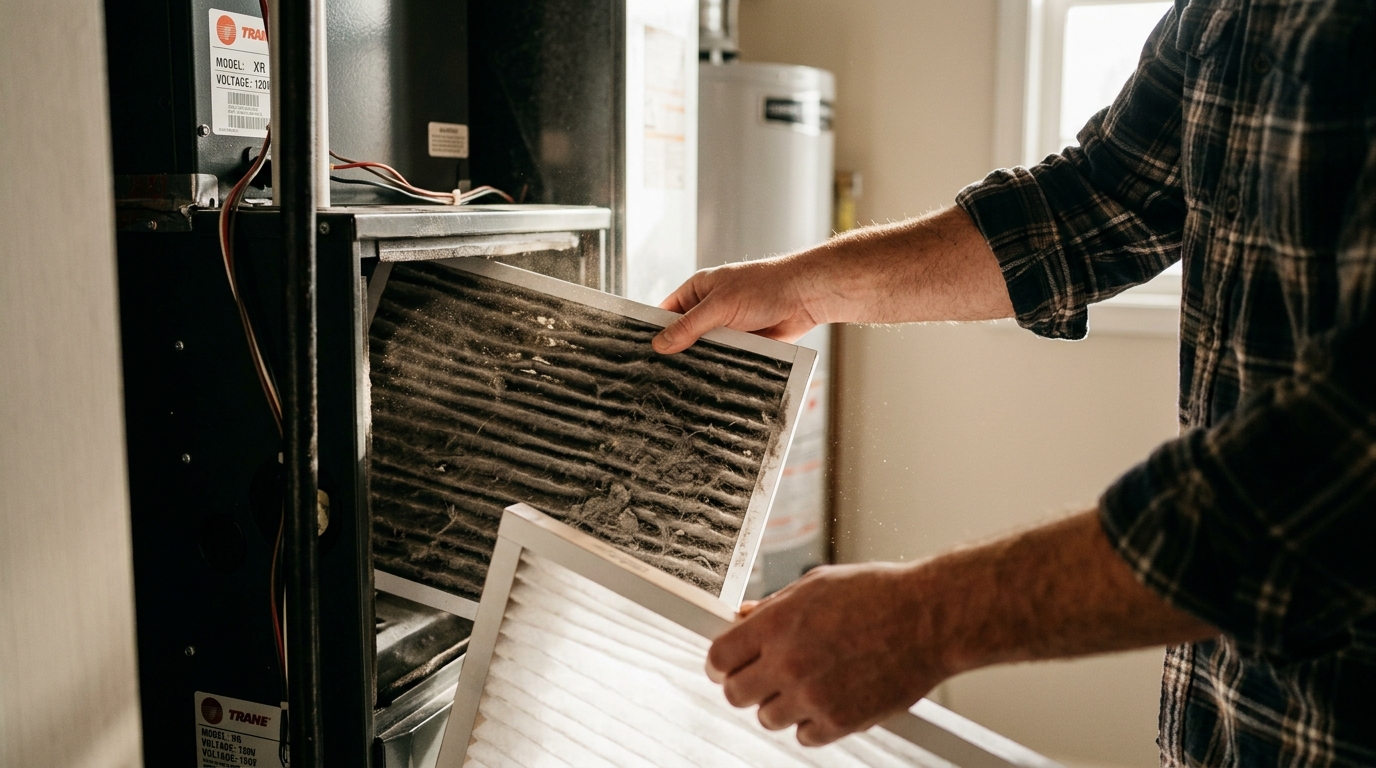
- Pull out your current filter and hold it up to a light source. If you cannot see light passing through the media, it is overdue for replacement, regardless of how long it has been installed.
- Note your household profile: add one pet, subtract 30 days from the standard interval; add two or more pets, use a 30-day maximum schedule; no pets and single occupant, 60 to 90 days is reasonable.
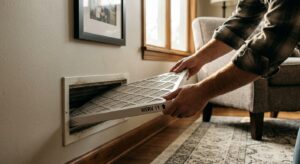
- Check the filter fit. Run your hand around the filter frame while the system is running. If you feel air flowing past the edges, the filter is the wrong size or the housing gasket needs replacing. Write the correct size on the housing with a marker.
- Set a recurring phone calendar reminder matching your new interval, not a generic quarterly reminder. Label it with the filter size and MERV rating so you can reorder quickly.
- If the current filter is dirty, replace it now with the correct size. A MERV 8 to 11 is appropriate for most residential systems. Do not exceed MERV 13 without confirming your system’s static pressure tolerance with an HVAC tech.
- Measure your filter slot precisely with a tape measure, including depth. Many systems use a 1-inch slot but some use 4 to 5-inch media filters that last 6 to 12 months. Confirm the actual slot depth before purchasing.
- If your system uses a 1-inch slot, consider upgrading the filter housing to accept a 4-inch media filter. These thicker filters have far greater surface area, load more slowly, and typically only need changing twice per year. Housings cost $30 to $80 and are a straightforward duct sheet-metal swap.
- Sign up for a filter subscription service (several major retailers offer this) at your determined replacement interval. Pre-set deliveries eliminate the ‘I forgot to buy one’ problem that leaves clogged filters in place for months.
- Install a $15 to $25 differential pressure gauge or a smart filter monitor on the filter housing. These devices measure the pressure drop across the filter and alert you when airflow restriction reaches a critical threshold, so you change based on actual loading, not the calendar.
- While the filter housing is open, shine a flashlight onto the evaporator coil fins. If you see visible dust buildup, use a coil cleaning spray to restore heat transfer efficiency. A clean coil can recover 5 to 10% of lost cooling capacity.
- Log the install date, filter brand, and MERV rating in a simple home maintenance note or app. Tracking this over 12 months reveals your home’s actual loading pattern so you can fine-tune your schedule.
- Schedule an HVAC tune-up that explicitly includes static pressure testing. A technician measures total external static pressure to determine the highest MERV rating your specific blower and duct system can support without restricting airflow.
- Request a coil cleaning as part of the service. Technicians use no-rinse foaming cleaners and compressed air to remove accumulated debris from evaporator fins, restoring rated heat-transfer capacity.
- Ask the technician to inspect all return air grilles and duct connections for bypass leakage. Unsealed connections allow unfiltered attic or wall-cavity air to enter the system, undermining even the best filter.
- Discuss adding a whole-home UV air purifier or electronic air cleaner if allergy or asthma concerns are a priority. These systems, installed at the air handler, can inactivate airborne pathogens and reduce fine particle counts beyond what media filters achieve.
Why It Works: The Benefits
Keeping a clean filter in place restores full airflow, reducing blower energy draw by 5 to 15% according to DOE estimates. On a $200 monthly cooling bill, that is $10 to $30 saved every month.
A fresh MERV 11 filter removes up to 85% of particles in the 1 to 3 micron range, including most pet dander, mold spores, and dust mite debris. Switching from a clogged MERV 8 to a fresh MERV 11 on the right schedule can dramatically reduce airborne allergen levels.
Restricted airflow causes the blower motor to overheat and the evaporator coil to ice over during cooling season. Maintaining proper airflow with regular filter changes can add years to a system that costs $5,000 to $12,000 to replace.
A dirty coil or overworked blower motor is one of the most common causes of mid-season HVAC breakdowns. HVAC technicians report that a significant percentage of no-cooling service calls trace directly back to a clogged filter, at $150 to $400 per visit.
The EPA links poor indoor air quality to increased asthma attacks, allergic rhinitis, and respiratory irritation. Households that switched to a correct filter schedule report fewer symptom flare-ups, particularly during high-pollen seasons.
💰 Savings Impact by Action
Replacing a clogged filter restores full airflow and reduces blower energy draw by up to 15% according to DOE estimates.
Cleaning an evaporator coil fouled by filter bypass can recover 5 to 10% of lost cooling and heating capacity.
A fresh MERV 11 filter captures up to 85% of particles in the 1 to 3 micron range including pet dander and mold spores.
Sealing return duct leaks reduces unfiltered particle entry and can cut overall HVAC energy loss by up to 20% in older homes.
🏠 Key Concepts Explained
The Science Behind It
Air filters work through two main mechanisms: mechanical interception and diffusion. Larger particles (above 1 micron) are captured when they physically contact filter fibers and stick due to static charge and Van der Waals forces. Smaller ultrafine particles actually move erratically due to Brownian motion and end up contacting fibers more often than their size would suggest, which is why a good MERV 11 to 13 filter can capture particles smaller than its pore size.
As the filter loads with debris, the layer of captured particles itself becomes an increasingly effective filter, but at the cost of airflow restriction. This is measured as static pressure (in inches of water column). Most residential air handlers are designed to operate at 0.1 to 0.5 inches w.c. of external static pressure. A heavily clogged filter can push that reading well above the design limit, forcing the blower motor into a steeper part of its performance curve where it draws significantly more power for less airflow output.
Reduced airflow has a thermodynamic cascade effect on the entire system. With less air moving across the evaporator coil, the refrigerant absorbs heat more slowly, coil surface temperature drops, and moisture begins to freeze onto the fins rather than draining away. An iced coil blocks airflow further, creating a feedback loop that can result in a complete system lockout. On the heating side, reduced airflow causes the heat exchanger to overheat, triggering the high-limit switch and producing short-cycling that accelerates wear. Maintaining a clean filter is genuinely the single most impactful thing a homeowner can do for system longevity.
Frequently Asked Questions
▼ I just changed my filter and my house still feels stuffy. What is wrong?
A fresh filter improves airflow, but stuffiness after a filter change usually points to one of three other issues: supply vents that are closed or blocked by furniture, an evaporator coil that is already fouled from months of running a clogged filter, or duct leakage losing conditioned air into unconditioned spaces. Check that all supply registers are open, then shine a flashlight on the coil through the filter slot. If the fins look gray or matted, schedule a professional coil cleaning.
▼ Can a filter that is too restrictive actually damage my HVAC system?
Yes, this is a real and common problem. Installing a MERV 14 or higher filter in a system designed for MERV 8 to 11 can reduce airflow enough to freeze the evaporator coil in cooling mode or overheat the heat exchanger in heating mode. If you want better filtration than a standard MERV 11, the safest upgrade is switching to a thick 4-inch or 5-inch media filter in the same MERV range: the larger surface area provides better particle capture without the pressure penalty.
▼ My filter looks dirty after just two to three weeks. Is something wrong with my system?
Probably not, but it means your home has a high particle load: multiple pets, recent renovation dust, high outdoor particulate (near roads or in dry climates), or a poorly sealed return duct pulling air from a dusty attic or crawlspace. Check all return duct connections for gaps and tape or mastic-seal any you find. In the meantime, a 4-inch media filter will handle the same particle load for much longer than a 1-inch filter due to its greater surface area.
▼ How long before I notice savings on my energy bill after switching to a correct filter schedule?
If your previous filter was severely restricted, you may notice lower runtime within days as the system reaches setpoint faster. On your monthly bill, expect a measurable difference within one full billing cycle. Homes in hot or cold climates where the system runs nearly continuously tend to see the most immediate savings, sometimes 10 to 15% in the first month after restoring proper airflow.
▼ I rent my apartment. Can I still improve my HVAC filter situation?
Renters can almost always change their own air filter without landlord permission since it is considered routine maintenance. Buy the correct size in MERV 8 to 11 and change it on your determined schedule. Document the old filter condition with a photo before discarding it. If the filter slot is inaccessible or you cannot determine the correct size, submit a written maintenance request to your landlord and keep a copy, as filter neglect is generally considered a landlord responsibility in most states.
Quick Tips
- Buy filters in multipacks and store them near the air handler so replacement takes under five minutes with no special trip to the store.
- In two-story homes, the return air is often on the first floor. If allergy symptoms are worse upstairs, check that all bedroom supply vents are open and unobstructed to maintain proper air circulation.
- During wildfire season or high outdoor pollen days, run your system in fan-only mode for 20 to 30 minutes with the filter in place to clean indoor air without running the compressor.
- Fiberglass 1-inch filters (the blue spun-glass type) have a MERV rating of 1 to 4 and capture almost no particles smaller than 10 microns. Replacing them with a pleated MERV 8 to 11 of the same size costs about $2 more and delivers a dramatic air quality improvement with minimal added restriction.
Variations for Your Situation
- Apartment/Rental: Renters can independently purchase and install the correct filter size at a MERV 8 to 11 rating without any landlord approval. A 6-pack of quality pleated filters from a hardware store runs $25 to $40 and covers a full year for most apartments. Set a 60-day reminder if you have no pets, or 30 days if you have one cat or dog. If the filter housing is locked or inaccessible, document the issue in writing to your landlord, as neglected filters can constitute a habitability concern.
- Tight Budget (under $50): Skip subscriptions and smart monitors. Instead, buy a 4-pack of MERV 8 pleated filters ($15 to $20), stack them near the air handler, and set a phone reminder for every 45 days. Even a basic MERV 8 changed regularly outperforms an expensive MERV 13 left in place too long. The zero-cost step of checking the filter visually every month costs nothing and immediately tells you if you need to change it ahead of schedule.
- Older Home (pre-1980): Homes built before modern duct sealing standards typically have significant return duct leakage, meaning your filter may be pulling in attic or crawlspace air loaded with insulation fibers, rodent dander, and construction debris. Check the filter after just two weeks to establish your actual loading rate. Prioritize sealing return duct connections with mastic or metal-backed tape before upgrading to a higher MERV filter, as better duct sealing reduces the particle load entering the system in the first place and may let you extend your filter interval considerably.