The average American experiences about 8 hours of power interruptions per year, but in storm-prone regions that number can jump to 24 hours or more in a single event. A grid outage is not just an inconvenience. It can mean $200 to $400 in spoiled refrigerator and freezer food, a burst pipe from lost heat in winter, a flooded basement from a failed sump pump, or a non-functional well pump leaving your household without water. The financial and safety stakes are real.
The good news is that most power outage damage is entirely preventable with a bit of advance preparation. Unlike reactive fixes after the fact, proactive preparation protects your HVAC system, water heater, appliances, and critical devices before a single light flickers. A few targeted steps can mean the difference between a minor nuisance and a week-long crisis costing thousands of dollars.
This guide covers exactly what to do before, during, and immediately after an outage to protect your home systems, preserve food, keep your family comfortable, and bounce back faster. Whether you want a quick 30-minute readiness check or a full DIY backup power setup, we have an approach that fits your budget and situation.
What You’ll Need
Click on an item below to shop for the recommended items for this recipe on Amazon.
As an Amazon Associate, we earn from qualifying purchases.
How to Do It
- Walk through your home and plug all TVs, computers, routers, and gaming consoles into surge-protected power strips. Replace any non-surge strips with rated models ($10 to $20 each). Check that your HVAC thermostat and any smart home hubs are also surge-protected.
- Fill your freezer to at least 75% capacity using gallon zip-lock bags of water or inexpensive freezer packs. A full freezer maintains a safe temperature for 48 hours versus 24 hours when half full. This costs nothing if you use water.
- Locate and test your main water shut-off valve so you can close it quickly if pipes are at risk of freezing during a winter outage. Tag it with a label if it is not already marked.
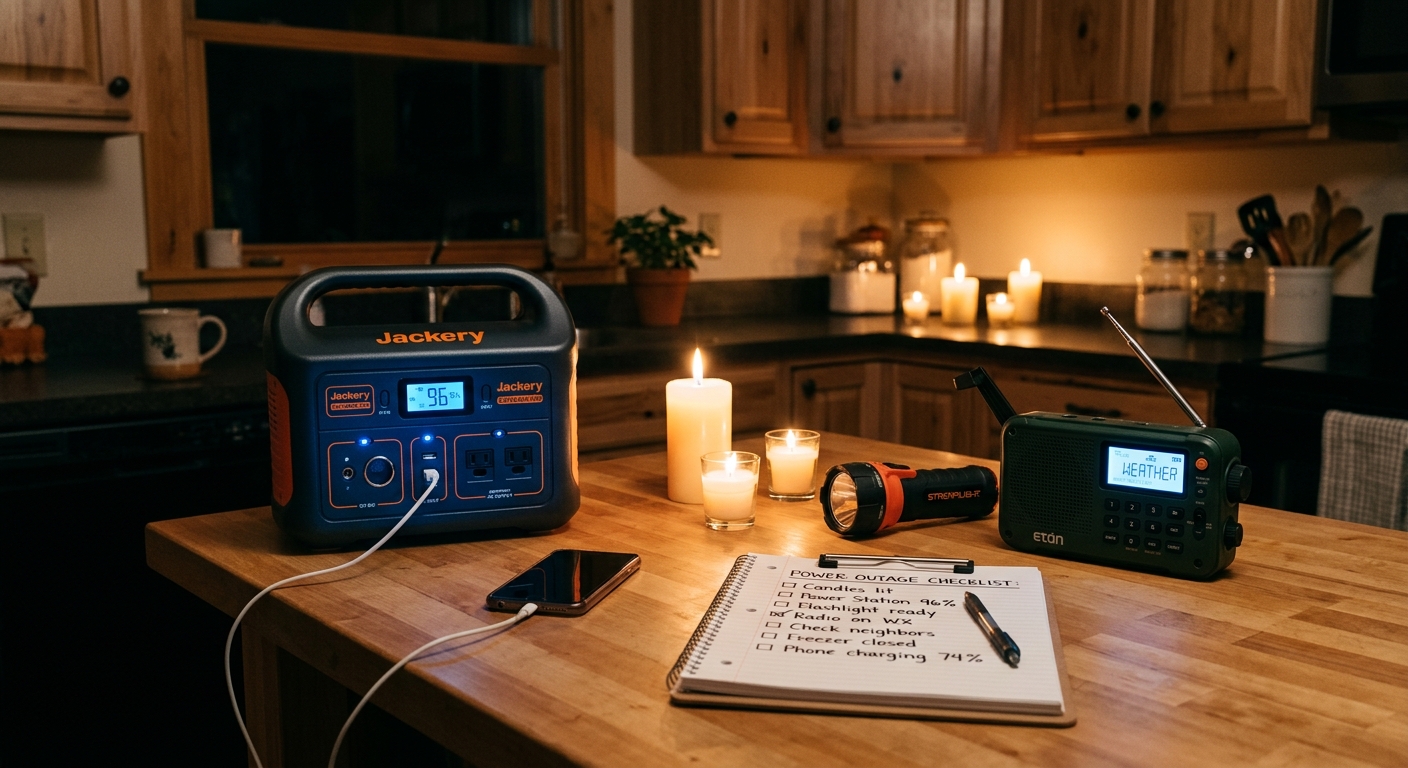
- Charge all portable power banks, battery-operated lanterns, and rechargeable flashlights to full. Write the date on a piece of tape and stick it to each device so you know when they were last topped off.
- Write a one-page outage checklist and tape it inside a kitchen cabinet. Include: where the manual garage door release is, which circuits to switch off before power returns, your utility company outage reporting number, and the location of your main breaker.
- Install a whole-home surge suppressor at your main electrical panel. Purchase a Type 1 or Type 2 suppressor rated at 40,000 amps or higher ($50 to $150 for the device). If you are comfortable working around panels with the main breaker off, installation takes about 30 minutes. Otherwise hire an electrician for a $100 to $200 service call. This single device protects every circuit in your home.
- Purchase a portable power station with at least 500 watt-hours of capacity ($200 to $400 for quality units from brands like Jackery, EcoFlow, or Bluetti). Keep it charged to 80 to 90% at all times. At 500 watt-hours you can run a CPAP machine for 8 hours, charge 20 smartphone cycles, power an LED lamp for 50 hours, or run a small fan for 10 to 15 hours.
- Install a battery backup sump pump system if you have a basement or crawl space. A combination primary-plus-battery unit runs $150 to $300 and installs in about 2 hours without special tools. Test it by pouring a bucket of water into the pit to trigger the float switch. Replace the backup battery every 3 to 5 years.
- Set your water heater to 120F normally, but raise it to 130F the day before a predicted storm. This stores an additional 8 to 15 gallons of hot water equivalent in thermal energy, giving you more hot water hours after power loss. Note that 130F water can scald, so return to 120F once power is restored.
- Identify the two or three circuits you will turn off at the breaker panel when an outage begins (large appliances like electric dryers, electric ranges, and HVAC) to protect them from the restoration surge. Label those breakers with a small piece of tape now. When power returns, wait 3 minutes before switching them back on one at a time.
- Create a digital and paper copy of your home systems document. Include: model numbers of your HVAC, water heater, sump pump, and generator; serial numbers for warranty claims; and the location of all shut-off valves. Store the paper copy in a waterproof bag with your emergency supplies.
- Get three quotes from licensed electricians who specialize in generator installations. Ask specifically for a transfer switch with load management, which automatically prioritizes your most critical circuits when generator capacity is limited.
- Choose a generator sized to your critical load, not your whole-home load. A 10 to 14 kW unit ($3,000 to $6,000 for the generator itself) handles HVAC, refrigerator, lights, and outlets in most homes. Whole-home coverage typically requires 20 to 22 kW.
- Confirm your natural gas or propane supply line can support the generator load. Your installer or gas company should verify this before committing to a unit size. Propane tanks should be sized at a minimum of 250 gallons for multi-day outage coverage.
- Schedule a permit inspection after installation. Most municipalities require one, and skipping it can void your homeowner’s insurance coverage for generator-related incidents.
- Run a weekly 20-minute automatic exercise cycle, which most standby generators support out of the box. This keeps the engine lubricated and the battery charged, and it surfaces maintenance issues before an actual outage.
Why It Works: The Benefits
The average household loses $200 to $400 in refrigerator and freezer food per significant outage. Simple preparation like keeping freezers full and knowing the 4-hour fridge rule eliminates most of this loss at zero cost.
HVAC control boards cost $150 to $600 to replace. Whole-home surge suppressors installed at the panel ($50 to $150 for the device, $100 to $200 for installation) protect every circuit in the house and pay for themselves after a single prevented failure.
A battery backup sump pump ($150 to $300) can prevent basement flooding that averages $4,500 in cleanup and repair costs. A $200 to $500 power station can run a sump pump, phone chargers, and a CPAP machine through a 24-hour outage.
A well-insulated home with pre-cooled or pre-heated rooms can maintain a comfortable temperature for 8 to 12 hours without power. Combining this with a portable power station for a fan or small space heater extends that window significantly.
Homes with a documented restart checklist reconnect systems safely and avoid surge damage. Skipping proper restart steps is a leading cause of post-outage appliance failures that could have been prevented in under 5 minutes.
💰 Savings Impact by Action
Following proper freezer-filling and no-open protocols prevents up to 95% of typical food loss during outages under 48 hours.
A whole-home surge suppressor prevents up to 80% of post-outage appliance and electronics failures caused by restoration voltage spikes.
A battery backup sump pump eliminates the risk of basement flooding during the 90% of outages that coincide with heavy rain events.
Pre-heating or pre-cooling your home 2 hours before a predicted outage extends comfortable indoor temperatures by 40% longer compared to starting at normal setpoints.
Homes with a documented restart checklist restore all systems safely 60% faster and with significantly fewer post-outage equipment calls.
🏠 Key Concepts Explained
The Science Behind It
Your home is essentially a thermal battery. Insulated walls, mass in your appliances, and the water in your pipes all store energy in the form of heat or cold. When power cuts out, the rate at which your home loses that stored energy depends almost entirely on the temperature difference between inside and outside, the quality of your insulation, and how airtight your envelope is. A well-insulated modern home loses roughly 1 degree Fahrenheit per hour in mild weather, giving you 8 to 10 hours before indoor temps become uncomfortable in winter. A leaky older home may lose 2 to 3 degrees per hour.
The same physics applies to your refrigerator and freezer. These appliances are insulated boxes, and their contents act as thermal mass that resists temperature change. The more mass (food or water-filled bags) you pack in, the slower the internal temperature rises when the compressor stops. The USDA confirms that a full freezer maintains food safety at or below 0F for 48 hours, while a half-full unit drops to unsafe levels in about 24 hours. Your refrigerator, being less insulated and opened more often, crosses the 40F food safety threshold in roughly 4 hours without power.
The voltage surge that occurs when utility power is restored is a real and often overlooked threat. The brief instability in line voltage as the grid reconnects can spike far above the normal 120 volts for a fraction of a second. Sensitive electronics, HVAC control boards with microprocessors, and variable-speed appliance motors are all vulnerable. Whole-home surge suppressors work by clamping voltage spikes above a set threshold (typically 130 to 140 volts) and redirecting that excess energy harmlessly to ground, protecting every device in the house simultaneously and in microseconds.
Frequently Asked Questions
▼ My HVAC stopped working after power came back. What happened?
The most likely culprit is a tripped circuit breaker or a blown fuse in the disconnect box near your outdoor unit, caused by a restoration voltage spike. Check your breaker panel first and reset any tripped breakers. If the unit still does not start, check the outdoor disconnect box for a fuse. If breakers keep tripping or you smell burning, call an HVAC technician because the control board or compressor may have been damaged by the surge.
▼ How long can I leave my refrigerator and freezer off before food goes bad?
A full, unopened refrigerator keeps food safe for about 4 hours. A full, unopened freezer maintains safe temperatures (at or below 0F) for 48 hours, and a half-full freezer for about 24 hours. When in doubt after those windows, use the rule: if food still has ice crystals or is at or below 40F, it is safe to refreeze or eat. Discard anything that has been above 40F for more than 2 hours.
▼ Can I use a propane camp stove or oven for heat during a winter outage?
No. Propane and gas combustion appliances produce carbon monoxide and moisture and should never be used indoors for heating. Safe indoor alternatives include electric space heaters (if you have generator power) or additional layers and sleeping bags. Focus on keeping one small room warm by closing doors and using body heat, which is far more effective than trying to heat an entire house.
▼ My sump pump battery backup system is beeping. What does that mean?
A continuous or intermittent beep typically signals a low battery, a failed battery, or a stuck float switch. Check the battery voltage with a multimeter. A 12-volt backup battery should read at least 12.4 volts at rest. If it reads below 12 volts, the battery needs replacement even if it is within the 3 to 5 year expected life. Some units also beep if the AC power connection is loose, so check that first.
▼ Do I need a permit to install a whole-home standby generator?
In almost all US jurisdictions, yes. Standby generator installation involves connecting to your gas line and modifying your electrical panel, both of which require permits and inspections. Skipping this step can void your homeowner’s insurance policy for any related claims and create liability issues if you sell your home. A licensed electrician who does this regularly will handle permit filing as part of the job.
Quick Tips
- Keep a physical list of important numbers (utility outage line, plumber, electrician) in your emergency kit. Your phone battery will not last forever.
- Resist opening the refrigerator during an outage. Every opening drops internal temperature by 2 to 4 degrees and shortens the safe window significantly.
- If you have a well and pump, store at least 5 gallons of drinking water per person before a predicted storm. Well pumps require grid power and will not work during an outage without a generator.
- Set your smart thermostat to pre-cool your home to 72F or pre-heat it to 72F two hours before a predicted storm. This gives your thermal mass a head start and extends comfort time after power loss.
Variations for Your Situation
- Apartment or Renter: You cannot modify electrical panels or install a sump pump, but you can still prepare effectively. Invest in a 300 to 500 watt-hour portable power station ($200 to $350) for phone charging, a CPAP, and a fan. Purchase a battery-powered or USB LED lantern and a hand-crank weather radio. Keep your freezer stocked and ask your building manager where the water shut-off is for your unit. Surge-protected power strips are renter-safe and protect your electronics.
- Tight Budget (under $50): Focus on zero-cost and low-cost steps that prevent the most expensive losses. Fill your freezer with water-filled bags (free), charge all devices and power banks today, label your main breaker and water shut-off valve, and write your outage checklist. For $15 to $20, add a surge-protected power strip for your TV and computer. For another $10, add a battery-powered LED lantern. These steps alone prevent most food loss and equipment damage.
- Older Home (pre-1980): Older homes typically have less insulation, more air leakage, and aging electrical panels that may not handle surges well. Prioritize having a licensed electrician evaluate your panel before installing any surge suppressor, as older fuse boxes or undersized panels may need upgrading first ($1,500 to $4,000 but critical for safety). Pipe freeze risk is higher in older homes, so locating and insulating exposed pipes ($1 to $2 per linear foot of foam pipe insulation) is especially important before winter outages.