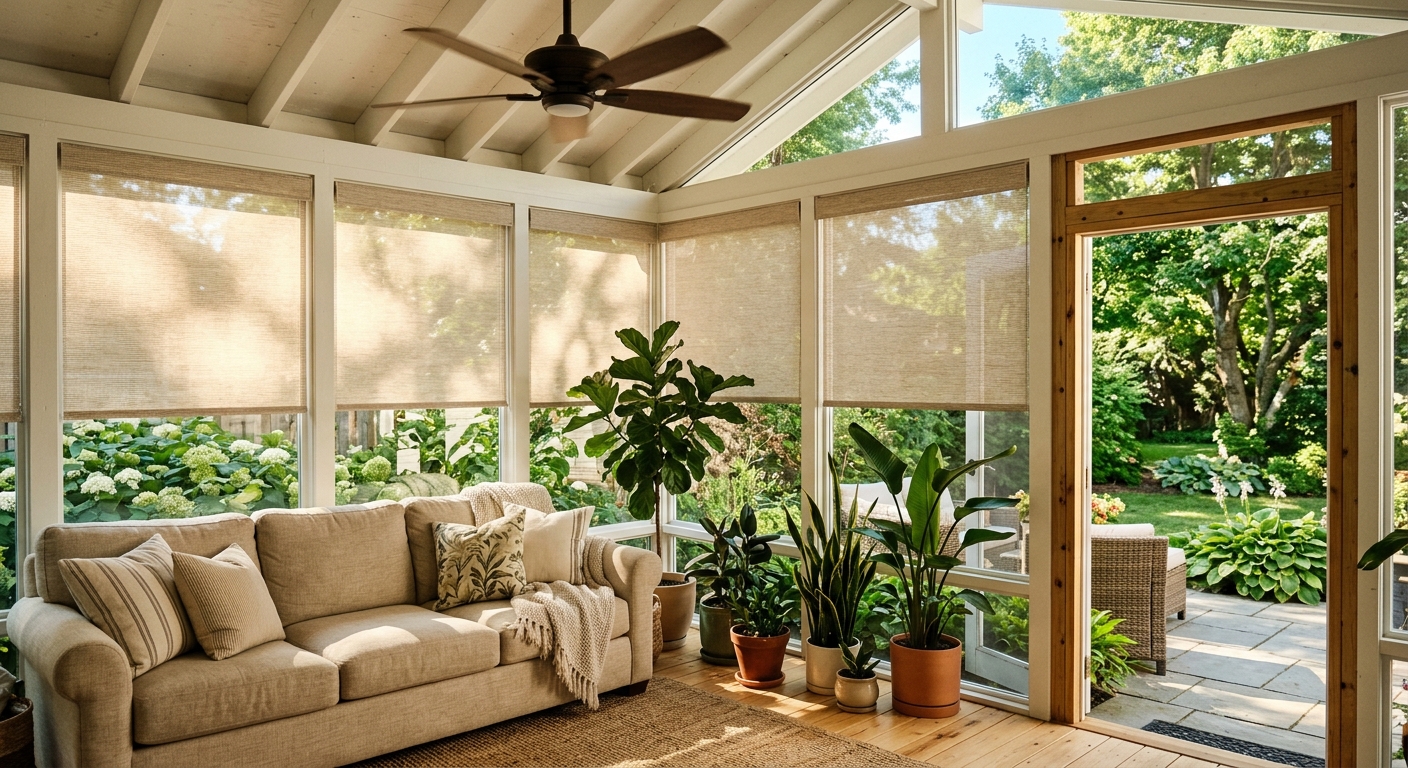
You added a sunroom to gain living space, but instead you got a room that sits empty from June through August and again from November through February. On a hot summer afternoon, the temperature inside can hit 95°F even when your main house is a comfortable 72°F. In January, it feels like stepping into a garage. This is not a design flaw you simply have to live with. It is a solvable building science problem.
The core issue is that most sunrooms are essentially glorified glass boxes. Glass has a very low R-value (typically R-1 to R-2 per pane), transmits solar radiation directly into the space, and loses heat rapidly at night. Without the right combination of shading, insulation, air sealing, and climate control, the room swings between extremes. Your main HVAC system almost certainly does not serve the sunroom adequately, which makes the problem worse.
This post walks you through the exact reasons your sunroom fails, starting with the most impactful and cost-effective fixes and working up to structural upgrades. Whether you have $0 or $5,000 to spend, there is a meaningful improvement you can make today. Real payback periods and energy numbers are included so you can decide what is worth it for your situation.
What You’ll Need
Click on an item below to shop for the recommended items for this recipe on Amazon.
As an Amazon Associate, we earn from qualifying purchases.
How to Do It
- Measure all sunroom glass surfaces and purchase solar-control window film with a Solar Heat Gain Coefficient (SHGC) of 0.25 to 0.40. Brands like Gila and 3M offer residential rolls for $30 to $80 per 36-inch by 15-foot roll.
- Clean all glass surfaces with soapy water and apply the film according to package directions. Work on a cloudy day or in the morning to avoid bubbling. Start with the roof panels or skylights first since they receive the most direct radiation.
- Inspect the door and window frames where the sunroom connects to the main house. Press a piece of tissue near the edges when the AC is running. If it moves, you have leakage. Apply self-adhesive foam weather stripping to door frames and V-seal strip to window sashes.
- Caulk any visible gaps at the baseboard, ceiling trim, or threshold where the sunroom meets the main house. Use a paintable latex caulk for indoor seams and silicone caulk for areas exposed to moisture or temperature extremes.
- Check that any door between the sunroom and main living area has a proper door sweep at the bottom. A $10 to $20 adhesive door sweep stops conditioned air from escaping under the door gap.
- Measure each glass panel, window, and roof section for double-cell cellular shades (also called honeycomb blinds). Order shades rated with a Center of Glass R-value of at least R-3. Budget $30 to $80 per shade panel from suppliers like Blinds.com or The Home Depot.
- Install inside-mount brackets at the top of each window frame using a drill and the provided hardware. For roof or skylight panels, use cordless top-down bottom-up shades so you can control how much sky is exposed at any time of day.
- Add a portable or window-mount air conditioner rated for at least 1.5 times the room’s square footage in BTUs if your main HVAC does not serve the sunroom. A 14,000 BTU portable unit handles up to 500 square feet and costs $350 to $550. Run it only when the room is occupied to avoid overcooling.
- Alternatively, consult a licensed HVAC technician about a ductless mini-split system as a dedicated solution. A single-zone 9,000 BTU mini-split costs $700 to $1,500 for equipment and $500 to $1,500 for installation, with payback in 3 to 5 years compared to running a portable unit daily.
- Install a simple remote temperature sensor or smart plug timer on any portable unit so it pre-cools the sunroom 30 minutes before you use it rather than running all day.
- Apply exterior solar shades (shade screens rated 90% openness factor) to the outside of south- and west-facing glass if the structure allows it. Exterior shading blocks heat before it enters the glass, which is 30 to 40% more effective than interior shading alone.
- Hire a sunroom contractor or window specialist to assess your existing glazing. Request a quote for replacing single-pane glass with low-E double-pane glass rated SHGC 0.25 or lower with a U-factor of 0.30 or lower. This alone can reduce heat gain by 50 to 70% compared to standard glass.
- Ask the contractor about replacing aluminum framing with thermally broken aluminum or vinyl-clad framing. Thermally broken frames insert a plastic isolator between the inner and outer aluminum, reducing conductive heat transfer through the frame by up to 60%.
- Have a licensed HVAC contractor install a dedicated ductless mini-split sized properly for the room. A Manual J load calculation specific to the sunroom is essential since standard rules of thumb underperform in high-glass spaces. Expect 18,000 to 24,000 BTU capacity for a typical 250 to 400 square foot sunroom with significant glass.
- Request that the contractor air-seal and insulate the knee walls and any solid wall sections of the sunroom to at least R-13 with batt insulation or R-15 with spray foam. This prevents the floor-level cold drafts common in sunrooms built on cantilevered decks or uninsulated slabs.
- Once the project is complete, apply for any applicable utility rebates. ENERGY STAR-rated windows and qualified mini-split systems qualify for federal tax credits of up to 30% of equipment cost under the Inflation Reduction Act (Section 25C), with a $600 cap for windows and $2,000 for heat pumps as of 2024.
Why It Works: The Benefits
Addressing solar gain and insulation can bring peak summer temperatures down from 95°F to a manageable 76 to 78°F, making the room comfortable without aggressive air conditioning.
Sealing the transition between your sunroom and main house and adding window film or cellular shades can reduce cooling load on your central HVAC by 10 to 15%, since unconditioned sunroom heat no longer bleeds into living areas.
Solar-control window film with a low SHGC (0.25 to 0.40) can block 40 to 70% of incoming solar heat, meaning your air conditioner cycles less frequently during peak afternoon hours.
Adding cellular shades rated at R-3 to R-5 and air sealing around doors and trim can raise the effective temperature of the sunroom on a cold day by 10 to 15°F without any additional heating equipment.
A sunroom that functions as a true four-season space adds more appraised living area than one classified as a seasonal enclosure, with finished four-season rooms returning 50 to 80% of renovation cost at resale according to Remodeling Magazine cost vs. value data.
💰 Savings Impact by Action
Solar-control window film with SHGC 0.30 blocks 40 to 70% of solar heat gain, reducing peak sunroom cooling load by up to 35%.
Sealing the transition between the sunroom and main house reduces whole-home air leakage by 15 to 25%, directly cutting HVAC runtime and energy cost.
Double-cell cellular shades rated R-3 to R-5 reduce heat loss through glass by 15 to 40% in winter compared to uncovered single-pane glazing.
Replacing single-pane glass with low-E double-pane (U-factor 0.28) cuts conductive heat loss through the glazing by up to 65% year-round.
A dedicated mini-split with SEER 18 to 22 uses 30 to 40% less electricity than a portable unit to condition the same space, with precise occupancy-based control.
🏠 Key Concepts Explained
The Science Behind It
The reason a sunroom overheats so dramatically comes down to one physical principle: glass is nearly transparent to shortwave solar radiation but nearly opaque to the longwave infrared radiation that objects emit after absorbing sunlight. Sunlight passes straight through the glass and heats up floors, furniture, and walls. Those surfaces then radiate heat back as infrared, but the glass traps it inside. This is the greenhouse effect operating at room scale, and it works whether you want it to or not.
The second mechanism is radiant asymmetry. Even if you manage to cool the air in the sunroom to a comfortable temperature, the glass surfaces themselves can reach 120 to 140°F on a summer afternoon. Your skin receives radiant heat from those surfaces regardless of air temperature, making you feel hot even in 72°F air. This is why standard air conditioning often fails to make a sunroom feel comfortable. You need to address the radiant source, not just the air temperature. Low-E glass coatings and solar-control films work by reflecting longwave infrared back outward before it can heat interior surfaces in the first place.
In winter, the same physics works against you in reverse. Glass with a U-factor of 1.0 (common in older single-pane sunrooms) loses heat 5 to 10 times faster per square foot than a standard insulated wall. A 300 square foot sunroom with 200 square feet of single-pane glass loses roughly 3,000 to 4,000 BTUs per hour on a 30°F night. That is the equivalent of leaving a large window wide open. Replacing with low-E double-pane glass (U-factor 0.25 to 0.30) cuts that loss by 65 to 75%, which is why glass replacement, while expensive upfront, often shows the strongest long-term payback of any sunroom upgrade.
Frequently Asked Questions
▼ I put a portable AC in my sunroom but it barely makes a dent. What am I doing wrong?
Two likely problems: the unit is undersized for the solar load, or the exhaust hose is not properly sealed. In a sunroom, you typically need 1.5 to 2 times the BTU capacity recommended for a standard room of the same square footage because of the glass heat gain. Make sure the window exhaust kit is fully sealed with no gaps, as every unsealed inch pulls hot outdoor air back in and can reduce efficiency by 20 to 30%. If the unit is correctly sealed and still underperforms, adding solar film to the roof glass first is your most effective next step.
▼ My sunroom is freezing in winter even with the portable heater running constantly. How do I fix this?
The heater is fighting massive heat loss through the glass and any air gaps at the floor and ceiling trim. Start by air sealing every visible gap where the sunroom meets the main house, paying attention to the threshold, crown molding, and baseboard transitions. Add double-cell cellular shades rated R-3 or higher and close them after sunset every evening. If the room still cannot hold heat, the only lasting fix is upgrading to double-pane low-E glass, which can cut heat loss through the glazing by up to 75%.
▼ Will window film make my sunroom dark and depressing?
Modern solar-control films are designed to reject heat while maintaining visible light transmission of 40 to 70%, which is only slightly darker than unfilmed glass. Neutral gray or bronze tint films are far less noticeable than older mirror-style films. For roof panels specifically, a slightly darker film is acceptable since overhead glass admits more light than wall glass anyway. Visit a local window film supplier and request sample swatches to hold against your glass before committing to a full roll.
▼ Can my existing HVAC system just extend a duct into the sunroom?
It can be done, but it usually performs poorly. Your existing system was sized for the original house, and adding a high-load space like a sunroom typically exceeds what the remaining capacity can handle, especially on peak summer days. A licensed HVAC technician can run a Manual J calculation to check remaining capacity, but in most cases a dedicated mini-split is the more effective and efficient solution. Mini-splits also allow you to condition the sunroom only when it is in use, rather than paying to heat or cool it 24 hours a day.
▼ I rent my home. Can I make the sunroom more comfortable without making permanent changes?
Yes, and there are several renter-safe options. Solar-control window film is removable and leaves no residue if taken down carefully. Freestanding cellular shade panels or tension-rod shade systems require no drilling. A portable air conditioner vented through a window kit is completely removable. These three steps together can drop peak summer temperature by 12 to 18°F with zero permanent modifications, and you take everything with you when you leave.
Quick Tips
- Use a simple infrared thermometer (under $20) to measure glass surface temperatures in your sunroom on a sunny afternoon. If the ceiling glass reads above 110°F, film or replacement glass will give you the biggest improvement.
- Set a portable fan to blow air out of the sunroom and into the main house in winter on sunny days. This free passive solar strategy can offset 5 to 10% of your home heating bill if your sunroom is south-facing.
- Open sunroom windows and doors in the early morning before 8 AM during summer to flush out accumulated heat from the previous day before the sun heats the glass again.
- Place light-colored or white area rugs on dark tile or stone floors in the sunroom. Dark floors absorb solar radiation and re-radiate it as heat, raising room temperature. Light surfaces reflect it back toward the glass where it can partially escape.
Variations for Your Situation
- Apartment or Rental Sunroom: Since you cannot modify the glazing or HVAC, focus on removable solutions. Apply 3M Prestige Series or Gila Heat Control window film (fully removable with a heat gun and adhesive remover) to all glass surfaces. Use tension-rod cellular shade panels on windows and a freestanding room divider with reflective backing to block direct radiation. A portable 12,000 to 14,000 BTU air conditioner with a window kit costs $350 to $500 and requires no permanent installation. Together these steps can reduce peak temperature by 15 to 20°F at a total cost under $600.
- Tight Budget Under $100: Start with the two highest-impact free steps: close the sunroom door during peak heat hours (noon to 4 PM) to prevent heat from bleeding into the main house, and open windows early morning to flush heat. Then spend $30 to $40 on a single roll of solar-control window film and prioritize the roof or skylight panels first since they have the highest heat gain per square foot. Add $10 to $15 in foam weather stripping to the door connecting the sunroom to the main house. These three steps cost under $60 and deliver 60 to 70% of the comfort benefit of a full upgrade.
- Older Sunroom Pre-1990: Older sunrooms were often built with aluminum frames and single-pane glass, making them among the least thermally efficient additions possible. Before investing in film or shades, have a contractor assess whether the frame seals are still intact, as aged aluminum frames often develop cracks and separated glazing tape that allow significant air infiltration. If the frame seals are compromised, film alone will have limited effect. Prioritize caulking all exterior frame-to-wall joints with silicone caulk rated for temperature extremes, then add film and shades. Budget $150 to $300 for caulking and sealing an older sunroom perimeter before moving to window treatments.