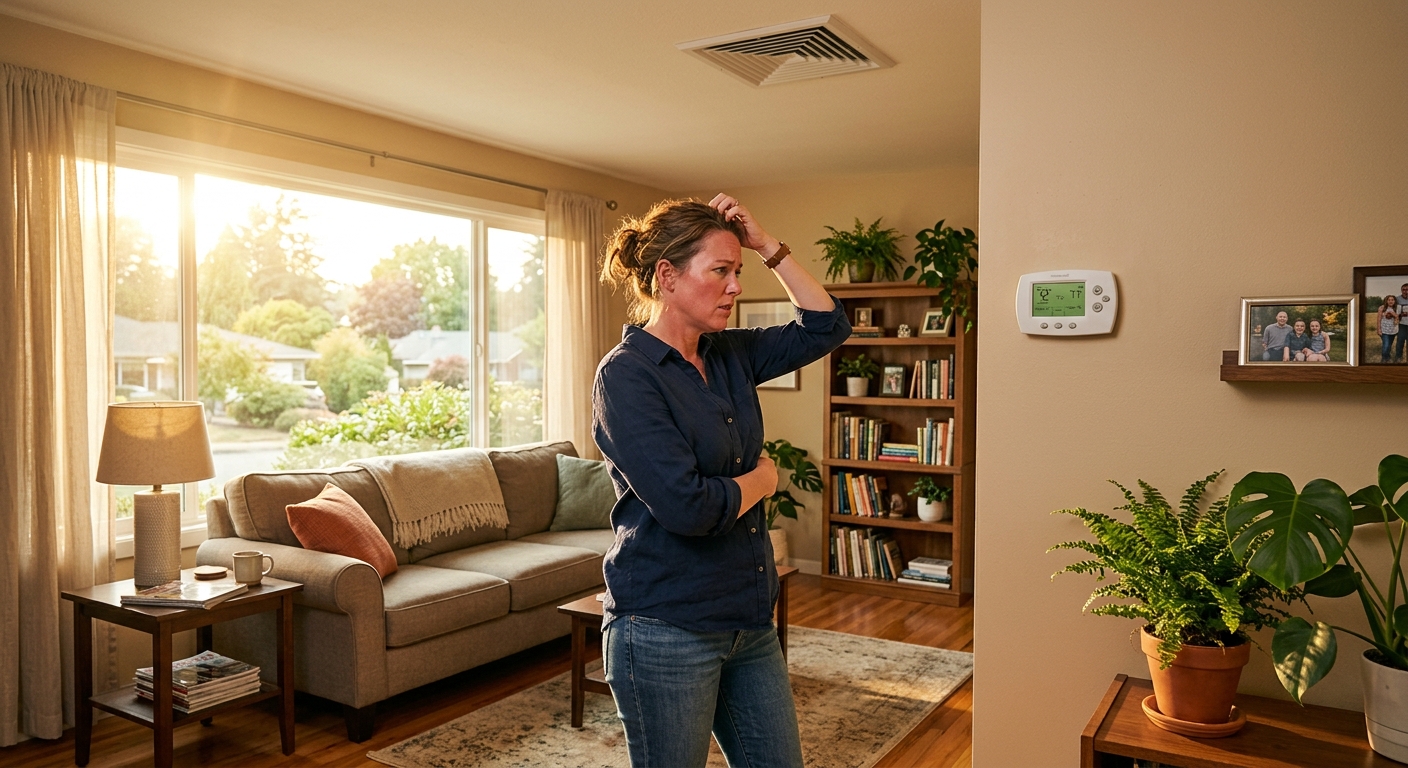
Few things are more frustrating than an air conditioner that hums along all afternoon while your house stays stuffy and warm. You set the thermostat to 72°F, the system never shuts off, and your electricity bill climbs toward record highs. Before you assume the unit is dying or the summer is just unusually brutal, know this: in most cases, a continuously running AC is a symptom of a fixable problem, not a broken compressor.
The causes range from the trivially simple, like a clogged air filter that costs $10 to fix in ten minutes, to more involved issues like duct leaks that are quietly dumping 20 to 30% of your cooled air into the attic. Understanding what is actually happening inside your home’s envelope and HVAC system lets you target the right fix rather than throwing money at a contractor for a system replacement you may not need.
This post walks you through the most common reasons an AC runs all day without cooling, how to diagnose each one yourself, and concrete steps, from free quick fixes to professional solutions, that will get your system back to cycling off the way it should. Real numbers are included throughout so you know exactly what kind of savings and payback period to expect.
What You’ll Need
Click on an item below to shop for the recommended items for this recipe on Amazon.
As an Amazon Associate, we earn from qualifying purchases.
How to Do It
- Check and replace the air filter: Hold it up to a light source. If you cannot see light through it, replace it immediately. A standard 1-inch filter should be swapped every 30 to 90 days. Use a filter rated MERV 8 to 11 for the best balance of airflow and filtration.
- Inspect all supply and return vents: Walk every room and confirm vents are fully open and unblocked by furniture, rugs, or curtains. A single blocked return vent can drop system airflow by 15% and cause the evaporator coil to freeze.
- Check the thermostat setting and location: Confirm it is set to COOL and not FAN only. Also check whether it sits in direct sunlight or near a lamp, which causes it to read a falsely high temperature and never signal the system to shut off.
- Inspect the outdoor condenser unit: Clear any grass, shrubs, or debris within 2 feet of the unit. A condenser surrounded by vegetation can overheat and lose 10 to 15% of its cooling capacity. Use a garden hose to gently rinse the fins from the inside out if they look dirty.
- Look for the evaporator coil ice: Remove the access panel on your indoor air handler and look for ice on the coil or refrigerant lines. If ice is present, turn the system to FAN ONLY for 2 to 3 hours to thaw it, then replace the filter and restart. If it refreezes, call a technician because low refrigerant is likely.
- Audit your home for air leaks: On a hot sunny day, hold a lit incense stick near window frames, door frames, electrical outlets on exterior walls, recessed lights, and attic hatches. Smoke that wavers indicates a draft. Mark each location with painter’s tape.
- Seal gaps with the right material: Use caulk for stationary cracks around window frames and trim. Use foam backer rod plus caulk for gaps wider than 0.5 inches. Use weatherstripping for moving parts like door bottoms and frames. Use fire-rated intumescent caulk around any penetrations through the ceiling into the attic.
- Insulate and seal the attic hatch: An uninsulated attic hatch is like leaving a window open to a 140°F oven in summer. Glue 2-inch rigid foam board to the attic side and add a weatherstripping gasket around the frame. This one step can reduce attic heat transfer by 50% at that location.
- Seal accessible duct connections: In your attic, basement, or crawlspace, look for duct joints that have separated or never had a proper seal. Apply UL 181-rated foil tape or mastic sealant to every seam. Do not use standard gray cloth duct tape as it fails within a few years. Sealing accessible ducts typically reduces duct leakage by 15 to 25%.
- Add window film or cellular shades to west and south-facing windows: Solar heat gain through unshaded windows can add 1,000 BTUs per hour per window to your cooling load. Reflective window film costs $1 to $3 per square foot and can block 50 to 70% of solar heat gain with no impact on your view.
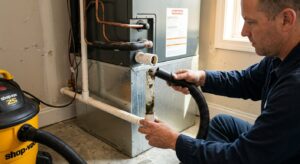
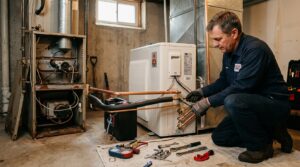
- Schedule a professional HVAC tune-up: A certified technician will measure refrigerant charge, check capacitors and contactors, measure airflow across the coil in CFM, and inspect the condensate drain. A low refrigerant charge is the single most common reason a properly maintained system stops keeping up, and it legally requires a licensed technician to correct.
- Request a duct leakage test (duct blaster): This pressurization test measures exactly how much conditioned air your duct system loses before it reaches living spaces. Industry average is 20 to 30% leakage. If your home tests above 15%, professional duct sealing with Aeroseal or mastic spray is cost-effective with a payback of 2 to 4 years.
- Ask about a Manual J load calculation: If a technician suggests replacing your system, insist on a Manual J calculation first. This ACCA-standard calculation determines the correct system size for your specific home. Oversized and undersized systems are both common and both cause the all-day-running problem. A properly sized system costs the same but performs dramatically better.
- Consider a whole-home energy audit with a blower door test: For older homes or those with persistent comfort problems, a certified energy auditor can identify the top 5 sources of air infiltration using a blower door, thermal camera, and combustion safety test. Audit costs range from $150 to $400 but typically identify improvements with $300 to $800 per year in savings.
Why It Works: The Benefits
Addressing the most common causes, dirty filters, duct leaks, and air infiltration, can reduce cooling energy use by 20 to 40%, which translates to $50 to $150 per month for a typical 2,000 sq ft home in a hot climate.
A compressor that runs 18 hours a day ages far faster than one cycling normally at 8 to 10 hours. Reducing runtime by even 30% can add years to compressor life and delay a $3,000 to $6,000 system replacement.
Duct leaks and poor airflow create hot and cold spots. Fixing distribution issues ensures conditioned air actually reaches every room, eliminating the bedroom that is always 5°F warmer than the rest of the house.
An AC that cycles properly removes more moisture per hour of runtime than one that runs continuously at reduced capacity. Proper dehumidification keeps indoor relative humidity in the comfortable 40 to 50% range rather than the clammy 60%+ that a struggling system produces.
A filter change or a cleared condensate drain can restore normal operation within 30 minutes at zero or near-zero cost. You may notice the system finally cycling off that same afternoon.
💰 Savings Impact by Action
Replacing a severely clogged filter restores full airflow and can recover up to 10% of lost cooling capacity immediately.
Sealing envelope gaps and cracks reduces hot air infiltration and cooling load by up to 20% per EPA estimates.
Sealing leaky ducts with mastic or foil tape can recover 20 to 30% of conditioned air that is currently lost to unconditioned spaces.
Adding exterior shades or interior cellular blinds to south and west windows reduces solar heat gain by 45 to 77%, cutting cooling load by 10 to 15%.
Raising the setpoint by 4°F when away or using a programmable schedule saves approximately 12% on cooling costs with no comfort loss.
🏠 Key Concepts Explained
The Science Behind It
Your air conditioner does not create cold air. It moves heat from inside your home to outside using a refrigerant cycle. The indoor evaporator coil absorbs heat from the air blown across it, and the outdoor condenser coil dumps that heat outside. For this to work efficiently, the system needs adequate airflow across both coils, a correctly charged refrigerant circuit, and a home envelope that is not constantly importing more heat than the system can remove.
The core problem when an AC runs all day is a mismatch between cooling capacity and cooling load. Capacity is fixed by the equipment. Load is determined by outdoor temperature, solar gain through windows, the thermal resistance of your insulation, and most importantly, the air leakage rate of your envelope. A home with significant duct leakage effectively increases the load because cooled air is lost before it does any work. A study by Lawrence Berkeley National Laboratory found that duct leakage in a typical US home wastes 20 to 30% of the energy used for heating and cooling.
Refrigerant behavior also matters enormously. When a system is low on refrigerant, the evaporator coil runs too cold and the pressure differential across the compressor drops. The coil may ice over, blocking airflow entirely and sending the system into a cycle of icing and thawing that provides almost no net cooling while the compressor runs continuously. This is why a frozen coil is almost never fixed by just letting it thaw: the underlying charge or airflow issue must be corrected or the ice returns within hours.
Frequently Asked Questions
▼ Why is my AC still running all day even after I changed the filter and cleared the vents?
If the basics are covered, the next most likely causes are duct leakage, a low refrigerant charge, or a home envelope that is simply gaining heat faster than your system can remove it. Start by checking the supply-to-return temperature split with an infrared thermometer. A split under 14°F points to a refrigerant or coil issue requiring a technician. A normal split but poor cooling performance usually points to duct leakage or a significantly undersized system.
▼ Can renters do anything about an AC that runs all day without getting landlord permission?
Yes, several steps require no modification to the property. Replace the air filter if accessible (many landlords appreciate this), use cellular shades or window film on west and south windows, keep blinds closed during peak sun hours, and run ceiling fans to raise the effective comfort temperature. If the unit is genuinely undersized or has a refrigerant leak, document it in writing and request repair from your landlord, as habitability standards in most states require functioning cooling in extreme heat.
▼ How long before I actually notice savings on my bill after fixing these issues?
Filter changes and vent corrections show up on your very next billing cycle, sometimes within days on a smart meter. Air sealing improvements are visible in one to two billing cycles. Duct sealing savings are most apparent when compared to the same month the prior year, accounting for weather differences. A 20% improvement on a $200 summer bill means $40 per month or roughly $120 to $160 over a full cooling season.
▼ What if my home is older than 30 years?
Homes built before the mid-1990s typically have significantly higher air leakage rates, thinner insulation, single-pane windows, and ductwork that was never properly sealed. These homes benefit most from professional air sealing and duct testing because the leakage rates are often two to three times higher than newer construction. Consider requesting a utility-sponsored home energy audit, many utilities offer them free or at low cost, before spending money on equipment upgrades.
▼ My AC is only 3 years old. Why is it already struggling to keep up?
A newer system that underperforms is almost always either improperly sized for the home (an unfortunately common outcome when contractors skip a Manual J calculation) or has developed a refrigerant leak. Have a technician verify the refrigerant charge and measure actual airflow in CFM against the rated capacity. If the system was oversized, it will short-cycle in mild weather and underperform on extreme heat days, both signs of the same sizing error.
Quick Tips
- Set your thermostat no lower than 78°F when home and 85°F when away for 4 or more hours. Each degree below 78°F increases cooling energy use by roughly 3%.
- Run ceiling fans counterclockwise (forward) in summer. The wind chill effect allows you to raise the thermostat 4°F with no reduction in comfort, saving about 12% on cooling costs.
- Close blinds and curtains on south and west-facing windows between 10am and 4pm. Interior shading reduces solar heat gain by 45%, though exterior shading like awnings reduces it by up to 77%.
- Check that your condensate drain line is clear every spring. A clogged drain causes the drain pan to overflow, can trigger a float switch that shuts the system off, and allows mold to grow in the air handler, all of which degrade performance and air quality.
Variations for Your Situation
- Apartment/Rental: Renters cannot modify ductwork or the central HVAC system, but can still achieve meaningful results. Focus on window treatments first: cellular honeycomb shades ($30 to $80 per window) block up to 60% of solar heat gain and are removable. Add draft snakes or door sweeps at the front door ($10 to $25). Replace the filter if the unit is a window or PTAC unit you control. For central HVAC, document any performance issues in writing and request service from the landlord under local habitability codes.
- Tight Budget (under $50): Prioritize in this order: replace the air filter ($8 to $15), clear all vents and the area around the outdoor condenser (free), close blinds on sun-facing windows from 10am to 4pm (free), seal the two or three worst door and window gaps with a single tube of caulk ($5), and add a door sweep to the front door ($12 to $20). These steps alone can reduce cooling load by 10 to 15% at a total cost under $40.
- Older Home (pre-1980): These homes typically leak 2 to 3 times more air than modern construction, with attic bypasses around chimneys, open top plates, and deteriorated duct tape throughout the duct system. Standard DIY sealing helps but will not solve the problem alone. Budget $300 to $600 for a professional energy audit with a blower door test to identify your top five infiltration points. Prioritize attic air sealing and duct mastic over window upgrades, as the energy-to-cost return is far higher. Many states offer rebates of $200 to $500 for professionally verified air sealing work.