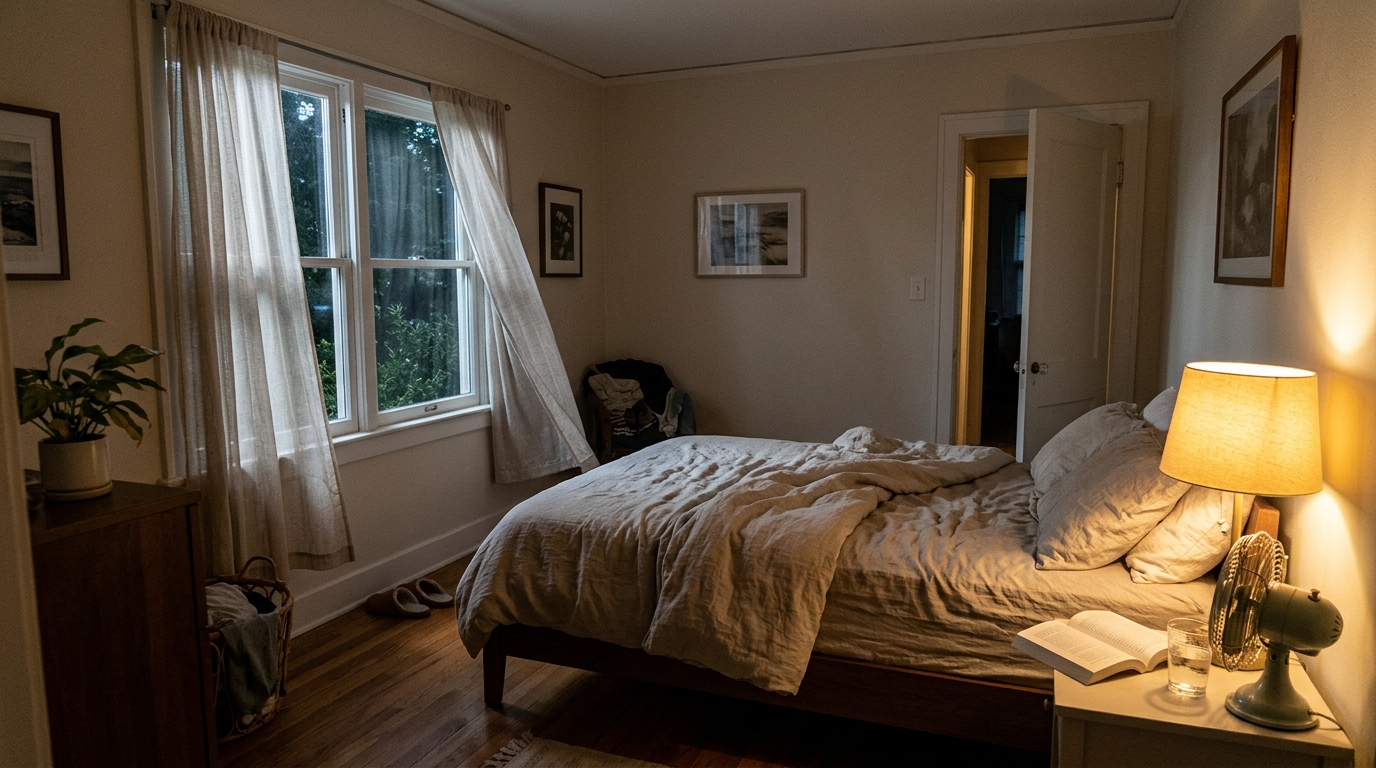
If you have ever woken up at 3 a.m. feeling too warm on one side of the bed and chilly on the other, your bedroom layout may be the culprit. Most homeowners place the bed where it looks best, not where air actually moves. A headboard pressed against a supply vent, a dresser sitting in front of a return, or a heavy curtain draped over a baseboard register can all choke the airflow your system is working hard to deliver.
The problem gets worse at night because bedrooms are usually closed up tight. With the door shut, supply air has nowhere to go, pressure builds, and the room can end up 3 to 5 degrees warmer or cooler than the rest of the house. Your HVAC system then runs longer to compensate, which means higher bills and less restful sleep.
This post walks through the simple layout changes that let air circulate freely around you while you sleep. You will learn a no-cost quick fix you can do tonight, a more thorough DIY upgrade that solves closed-door pressure problems, and how to tell when a professional should step in.
What You’ll Need
Click on an item below to shop for the recommended items for this recipe on Amazon.
As an Amazon Associate, we earn from qualifying purchases.
How to Do It
- Locate every supply register and return grille in the bedroom, then check that nothing blocks them. Pull furniture at least 12 inches away from supply vents and 18 to 24 inches away from returns.
- Move the bed so the headboard is not directly against a supply vent or return. Pointing a vent straight at your body overnight causes drafts and uneven temperatures, so aim for air that flows across the room rather than onto the bed.
- Pull curtains and long drapes back from baseboard registers, or shorten them so they hang above the floor and vent.
- Keep tall dressers and bookcases off interior walls where they would block air from circulating, or leave a 2 to 3 inch gap behind them so air can move.
- Crack the bedroom door open about 1 inch, or set a door wedge, for the first night. If the room feels more even by morning, you have confirmed a pressure problem worth solving permanently.
- Decide which method fits your home: an undercut door (trim 3/4 to 1 inch off the bottom), a transfer grille (a vented plate installed in the wall above the door), or a jumper duct that connects the room to a central return.
- For the simplest option, measure your door and trim the bottom with a circular saw or hire a handyman. Aim for roughly 1 square inch of free area per cubic foot per minute (CFM) of supply air, so a typical bedroom with a 100 CFM vent needs about 100 square inches of opening.
- If you prefer a transfer grille, cut a rectangular opening in the wall above the door frame, install a vented grille on both sides, and line the cavity with a short section of duct board to reduce sound transfer.
- Reposition the bed and furniture using the quick fix rules so the new airflow path is not blocked by a dresser or headboard.
- Test overnight with a simple thermometer on each side of the room. A well-balanced room should stay within 2 degrees from bed to opposite wall.
- Hire an HVAC contractor or energy auditor to measure airflow at each register using a flow hood and compare it to the design CFM for the room.
- Ask them to adjust dampers, resize or add return pathways, and check for crushed or disconnected ducts that starve the bedroom of air.
- If the room is on a long duct run with undersized supply, request a quote for upgrading to a larger duct section or adding a second supply register.
Why It Works: The Benefits
Clearing vents and balancing airflow can shrink the temperature swing between the bed and the far wall from 4 to 6 degrees down to 1 to 2 degrees.
When air moves freely, your system reaches the setpoint faster and cycles off sooner, which can trim run time for that zone by 5 to 15%.
Sleep research generally points to a bedroom temperature of roughly 60 to 67 degrees F as ideal, and even airflow makes that range much easier to hold all night.
Good circulation reduces the buildup of CO2 and humidity that happens in a closed bedroom, which can lower that heavy, groggy morning feeling.
Fixing pressure imbalances means the blower works against less resistance, which can modestly extend equipment life and reduce duct leakage losses.
💰 Savings Impact by Action
Removing furniture and drapes from supply registers can restore up to 10% of lost airflow and reduce HVAC run time.
Adding a door undercut or transfer grille equalizes pressure and can cut room-specific energy waste by 8 to 15%.
Moving the bed off exterior walls and away from direct vent blast reduces temperature swings and thermostat adjustments by about 5%.
Sealing leaky ducts serving the bedroom can recover up to 20% of conditioned air that would otherwise be lost.
🏠 Key Concepts Explained
The Science Behind It
Air in your home moves from high pressure to low pressure, and it follows the path of least resistance. When your HVAC system pushes conditioned air into a bedroom and the door is closed, the air has no easy way to return to the system. Pressure builds in the room, and that pressure forces air out through every small gap in the walls, ceiling, and window frames, which pulls unconditioned air in from elsewhere to replace it. This is why a closed bedroom often feels either stuffy or oddly drafty.
Airflow also depends on temperature. Warm air is less dense and rises, while cool air sinks, which creates natural convection loops inside a room. When furniture sits tight against walls or blocks a vent, it interrupts those loops and creates dead zones where air barely moves. People sleeping in a dead zone feel warmer because their own body heat has nowhere to dissipate.
Thermal comfort is also affected by radiant exchange with cold or hot surfaces. A bed near an exterior wall or window loses body heat to that surface in winter and gains heat from it in summer, even when the air temperature reads the same. Moving the bed just 18 to 24 inches off an exterior wall can noticeably reduce that effect while also opening up room for air to flow around the furniture.
Frequently Asked Questions
▼ Why is my bedroom still too hot or cold at night even after moving furniture?
The most likely cause is a closed door creating a pressure imbalance. Try leaving the door cracked 1 inch overnight, and if that helps, install a transfer grille or undercut the door. If the room is still off by more than 3 degrees, have an HVAC pro check the duct size and airflow to that room.
▼ Can renters do this without landlord permission?
Yes, the quick fix is entirely renter safe since it only involves moving furniture and clearing vents. Door wedges, vent deflectors, and a portable fan are also fine. Skip cutting doors or walls without written permission, but you can ask your landlord about a simple door undercut, which is a low-cost fix.
▼ How long before I actually notice a difference?
You should feel the improvement the first night after clearing vents and balancing airflow. Savings on your energy bill will show up over a billing cycle or two, typically as a 5 to 10% drop in run time for that zone, though results depend on how bad the original airflow problem was.
▼ What if my home is older than 30 years?
Older homes often have leaky ducts, undersized returns, or no return in the bedroom at all. Start with the quick fix, then consider a duct leakage test, since leaky ducts in an attic or crawl space can waste 20 to 30% of your conditioned air. Sealing ducts with mastic often pays back in 1 to 3 years.
▼ Is it okay to sleep with the bedroom door open for better airflow?
It is fine and often helps, but it can let in light and noise and reduce privacy. If that bothers you, a transfer grille or undercut door gives you the same pressure relief while keeping the door closed.
Quick Tips
- Test with a strip of tissue paper held near each vent to see the direction and strength of airflow before and after you rearrange.
- Place the bed so air can flow across the room, not directly onto you, ideally with the headboard on an interior wall away from vents.
- Run a ceiling fan on low in summer (counterclockwise) to help mix air, and clockwise on low in winter to gently push warm air down.
- Vacuum supply and return grilles every few months, since dust buildup can reduce airflow by 10 to 15%.
Variations for Your Situation
- Apartment/Rental: Focus on moving the bed and furniture off vents, using a $15 to $30 door wedge or draft-free door vent, and adding a small $25 to $40 quiet fan to circulate air. Avoid any cutting or drilling, and ask your landlord about an undercut door if the problem persists.
- Tight Budget (under $50): Clear all vents, pull furniture 12 inches off walls where possible, crack the door overnight, and use a $20 box fan on low pointed at the ceiling to mix air. These steps cost almost nothing and often solve most of the problem.
- Older Home (pre-1980): Expect leaky ducts, small returns, and sometimes no return at all in bedrooms. Prioritize a transfer grille or door undercut, consider duct sealing with mastic, and have an energy auditor check for hidden airflow restrictions in the attic or crawl space.