If your utility charges time-of-use (TOU) rates, you are already paying two different prices for the same electron. Overnight, power might cost 12 to 20 cents per kilowatt-hour. Between 4 and 9 PM, that same kilowatt-hour can cost 35 to 60 cents in places like California, Arizona, and parts of the Northeast. A home battery lets you buy at the low price and use it at the high price. That price gap is called arbitrage, and it is the engine behind a battery that earns its keep.
Here is why it matters. A typical home battery of 10 to 13.5 kWh can shift about 9 to 12 usable kilowatt-hours per day. If your rate spread is 25 cents per kWh, that is roughly $2.25 to $3.00 per day, or $800 to $1,100 per year, before counting any blackout protection value. Pair it with rooftop solar and the savings stack even higher.
This post walks through how night arbitrage works, how to tell whether your rate plan makes it worthwhile, and two ways to get started: a no-hardware quick fix to test your own load shifting, and a full installed battery system. You will also see the real math, the common mistakes, and what to do if your utility does not offer a strong rate spread.
What You’ll Need
Click on an item below to shop for the recommended items for this recipe on Amazon.
As an Amazon Associate, we earn from qualifying purchases.
How to Do It
- Log into your utility account and confirm you are on a time-of-use plan. Write down the off-peak, mid-peak, and peak prices and the exact hours for each.
- Subtract your off-peak rate from your peak rate to get your spread. A spread of 20 cents or more is a strong sign a battery could pay off.
- Download 30 days of hourly usage data from your utility portal, often labeled Green Button data. Add up how many kWh you use during the peak window on a typical day.
- Shift what you can by hand for two weeks: run the dishwasher and laundry after 9 PM, pre-cool your home before 4 PM, and charge any EV overnight.
- Compare your new bill to the old one. Whatever you save by hand is the floor of what a battery could save, since a battery shifts load you cannot easily move yourself.
- Get 3 quotes from licensed installers and ask each for projected annual savings based on your actual rate plan and your 30-day usage data.
- Size the battery to your evening peak load. For most homes, 10 to 13.5 kWh covers the 4 to 9 PM window, and a second unit adds backup depth if needed.
- Confirm incentives before signing: the 30 percent federal credit, any state or utility rebates, and whether your utility runs a battery dispatch program that pays extra.
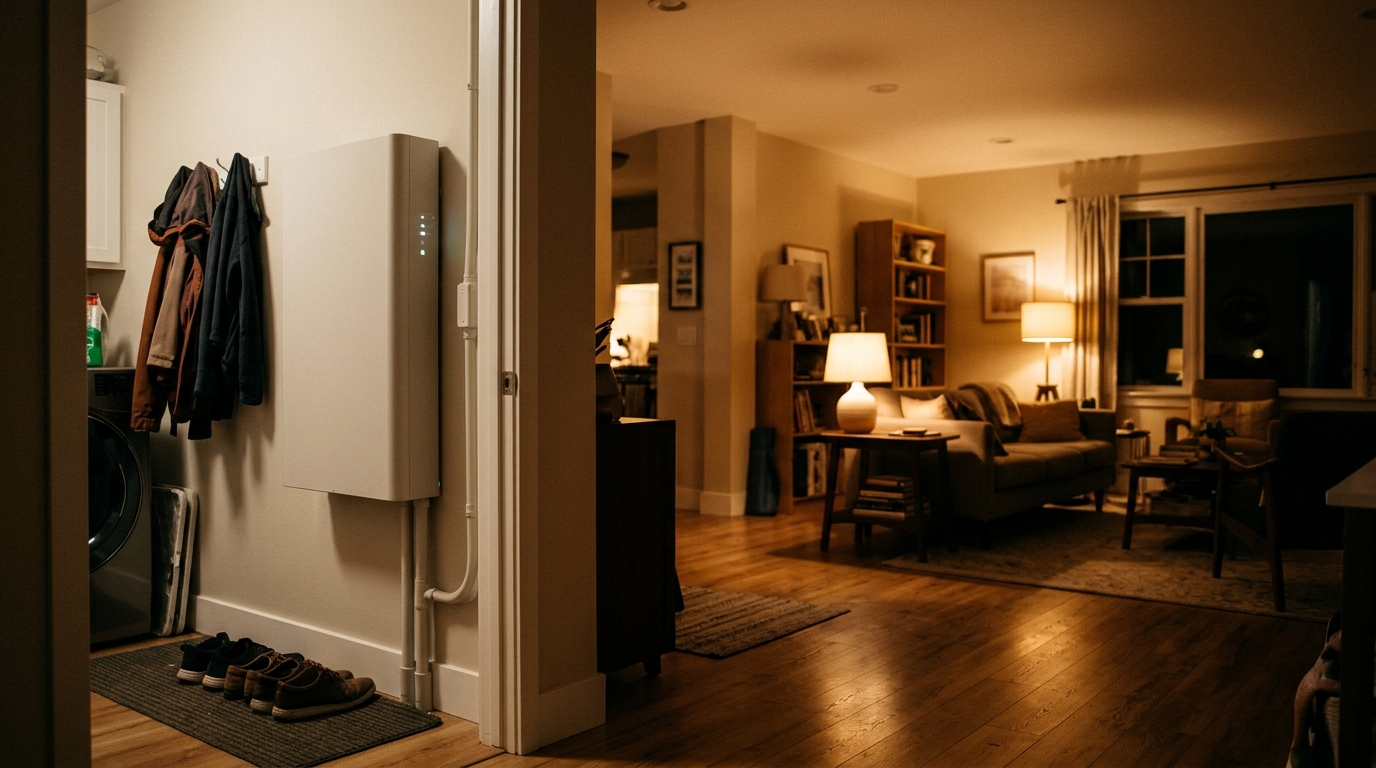
- Let the installer handle permitting and the interconnection application, then schedule the install. Expect the battery to be mounted in a garage or exterior wall with a backup gateway at your main panel.
- Set the charging schedule to charge during your cheapest rate window and discharge during the peak window. Most systems use an app with a time-based control or a self-optimizing mode.
- Review the first full month of bills and the app’s energy report, then adjust the discharge window or reserve level to fit your real usage.
Why It Works: The Benefits
Shifting 9 to 12 kWh from peak to off-peak at a 25 cent spread saves about $2.25 to $3.00 per day, or $800 to $1,100 per year.
The same battery that earns money daily can run your refrigerator, lights, internet, and a few outlets for 12 to 24 hours during an outage.
If your utility pays low rates for exported solar, storing midday production for evening use can raise the value of each solar kWh from about 5 to 8 cents to 30 cents or more.
Drawing less during the 4 to 9 PM peak helps your utility avoid running its most expensive and highest-emission generators.
Homes with solar and storage often attract buyers who value lower operating costs and backup power, particularly in outage-prone regions.
💰 Savings Impact by Action
Moving 9 to 12 kWh from peak to off-peak can cut the evening portion of your bill by roughly 60 percent on a strong TOU plan.
For a typical home spending $2,400 per year on electricity, a well-sized battery on a TOU plan can reduce the total annual bill by about 20 to 30 percent.
Storing exported solar for evening use raises the value of each kWh by up to 40 percent or more compared to selling it back at low rates.
The residential clean energy credit offsets 30 percent of installed cost for qualifying battery storage.
Expect to lose about 5 to 10 percent of stored energy as heat, which is why a spread of at least 20 cents per kWh is recommended.
🏠 Key Concepts Explained
The Science Behind It
Night arbitrage works because electricity prices follow demand, and demand follows the sun and the clock. In the evening, solar output collapses just as people return home, cook, run air conditioning, and turn on lights. Utilities must fire up their costliest peaker plants to cover that surge, and time-of-use rates pass that cost to customers as a higher price per kilowatt-hour. Overnight, demand drops and cheap baseload power is abundant, so prices fall.
A lithium iron phosphate battery stores electrical energy as chemical potential in its cells. Charging pushes lithium ions into the anode and discharging releases them, and each cycle loses a small amount as heat, which is why round-trip efficiency lands around 90 to 95 percent. That loss is the cost of doing business: if you buy 10 kWh at 15 cents and only recover 9.3 kWh, your effective stored price is about 16 cents per usable kWh, still far below a 45 cent peak rate.
The economics improve when paired with solar. Midday solar often exports to the grid at low net-metering or avoided-cost rates. Storing that energy and using it at 6 PM turns a low-value kilowatt-hour into a high-value one. The battery effectively moves energy across time, selling your home’s flexibility in the same way a utility sells capacity.
Frequently Asked Questions
▼ Why is my battery not saving as much as the installer promised?
Check that the charge and discharge schedule matches your actual TOU windows, since a mismatch of even an hour can cut savings significantly. Also confirm your reserve setting is not locking up too much capacity for backup. Review your app’s energy report for the first full month and ask your installer to adjust the schedule if needed.
▼ Can renters or apartment dwellers use night arbitrage?
Whole-home batteries require owning the property, but renters can capture a small version with a portable power station of 1 to 2 kWh charged overnight and used to run a laptop, router, and lights in the evening. Savings are modest, around $20 to $60 per year, so treat it as a backup tool with a side benefit rather than a money maker.
▼ How long before I see savings on my bill?
You will see the effect in your very first full billing cycle, since arbitrage savings occur every day. Compare your peak-period kWh before and after installation. The payback on the upfront cost, however, takes years, typically 7 to 12 without solar or incentives.
▼ What if my utility has no time-of-use rate?
Without a rate spread, arbitrage savings are close to zero and a battery is only worth it for backup power or solar self-consumption. Ask your utility whether a TOU or EV rate is available and whether you can switch, since even an optional plan can change the math. If none exist, consider waiting or focusing on a solar-plus-storage system instead.
▼ What if my home is older or has an outdated electrical panel?
Older homes with 100-amp panels or aging wiring may need a panel upgrade costing $1,500 to $4,000 before a battery can be installed. Have your installer inspect the panel early so the cost does not surprise you. Many installers can use a smaller backup gateway or a load-managed design to avoid a full upgrade.
Quick Tips
- Check your rate plan annually, since utilities regularly revise TOU windows and prices, and a newer plan can improve your spread.
- Size the battery to your evening usage rather than buying the largest unit, because unused capacity does not earn extra money.
- Pair the battery with an EV or heat pump water heater scheduled to charge off-peak for additional load-shifting savings.
- Set a backup reserve of 20 to 30 percent if outages are a concern, but know that every kWh held in reserve is a kWh not used for arbitrage.
- Get your installer’s savings estimate in writing based on your own usage data, not a generic average.
Variations for Your Situation
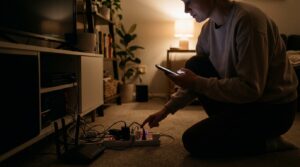
- Apartment/Rental: Whole-home batteries are not an option, so use a portable power station of 1 to 2 kWh ($700 to $1,500) charged overnight to run a router, laptop, and lamps in the evening, and shift dishwasher and laundry to off-peak hours at no cost.
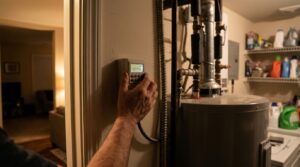
- Tight Budget (under $50): Skip the hardware and shift load by hand. Run the dishwasher, washer, and dryer after 9 PM, pre-cool or pre-heat your home before the peak window, and set a smart plug timer on a water heater or space heater, which can save $100 to $300 per year on a TOU plan.
- Older Home (pre-1980): Expect to budget for a panel upgrade of $1,500 to $4,000 and check wiring condition before installing a battery. Prioritize air sealing and insulation first, since cutting your evening load by 15 to 20 percent lets you buy a smaller, cheaper battery.
- Solar Owner: If you already have solar, add storage to capture midday exports and sell them to yourself at peak rates. Ask whether your system is AC-coupled or DC-coupled, since retrofits on older solar often use AC-coupled batteries at a slightly lower efficiency.