If you are one of the millions of Americans who cranks the thermostat down to 66 or 68 degrees at bedtime, you are likely paying for comfort you do not need. Research from sleep scientists generally points to bedroom temperatures between 65 and 72 degrees as workable for most adults, with air movement making a warmer room feel several degrees cooler. The real culprit behind restless nights is often not heat alone but the combination of temperature swings and sudden noise: the AC compressor kicking on, ducts popping as they expand, a neighbor’s door slamming, or the dead silence that makes every tiny sound feel enormous.
This is where an unlikely duo comes in. A white noise machine masks the abrupt sounds that fragment your sleep, while a continuously running HVAC fan (or a simple bedroom fan) creates gentle, constant airflow that makes you feel cooler at a higher thermostat setting. Together they give you a steady sound floor and steady air movement, so you can raise your nighttime setpoint by 3 to 4 degrees without feeling the difference.
In this post we will cover how the combination works, two practical ways to set it up (a no-cost quick fix and a more permanent DIY upgrade), what to watch out for, and how much you can realistically save. You do not need to be an HVAC expert, and most of this works whether you own or rent.
What You’ll Need
Click on an item below to shop for the recommended items for this recipe on Amazon.
As an Amazon Associate, we earn from qualifying purchases.
How to Do It
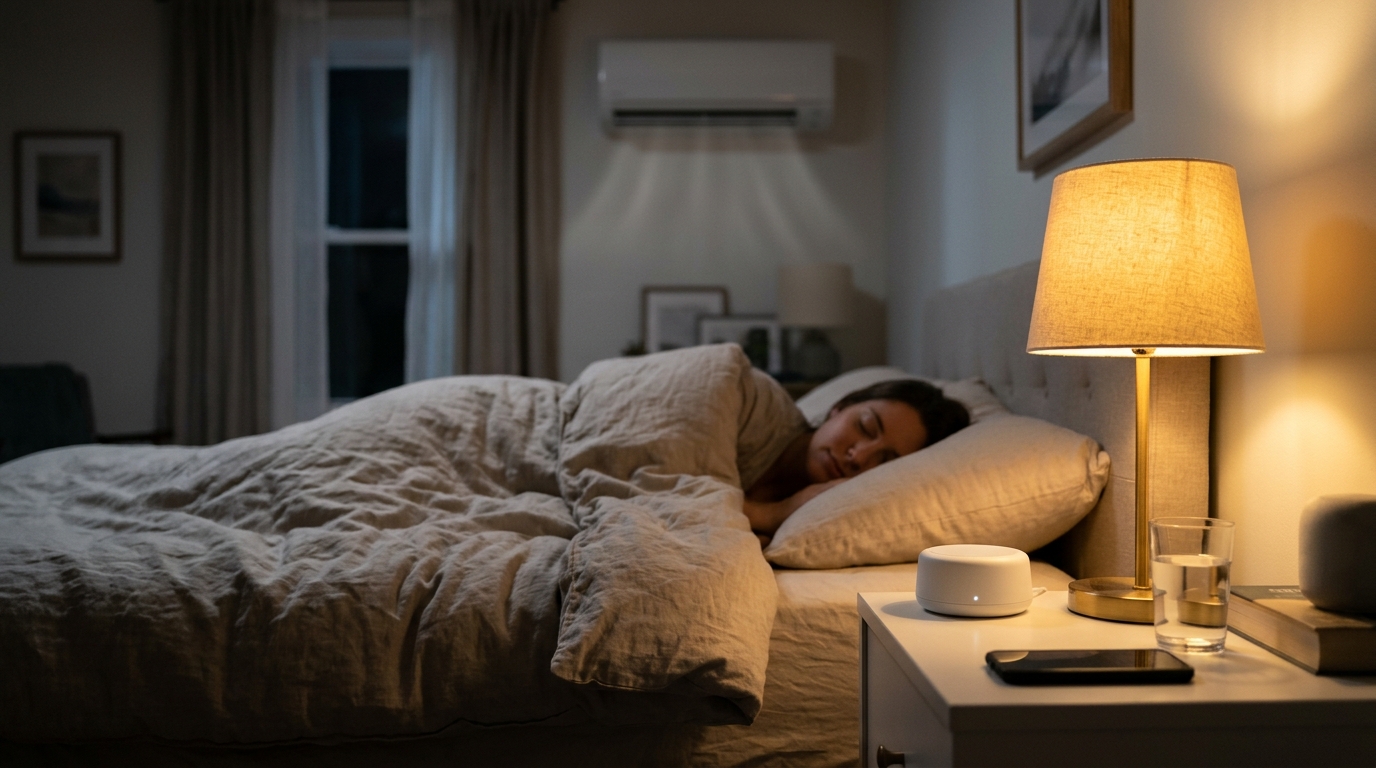
- Set a standalone white noise machine or phone app on a nightstand or dresser, not on the bed, and start at about 45 to 50 decibels (roughly the volume of a quiet conversation). Pick a steady sound like broadband white noise, pink noise, or fan sound rather than rain or waves with changing patterns.
- Raise your nighttime thermostat setpoint by 3 to 4 degrees from your current level. If you sleep at 68, try 71 or 72 and give yourself three nights to adjust.
- Place a box fan or oscillating fan 6 to 10 feet from the bed, set it to low, and aim it to move air across the room rather than straight at your face. Direct airflow on your face and neck can cause dry eyes and a stuffy nose.
- Set your thermostat fan to AUTO unless you have an efficient ECM blower, then leave the bedroom fan to provide the continuous airflow instead. Running a standard furnace blower all night can add $15 to $40 per month.
- Use lightweight cotton or linen sheets and keep the bedroom door open or closed consistently so the airflow pattern stays stable night to night.
- Install a programmable or smart thermostat and create a sleep schedule that starts a gentle setback about 30 minutes before bed, then holds your chosen overnight temperature (such as 72 degrees) until 30 minutes before wake time. Smart thermostats typically cost $100 to $200 and many utilities offer $25 to $75 rebates.
- Check whether your system has an ECM or variable-speed blower. If it does, set the thermostat fan to a low continuous or circulate mode overnight, which typically uses 50 to 100 watts versus 400 to 700 watts for an older PSC motor. If you are unsure, check the air handler nameplate or ask an HVAC tech during your next tune-up.
- Replace the air filter with a clean MERV 8 to 11 filter. A clogged filter forces the blower to work harder, increases airflow noise at the vents, and can add 5 to 15% to fan energy use.
- Reduce vent whistle and rattle by tightening loose register covers, adding foam gasket tape around the register edges, and making sure furniture or curtains are not blocking supply vents. Blocked registers raise static pressure and noise.
- Place the white noise machine between the bed and the loudest noise source (window, wall shared with a neighbor, or the wall closest to the outdoor condenser) and set the volume just high enough to mask it, usually 40 to 50 decibels.
- Add a timer or smart plug to your bedroom fan so it runs only during your sleep window instead of all day, saving 20 to 40 kWh per cooling season.
Why It Works: The Benefits
Raising your bedroom or whole-house nighttime setpoint from 68 to 72 degrees can cut overnight cooling energy by about 10 to 12%, which often translates to 5 to 8% off total summer cooling cost.
Studies on sound masking show steady background noise can reduce the time it takes to fall asleep and cut noise-triggered awakenings, especially in urban or noisy homes.
Gentle air circulation reduces hot and cold pockets, so the side of the bed near the window does not feel 3 degrees warmer than the doorway side.
A white noise machine at 40 to 50 decibels covers the 45 to 55 decibel hum of many outdoor condensers, so equipment noise stops being a wake-up trigger.
A white noise machine draws 2 to 5 watts, costing about $1 to $2 per year to run all night. A 40-watt bedroom fan costs roughly $4 to $8 per summer.
💰 Savings Impact by Action
Raising the overnight cooling setpoint 3 to 4 degrees reduces cooling energy by roughly 10% during sleep hours.
Using a 30 to 50 watt fan to offset a higher thermostat setting costs far less than the compressor energy it replaces.
Automated sleep setbacks remove the guesswork and can save 8% annually compared with manual adjustments.
Clean filters and unobstructed registers cut blower strain and reduce airflow noise, saving up to 5% on HVAC fan energy.
Timing the fan to run only during your sleep window avoids wasting 20 to 40 kWh per cooling season.
🏠 Key Concepts Explained
The Science Behind It
Two distinct mechanisms are at work here. The first is convective cooling. Your body continuously releases heat, and a thin boundary layer of warm, humid air forms around your skin. When air moves across you, that layer is stripped away and sweat evaporates faster, which is why a 75 degree room with a gentle breeze can feel like 71 or 72 degrees. This is the same principle behind the ceiling fan rule: raise your setpoint about 4 degrees with a fan running and you can feel the same comfort. The room itself is not cooler, so fans should cool people, not empty rooms.
The second mechanism is auditory. Your brain keeps monitoring sound while you sleep, and it is highly sensitive to sudden changes rather than steady levels. When the compressor kicks on at 2 a.m. in a silent room, the jump from near silence to 50 decibels can pull you into lighter sleep stages. A steady masking sound raises the baseline so the same event is a smaller relative change, which is why people sleep better in a room with a constant hum than in perfect silence.
Finally, the energy math is straightforward. The DOE estimates about 1 to 3% savings per degree of setpoint increase in cooling mode, depending on climate and house tightness. A 4 degree overnight increase for eight hours, combined with a fan that draws a fraction of what your air conditioner does, produces net savings as long as the fan itself is efficient and only runs when you are in the room.
Frequently Asked Questions
▼ Why is my AC still running all day even after I tried these fixes?
A warmer nighttime setpoint only helps the overnight hours, so daytime run time depends on insulation, air leaks, solar gain, and equipment condition. Check your air filter first, then look for blocked vents, dirty outdoor coil fins, and attic or window gaps. If the system runs continuously on 85 degree days without ever reaching setpoint, have a technician check refrigerant charge and duct leakage.
▼ Can renters do this without landlord permission?
Yes. A white noise machine, a plug-in fan, and a smart plug are all fully portable and require no installation. If you have a window or wall unit, simply raise the setpoint and use a fan to circulate air. Skip the thermostat and duct steps unless your landlord approves.
▼ How long before I actually notice savings on my bill?
You should see a measurable drop in your next full billing cycle, typically 3 to 8% on cooling costs depending on how big your setpoint change is. To verify, compare kWh usage rather than dollars, since rates and weather vary month to month. A smart thermostat or utility app that shows daily usage makes this much easier.
▼ What if my home is older than 30 years?
Older homes often have leaky ducts, thinner insulation, and noisier equipment, so the masking benefit is usually bigger but the energy savings are smaller until you address air sealing. Start with a clean filter and sealed supply registers, and consider a duct leakage test, since leaky ducts can waste 20 to 30% of conditioned air.
▼ Will white noise bother my partner or make my sleep worse?
Some people find constant sound irritating at first, which is why starting low and giving it a week to adjust matters. If you or your partner dislike traditional white noise, try a fan sound or a low-pitched brown noise. If you still wake up feeling unrested after two weeks, turn it off and check for other causes like room temperature, light, or sleep habits.
Quick Tips
- Make the change gradually: raise your setpoint by one degree every two nights until you reach your target, so your body adapts without noticeable discomfort.
- Keep the white noise machine away from walls and hard surfaces that can cause echo, and place it so the sound fills the room evenly rather than blasting at one ear.
- Pre-cool the bedroom during the late afternoon when electricity rates are often lower, then let the room drift up slowly overnight.
- Put a smart plug on your bedroom fan and schedule it to turn off 60 to 90 minutes after you fall asleep, when your body temperature has already dropped.
Variations for Your Situation
- Apartment/Rental: Use a portable white noise machine ($20 to $35), a quiet tower or box fan ($30 to $60), and a smart plug ($10 to $15). Raise your setpoint 3 degrees if you control a thermostat, or use a window unit’s sleep mode. No modifications to the unit are needed, and everything goes with you when you move.
- Tight Budget (under $50): Use a free white noise app on an old phone placed on a nightstand in airplane mode, run an existing fan on low, and raise your thermostat setpoint 3 to 4 degrees. Replace the HVAC filter if it is more than 90 days old ($8 to $15). This combination alone typically saves 5 to 8% on summer cooling for under $15 in new spending.
- Older Home (pre-1980): Prioritize sealing supply register gaps with gasket tape, replace the filter, and check for loose or disconnected ductwork in the attic or crawlspace. Older systems often use PSC blower motors, so avoid running the HVAC fan continuously and rely on a bedroom fan instead. Heavier masking noise at 45 to 50 decibels is usually needed to cover duct popping and compressor noise.
- Light Sleeper or Noisy Neighborhood: Place a second small white noise machine near a window or shared wall, use pink or brown noise for better low-frequency coverage, and add heavy curtains and weatherstripping on bedroom windows. Together these can cut perceived outside noise by 5 to 10 decibels.