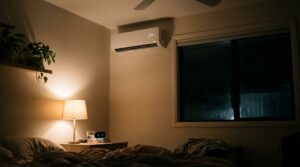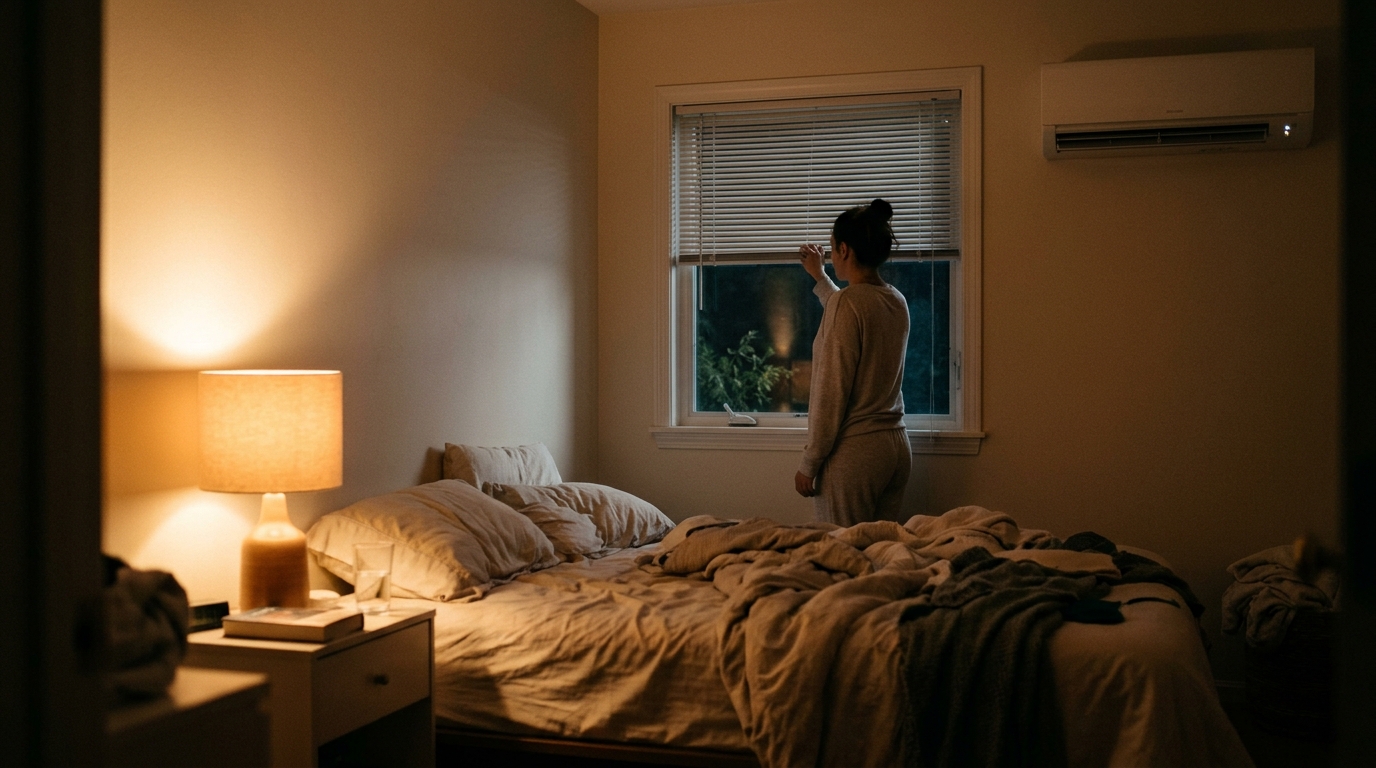
You probably think of blinds as a daytime tool, something you close to block the afternoon sun. But the real surprise is what happens after dark. Your windows are the weakest thermal link in your home’s envelope. Even a good double-pane window insulates at only about R-3, compared to R-13 or higher for a typical wall. All day, those windows absorb solar heat and warm the glass, frames, and the air pressed against them. When evening arrives, that stored heat keeps radiating into your rooms, right when you want things cool enough to sleep.
That is where closing your blinds before bed earns its keep. A closed blind or shade creates a trapped layer of air between the glass and your room, slows radiant heat from the warm glass, and cuts convective air currents that pull warm air into your living space. The result is a bedroom that holds its temperature better, a thermostat that cycles less often, and an AC compressor that gets more rest overnight. The U.S. Department of Energy estimates that well-fitted window coverings can reduce heat gain by up to 40% on sunny days, and some of that benefit carries into the evening hours.
In this post, we will break down exactly why this simple habit works, how much you can realistically save, and how to go from a 30-second nightly routine to a more complete window strategy. Whether you rent a small apartment or own a 1970s ranch, there is an approach here that fits your budget and your home.
What You’ll Need
Click on an item below to shop for the recommended items for this recipe on Amazon.
As an Amazon Associate, we earn from qualifying purchases.
How to Do It
- Make it a habit: close all blinds, shades, or curtains on sun-facing windows as part of your bedtime routine, ideally an hour before bed so the room can start shedding stored heat.
- Start with west-facing and south-facing windows first, since they absorb the most solar heat and radiate it longest into the evening.
- Tilt slat blinds fully closed with the slats curving downward toward the room, which blocks radiant heat and reduces airflow through the gaps.
- Use heavy curtains over blinds if you already have them. Layering a curtain over a blind adds a second air gap and can double the insulating effect.
- Open windows on the shaded side of the house (if outdoor temps drop below indoor temps) and keep the sun-facing ones sealed shut and covered.
- Measure each bedroom window carefully, inside-mount width and height, and note whether the window gets direct sun. Prioritize the hottest windows first to maximize your return.
- Buy cellular (honeycomb) shades in a light color on the room side, or a light-colored cell with a reflective backing. Double-cell designs offer the best insulation, typically adding R-3 to R-5 to the window.
- Mount the shades as close to the glass as possible and choose an inside-mount with minimal side gaps. Gaps at the edges let warm air slip around the shade and defeat the purpose.
- Optionally apply a low-E or solar-control window film to the glass itself. Quality films reject 40 to 60% of solar heat and can be applied with a squeegee and soapy water in about 30 minutes per window.
- Close the shades each evening and set your thermostat 1 to 2 degrees higher than you normally would. You should feel the same comfort with less compressor run time.
- Install exterior solar screens, awnings, or roll-down shutters on the worst sun-exposed windows. Exterior shading can block up to 65 to 77% of solar heat gain, per DOE estimates.
- Hang thermal-lined blackout curtains on a wide rod that extends 4 to 6 inches past the window frame on each side, mounted a few inches above the trim to seal the top.
- Add a cornice or valance above the curtains to block air from flowing behind the fabric, which creates a sealed insulating pocket.
- Pair the setup with a programmable or smart thermostat so you can schedule a gentle overnight setpoint rather than relying on manual adjustments.
Why It Works: The Benefits
Cutting heat gain through windows can reduce cooling energy by 5 to 15% during evening and night hours, which adds up to roughly $15 to $60 per cooling season for a typical home.
Closed blinds can lower the surface temperature you feel radiating off the window by several degrees, helping you fall asleep faster without dropping the thermostat.
Less heat entering the room means the thermostat reaches setpoint sooner and stays there longer, reducing short-cycling and compressor wear.
The same habit that saves energy also blocks streetlights and blocks views in, which supports deeper sleep and a more private bedroom.
Closing insulating shades at night in cold months can cut window heat loss by up to 40%, so the same habit pays you back year-round.
💰 Savings Impact by Action
Closing standard blinds on sun-facing windows at night reduces evening heat transfer and cooling run time by roughly 5 to 15%.
Double-cell honeycomb shades add R-3 to R-5 of insulation and can cut window heat gain by up to 20 to 25%.
Solar-control film rejects 40 to 60% of incoming solar heat, lowering overall cooling loads by about 10 to 20%.
Awnings and solar screens block up to 65 to 77% of heat before it reaches the glass, making them the most effective option.
Raising the overnight setpoint by 2 degrees once windows are covered saves about 6% on cooling energy.
🏠 Key Concepts Explained
The Science Behind It
Windows lose and gain heat through three mechanisms at once: conduction, convection, and radiation. During the day, the sun strikes the glass and a portion of the energy passes through as shortwave radiation, warming anything it hits inside. The glass itself also absorbs some of that energy and heats up. When the sun sets, the outdoor air cools quickly, but the glass, frame, and interior surfaces keep their stored heat for hours, a phenomenon called thermal lag. Your AC then has to remove that leftover heat while you sleep.
A closed blind interrupts this process in several ways. First, it blocks direct radiant exchange between the warm glass and the people and furniture in the room, because infrared heat travels in straight lines and gets absorbed or reflected by the shade material. Second, it creates a thin pocket of relatively still air between the glass and the blind. Still air has a very low thermal conductivity, so that pocket works as extra insulation. Third, it disrupts the convective loop in which warm air rises along the glass and cooler air flows in to replace it, which is a major pathway for heat to enter a room.
The effectiveness of a window covering depends on its construction. Honeycomb or cellular shades are among the best performers because each cell is a tiny sealed air pocket, and double-cell designs stack two layers of that insulation. Tight side channels or inside mounts reduce edge leakage, which can otherwise let 20 to 30% of the benefit escape. Light-colored or reflective surfaces facing the glass bounce radiant heat back toward the window instead of absorbing it. The takeaway is that the habit matters, but the hardware and the fit multiply the savings.
Frequently Asked Questions
▼ Why is my AC still running all day even after I started closing the blinds at night?
Window heat gain is only one piece of your cooling load. Check your attic insulation (aim for R-38 to R-60), seal air leaks around doors and outlets, and replace a dirty air filter, since a clogged filter can cut airflow and efficiency by 5 to 15%. If your system is more than 12 to 15 years old, have an HVAC technician check refrigerant charge and airflow.
▼ Can renters do this without landlord permission?
Yes. Tension-rod curtains, stick-on blackout liners, removable cordless cellular shades with adhesive mounts, and static-cling window film require no drilling and leave no damage. Cost ranges from about $15 to $80 per window, and everything can go with you when you move.
▼ How long before I actually notice savings on my bill?
You will likely feel the comfort difference the first night, but bill savings show up in your next full billing cycle. Expect savings of roughly 5 to 15% on cooling usage, which is typically $10 to $30 per month in summer for an average home. Compare against the same month last year, adjusting for weather, to see the real change.
▼ What if my home is older than 30 years?
Older homes tend to have single-pane or early double-pane windows with higher heat gain, so window coverings often deliver bigger percentage savings. Pair them with weatherstripping and caulk around the frames, since older windows also leak more air. If your frames are warped or rotting, plan on window replacement as a longer-term upgrade.
▼ Should I close the blinds all day or only at night?
On sunny summer days, closing blinds on sun-facing windows during the day blocks the biggest heat load and prevents stored heat from building up. If you prefer natural light, close them only during peak sun hours (typically 11 a.m. to 6 p.m. on west and south windows). At night, close them everywhere you want extra insulation.
Quick Tips
- Close blinds on sun-facing windows 60 to 90 minutes before bedtime so the room has time to shed stored heat before you sleep.
- Choose light-colored or reflective-backed shades facing the glass, since dark colors absorb heat and re-radiate it into the room.
- Layer a curtain over a blind for a double air gap, which can roughly double the insulating benefit of either one alone.
- Seal the edges with side channels, magnetic strips, or tight inside mounts to prevent warm air from sneaking around the shade.
- Raise your thermostat setpoint by 1 to 2 degrees overnight once your windows are covered. Each degree higher saves roughly 3% on cooling costs.
Variations for Your Situation
- Apartment/Rental: Use tension-rod or adhesive-mounted cordless cellular shades ($25 to $60 per window) and static-cling reflective film ($15 to $30 per roll), neither of which requires drilling or landlord approval. Focus on bedroom and living room windows with direct sun exposure.
- Tight Budget (under $50): Close existing blinds nightly, hang a bed sheet or old blanket over the hottest window with removable hooks, and add DIY foam board panels cut to fit the window frame for the worst offenders. Dollar-store reflective car sunshades also work as a stopgap on west-facing glass.
- Older Home (pre-1980): Start with weatherstripping and window caulk ($10 to $30 per window) to cut air leaks, then add thermal-lined curtains or cellular shades on the leakiest windows. If you still have single-pane glass, a removable interior storm panel kit ($30 to $60 per window) can add significant insulation.