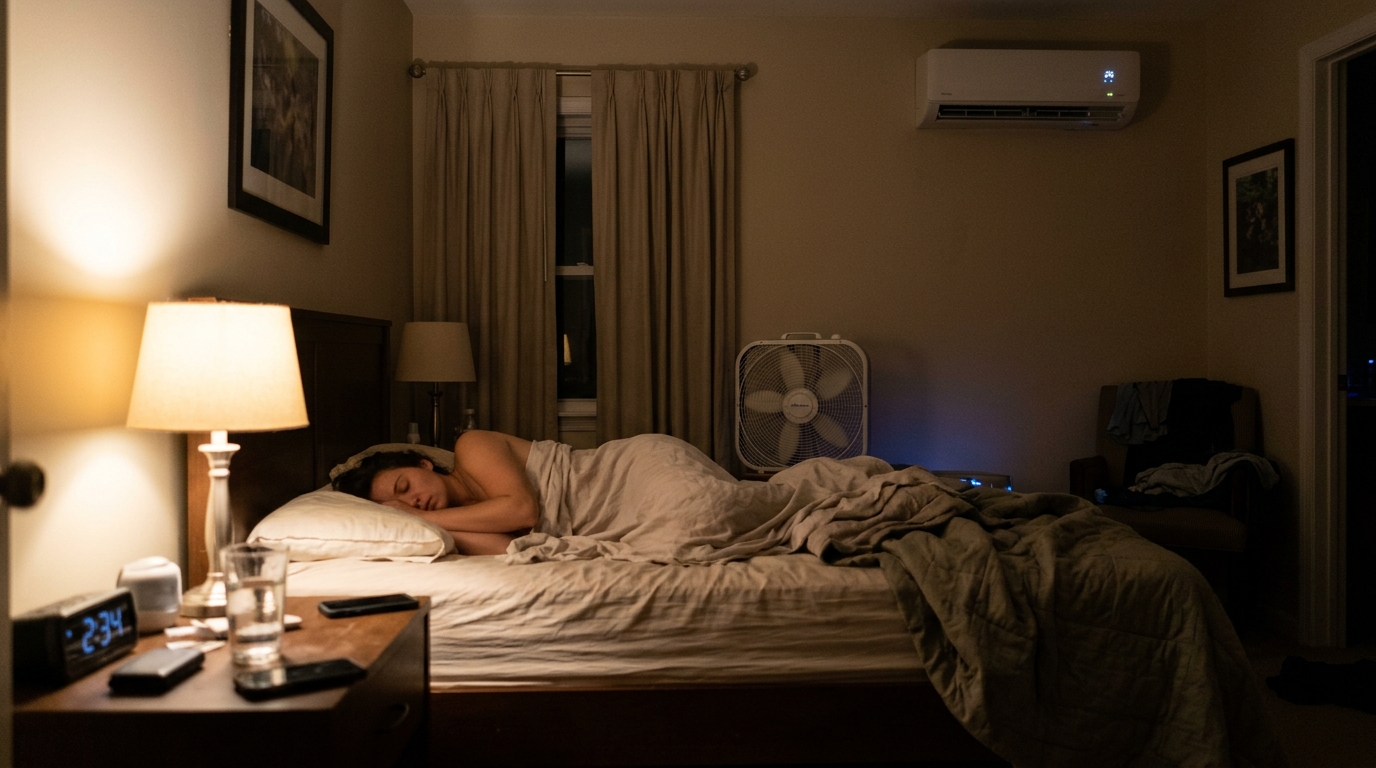
You set the thermostat to 72, the AC hums along all evening, and yet by midnight your bedroom feels stuffy and warm while the living room downstairs is perfectly comfortable. You are not imagining it, and you are not alone. Bedrooms are one of the most common comfort complaints in American homes, especially in two-story houses and rooms on the top floor or the west side.
The reason is that your thermostat only measures the temperature in one spot, usually a hallway. It has no idea what is happening in the farthest room on the duct run. Bedrooms often suffer from undersized or leaky ducts, closed doors that block return air, afternoon sun baking the walls and roof, and a hot attic sitting directly overhead. In summer, attic temperatures can reach 120 to 150 degrees, and that heat radiates down through the ceiling all night long.
This post walks through the real causes of a hot bedroom and gives you two approaches: a quick fix you can do tonight for almost no money, and a DIY upgrade that tackles the root causes. Most homeowners can drop bedroom temperatures by 3 to 8 degrees without touching the AC unit itself.
What You’ll Need
Click on an item below to shop for the recommended items for this recipe on Amazon.
As an Amazon Associate, we earn from qualifying purchases.
How to Do It
- Open the bedroom supply vent fully and check that nothing blocks it. Move furniture, curtains, or rugs at least 6 inches away from vents and returns.
- Prop the bedroom door open an inch or two, or place a rolled towel under it, to give air a return path. If you need the door closed for privacy or noise, move on to the DIY approach for a permanent fix.
- Close blinds, blackout curtains, or cellular shades on any window facing east or west during the day. Do this before the sun hits, not after the room has already heated up.
- Swap in a clean air filter. A clogged filter can cut airflow by 15% or more and is the cheapest fix on this list (about $5 to $20).
- Run the thermostat fan setting to ON for a few hours in the evening to keep air moving through the ducts and equalize temperatures.
- Set a ceiling or box fan to run counterclockwise (summer mode for ceiling fans) to create a breeze across the bed. This will not lower the room temperature, but it can make you feel 3 to 4 degrees cooler.
- Inspect the ducts serving the bedroom. In the attic or crawlspace, look for disconnected joints, crushed flex duct, sagging runs, or torn insulation. Make sure the duct run to the bedroom is not kinked or compressed.
- Seal duct joints and seams with mastic sealant or foil tape (UL 181 rated). Do not use standard cloth duct tape, which dries out and fails within a few years. Sealing alone can improve delivery by 10 to 20%.
- Add a transfer grille or jump duct between the bedroom and the hallway so air can return when the door is closed. A simple wall or door grille costs $15 to $40 and can fix pressure imbalance immediately.
- Install cellular shades or reflective window film on the hottest windows. Quality window film runs $20 to $50 per window and can block 60 to 80% of solar heat.
- Add or top off attic insulation above the bedroom to R-38 or higher (about 12 to 14 inches of fiberglass or cellulose). Pay special attention to the area directly over the room.
- Weatherstrip the bedroom door, windows, and any attic hatch nearby to stop hot air infiltration. Foam tape and door sweeps cost under $20 total.
Why It Works: The Benefits
Sleep researchers generally find the ideal bedroom temperature is 65 to 68 degrees. Bringing a 78-degree room down to even 72 can noticeably reduce nighttime waking and tossing.
Fixing duct leaks and improving airflow lets your system reach setpoint faster, cutting runtime. Homeowners often see 5 to 15% lower cooling costs after sealing ducts and shading windows.
Restricted airflow and long runtimes wear out compressors and blower motors. Improving airflow can add years to system life and reduce the risk of a $5,000 to $12,000 replacement.
Balancing airflow means you can stop overcooling the downstairs just to get the bedroom tolerable, which typically wastes 10 to 20% of cooling energy.
A properly ventilated bedroom with good return air stays drier. Keeping indoor humidity between 40 and 50% prevents that clammy feeling that makes 74 degrees feel like 79.
💰 Savings Impact by Action
Sealing leaky duct joints can recover 10 to 20% of lost cooling delivery and cut bedroom temperatures by several degrees.
Reflective film and blackout curtains block 60 to 80% of solar gain, reducing a room’s cooling load by up to 25%.
Boosting attic insulation to R-38 can reduce ceiling heat transfer by 15 to 25% in top-floor rooms.
Adding a transfer grille balances pressure and can improve airflow to a closed bedroom by around 10%.
A clean filter restores airflow and can reduce AC energy use by 5 to 15% compared with a clogged one.
🏠 Key Concepts Explained
The Science Behind It
Your AC does not make a room cold; it removes heat by moving air across a cold coil and distributing that cooled air through ducts. A bedroom stays hot when heat entering the room outpaces the cooling delivered to it. In a typical home, a single bedroom needs around 3,000 to 6,000 BTUs of cooling per hour on a hot day, but a leaky or restricted duct may deliver only half of what that room was designed to receive.
The closed-door problem is a perfect example of how airflow and pressure work together. Supply air enters the room with nowhere to exit, so the room pressurizes. That slows incoming air and forces pressure-driven leakage through the ceiling and walls, pulling in hot attic or outdoor air. In a depressurized house, the opposite happens. Either way, the thermostat in the hallway stays happy while the bedroom suffers.
Heat also travels three ways: conduction through walls and ceilings, convection through moving air, and radiation from hot surfaces. A 130-degree attic transfers heat to your ceiling by conduction, then your ceiling radiates that heat to you and the bed below. This is why adding insulation and radiant barriers often feels like turning on a second AC. Because warm air rises, a second-floor bedroom also receives the hottest air in the house through stack effect, meaning cooling needs are highest exactly where airflow is usually weakest.
Frequently Asked Questions
▼ Why is my AC still running all day even after I tried these fixes?
If the system runs nonstop and still cannot keep up, you may have a refrigerant leak, a dirty evaporator coil, or ducts losing far more air than expected. Check that your filter is clean and the outdoor unit is not clogged with debris or grass clippings. If the problem continues, ask an HVAC contractor for a duct leakage test (typically $100 to $400), which can pinpoint exactly where cooling is being lost.
▼ Can renters do this without landlord permission?
Yes, most of the quick fixes are renter-friendly. You can add blackout curtains, window film, door sweeps, a transfer fan, and a clean filter without altering the structure. Skip duct sealing and attic work, and instead send your landlord a written request if you suspect leaky or disconnected ducts.
▼ How long before I actually notice savings on my bill?
Comfort improvements like blocking window heat and opening the return path show up the very first night. Bill savings usually appear within one billing cycle, often 5 to 10% lower, as the AC cycles off sooner. Larger savings from duct sealing and attic insulation typically show up over a full summer.
▼ What if my home is older than 30 years?
Older homes often have leaky metal ducts, minimal attic insulation (R-11 or less), and single-pane or drafty windows, so gains can be larger. Start by sealing ducts and bringing attic insulation up to R-38, which often yields a 15 to 25% reduction in cooling load. If the home has no return in the bedroom or ductwork runs through an unconditioned crawlspace, a professional assessment is worth the cost.
▼ Should I just buy a window AC or portable unit for the bedroom?
A window unit can be a reasonable stopgap, but it costs more to run per BTU than central air and may not fix the underlying duct issue. If you go this route, choose an Energy Star model sized at roughly 5,000 to 8,000 BTUs for a standard bedroom. Fix airflow first; if the room still lags, a small window unit or ductless mini-split is the next logical step.
Quick Tips
- Check supply and return vents in the bedroom at night with your hand or a tissue strip. Weak airflow from the supply vent means a duct problem, not a bad thermostat.
- Use blackout curtains with a white or reflective backing on west-facing windows to cut solar heat gain by up to 40%.
- Set your thermostat to 76 or 78 during the day and let it drop to 72 to 74 about an hour before bed so the bedroom pre-cools without overworking the system.
- Keep a basic indoor thermometer in the bedroom to track real conditions rather than trusting the thermostat’s single reading.
Variations for Your Situation
- Apartment/Rental: Focus on what you control. Use blackout curtains ($20 to $40), tension-rod window film, a door sweep ($10), and a quiet inline vent booster fan ($25 to $45) that fits over a floor or wall register. Keep the door cracked or use a plug-in transfer fan. If the room has no return and the landlord manages HVAC, send a written maintenance request describing the temperature difference.
- Tight Budget (under $50): Replace the air filter ($8 to $15), open the vent and door gap, close blinds on sun-facing windows, and use a $20 box fan in the window at night to pull in cooler outdoor air once temperatures drop below 75. Add foam weatherstripping to the door ($8). These steps alone often cut bedroom temperatures by 3 to 5 degrees.
- Older Home (pre-1980): Expect higher baseline leakage. Prioritize attic air sealing around light fixtures, wiring holes, and the attic hatch, then top off insulation to R-38 or higher. Have ducts inspected for disconnected joints, since older systems commonly lose 25 to 40% of airflow. Consider adding a dedicated return or a transfer grille if the bedroom has only a supply register.