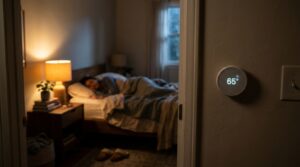
If you have ever lain in bed shivering while the thermostat downstairs reads a comfortable 70 degrees, you have met the single-zone problem. A standard central HVAC system has one thermostat, usually in a hallway or living area, and it tries to satisfy that one spot by blowing the same amount of air into every room. Meanwhile, your bedrooms, often at the far end of the duct run, stay a few degrees colder than the rest of the house.
At night, that mismatch gets expensive. You are paying to heat a kitchen, dining room, and home office that nobody is using, while the rooms where you actually spend 7 to 9 hours are underserved. The common fix is to crank the whole house up, which raises your bill by about 1 to 3 percent for every degree you add, according to the U.S. Department of Energy.
This post covers a smarter option: redirecting heated air to the bedrooms at night by controlling which vents are open. We will walk through a free manual method, a smart vent upgrade you can install in an afternoon, and a professional zoning system for homeowners who want a permanent solution. You will also learn the one big mistake that can damage your furnace if you close too many vents.
What You’ll Need
Click on an item below to shop for the recommended items for this recipe on Amazon.
As an Amazon Associate, we earn from qualifying purchases.
How to Do It
- Count the supply vents in your home. Divide by five to find your limit. In a house with 20 vents, you should close no more than 4.
- Choose the vents in rooms nobody uses at night, such as a dining room, office, or guest room with the door closed, and close them about three-quarters of the way, not fully.
- Open the bedroom vents completely and make sure furniture, rugs, or curtains are not blocking them.
- Set your thermostat to its normal nighttime temperature and check each bedroom with a simple thermometer after 2 to 3 hours.
- Adjust one vent at a time over a few nights until bedrooms are 1 to 3 degrees warmer than before, then mark the vent positions with a small piece of tape so you can restore them easily.
- Measure each vent opening you want to replace, including width and length, and confirm whether it is a floor, wall, or ceiling register before ordering.
- Install the smart hub or bridge first, following the app instructions, and connect it to your Wi-Fi and, if supported, your smart thermostat.
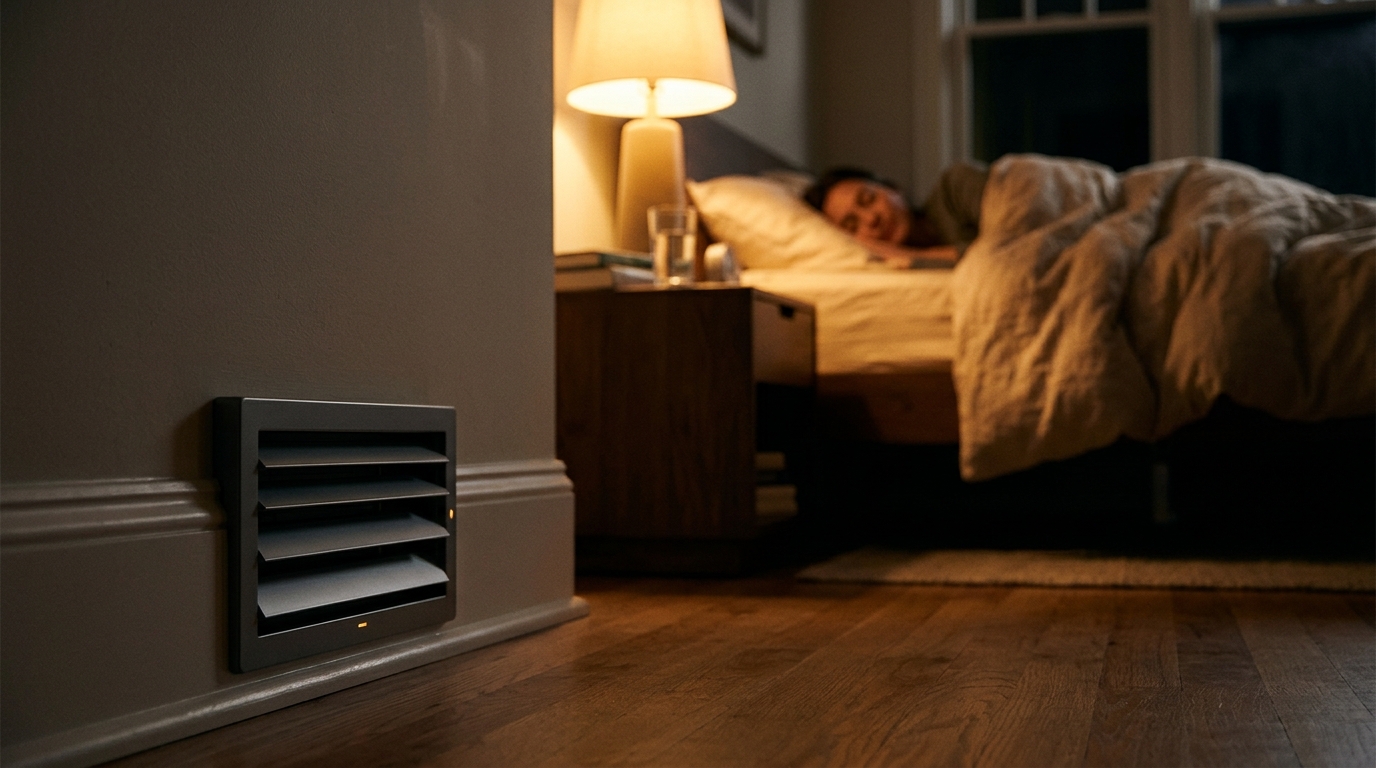
- Turn off your HVAC system, unscrew the old registers, and drop in the smart vents. Most simply replace the register and run on batteries or a rechargeable cell.
- Pair each vent to the app and assign it to a room. Add a small room temperature sensor or puck in each bedroom for the most accurate readings.
- Create a nighttime schedule that opens bedroom vents fully from about 9 p.m. to 7 a.m. and reduces airflow to living areas, while keeping the app’s safety minimum so total airflow stays within a healthy range.
- Review the app’s usage reports after a week and fine-tune target temperatures. Aim for 64 to 67 degrees in bedrooms and 62 to 64 in empty rooms at night.
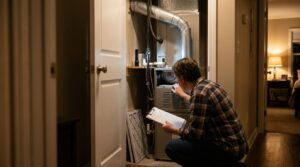
- Request a Manual J load calculation and duct inspection from a licensed HVAC contractor so the zoning plan matches your equipment capacity.
- Define zones, typically a sleeping zone (bedrooms), a living zone, and optionally a separate floor, each with its own thermostat or sensor.
- Have the contractor install motorized dampers in the main duct trunks along with a zone control panel and, if needed, a bypass duct or variable-speed blower.
- Program the zone thermostats so the sleeping zone receives priority from bedtime to wake-up while the living zone sets back to 60 to 64 degrees.
- Test airflow, static pressure, and temperature in every room during the first week and ask for a follow-up adjustment visit.
Why It Works: The Benefits
Reducing airflow to unused rooms and pairing it with a nighttime setback can trim heating costs by 5 to 15 percent. On a $200 monthly winter bill, that is $10 to $30 saved per month.
Bedrooms at the far end of a duct run are often 3 to 6 degrees colder than the thermostat reading. Boosting airflow to those rooms closes that gap without raising the whole-house temperature.
Sleep research generally points to 60 to 67 degrees as ideal for most adults. Smart control lets you hold bedrooms steady in that range instead of swinging between too cold and overheated.
When rooms are balanced, the thermostat is satisfied more consistently, so the system short-cycles less. Fewer start-stop cycles reduce wear on the blower and heat exchanger.
The same vents that push warm air to bedrooms in winter can prioritize cool air to upstairs rooms in summer, helping with the hot-bedroom problem too.
💰 Savings Impact by Action
Lowering the thermostat 7 to 10 degrees for 8 hours saves about 10 percent annually per DOE estimates.
Prioritizing occupied bedrooms lets you hold a lower whole-house setpoint, saving roughly 5 to 10 percent.
Sealing leaky ducts can recover up to 20 percent of heated air that would otherwise be lost in attics and crawlspaces.
Eliminating plug-in heaters in cold bedrooms avoids the $30 to $60 monthly cost of running a 1,500-watt unit overnight.
🏠 Key Concepts Explained
The Science Behind It
Heat moves through your home by convection, which means warm air carries energy wherever the blower pushes it. In a standard system, the blower delivers a fixed volume of air divided roughly by the size of each duct branch, not by who is actually in the room. That is why a bedroom 40 feet from the furnace can receive noticeably less warm air than a living room 10 feet away, especially when ducts run through a cold attic or crawlspace and lose heat along the way.
Smart vents work by changing the resistance in each branch of the duct system. Partially closing a vent forces more air to take the path of least resistance, which sends additional flow to the open vents. This is the same principle as adjusting valves in a plumbing system. The limit is pressure: ductwork and blowers are designed for a specific airflow, and too much restriction forces the blower to work against higher back pressure, reducing efficiency and increasing noise.
The energy savings come from two sources. First, you can safely lower the whole-house thermostat setting because the rooms you occupy receive priority heat. The DOE estimates about 1 percent savings per degree of setback over 8 hours. Second, you avoid overheating spaces that do not need conditioning, which reduces the total heat the furnace has to produce. Combined, that typically lands in the 5 to 15 percent range depending on your home layout and how uneven your temperatures were to begin with.
Frequently Asked Questions
▼ Why are my bedrooms still cold even after I closed vents in other rooms?
The problem is likely duct leakage or poor insulation rather than airflow balance. Check for disconnected or uninsulated ducts in the attic or crawlspace, since leaky ducts can lose 20 to 30 percent of the heated air before it arrives. Sealing ducts with mastic and adding R-6 or higher duct insulation often does more than any vent adjustment.
▼ Can renters use smart vents without landlord permission?
Usually yes, because most smart vents simply replace the register cover and can be swapped back to the originals when you move out. Keep the old registers in a labeled bag. For zero-modification options, use magnetic vent covers and a portable space heater with a thermostat, but check lease terms on electric heaters.
▼ How long before I notice savings on my bill?
Comfort improvements show up the first night, but bill savings appear in your next full billing cycle. Compare heating degree days, not just dollars, because a colder month will mask savings. Most homeowners see 5 to 15 percent lower heating costs after a full winter of scheduled use.
▼ What if my furnace starts making whistling or banging noises?
That is a sign of excess static pressure, usually from too many closed vents. Open the closed vents partway right away and keep total restricted vents under 20 percent. If the noise continues, have an HVAC tech measure static pressure, since your ductwork may be undersized.
▼ Do smart vents work with a heat pump?
They can, but heat pumps are more sensitive to airflow than gas furnaces because they run at lower supply temperatures and need steady airflow to avoid coil icing in cooling mode. Use a system that includes pressure monitoring and keep restrictions modest, or ask an HVAC pro about a zoning system designed for heat pumps.
Quick Tips
- Close doors to unused rooms when you partially close their vents. This keeps the redirected air from leaking back into spaces you are trying to deprioritize.
- Place a cheap digital thermometer in each bedroom and check it at 6 a.m. for a week. The data tells you exactly which vents need to open more.
- Replace your furnace filter before starting. A clogged filter already restricts airflow, and adding closed vents on top of that makes pressure problems much worse.
- Keep bedroom doors cracked an inch or install a transfer grille so air can return to the system. Fully closed doors on a room with no return create pressure imbalances that fight your vent adjustments.
Variations for Your Situation
- Apartment/Rental: Swap in smart vents or use simple magnetic vent covers on unused room registers, and keep the originals for move-out. Expect to spend $20 to $40 for magnetic covers or $300 to $600 for a starter smart vent kit. If your building has shared or hydronic heat, vent adjustments will not apply, so use a programmable plug-in oil-filled radiator in the bedroom set to 66 degrees instead.
- Tight Budget (under $50): Do the manual vent balancing method for free, then add a $10 to $15 digital thermometer for each bedroom and a $20 door draft stopper for the unused rooms you want to isolate. Add a $25 programmable thermostat if you do not already have one to schedule nighttime setbacks.
- Older Home (pre-1980): Older ductwork is often leaky, undersized, or poorly insulated, so seal and insulate accessible ducts first, which costs $100 to $300 in DIY materials and can improve delivery by 15 to 25 percent. Only after that should you add smart vents. Be especially cautious about closing vents in older systems, since they often have lower tolerance for added static pressure.