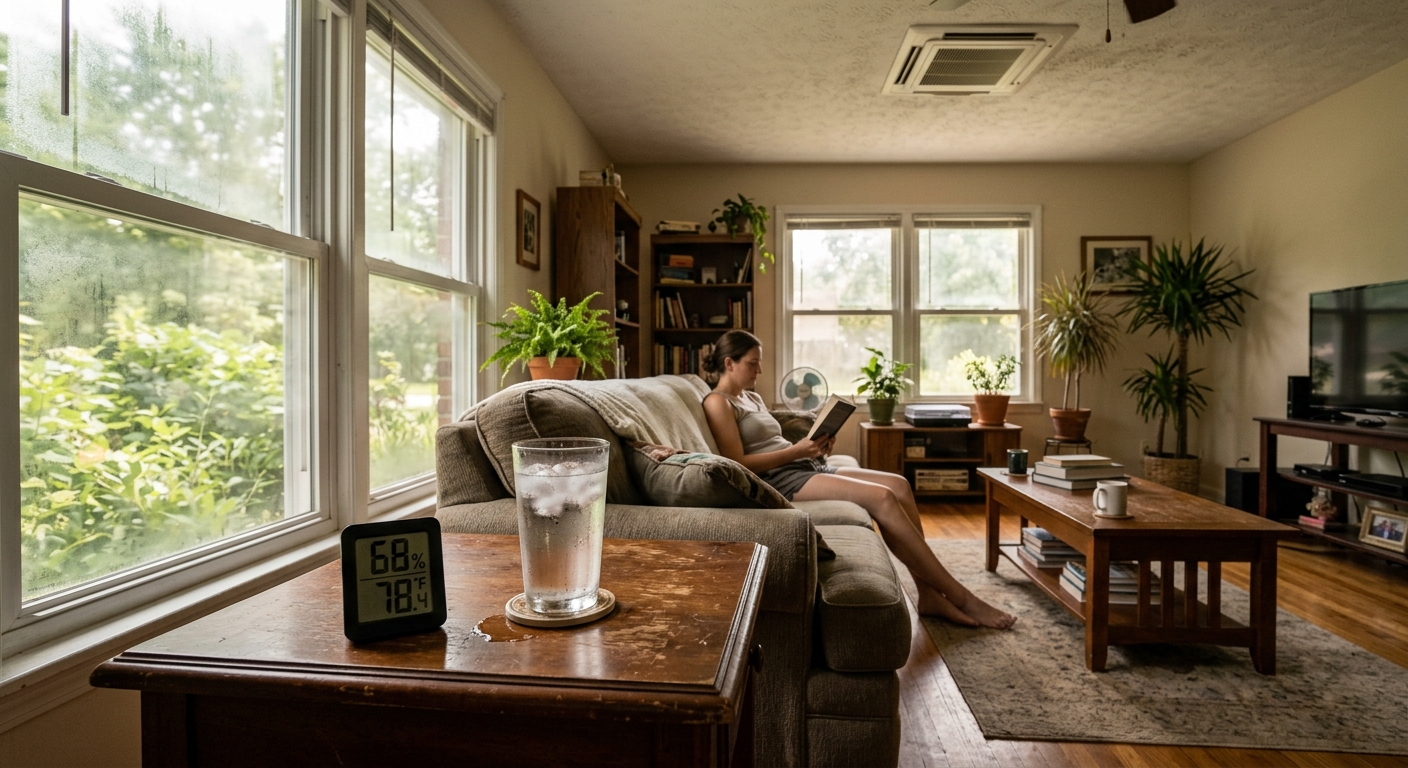
You set the thermostat to 72°F, the AC kicks on, and yet the air inside still feels thick and sticky. You are not imagining it. A home can hit its target temperature and still carry 65% or even 70% relative humidity, which is well above the comfortable and healthy range of 30% to 50%. High indoor humidity makes 74°F feel like 80°F, encourages mold growth, warps wood furniture, and can even trigger respiratory issues for sensitive family members.
The frustrating truth is that air conditioners are primarily designed to remove heat, not moisture. Dehumidification is a side effect of the cooling process, and several common conditions, from an oversized AC unit to a leaky duct system, can short-circuit that side effect entirely. The result is a home that feels clammy no matter how low you push the thermostat, which also drives up your energy bill as you chase comfort that never quite arrives.
In this post we cover the six core reasons humidity stays high even when your AC is running, how to diagnose which one is causing your problem, and exactly what to do about it, whether you want a free fix you can try today or a longer-term upgrade that solves the issue for good.
What You’ll Need
Click on an item below to shop for the recommended items for this recipe on Amazon.
As an Amazon Associate, we earn from qualifying purchases.
How to Do It
- Check your thermostat fan setting. If it is set to ON instead of AUTO, the blower runs continuously and blows moisture that condensed on the coil back into your air. Switch it to AUTO so the fan only runs during active cooling cycles.
- Lower your AC fan speed if your system allows it. Many air handlers have a low, medium, and high blower speed selectable at the air handler or on some smart thermostats. A slower fan keeps air in contact with the cold coil longer, improving moisture removal by 10 to 20%.
- Run kitchen and bathroom exhaust fans every time you cook or shower, and for 20 minutes afterward. These activities can dump 1 to 3 pints of water vapor directly into the air per event.
- Check that your AC drain line is clear. Locate the condensate drain line, which is typically a white PVC pipe exiting the air handler. Pour a cup of water into the drain pan to confirm it flows freely. A clogged drain causes the pan to overflow, which can trip a float switch and shut off dehumidification entirely.
- Close the fresh air damper if your system has a manual outdoor air intake. While ventilation is important, an open damper during a humid day continuously imports outdoor moisture. Close it during peak humidity and rely on exhaust fans for ventilation.
- Buy a digital hygrometer ($10 to $20) and place it in your main living area. Measure humidity at several times of day for two to three days. This tells you whether you have a mild problem (55 to 60%), moderate problem (60 to 70%), or severe problem above 70%, which guides the fix intensity.
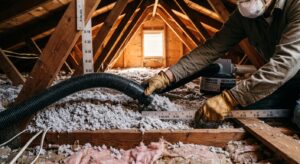
- Air seal the big leakage points around the home. Focus on the attic hatch, plumbing and wiring penetrations in ceilings and walls, gaps behind baseboard trim, and the band joist in the basement or crawl space. Use caulk for gaps under 1/4 inch and canned spray foam for larger gaps. This can reduce infiltration by 15 to 25% in an average home.
- Inspect and seal accessible duct connections in the attic, basement, or crawl space. Use mastic sealant (not standard duct tape, which fails over time) to seal joints at registers, elbows, and the air handler cabinet. Sealing 20% of duct leakage reduces the moisture load your AC fights continuously.
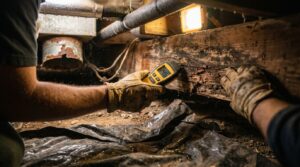
- Add a whole-house dehumidifier to a crawl space or basement if that area has visible moisture, condensation on pipes, or musty odors. A 70-pint standalone dehumidifier ($200 to $280) running in a 1,000 square foot basement reduces the moisture that migrates up through floors into the living space.
- Install a smart thermostat with humidity sensing ($120 to $250), such as the Ecobee or certain Honeywell models. These can run the AC fan briefly after the cooling cycle ends to extract additional moisture from the coil, improving dehumidification by 5 to 10% without any hardware changes to the AC itself.
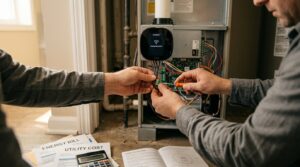
- Schedule an HVAC load calculation, also called a Manual J calculation, with a licensed contractor. This confirms whether your AC is correctly sized for your home. An oversized unit is the single most common cause of chronic humidity, and no behavioral fix fully compensates for it. Expect to pay $150 to $300 for this service as a standalone evaluation.
- Ask your contractor about installing a whole-house dehumidifier integrated into the duct system, such as a Santa Fe or Aprilaire unit. These units are separate from the AC, run independently on a humidistat, and remove 70 to 130 pints of moisture per day. Installed cost ranges from $1,500 to $2,500 but solves humidity problems the AC was never designed to handle.
- Have a professional duct leakage test performed (blower door with duct pressurization). This quantifies exactly how much conditioned air, and how much unconditioned humid air, your duct system is exchanging. Professional duct sealing of a leaky system can improve system efficiency by 20 to 30% and dramatically reduce latent load.
- If your AC is oversized or near end of life, consider replacing it with a variable-speed or two-stage system. Unlike single-stage units that cycle on at full blast, variable-speed systems can run at 40 to 60% capacity for long gentle cycles that remove dramatically more moisture. These systems cost $1,500 to $3,000 more than single-stage equivalents but deliver significantly better humidity control.
- Request that your contractor verify refrigerant charge and coil cleanliness. Low refrigerant or a dirty evaporator coil raises coil temperature, reducing condensation and moisture removal. A properly charged, clean coil running at 35 to 40°F removes far more moisture than a marginal system running at 45 to 50°F.
Why It Works: The Benefits
Dropping indoor relative humidity from 65% to 45% makes 76°F feel as comfortable as 72°F, meaning you can raise the thermostat setpoint by 3 to 4 degrees and feel equally comfortable while the AC runs less.
Homes with persistent humidity problems often overcool by 2 to 4 degrees chasing comfort. Correcting the humidity issue and raising the thermostat even 2 degrees saves roughly 6% on cooling costs, which is $30 to $80 per summer in most climates.
Mold and dust mites thrive above 60% relative humidity. Keeping indoor humidity consistently below 50% significantly slows mold growth, reduces dust mite populations, and improves air quality for allergy and asthma sufferers.
An oversized or short-cycling AC experiences more compressor starts per hour than a properly matched system. Each start creates mechanical stress. Fixing the root humidity problem, whether through equipment rightsizing or a standalone dehumidifier, reduces compressor cycling and can extend equipment life by several years.
Chronic indoor humidity above 60% causes wood floors to cup, cabinet joints to swell, and paint to peel. Hardwood flooring installation guidelines typically specify maintaining 35% to 55% relative humidity to prevent permanent warping and void warranties.
💰 Savings Impact by Action
Switching the blower from On to Auto prevents re-evaporation of condensed moisture and can reduce effective humidity load by up to 10% at zero cost.
Sealing gaps and cracks in the building envelope reduces continuous humid-air infiltration by 15 to 25%, cutting the moisture load the AC must overcome.
Sealing leaky return ducts that pull in unconditioned air improves system efficiency by up to 20% and directly reduces the latent load delivered to the living space.
A ducted whole-house dehumidifier removes 70 to 130 pints per day independently of the AC, reducing total system cooling load by up to 30% in humid climates.
Replacing a single-stage unit with a variable-speed system enables long low-capacity cycles that remove up to 25% more moisture per cooling hour than short full-blast cycles.
🏠 Key Concepts Explained
The Science Behind It
Air conditioning removes moisture through a process called condensation on the evaporator coil. The coil is chilled to 35 to 45°F by refrigerant circulating inside it. When warm humid indoor air passes over this surface, water vapor in the air loses energy, changes phase from gas to liquid, and drips into the drain pan below. This is exactly what happens on a cold glass of ice water on a humid day. The key variable is how long the air stays in contact with the cold surface and how cold that surface is. The lower the coil temperature and the slower the air moves across it, the more moisture condenses out.
Humidity in air exists in two states that affect comfort differently. Sensible heat is what a thermometer measures. Latent heat is the energy stored in water vapor that does not register as temperature but makes the air feel heavy and hot. In a humid climate like the southeastern United States, the latent cooling load on a home can represent 40 to 50% of the total cooling demand. This means nearly half of what your AC must remove is invisible to your thermostat. A single-stage AC controlled only by a temperature sensor can satisfy the thermostat setpoint while leaving the latent load largely unaddressed, which is exactly why your house hits 72°F but still feels uncomfortable.
The short-cycling problem with oversized equipment compounds this issue. An oversized 4-ton unit in a home that only needs 2.5 tons will cool the air fast enough to satisfy the thermostat in 6 to 8 minutes. Effective dehumidification requires run cycles of at least 15 to 20 minutes for the coil to become fully cold and for a meaningful volume of air to pass over it. Short cycles mean the coil never fully establishes its coldest operating temperature, moisture removal per cycle is minimal, and the compressor restarts frequently, adding wear and electricity consumption without resolving the humidity problem.
Frequently Asked Questions
▼ Why does my house feel humid in the morning even after the AC ran all night?
Overnight is when outdoor humidity often peaks, particularly in coastal or southern climates, and infiltration through gaps in the building envelope continuously imports moist air. Check that your thermostat fan is set to Auto rather than On, and consider using a humidistat-controlled dehumidifier that can run independently of the AC during the night. Improving air sealing around the attic hatch and top-floor ceiling penetrations will also reduce the stack-effect-driven infiltration that is worst during cooler nighttime hours.
▼ My AC was just replaced and the new one is bigger, but the house feels more humid than before. Why?
A larger AC unit that short-cycles is the most common cause of worse humidity after a system replacement. If your contractor sized the new unit by simply matching the old unit’s tonnage or upsizing for comfort, it is likely too large for your home’s actual heat load. Request a Manual J load calculation to verify correct sizing. If the unit is confirmed oversized, ask about adding a whole-house dehumidifier or, in some cases, having the contractor adjust the refrigerant charge or blower speed to force longer run cycles.
▼ Can I just buy a portable dehumidifier instead of fixing the AC?
A portable dehumidifier can meaningfully reduce humidity in a single room or a basement, typically removing 30 to 50 pints per day in a 500 square foot space. However, portable units exhaust warm air into the space as a byproduct, which makes your AC work harder to compensate. They also require manual emptying unless you route a drain hose to a floor drain. For a whole-house humidity problem, a ducted whole-house unit or fixing the root cause with the AC is a more effective long-term solution.
▼ How do I know if my ducts are pulling in humid air from outside?
Return ducts in unconditioned attics or crawl spaces are the most common culprit. Check for visible gaps or disconnected sections at duct joints near the air handler. You can also hold a stick of incense near duct connections while the system runs; smoke that gets pulled into the duct indicates a leak drawing in outside air. A professional duct leakage test can quantify the problem exactly and costs $150 to $300, but most homeowners notice improvement simply from sealing visible joints with mastic.
▼ What indoor humidity level is actually safe for my home and health?
The EPA and ASHRAE recommend keeping indoor relative humidity between 30% and 50%. Below 30%, respiratory irritation and static electricity become issues. Above 60%, mold growth accelerates significantly and can begin within 24 to 48 hours on organic surfaces. The sweet spot of 45% to 50% is comfortable for most people, safe for wood finishes and flooring, and well below the threshold where dust mites and mold colonies establish themselves.
Quick Tips
- Target 45% to 50% indoor relative humidity as your goal, not just a comfortable temperature. A $15 hygrometer gives you the data to know when you have actually solved the problem.
- In very humid climates, run your AC at a setpoint 1 to 2 degrees lower overnight when outdoor humidity peaks, then raise it during the day. This pre-conditions the home when the AC can remove the most moisture.
- Keep interior doors open throughout the home. Closing them restricts return airflow, reduces how much air crosses the evaporator coil each hour, and cuts dehumidification capacity by reducing system airflow.
- Check your air filter monthly during summer. A clogged filter reduces airflow across the coil, which can cause the coil to ice over. A frozen coil removes zero moisture and can damage your compressor within hours.
Variations for Your Situation
- Apartment or Rental: Renters cannot modify central HVAC equipment or duct systems, but can address humidity meaningfully with portable solutions. A 30 to 50 pint dehumidifier ($150 to $220) running in the main living area targets the root problem directly. Set it to maintain 50% relative humidity rather than running continuously. Also switch the thermostat fan from On to Auto if you have access, seal window air gaps with removable foam weatherstripping ($8 to $15), and always run bathroom and kitchen exhaust fans during and after moisture-producing activities.
- Tight Budget (under $50): Focus first on the thermostat fan setting switch to Auto, which costs nothing and addresses one of the most common causes. Add a $15 hygrometer to measure the actual problem. Spend the remainder on a tube of caulk ($5) and spray foam ($8) to seal the most obvious gaps around windows, the attic access hatch, and plumbing penetrations under sinks. These zero-to-minimal cost steps can reduce humidity by 5 to 15 percentage points in a moderately leaky home.
- Older Home (pre-1980): Homes built before modern building codes have significantly higher air infiltration rates, often two to three times that of a newer home, and original duct systems with decades of deteriorated joints. Prioritize a professional duct inspection since old duct tape dries out and loses adhesion within 10 to 15 years, leaving major leaks at every joint. Air sealing the attic floor and rim joists delivers the highest return in older construction. Budget $500 to $1,500 for professional air sealing and duct sealing, which can cut humidity infiltration by 30 to 40% and reduce summer cooling bills by 20% or more.