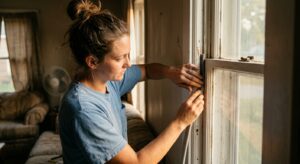
If you have a room that faces south or west, you already know the drill: beautiful morning light gives way to brutal afternoon heat that no amount of air conditioning seems to tame. A single unshaded window can pour in as much heat as a small space heater, and when you have two or three of them, your HVAC system is fighting a battle it was never sized to win on its own. The result is higher bills, a room that stays 10 to 15 degrees warmer than the rest of the house, and furniture that fades season after season.
The instinct is to pull the blinds and block everything out, but that trades one problem for another. You lose the daylight that makes the room feel alive, you flip on electric lights to compensate, and you end up paying for both the cooling load and the extra lighting. There is a smarter path: controlling where and how sunlight enters, rather than simply shutting it out.
In this post we cover the building science of solar heat gain, then walk through three practical approaches ranked by cost and effort, from zero-dollar behavioral fixes to a DIY window film installation to a professional exterior shading upgrade. Each approach gives you real numbers on what to expect in savings and comfort so you can choose the one that fits your situation.
What You’ll Need
Click on an item below to shop for the recommended items for this recipe on Amazon.
As an Amazon Associate, we earn from qualifying purchases.
How to Do It
- Identify your peak heat window: track when the sun directly strikes each window and note the 2 to 3 hour window when the room heats most aggressively, usually 1 PM to 5 PM for west-facing rooms.
- Close existing blinds or curtains at a 45-degree angle rather than fully shut: horizontal slats angled upward reflect sunlight toward the ceiling instead of into the room, preserving some indirect light while deflecting direct rays.
- Open a low window on the shaded north or east side of the home and crack a high window or attic hatch on the hot side to create a stack-effect draft that flushes accumulated heat out of the room.
- Shift heat-generating activities (cooking, laundry, dishwasher) to morning or evening hours so you are not adding internal heat loads on top of solar gain during peak afternoon hours.
- Place a portable fan in the doorway blowing outward into a hallway or toward a cooler room to pull hot air away from the sun-facing room and circulate cooler conditioned air in.
- Measure each window precisely and purchase solar control film rated for interior application with a Solar Heat Gain Coefficient below 0.30 and Visible Light Transmittance above 40%. Brands like Gila, 3M, and Madico are widely available at home improvement stores for $3 to $8 per square foot.
- Clean the glass thoroughly with a mixture of one drop of dish soap per quart of water, remove all dust, grease, and streaks using a lint-free cloth or squeegee, and let it dry completely. Film will not adhere to a dirty surface and bubbles will result.
- Cut the film 1 inch oversized on all edges using a sharp utility knife and a straight edge. You will trim to final size after application.
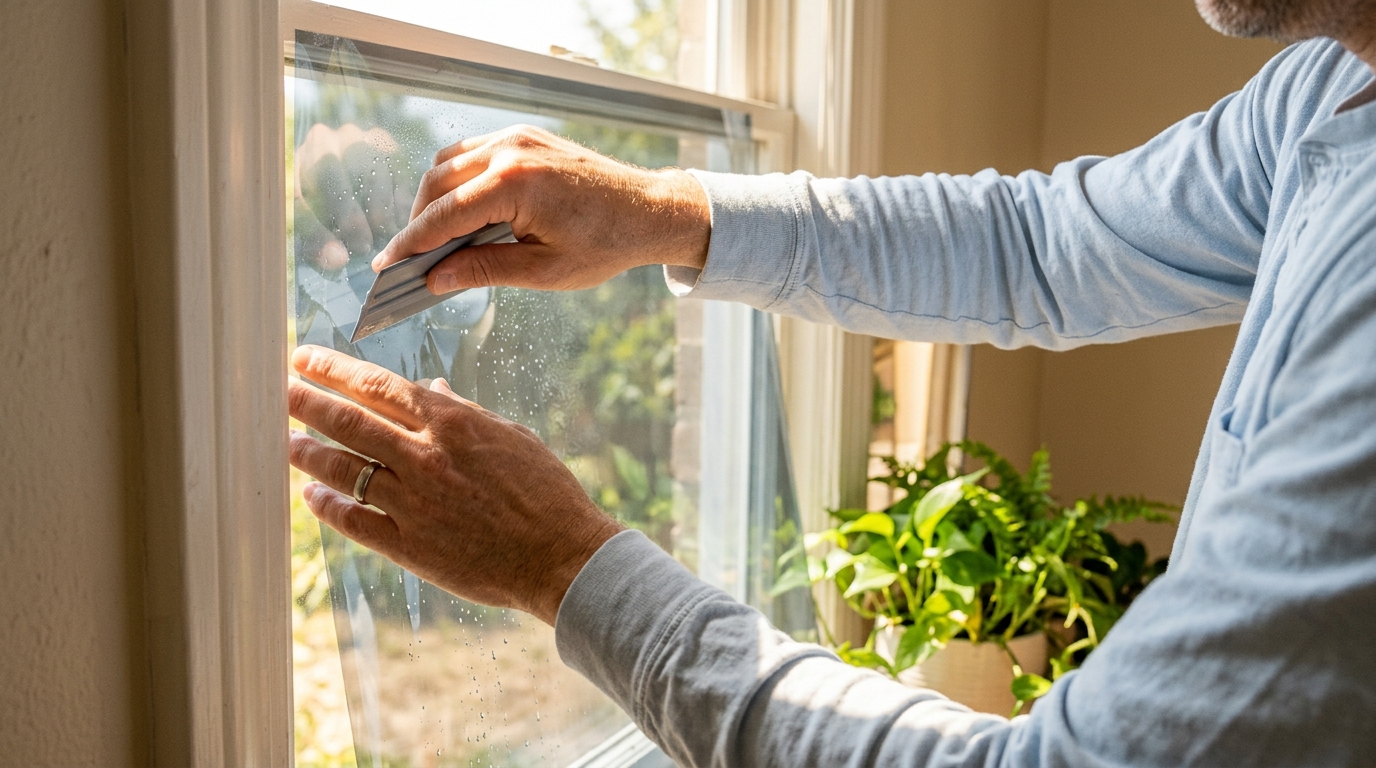
- Spray the glass surface generously with the soapy water solution, peel the film backing, spray the adhesive side as well, and apply the film to the wet glass. The water layer lets you reposition the film for 2 to 3 minutes before the adhesive sets.
- Use a hard squeegee to push water and air bubbles outward from the center toward the edges in firm overlapping strokes. Work methodically and do not rush this step, as trapped bubbles are the most common DIY failure.
- Trim the excess film flush with the window frame using a utility knife and straight edge, then do a final squeegee pass along all edges. Allow 30 days for full curing before cleaning the film.
- Determine which approach fits your window geometry: fixed overhangs work best on south-facing windows where sun angle is high in summer, while retractable awnings or exterior roller shades work better on west-facing windows with low-angle afternoon sun.
- For exterior roller solar shades, measure the window width and height, add 4 to 6 inches on each side for proper coverage, and order shades rated at 3% to 5% openness factor for maximum heat rejection while retaining outward views.
- Locate wall studs or use heavy-duty masonry anchors rated for at least 3 times the shade weight to mount the header bracket. Exterior installations face wind loads that require solid anchoring, a critical safety step.
- Install the bracket and shade roller per manufacturer instructions, ensuring the shade hangs plumb and the bottom bar sits within 1 inch of the window sill when fully extended.
- For a retractable awning, follow the same stud-finding and anchoring process, then connect the motor wiring to a dedicated outdoor-rated circuit if opting for a motorized model. Hire a licensed electrician for the wiring portion.
- Test the full range of motion, check that wind sensors are connected if the product includes them, and verify the shade covers the full glass area with no gaps at the sides where low-angle sun can sneak in.
Why It Works: The Benefits
Reducing solar heat gain in sun-facing rooms can cut cooling costs for those zones by 15 to 30%, according to DOE data on window treatments and films. In a home where one or two west-facing rooms are driving the HVAC system to run overtime, the savings can be meaningful across a full cooling season.
Unlike blackout curtains or reflective films that darken a room completely, solar control films and sheer solar shades maintain 40 to 70% visible light transmittance, keeping the room bright and reducing the need for electric lighting during daylight hours.
Quality solar window film blocks 99% of UV radiation, the primary driver of fabric fading, wood bleaching, and carpet discoloration. Protecting furniture and flooring can save hundreds to thousands of dollars over the life of the film.
By reducing peak solar gain, you can bring a room that runs 10 to 15 degrees hotter than the rest of the house back within 4 to 6 degrees of the thermostat setpoint, making the space actually usable during afternoon hours without cranking the AC.
When a sun-facing room forces the air conditioner to run longer cycles to compensate for solar load, it adds compressor hours and increases the likelihood of early system failure. Cutting that load extends equipment life and reduces maintenance costs over time.
💰 Savings Impact by Action
Quality solar control film with SHGC of 0.20 to 0.25 rejects 50 to 70% of incoming solar heat gain through treated windows.
Exterior awnings or solar roller shades block solar radiation before it reaches the glass, reducing heat gain through that window by up to 80 to 90%.
Light-colored interior roller solar shades reduce solar heat gain by 25 to 35% while preserving diffuse natural light in the room.
Running a ceiling fan allows thermostat setpoints to increase by 4 degrees, saving approximately 8% on cooling costs per degree of setpoint increase.
Combining interior solar film with an interior solar shade delivers 75 to 85% solar heat rejection through the treated window, approaching exterior shading performance at lower installation cost.
🏠 Key Concepts Explained
The Science Behind It
Windows are essentially one-way energy valves. Shortwave solar radiation passes through glass easily because the wavelengths are short enough to slip through the molecular structure of silica. Once that energy strikes a surface inside your home, it is absorbed and converted into longwave infrared heat, which cannot pass back out through the glass as efficiently. This is the greenhouse effect at the window scale, and it is why a room with three hours of direct sun exposure can accumulate heat far faster than your air conditioner can remove it.
The solar spectrum has three main components relevant to window performance: ultraviolet light (about 3% of solar energy, responsible for fading and skin damage), visible light (about 44%, responsible for brightness and daylight), and near-infrared radiation (about 53%, responsible for the heat you feel). A well-designed solar control film or low-e coating selectively targets the near-infrared and UV bands using metallic or ceramic layers just nanometers thick, reflecting or absorbing those wavelengths before they enter the room while passing visible light through relatively unimpeded. This selective filtering is why a quality film can reject 60% of total solar energy while only reducing visible brightness by 30 to 40%.
Exterior shading works on a more fundamental principle: it intercepts solar radiation before it ever reaches the glass, eliminating the greenhouse conversion entirely. When sunlight hits an awning or exterior shade, the heat is dissipated into outdoor air rather than being trapped inside. This is why exterior solutions can achieve 70 to 90% solar heat gain reduction compared to 40 to 60% for interior films alone. The downside is cost and installation complexity, which is why layering a film with an interior shade gives you most of the performance benefit at a fraction of the exterior shading price.
Frequently Asked Questions
▼ I installed window film but the room still heats up a lot in the afternoon. What did I do wrong?
The most common cause is choosing a film with a SHGC that is still too high, anything above 0.35 will provide limited cooling benefit for a heavily sun-exposed west window. Check the film spec sheet and look for total solar energy rejected, which should be 50% or higher for meaningful results. Also check whether heat is entering through the wall, roof, or attic above the room, since a poorly insulated attic can contribute as much heat as an unshaded window.
▼ Can renters install window film without landlord permission?
Static-cling solar film requires no adhesive and leaves no residue, making it a renter-safe option in most cases, but it is still wise to notify your landlord before modifying windows since leases vary. Avoid permanent adhesive-backed film in a rental unless you have written permission, as removal can damage glass coatings on newer windows. Interior solar shades on tension-mount rods are a completely non-damaging alternative that installs and removes in minutes.
▼ Will solar window film make my room too dark?
Not if you choose the right product. Look for films with a Visible Light Transmittance of 40% or higher, which is roughly equivalent to wearing light sunglasses inside the room. Films in the 50 to 70% VLT range are nearly imperceptible in terms of brightness while still rejecting 30 to 50% of solar heat gain. Avoid reflective mirror films or very dark tints, which can drop VLT below 20% and create a noticeably dim interior.
▼ My bubbles disappeared after a few days but now there are small water pockets near the edges. Is that normal?
Yes, small water pockets near the edges during the first 30 days of curing are completely normal and will disappear as the adhesive fully bonds and the moisture evaporates. Do not attempt to pop or squeegee them out during this period as you risk lifting the film from the glass. If large bubbles or lifting persist after 30 days, the glass surface was likely not clean enough at installation and the film may need to be replaced.
▼ How long before I see a difference on my energy bill?
You will feel the comfort difference immediately after installation on a sunny afternoon, but the billing impact shows up on your next monthly statement. Most homeowners in hot climates report a 15 to 25% reduction in the cooling portion of their bill during peak summer months after treating the primary sun-facing windows. Because utility bills bundle many costs, compare your kWh usage month-over-month rather than the dollar amount, which can be skewed by rate changes.
Quick Tips
- West-facing rooms heat up later in the day than south-facing ones, so if you have limited budget, prioritize west windows for film or shading since they produce the longest and most intense heat exposure during the hottest part of the day.
- Light-colored interior blinds or sheer solar shades in white or light gray reflect more solar energy back out through the glass than dark ones, improving their heat-rejection performance by 10 to 15% compared to the same product in a dark color.
- Adding a ceiling fan rated for the room size and running it counterclockwise in summer increases the wind-chill effect so the thermostat setpoint can be raised 4 degrees without any loss of comfort, saving roughly 8% on cooling costs per degree increase.
- If you are renting or do not want permanent film on your windows, static-cling solar films are available for around $2 to $4 per square foot and can be removed without residue when you move or want to change the solution.
Variations for Your Situation
- Apartment or Rental: Focus on static-cling solar film at $2 to $4 per square foot and tension-mount interior solar shades, both of which install without tools and leave no damage. These are genuinely effective, with quality static-cling films achieving SHGC reductions of 0.10 to 0.15. A 36 by 60 inch window can be covered for under $30 and the film can be repositioned if you get bubbles during installation.
- Tight Budget (under $50): Start with reflective white or cream-colored roller blinds at $15 to $25 each and position them angled to reflect light toward the ceiling rather than closing them flat. Add a box fan in the window during cooler morning hours to flush in outside air before the heat builds. These two steps combined can reduce peak room temperature by 5 to 8 degrees at zero to minimal cost before investing in film or exterior shading.
- Older Home (pre-1980): Homes of this era typically have single-pane glass with an SHGC near 0.86, meaning they transmit nearly all solar energy as heat. Window film delivers the highest proportional benefit in this scenario, often cutting solar heat gain by more than 60% on single-pane glass. Pair the film with interior cellular shades for an air gap that also reduces convective heat transfer through the glass, a combination that can cut total window heat gain by 70% or more at far lower cost than full window replacement.