Every spring, millions of homeowners flip on their air conditioning for the first time and just hope for the best. No filter check, no thermostat review, no quick inspection of the vents or windows that have been sitting closed and ignored since October. Then July arrives and they wonder why their home feels stuffy, their bills spike, and their AC runs constantly without ever quite keeping up. The culprit is almost never the equipment itself. It is the small, fixable details that compound into big inefficiencies.
A spring comfort tune-up is not about spending money on contractors or upgrades. It is about spending two focused hours resetting your home for the cooling season. Clean filters, sealed gaps, unblocked vents, a properly programmed thermostat, and a few minutes with your ceiling fans can collectively reduce your cooling load by 15 to 25%, improve airflow throughout every room, and make the entire home feel more consistently comfortable. Most of the materials cost nothing, and the most expensive item on the list is usually a $10 air filter.
This guide walks you through the complete spring tune-up in two distinct ways: a zero-cost quick pass you can finish in under 45 minutes, and a slightly deeper DIY version that covers air sealing, insulation checks, and outdoor unit maintenance for homeowners who want to be thorough. Either way, you will finish with a home that is genuinely ready for summer, not just hoping to survive it.
What You’ll Need
Click on an item below to shop for the recommended items for this recipe on Amazon.
As an Amazon Associate, we earn from qualifying purchases.
How to Do It
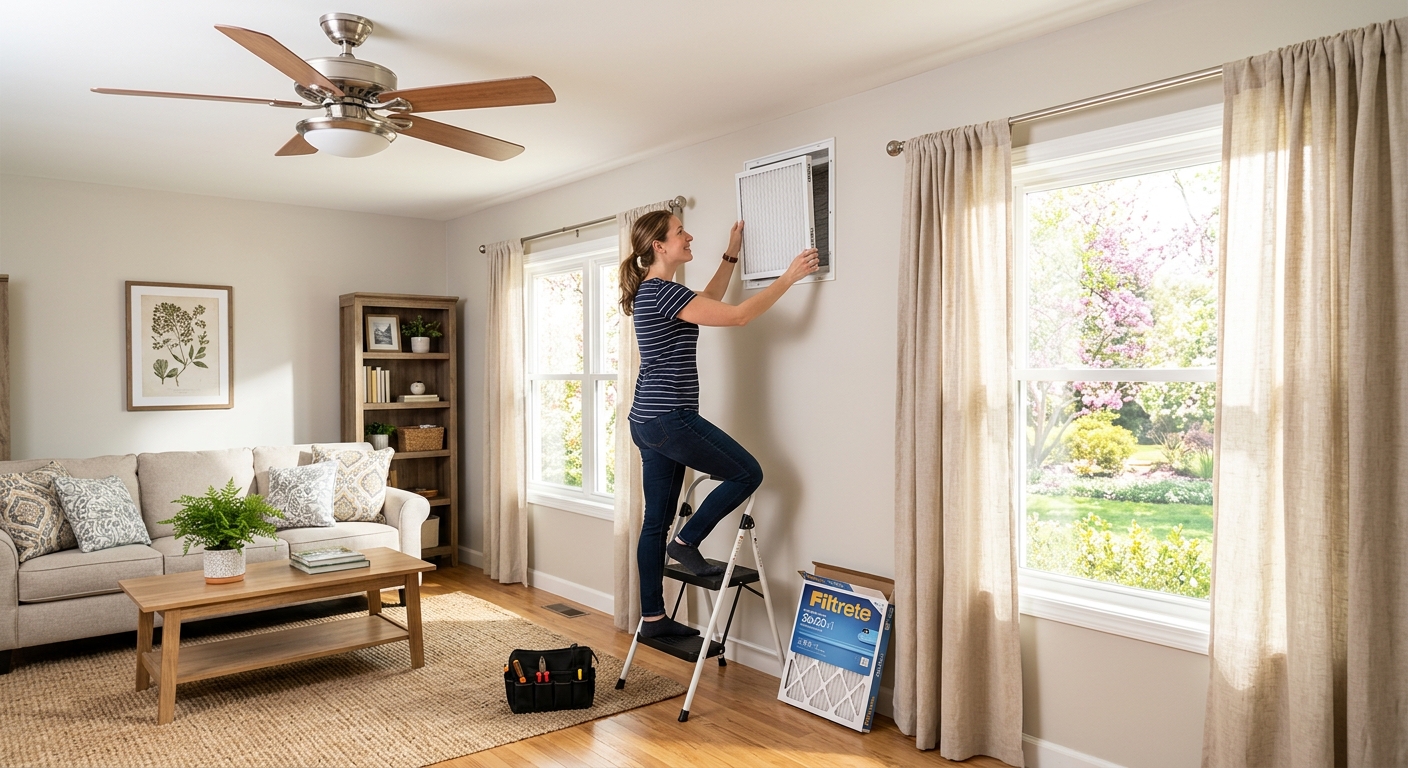
- Replace or clean the air filter. Hold the old filter up to light. If you cannot see light through it, replace it now. Use a MERV 8 filter for balanced filtration and airflow. Write the replacement date on the filter frame with a marker.
- Check every supply and return vent in the house. Make sure no furniture, rugs, or curtains block them. Move anything within 12 inches of a supply vent. Open all vent dampers fully unless a specific room is intentionally closed off.
- Switch all ceiling fans to counterclockwise rotation for summer. Stand below the fan and feel for a downdraft. If you feel air moving downward, it is correct. There is a small switch on the motor housing that reverses direction.
- Set your thermostat to a summer schedule: 78 degrees Fahrenheit when home, 85 degrees when away, and 80 degrees at night. If you have a smart or programmable thermostat, program these setbacks now before hot weather arrives.
- Walk the exterior of the house and clear at least 2 feet of space around the outdoor condenser unit. Remove leaves, trim back any shrubs, and straighten any bent metal fins on the coil with a fin comb or a butter knife if needed.
- Close blinds and curtains on south and west-facing windows before 11 a.m. on sunny days. This one behavioral habit reduces afternoon cooling load measurably and costs nothing.
- Complete all six steps in the Quick Pass approach first, then continue below.
- Flush the AC condensate drain line. Locate the PVC drain line near the indoor air handler and pour 1 cup of distilled white vinegar into the access port. This dissolves algae buildup that causes clogs, overflows, and water damage. Repeat this every 3 months during cooling season.
- Inspect accessible duct connections in the attic, basement, or crawlspace. Look for sections that have pulled apart, joints wrapped only in standard gray tape (which fails within 2 to 3 years), or flex duct that is kinked or compressed. Seal any open joints with UL 181-rated foil tape or mastic sealant. Even small duct leaks waste 20 to 30% of conditioned air before it reaches living spaces.
- Check attic insulation depth if you have access. The DOE recommends R-38 to R-60 for most U.S. climates. If you can see the tops of the ceiling joists through your insulation, you are likely under-insulated and losing significant cooling capacity. Note this for a future upgrade.
- Seal air leaks around window and door frames using a $5 tube of paintable acrylic caulk. Pay special attention to the corners of window frames, the gap between the window frame and the rough opening, and the threshold seal at exterior doors. Air infiltration accounts for 25 to 40% of heating and cooling energy loss in a typical home.
- Test and replace smoke and CO detector batteries while you have a step stool out. Spring is also the right time to check that bathroom and kitchen exhaust fans are venting properly. Hold a tissue near the grille while the fan runs. If the tissue does not get pulled toward the grille, the fan is either clogged or the duct is blocked, which adds humidity load to your AC system.
Why It Works: The Benefits
Combining a clean filter, sealed duct leaks, and proper thermostat scheduling can reduce seasonal cooling costs by 15 to 25%, saving the average household $60 to $150 over a single summer depending on climate and home size.
Unblocked vents, balanced fan direction, and sealed supply duct connections eliminate the hot and cold spots that make one room 5 to 8 degrees warmer than another on the same floor.
A system that runs cleanly with adequate airflow and a clear condenser experiences less compressor strain, reducing the risk of premature failure and potentially adding 2 to 5 years to equipment lifespan.
Replacing a clogged filter with a fresh MERV 8 to 11 filter removes more dust, pollen, and allergens from recirculated air, which matters most at the start of allergy season in spring.
Ceiling fans set correctly plus window treatments managed for afternoon sun can reduce perceived temperature by 4 to 6 degrees Fahrenheit without touching the thermostat, improving comfort at zero ongoing cost.
💰 Savings Impact by Action
Replacing a severely clogged filter restores full system airflow and can recover 10 to 15% of lost cooling efficiency immediately.
Programming 7 to 10 degree setbacks while away or sleeping saves approximately 10% annually on heating and cooling per DOE data.
Sealing gaps around windows, doors, and penetrations can reduce conditioned air loss by up to 20% in a typical home.
Sealing leaky duct connections in unconditioned spaces recovers 20 to 30% of conditioned air that would otherwise be lost to attics or crawlspaces.
Closing reflective window coverings on south and west windows during peak afternoon hours reduces solar heat gain by up to 45%, cutting cooling load by roughly 10 to 12%.
🏠 Key Concepts Explained
The Science Behind It
Your home’s comfort system works on a simple principle: the AC removes heat and humidity from indoor air and rejects it outside, while your building envelope determines how fast that heat returns. When any link in that chain is degraded, whether it is a dirty filter restricting airflow over the evaporator coil, a duct leak dumping conditioned air into the attic, or a clogged condenser coil struggling to shed heat on a 95-degree day, the system must run longer to achieve the same result. Longer runtimes mean higher bills, more wear, and rooms that never quite reach the set temperature.
Ceiling fans and solar control address a different physics problem: sensible heat gain. Windows, especially single-pane or older double-pane units facing west or south, transmit solar radiation directly into living spaces as heat. A standard 3-foot by 5-foot west-facing window can admit the equivalent of a 500-watt space heater worth of heat during peak afternoon hours. Closing a reflective blind or cellular shade before that heat enters is far more efficient than running the AC harder after it does. Similarly, the wind-chill effect of a ceiling fan lowers perceived temperature by 4 degrees Fahrenheit, meaning a thermostat set to 78 feels like 74, with no additional energy input beyond the fan motor’s 15 to 75 watts.
Air sealing matters because infiltration load is invisible and constant. Every crack around a window frame, outlet on an exterior wall, or gap where a pipe penetrates the floor allows outside air to enter and conditioned air to escape. The DOE estimates that the combined effect of these gaps in a typical home equals a 2-square-foot hole in the wall running 24 hours a day. Sealing those pathways with caulk and weatherstripping does not just reduce energy loss. It removes the humidity that outdoor air brings indoors, which is often the real reason homes feel uncomfortable even when the thermostat reading looks fine.
Frequently Asked Questions
▼ Why is my AC still running all day even after I did the tune-up?
A system that runs continuously on a very hot day is often correctly sized and simply working at its design limit. However, if it runs all day and still cannot reach the set temperature, check for duct leaks in the attic, a dirty evaporator coil inside the air handler, or a low refrigerant charge. Those last two require a licensed HVAC technician to diagnose and fix.
▼ Can renters do this without landlord permission?
Yes, almost entirely. Replacing filters, setting fan direction, adjusting thermostat schedules, clearing around the outdoor unit, and using window coverings require no permission and no permanent changes. For air sealing, use removable rope caulk on windows rather than permanent acrylic caulk, and skip any ductwork steps unless your lease specifically covers maintenance access.
▼ How long before I actually see the savings on my utility bill?
Most of these steps take effect immediately, but you will see the bill impact in your first full month of cooling season use compared to the same period last year. Thermostat scheduling alone typically shows a measurable reduction within the first 30-day billing cycle. Air sealing results compound over the full season and are most noticeable in months with extreme heat or humidity.
▼ What if my home is older than 30 years?
Older homes typically have higher baseline air leakage, thinner insulation, and single-pane or early double-pane windows, so the tune-up steps here still apply but the gains from air sealing and insulation checks will be proportionally larger. Focus especially on the attic insulation depth check and duct inspection since older duct systems with gray cloth tape are almost certainly leaking significantly. Consider budgeting for a professional energy audit to identify the highest-impact upgrades.
▼ My second floor is always hotter than the first floor. Will this help?
Yes, and the second floor temperature gap is almost always caused by a combination of duct leaks in the attic, insufficient attic insulation, and the natural stack effect carrying heat upward. Sealing attic duct connections and ensuring R-38 or better attic insulation are the two highest-impact fixes for this specific problem. Closing blinds on upper-floor south and west windows also makes a noticeable same-day difference.
Quick Tips
- Do your spring tune-up in April or early May, before the first heat wave, so you have time to address anything that needs a follow-up repair.
- Set a phone reminder to replace your air filter every 60 days during cooling season. Running a clogged filter for just one extra month can cut system airflow by 20%.
- If your home has a crawlspace, check that the vapor barrier is intact and that foundation vents are open heading into summer. Ground moisture adds humidity load that your AC must remove on top of air conditioning the space.
- Weatherstrip your attic hatch or door if it is inside the conditioned envelope. Attic air at 130 to 150 degrees Fahrenheit leaking into a second-floor hallway is one of the most overlooked comfort problems in two-story homes.
Variations for Your Situation
- Apartment/Rental: Renters can complete most of the Quick Pass with zero landlord interaction. Replace the filter if your lease requires tenant maintenance, or request the landlord do it in writing. Set ceiling fan direction, adjust thermostat scheduling, use removable rope caulk on drafty window frames (it peels off cleanly at move-out), and hang thermal curtains on west-facing windows. Budget $20 to $40 for rope caulk, a light-blocking curtain panel, and a basic smart plug for fan scheduling.
- Tight Budget (under $30): Focus on the zero-cost steps first: fan direction, vent unblocking, thermostat setback programming, and window shading habits. Then spend $10 on a new air filter and $5 on a tube of caulk for the leakiest window frames you can find. These four steps alone account for the majority of the energy savings in this guide and cost almost nothing.
- Older Home (pre-1980): Treat this as a diagnostic session, not just a tune-up. Use a stick of incense or a smoke pencil to find air leaks around outlets, window frames, and baseboards on exterior walls. Budget $40 to $80 for caulk, foam sealant for larger gaps, and door sweeps. Check the attic insulation depth carefully. Homes built before 1980 often have R-11 or less in the attic, and adding blown-in insulation to R-38 typically pays back in 2 to 4 years with significant comfort improvements in the first season.