Most homeowners do not think about air circulation until they spot black spots on a bathroom ceiling or peel back wallpaper to find a fuzzy surprise behind it. By that point, a ventilation problem that could have been fixed for under $200 has turned into a remediation bill that can easily top $3,000. Poor air circulation is one of the most common and most overlooked contributors to mold growth, and the signs are almost always present weeks or months before spores take hold.
The physics are straightforward: stagnant, humid air lingers against cool surfaces like windows, exterior walls, and ceiling corners. When that surface temperature drops below the dew point of the surrounding air, moisture condenses. Give it 24 to 48 hours of sustained moisture and you have the perfect conditions for mold colonization. The fix is rarely a major renovation. It usually starts with understanding where air is and is not moving inside your home.
This guide walks you through a systematic process for diagnosing circulation problems yourself, from a no-cost visual inspection you can finish in 30 minutes to a targeted DIY upgrade using inexpensive tools and fans. You will learn which rooms are highest risk, what warning signs to look for before mold appears, and exactly what to do about them.
What You’ll Need
Click on an item below to shop for the recommended items for this recipe on Amazon.
As an Amazon Associate, we earn from qualifying purchases.
How to Do It
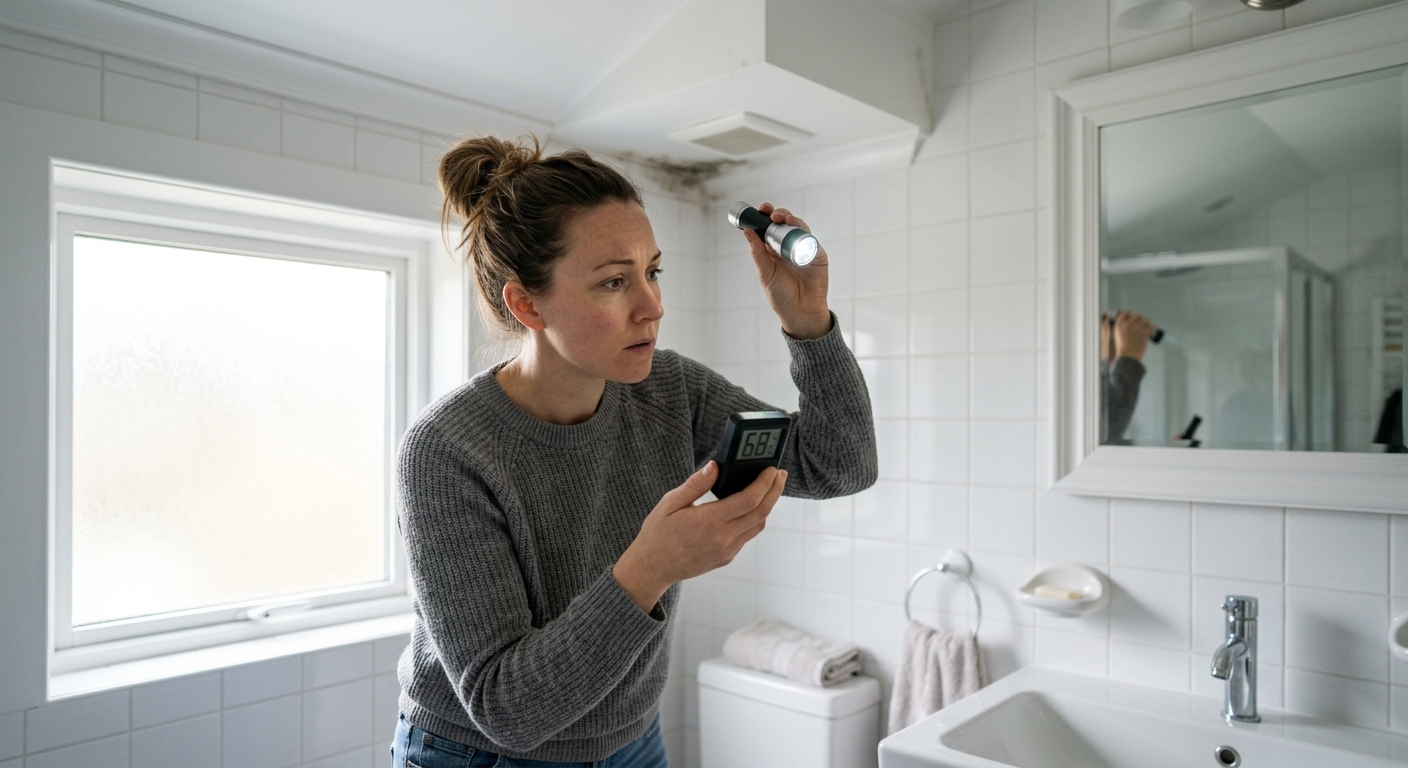
- Walk every room and check relative humidity with an inexpensive hygrometer ($10 to $15). Flag any room consistently above 55 percent RH as high risk and note the reading.
- Hold a single sheet of toilet paper or a lit incense stick near each HVAC supply and return register. Weak movement or no flutter indicates a blocked, closed, or undersized register. Mark these locations.
- Inspect bathroom exhaust fans by holding a sheet of toilet paper flat against the grille while the fan runs. It should hold the paper firmly in place. If it falls, the fan is underperforming and likely needs cleaning or replacement.
- Check all exterior wall corners, ceiling angles, behind furniture, and inside closets on exterior walls for soft drywall, discoloration, or a musty smell. These are the first signs of chronic condensation.
- Move furniture at least 2 to 3 inches away from exterior walls to restore airflow against those cold surfaces. This single step can reduce condensation risk on those walls by eliminating the dead air pocket.
- Open interior doors and keep them open during the day to allow air to circulate between rooms and equalize humidity. Closed doors can cause humidity in bathrooms and laundry rooms to spike 10 to 15 percent above adjacent spaces.
- Clean all bathroom and kitchen exhaust fan grilles and blades using a vacuum and damp cloth. A heavily dust-clogged fan can lose 30 to 50 percent of its rated CFM. If the fan is more than 10 years old and still underperforms after cleaning, replace it with a unit rated for at least 1 CFM per square foot of bathroom area.
- Add a small oscillating or box fan to any room that tested above 55 percent RH and showed weak register airflow. Position it to push air across the exterior wall, not just circulate it in the center of the room. Even a 20-watt fan running 8 hours per day costs roughly $0.50 per month to operate.
- Seal HVAC register dampers that are partially or fully closed in rooms you actually use. Every closed register increases static pressure in the duct system and reduces flow to adjacent rooms. Open all registers fully in occupied spaces.
- Install a plug-in dehumidifier in any basement, crawl space area, or chronically humid room. A 30-pint unit covers up to 1,500 square feet and can drop basement RH from 70 percent to below 50 percent within 24 to 48 hours, costing roughly $5 to $8 per month to operate.
- Apply weatherstripping to the bottom of bathroom doors if there is no gap for makeup air to enter when the exhaust fan runs. An exhaust fan cannot work efficiently without a makeup air path, usually a 1-inch gap under the door or a transfer grille.
- Run bathroom exhaust fans for 20 minutes after every shower, not just during. Post-shower humidity lingers in the room and continues to condense on cool surfaces for 15 to 30 minutes after the water stops. Use a timer switch ($15 to $25) so this happens automatically.
- Schedule a Manual J load calculation and duct leakage test with a licensed HVAC contractor. Duct leakage to unconditioned spaces averages 20 to 30 percent in homes built before 2000 and is a major driver of humidity imbalances between rooms.
- Request a blower door test from a BPI-certified energy auditor. This identifies where outside air is infiltrating and where conditioned air is escaping, pinpointing the pressure imbalances that create dead zones and draw humid air into wall cavities.
- Have the contractor check whether your home has balanced ventilation. Many older homes rely entirely on natural infiltration with no mechanical fresh air system. Adding an Energy Recovery Ventilator (ERV) provides controlled fresh air while recovering 70 to 80 percent of the energy from exhaust air.
- Ask for a room-by-room airflow measurement using an anemometer or flow hood. Any room receiving less than 0.35 air changes per hour is inadequately ventilated per ASHRAE Standard 62.2 and is a mold risk candidate.
- Review recommendations and prioritize duct sealing first if leakage exceeds 10 percent of system airflow. Professionally sealed ducts using mastic or aerosol duct sealing (Aeroseal) can reduce leakage by 70 to 90 percent and typically pay back within 3 to 5 years in energy savings alone.
Why It Works: The Benefits
Correcting air circulation early eliminates the sustained surface moisture mold requires, avoiding remediation costs that average $2,000 to $6,000 for a single affected room and can exceed $30,000 for whole-home infestations.
Reducing indoor relative humidity from 65 percent to 50 percent can lower the perceived temperature by 3 to 5 degrees, allowing you to raise your thermostat setpoint and cut cooling costs by 6 to 10 percent.
Improving air circulation dilutes indoor pollutants including VOCs, carbon dioxide, and particulates. Studies show properly ventilated homes can have 2 to 5 times lower concentrations of airborne contaminants than stagnant homes.
Persistent moisture without adequate circulation causes wood rot, paint failure, and drywall deterioration. Addressing circulation early prevents structural repairs that can cost $500 to $5,000 per affected area.
Research links high indoor humidity and poor air movement to disrupted sleep and increased allergy symptoms. Homes maintained at 40 to 50 percent RH with adequate airflow report measurably better occupant comfort scores.
💰 Savings Impact by Action
Running bathroom exhaust fans properly after every shower reduces post-shower surface moisture by up to 80 percent, the primary factor in bathroom mold prevention.
Lowering indoor relative humidity from 65 percent to 50 percent reduces the air conditioning system’s latent load, cutting cooling energy use by approximately 10 percent.
Sealing leaky ducts reduces conditioned air loss to unconditioned spaces by up to 20 percent, directly improving room-to-room airflow balance and humidity distribution.
Catching and correcting a ventilation problem before visible mold appears avoids remediation costs that in most cases exceed the prevention cost by 95 percent or more.
Moving furniture 2 to 3 inches from exterior walls restores boundary-layer airflow against those surfaces, reducing localized condensation risk by an estimated 30 percent in affected corners.
🏠 Key Concepts Explained
The Science Behind It
Air circulation prevents mold through two distinct mechanisms: it keeps surface temperatures above the dew point, and it dilutes and removes moisture-laden air before it can deposit on those surfaces. When air moves across a wall or ceiling, it carries a thin boundary layer of relatively dry air with it, which acts as a buffer against condensation. In a stagnant room, that boundary layer becomes saturated with moisture and sticks in place, allowing condensation to build over hours and days.
Relative humidity alone does not cause mold. What matters is the moisture content of the specific surface where mold might grow. A room at 50 percent RH with poor airflow can still develop mold on an exterior wall corner where the surface temperature has dropped to 55 degrees F, because that localized surface is well below the dew point of the room air. This is why circulation matters more than average humidity readings, and why corner and wall-adjacent measurements tell a more accurate story than center-room readings.
ASHRAE Standard 62.2 defines the minimum ventilation rate for residential spaces as 0.35 air changes per hour or 15 CFM per person, whichever is greater. Most older homes achieve this accidentally through infiltration, but when homes are tightened through air sealing and insulation upgrades without adding mechanical ventilation, air change rates can drop to 0.10 to 0.15 per hour, dramatically increasing mold and indoor air quality risk. This is the core principle behind the building science phrase: build tight, ventilate right.
Frequently Asked Questions
▼ My bathroom exhaust fan is running but the room still steams up and smells musty. What is wrong?
The most common culprit is a disconnected or crushed duct behind the fan that is venting into the attic or wall cavity instead of outside. Get on a ladder and trace the duct from the fan housing to where it exits the roof or soffit. If it is disconnected, reconnect it with foil tape (not standard duct tape) and ensure the exterior cap opens freely when the fan runs. Also confirm the fan is rated for at least 50 CFM for a standard bathroom or 1 CFM per square foot for larger spaces.
▼ I found a small amount of mold in my bathroom. Can I clean it myself and fix the circulation, or do I need a professional?
Mold patches smaller than 10 square feet can generally be cleaned yourself using a solution of 1 cup bleach per gallon of water on non-porous surfaces, or a commercial mold cleaner rated for the surface type. Wear gloves and eye protection, and ventilate the room well during cleaning. After cleaning, you must fix the underlying airflow or humidity issue or the mold will return within weeks. If the mold is on drywall and has penetrated the paper face, that section of drywall needs to be cut out and replaced, not just surface-cleaned.
▼ My home has central air conditioning but some rooms are always more humid than others. Why?
Room-to-room humidity imbalances usually mean those rooms have inadequate supply airflow, excessive air leakage to the outside, or both. Check that supply registers in the humid rooms are fully open and unobstructed. If the rooms are above a garage or on an exterior corner, air sealing the floor and wall penetrations in those spaces may resolve it. A contractor can measure airflow at each register with a flow hood and rebalance the system by adjusting dampers or adding a booster fan if one room is consistently under-served.
▼ How long after I improve the airflow should it take to see my humidity levels drop?
In a typical 1,500 to 2,500 square foot home, adding a running dehumidifier or improving exhaust fan performance will drop relative humidity to the target range of 30 to 50 percent within 24 to 72 hours under normal conditions. Opening interior doors and moving furniture takes effect almost immediately on a hygrometer reading in that specific spot. If humidity remains above 55 percent in a room after 5 to 7 days of consistent fan use and open doors, there is likely a moisture source such as a slow plumbing leak, a foundation crack, or a dryer venting indoors that needs to be found and addressed.
▼ Can poor air circulation cause health problems even if I do not see any visible mold?
Yes. Elevated indoor humidity, stagnant air, and the early-stage microbial growth that precedes visible mold can all irritate respiratory systems and worsen asthma and allergy symptoms. Indoor VOC concentrations also rise in poorly ventilated homes because there is less dilution from fresh air. If occupants are experiencing persistent headaches, allergy symptoms, or respiratory irritation without an obvious cause, poor ventilation is a logical place to start investigating alongside a home inspection for hidden moisture.
Quick Tips
- Check humidity in every room on the same day and same time of day for a useful apples-to-apples comparison. Humidity fluctuates 10 to 20 percent throughout the day depending on cooking, showers, and outdoor conditions.
- Closets on exterior walls are one of the most overlooked mold locations. Leave closet doors cracked open 2 to 3 inches to allow the conditioned air from the room to moderate the temperature and humidity inside.
- Cooking and showering generate the two largest single-event humidity spikes in a home. Always run kitchen and bathroom exhaust fans during and for 15 to 20 minutes after these activities, every time, without exception.
- If your dryer vents indoors in winter to capture heat, stop immediately. A single dryer cycle releases 4 to 6 pints of moisture into the indoor air, which is enough to spike whole-home humidity by 5 to 10 percent and create condensation on every cold surface in the home.
Variations for Your Situation
- Apartment/Rental: Renters cannot modify central HVAC or install permanent exhaust fans, but you can clean existing fan grilles, place a plug-in hygrometer in each room, run a $40 to $80 plug-in dehumidifier in high-humidity spaces, and use a $25 to $50 HEPA air circulator to keep air moving along exterior walls. Document humidity readings and share them with your landlord if levels consistently exceed 60 percent, as many jurisdictions require landlords to maintain habitable air quality conditions.
- Tight Budget (under $50): Focus on the free actions first: move furniture away from exterior walls, open interior doors, and run existing exhaust fans longer. A $10 to $15 hygrometer is the single highest-value purchase because it tells you exactly which rooms to prioritize. A $5 bag of baking soda placed open in a closet or a reusable desiccant pack ($8 to $12) can meaningfully reduce humidity in a small enclosed space like a closet or cabinet.
- Older Home (pre-1980): Homes built before modern vapor barriers and insulation standards have much higher baseline infiltration rates, which can mask poor mechanical ventilation while still creating cold spots on poorly insulated walls. Focus your inspection on exterior wall corners, basement rim joists, and any room above an unheated crawl space or garage, as these are the coldest surfaces in the building envelope and the most likely to fall below the dew point in winter. Adding 2 to 3 inches of spray foam insulation to the rim joist area costs $200 to $500 and can eliminate one of the most common mold entry points in older construction.