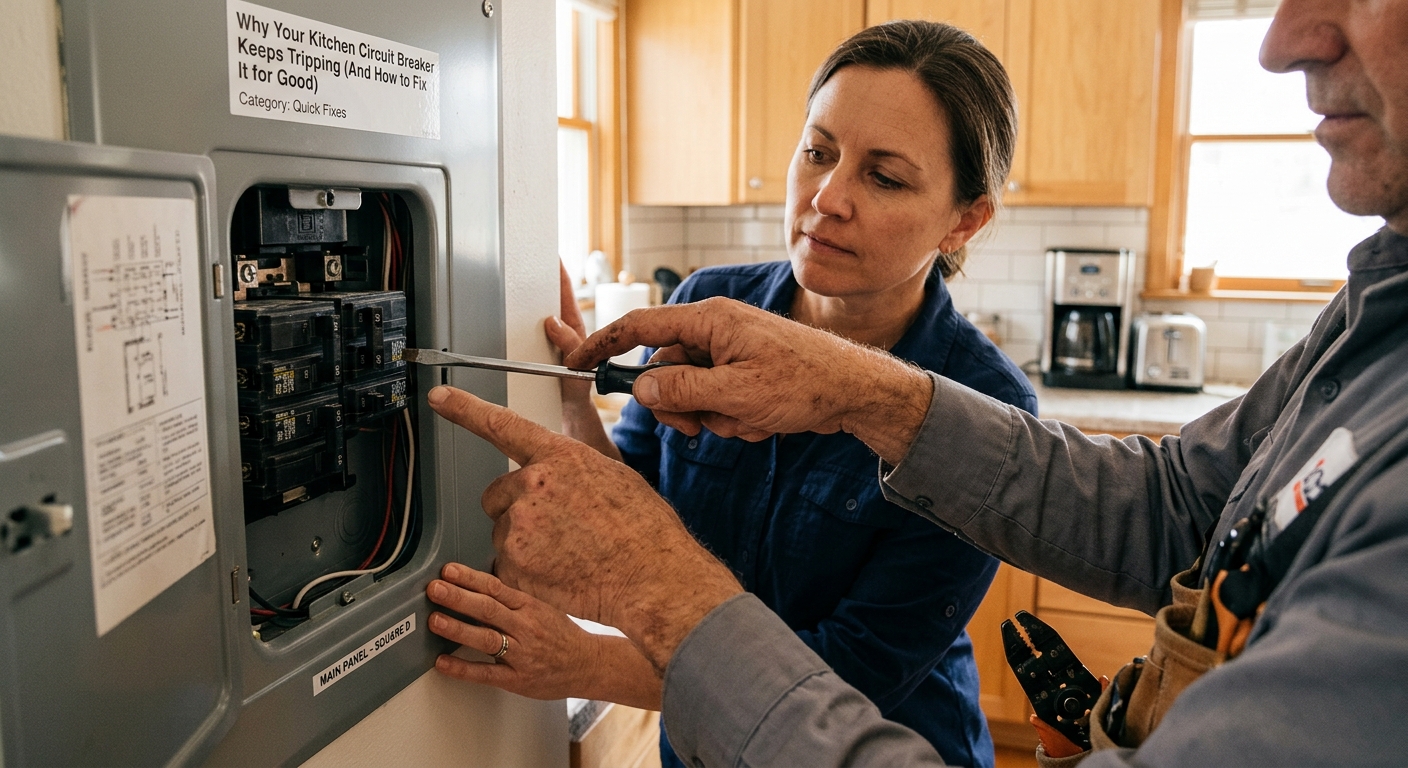
Few things are more frustrating than a kitchen breaker that trips mid-meal, shutting down your microwave, toaster, and coffee maker all at once. Most homeowners just flip the breaker back and move on, but repeated tripping is your electrical panel’s way of telling you something is wrong. Ignoring it can mean damaged appliances, wasted energy, or in serious cases, a house fire.
Kitchen circuits are among the most heavily loaded in any home. Modern kitchens pack refrigerators, microwaves, dishwashers, and a lineup of countertop appliances onto circuits that may not have been designed for today’s energy demands. A standard 15-amp circuit can only handle about 1,800 watts continuously, and a single microwave alone can draw 1,000 to 1,500 watts. Add a toaster at 900 watts and you have already hit the limit before your morning coffee is ready.
This post covers exactly why kitchen breakers trip, how to diagnose whether you have an overloaded circuit, a faulty breaker, or a wiring issue, and what you can do about it – from zero-cost habit changes to a professional circuit upgrade. You will also find real numbers on costs, safety guidance, and answers to the questions homeowners most commonly ask.
What You’ll Need
Click on an item below to shop for the recommended items for this recipe on Amazon.
As an Amazon Associate, we earn from qualifying purchases.
How to Do It
- Unplug all appliances on the tripped circuit, then reset the breaker by pushing it firmly to the OFF position first, then back to ON. Never force a breaker that resists.
- Make a list of every appliance on that kitchen circuit. Check the wattage label on each appliance and add them up. A 15-amp circuit handles up to 1,800 watts; a 20-amp circuit handles up to 2,400 watts. If your total exceeds 80% of capacity (1,440W or 1,920W), you have an overload.
- Stagger high-draw appliances so they never run simultaneously. For example, finish toasting before running the microwave, and start the dishwasher after the coffee maker finishes.
- Check whether any GFCI outlets in the kitchen have tripped separately from the main breaker. Look for small TEST and RESET buttons on outlets near the sink. Press RESET firmly. A tripped GFCI will cut power to all outlets downstream of it on that circuit.
- Move any portable high-draw appliances such as an air fryer, electric kettle, or countertop oven to a different circuit in another room if possible. Reducing the kitchen circuit load by even 500 watts can eliminate trips entirely.
- Confirm the breaker is the problem by first eliminating overloading using the load management steps above. If the breaker still trips at normal loads, or if it trips immediately upon reset, or if it feels loose or shows scorch marks, the breaker itself is likely faulty.
- Purchase an exact replacement breaker that matches the brand, amperage, and pole configuration of your existing breaker. Brands are generally not interchangeable; a Square D breaker cannot safely replace a Siemens breaker. Check the panel door label for the approved breaker list.
- Turn off the main breaker to cut power to all branch circuits. Use a non-contact voltage tester to verify the wires going to the problem breaker are no longer live before touching anything.
- Remove the panel cover plate by unscrewing the four corner screws. Loosen the screw terminal on the faulty breaker, remove the wire, then unclip the breaker from the bus bar by tilting it outward.
- Snap the new breaker onto the bus bar, insert the wire into the terminal, and tighten the screw to the torque specified on the breaker label, typically 20 to 35 inch-pounds. Replace the panel cover, restore main power, and test the circuit under normal load.
- If the new breaker trips at the same loads, the problem is not the breaker. Stop and call a licensed electrician, as the issue may be a wiring fault, loose connection, or undersized wire.
- Hire a licensed electrician to evaluate your current kitchen circuit layout and identify which appliances need their own dedicated circuit. Refrigerators, microwaves, and dishwashers each ideally have a dedicated 20-amp circuit.
- Have the electrician run 12-gauge wire from the panel to new outlet locations. In most kitchens this involves fishing wire through walls, which is where the labor cost is concentrated.
- Ensure new circuits include proper GFCI protection at all countertop outlets within 6 feet of a sink, as required by current NEC code. Your electrician should install GFCI breakers or GFCI outlets at the first outlet on each circuit.
- Request an electrical permit for the work. Permitted work is inspected, which protects you legally and ensures the job is done to code. Unpermitted electrical work can void homeowner’s insurance and complicate a future home sale.
- After installation, label each new breaker clearly in your panel. Keep a written record of which outlets and appliances are on which circuit. This simple step saves significant diagnostic time if a trip ever occurs in the future.
Why It Works: The Benefits
Properly load-balanced or dedicated kitchen circuits stop unexpected shutdowns entirely, so you never lose power mid-cooking again.
Repeated power interruptions and voltage fluctuations caused by overloaded circuits can degrade compressors, control boards, and heating elements, shortening appliance life by 2 to 5 years and costing $200 to $800 or more in early replacements.
Overloaded wiring is a leading cause of residential electrical fires. The U.S. Fire Administration attributes roughly 51,000 home electrical fires per year to electrical failures, many of which stem from overloaded circuits. Addressing the root cause directly lowers your risk.
Sharing circuits forces appliances to compete for power, increasing inefficiency. Dedicated circuits for high-draw appliances can reduce wasted standby energy by 5 to 10% on those specific loads.
Updated, code-compliant kitchen wiring is a selling point and can lower homeowner’s insurance premiums. Some insurers reduce rates by 5 to 10% for panel upgrades in homes with older electrical systems.
💰 Savings Impact by Action
Staggering high-draw appliances reduces peak demand and can lower energy waste from power fluctuations by up to 8% on kitchen circuits.
Dedicated circuits eliminate shared-load inefficiency and reduce standby energy waste by 5 to 10% for refrigerators and dishwashers.
Preventing repeated power interruptions extends appliance lifespan by up to 20%, avoiding $200 to $800 in premature replacement costs.
Upgrading to a code-compliant panel and dedicated kitchen circuits can reduce homeowner’s insurance premiums by 5 to 10% annually.
🏠 Key Concepts Explained
The Science Behind It
A circuit breaker is a thermally actuated switch. Inside the breaker is a bimetallic strip made of two metals bonded together that expand at different rates when heated. When current flows through the strip, it heats up. At normal loads, the heat is manageable. But when current exceeds the rated amperage, the strip bends enough to trip a mechanical latch and open the circuit. This thermal response takes a few seconds to minutes depending on how far over the limit the current is, which is why a severe overload trips the breaker faster than a mild one.
Kitchens are uniquely challenging because they concentrate resistive heating loads in one room. Resistive appliances like toasters, microwaves, and electric kettles convert nearly all electrical energy to heat, drawing maximum current the entire time they operate. Unlike lighting or entertainment electronics that draw modest, steady current, these appliances push circuits to the edge of their rated capacity immediately on startup. The 80% continuous load rule exists precisely because sustained operation at 100% of rated capacity generates enough heat in the wire insulation over time to degrade it, even if the breaker does not immediately trip.
GFCI protection operates on an entirely different principle. Rather than measuring total current, a GFCI device continuously compares current flowing out on the hot wire against current returning on the neutral wire. Under normal conditions these are equal. If even 4 to 6 milliamps goes missing, it means current is leaking somewhere, possibly through a person or through water. The GFCI trips in under 1/40th of a second, fast enough to prevent electrocution. In kitchens, where water and electricity coexist at every counter, this protection is not optional under modern building codes.
Frequently Asked Questions
▼ My breaker trips immediately every time I reset it. What does that mean?
Immediate re-tripping with nothing plugged in almost always means a short circuit or a ground fault in the wiring, not an overloaded circuit. Stop resetting it and call a licensed electrician. Repeatedly forcing a breaker closed against a short can damage wiring, melt insulation, or start a fire inside a wall.
▼ Can I just replace a 15-amp breaker with a 20-amp breaker to fix the tripping?
Only if the wiring on that circuit is confirmed to be 12-gauge copper wire. If the wire is 14-gauge, upsizing the breaker removes the wire’s only overload protection and is a serious fire hazard. Check the wire gauge at the outlet box before touching the panel, or have an electrician confirm it. Do not guess.
▼ My breaker trips only when I run the dishwasher. Is that a dishwasher problem or a circuit problem?
If the dishwasher is sharing a circuit with other loads, it is most likely a circuit overload triggered by the dishwasher’s startup surge. Try running the dishwasher with nothing else on that circuit. If it still trips alone, the dishwasher may have an internal fault causing a ground fault condition, or the circuit is undersized. Dishwashers ideally run on a dedicated 20-amp circuit.
▼ How do I tell whether it is the panel breaker or a GFCI outlet that tripped?
Go to the affected outlets and look for small TEST and RESET buttons, usually located on one outlet near the sink or on the outlet where the appliance is plugged in. If you see a popped RESET button, press it firmly until it clicks. If that restores power, it was the GFCI, not the panel breaker. Panel breakers are located in your main electrical panel and have a physical switch handle that lands in a middle position when tripped.
▼ My kitchen is in a home built in the 1970s. Should I be worried about more than just the breaker?
Yes. Homes built before 1985 may have aluminum branch circuit wiring, which expands and contracts at a different rate than copper and can loosen connections over time, creating heat and fire hazards. Have a licensed electrician inspect the wiring if you see silver-colored wire (copper is orange-pink) or if your panel uses aluminum wire on 15 and 20-amp circuits. This is a separate and more serious issue than an overloaded circuit.
Quick Tips
- Know the wattage of your top five kitchen appliances. Add them up before running them together. If the total exceeds 1,440 watts on a 15-amp circuit or 1,920 watts on a 20-amp circuit, stagger your usage.
- A microwave and a toaster running simultaneously on the same 15-amp circuit will almost always cause a trip. These two appliances alone can draw 1,900 to 2,400 watts combined.
- Check your refrigerator’s electrical label. Many modern refrigerators recommend a dedicated 15 or 20-amp circuit. If your fridge shares a circuit with other appliances, a compressor startup surge can trip the breaker unexpectedly.
- Replace any GFCI outlet that trips frequently even with no apparent fault. GFCI devices have a lifespan of about 10 to 15 years, and aging GFCIs develop nuisance tripping that feels identical to a panel breaker trip but is completely separate.
Variations for Your Situation
- Apartment/Rental: Renters cannot modify wiring or replace breakers, but load management is fully within your control. Map your kitchen outlets using a smart plug with an energy monitor (around $15 to $25) to measure actual wattage in real time. Avoid running the microwave and toaster simultaneously, and plug high-draw countertop appliances like air fryers into outlets in the living room that are on a separate circuit. Report repeated tripping to your landlord in writing, as it is their legal responsibility to maintain safe electrical systems.
- Tight Budget (under $50): Focus entirely on the zero-cost load management approach first. If you identify a faulty GFCI outlet as the cause, replacement GFCI outlets cost $12 to $20 at any hardware store and are a straightforward swap with no panel work involved. Replacing a single faulty breaker yourself costs $15 to $60 and is the only other sub-$50 fix available.
- Older Home (pre-1980): Older homes frequently have only one kitchen circuit and 14-gauge wiring throughout, limiting circuits to 15 amps. Before any DIY work, have an electrician inspect for aluminum branch wiring, Federal Pacific or Zinsco panels, and two-prong ungrounded outlets, all of which indicate electrical systems that need professional evaluation before adding load. Budget $150 to $300 for an electrical inspection and get a written scope of work before starting any upgrades.