If you’ve ever woken up sweating at 2 a.m. despite your thermostat being set to 74°F, the problem probably isn’t your AC. It’s the heat stored in your walls, ceilings, and floors all day long. That stored heat, called thermal mass, keeps radiating into your living spaces long after the sun goes down, forcing your air conditioner to fight an uphill battle all night. The result is higher bills, a noisier home, and bedrooms that never quite cool down to comfortable sleeping temperatures.
A whole-house fan is one of the most underrated solutions in residential energy efficiency. Mounted in the ceiling between your living space and attic, it draws in cool outdoor air through open windows and exhausts the hot attic air out through roof vents, replacing your entire home’s air volume in just a few minutes. On a night when outdoor temperatures drop to 65°F or below, most homeowners can shut off the AC entirely and run the fan for pennies. The Department of Energy estimates whole-house fans can reduce air conditioning use by 50 to 90% on mild summer evenings.
This post covers everything you need to know: how whole-house fans actually work, the two main approaches (DIY installation vs. hiring a pro), realistic costs and payback periods, and the specific situations where they perform best. Whether you’re tired of $300 electric bills or just want your home to feel fresher in the mornings, this is one home upgrade that pays for itself faster than almost anything else you can do to your HVAC system.
What You’ll Need
Click on an item below to shop for the recommended items for this recipe on Amazon.
As an Amazon Associate, we earn from qualifying purchases.
How to Do It
- Calculate the CFM you need: multiply your home’s square footage by 2 to 3 (a 2,000 sq ft home needs 4,000 to 6,000 CFM). Choose a fan sized to that range or slightly above.
- Verify attic ventilation: measure your existing net free vent area (marked on vent packaging). You need at least 1 sq ft of vent area per 750 CFM of fan capacity. Add gable or ridge vents if needed before proceeding.
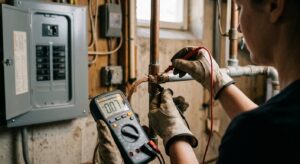
- Turn off the circuit at the breaker and use a non-contact voltage tester to confirm power is off. Choose an installation location centered in a hallway ceiling, away from joists, for maximum airflow from all rooms.
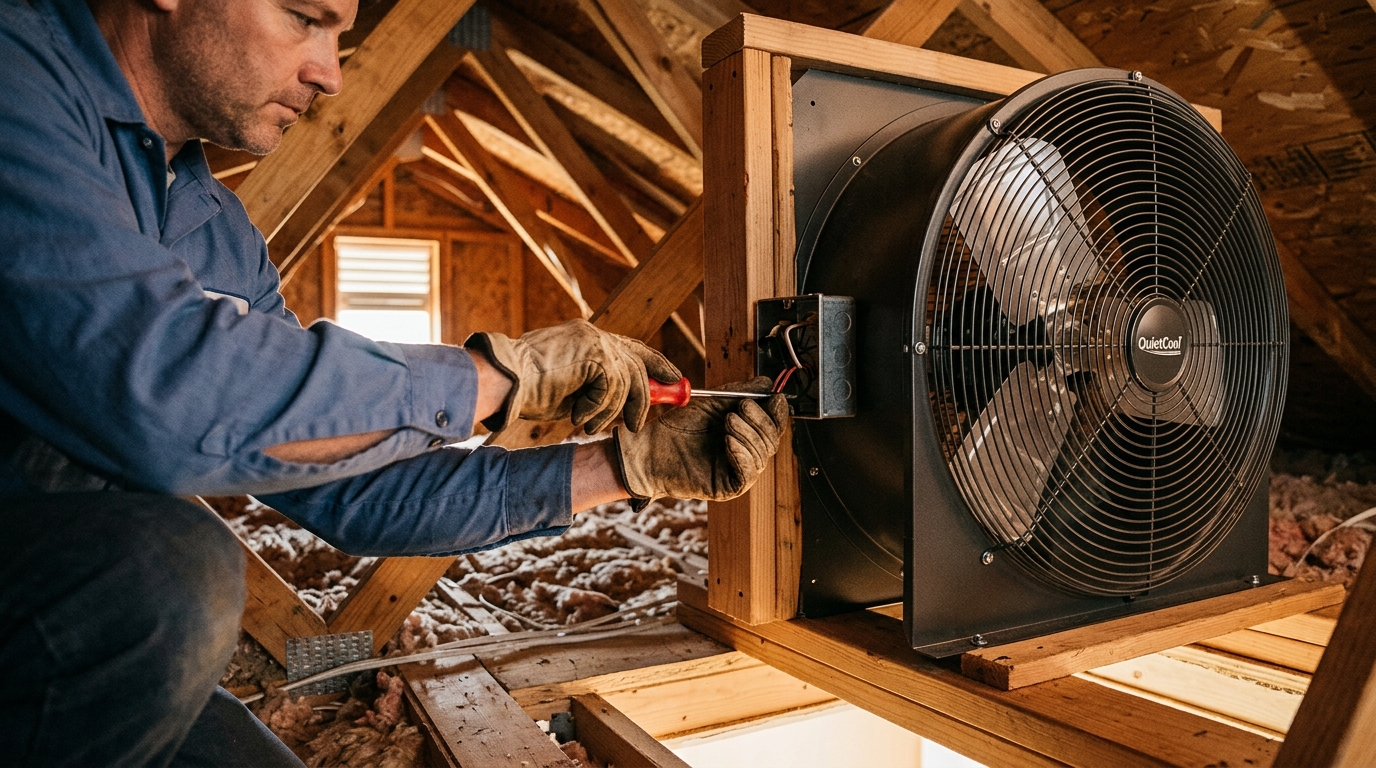
- Cut the ceiling opening per the fan’s template. In the attic, secure the fan mounting frame to joists using the supplied hardware, ensuring the damper or shutter sits flush against the ceiling drywall.
- Run a dedicated 120V circuit from your electrical panel to the fan location if one does not already exist, or connect to an existing 15-amp circuit with no other major loads. Wire according to the fan’s diagram using appropriate wire gauge (typically 14-gauge for 15-amp).
- Install the wall-mounted timer or speed switch, restore power, and test the fan at each speed with windows open at least 4 inches per room. Check attic for adequate airflow and listen for rattling or vibration at the ceiling mount.
- Get at least two quotes from licensed HVAC contractors or electricians who have installed whole-house fans. Ask specifically about experience with insulated, quiet-rated models rather than older belt-driven units.
- Before the appointment, clear access to your attic hatch and identify the central hallway ceiling location you prefer. Let the contractor confirm feasibility and suggest alternatives if needed.
- Request that the installer use an insulated, dual-damper model (such as the Tamarack HV1600 or QuietCool QC ES-4700) to prevent winter heat loss and reduce noise compared to traditional shutter-style fans.
- Ask for a dedicated circuit rather than sharing with other loads. Confirm the installer will verify and if necessary upgrade attic net free vent area to match the fan’s CFM rating.
- After installation, ask the contractor to walk you through the timer or smart control operation and confirm all dampers seal properly when the fan is off. Request documentation of the circuit breaker location and breaker label.
- Select a variable-speed whole-house fan with a compatible smart controller (QuietCool’s Smart App series or models compatible with Leviton Z-Wave switches work well).
- Complete the physical installation following the DIY approach steps above, but wire to a smart in-wall switch or the fan’s proprietary smart module rather than a standard timer.
- Connect the smart switch to your home Wi-Fi and install the manufacturer’s app. Set automation rules: turn on when outdoor temp drops below 68°F and indoor temp is above 72°F, and shut off at 6 a.m. or when outdoor humidity exceeds 65% relative humidity.
- Integrate with your smart thermostat using IFTTT or the thermostat’s built-in routines so the AC does not run simultaneously with the whole-house fan. Most smart thermostats support a ‘fan running’ input that suppresses cooling mode.
- Use a plug-in energy monitor (like Emporia Vue) on the fan’s circuit for the first 30 days to calculate actual hourly operating cost and verify savings against your prior billing period.
Why It Works: The Benefits
On nights when outdoor temperatures drop below 68°F, running a whole-house fan instead of the AC costs roughly 10 to 15 cents per hour versus $1.00 or more for central air. Homeowners in climates like the Pacific Northwest, Mountain West, and Upper Midwest often cut summer cooling costs by 50 to 75% annually.
A properly sized whole-house fan (typically 1,000 to 4,000 CFM) can drop interior temperatures by 5 to 10°F in 15 to 30 minutes by flushing out hot air and drawing in cool outdoor air, compared to the 1 to 2 hours it can take AC alone to overcome evening heat retention.
Most homes have very little natural ventilation. A whole-house fan can exchange the entire volume of interior air in 1 to 3 minutes, purging cooking odors, VOCs from furniture and cleaners, pet dander, and carbon dioxide that accumulates during the day.
Every hour the whole-house fan replaces your AC is an hour less run time on your compressor. Reducing AC runtime by even 30% annually can extend compressor life by several years and reduce the frequency of refrigerant and coil maintenance calls.
Sleep research shows the ideal bedroom temperature for deep sleep is 65 to 68°F. The gentle, consistent airflow from a whole-house fan makes bedrooms feel cooler than the thermostat reading suggests, and the white noise masks outside sounds, which many people find helps them sleep more soundly.
💰 Savings Impact by Action
On nights when outdoor temps drop below 68°F, running a whole-house fan instead of the AC reduces cooling energy use by up to 90%, with a practical average of 70 to 75% on those evenings.
Purging superheated attic air drops attic temperatures by 40 to 60°F within 15 minutes, reducing the heat load radiating through ceiling insulation by approximately 40%.
Pre-cooling the home’s thermal mass before bed allows many homeowners to run no AC overnight, reducing nightly HVAC runtime by 50% or more during the cooling season.
In favorable climates (Pacific Northwest, Mountain West, Upper Midwest), whole-house fans can reduce total seasonal cooling costs by 30 to 50% compared to AC-only households.
A 3,000 CFM whole-house fan draws roughly 400 watts versus 3,500 watts for a 3-ton AC compressor, costing about 88% less per hour to operate at average U.S. electricity rates.
🏠 Key Concepts Explained
The Science Behind It
The reason a whole-house fan feels so effective comes down to two overlapping physics principles: convective cooling and thermal mass discharge. During the day, your home’s structural materials absorb solar energy. By evening, even after the outdoor air cools, those materials continue to radiate heat inward. Your AC must remove not just the air temperature but the energy stored in every surface. A whole-house fan accelerates the discharge of that stored energy by forcing a continuous flow of cooler outdoor air across every surface, carrying heat away through convection at a rate no AC system can match.
The attic is the other critical piece. A poorly ventilated attic in summer routinely reaches 140 to 160°F, and that superheated air mass sits directly above your insulated ceiling, continuously conducting heat downward. A whole-house fan exhausts this hot attic air in minutes once it begins operating, dropping attic temperatures by 40 to 60°F within the first 15 minutes of operation. This directly reduces the temperature gradient across your ceiling insulation and cuts the heat gain into your living space even after you turn the fan off.
From an energy standpoint, the comparison is stark. A whole-house fan motor typically draws 200 to 600 watts depending on size and speed. A central air conditioner with a 3-ton compressor draws 3,000 to 5,000 watts. That means the fan costs roughly one-tenth as much per hour to operate. When outdoor conditions allow the fan to replace AC entirely for 4 to 6 hours per night, and your cooling season spans 90 to 120 days, the cumulative savings on a typical utility rate of $0.14 per kWh can easily reach $150 to $400 per year, producing a payback period of 2 to 4 years on a mid-range installation.
Frequently Asked Questions
▼ How do I know if my attic has enough ventilation for a whole-house fan?
Measure your existing vents and check their net free area (NFA) rating printed on the label or in the product specs. You need at least 1 square foot of NFA per 750 CFM of fan capacity, so a 3,000 CFM fan requires 4 square feet of NFA total. If you fall short, add gable vents or a ridge vent before operating the fan, or you risk back-drafting combustion appliances.
▼ My whole-house fan is really loud. Is that normal?
Older shutter-style fans are notoriously loud, often 60 to 70 decibels, because of belt-driven motors and lightweight plastic shutters that rattle. If you have one of these, replacing the shutters and lubricating the motor bearings can help marginally. The real fix is upgrading to a modern insulated-damper model with a direct-drive motor, which typically operates at 40 to 50 decibels, similar to a quiet conversation.
▼ Can I use a whole-house fan in a humid climate like Florida or the Gulf Coast?
Whole-house fans are least effective in climates where nighttime dew points stay above 65°F, which is common in Florida, coastal Louisiana, and similar regions from June through September. In these areas, bringing in outdoor air at night may raise indoor humidity rather than lower it, which can make the space feel hotter and potentially cause moisture issues. Stick to AC in peak humidity months and reserve the fan for spring and fall evenings.
▼ Will a whole-house fan make my heating bills worse in winter?
It can if you choose the wrong model. Traditional shutter-style fans leave a significant gap in your ceiling when closed, which can increase heating costs by 5 to 15%. Always choose an insulated damper model (like the Tamarack or QuietCool insulated series) that seals with a foam-gasketed cover in winter. If you already have an older fan, purchase an insulating cover kit for the ceiling opening that adds an R-38 barrier during heating season.
▼ How many windows do I need to open for the fan to work properly?
Open at least one window in every occupied room, with a minimum opening of 4 inches. More opening area is better: a completely blocked window in a bedroom means that room gets no fresh air and the fan pulls harder through other openings, creating uncomfortable drafts elsewhere. If you want to focus cooling on specific rooms, open those windows wider and crack others to balance airflow throughout the house.
Quick Tips
- Open windows on multiple sides of the house rather than just one side to maximize cross-ventilation and avoid creating a single pressure point that stresses window frames.
- Start the fan before the outdoor temperature drops to its nightly low, typically around 8 to 9 p.m., so you capture the full cooling window rather than waiting until midnight.
- Close your window blinds and curtains during the day to reduce solar heat gain, so you start the evening with lower thermal mass temperatures and the fan has less work to do.
- Check your attic insulation depth before installing: a whole-house fan works best when ceiling insulation is R-30 or above, because inadequate insulation means the fan’s benefits are partially offset by ongoing heat transfer from the attic.
Variations for Your Situation
- Apartment/Rental: You cannot install a whole-house fan in an apartment, but you can replicate some of the effect using a window fan set to exhaust mode in one room while opening windows in other rooms. A 20-inch box fan rated at 2,500 CFM placed in a bedroom window blowing outward pulls cooler air through the rest of the unit. Pair this with a $25 tower fan for airflow and you can drop bedroom temperatures 4 to 6°F on cool nights for under $60 total.
- Tight Budget (under $200): If a full whole-house fan installation is not in the budget this season, focus on maximizing natural ventilation for free. Open high windows and low windows simultaneously to drive the stack effect, hang blackout curtains on south and west-facing windows during the day, and use a box fan in a window set to exhaust heat out in the evening. These steps combined can reduce the hours your AC runs by 1 to 2 hours per night and save $30 to $80 per summer at no cost.
- Older Home (pre-1980): Homes built before 1980 often have limited attic access, undersized electrical panels (60 to 100 amp), and inadequate roof ventilation. Before purchasing a fan, have an electrician verify your panel can support an additional 15-amp circuit and have a roofer or HVAC contractor assess your attic venting. You may need to add ridge or gable vents ($150 to $400) before installation. The good news is older homes often have higher ceilings and more interior volume, which makes a well-sized whole-house fan especially effective at purging heat.