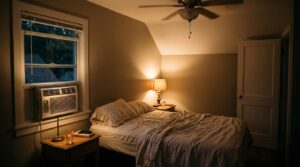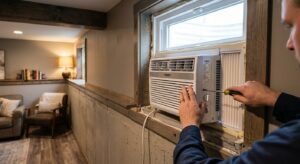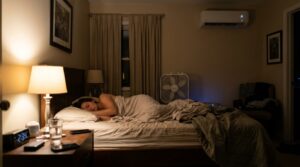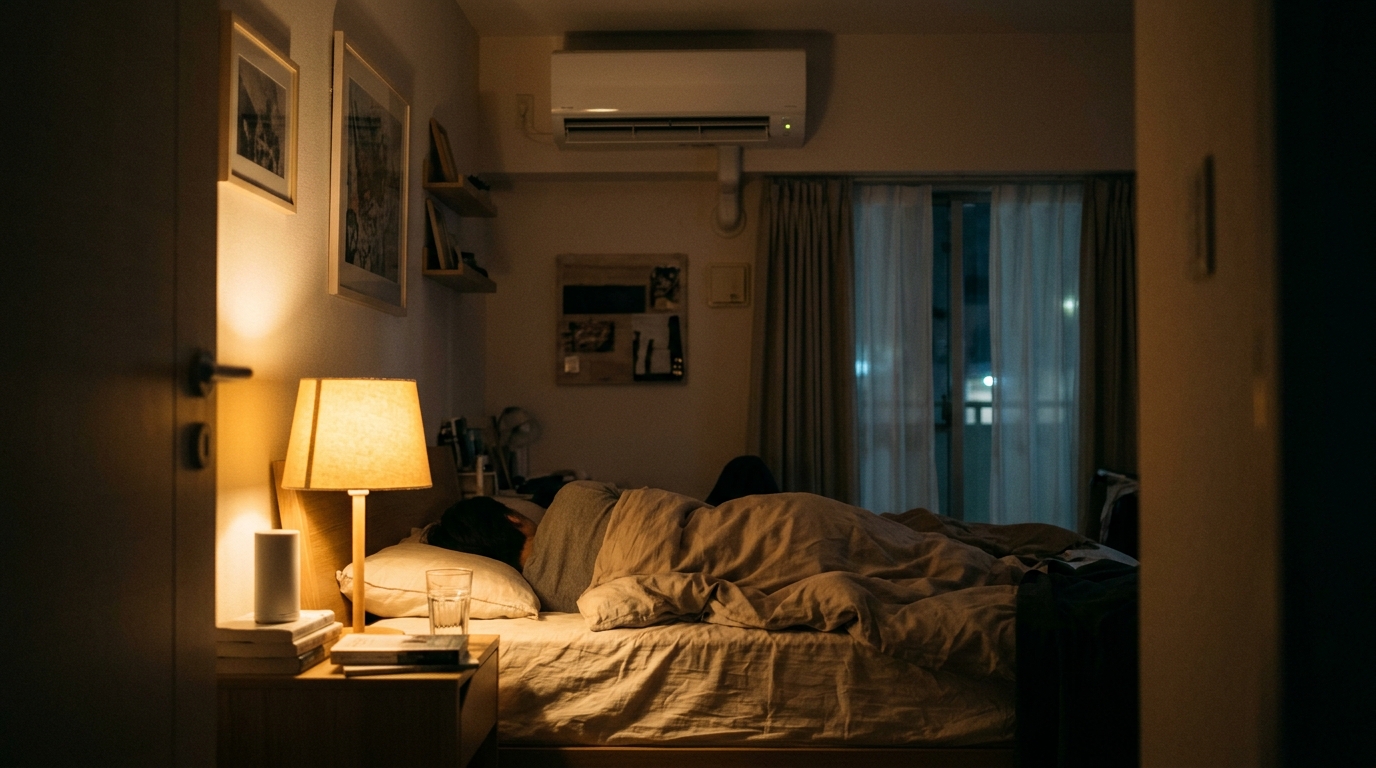
You are lying in bed and you hear it: the AC clicks on, hums for three minutes, shuts off, then does it all over again ten minutes later. That is short-cycling, and it is more common at night than most homeowners realize. A healthy system typically runs 10 to 20 minutes per cycle, two to three times an hour on a warm day. When it runs for only 3 to 5 minutes at a time, something is out of balance.
Nighttime makes the problem worse for a simple reason: your cooling load drops. The sun is down, outdoor temperatures fall 15 to 25 degrees, and your house is no longer absorbing solar heat through the roof and windows. An AC that was sized for a 95 degree afternoon suddenly has far too much capacity for a 75 degree night. It cools the air near the thermostat almost instantly, shuts off, and never gets the chance to remove humidity or run through a full cycle.
Short-cycling matters because starting up is the hardest thing a compressor does. Each start draws a surge of current, and frequent starts can shorten compressor life by years while leaving your home clammy and uncomfortable. In this post you will learn why nighttime triggers it, how to diagnose the cause, and what to do about it, from a free thermostat tweak to professional-level fixes.
What You’ll Need
Click on an item below to shop for the recommended items for this recipe on Amazon.
As an Amazon Associate, we earn from qualifying purchases.
How to Do It
- Turn off the system at the thermostat and check your air filter. If it is gray, clogged, or you cannot remember when you changed it, replace it. Use the size printed on the old filter’s frame.
- Walk through the house and make sure every supply and return vent is open and unblocked by furniture, rugs, or curtains. Closing too many vents raises duct pressure and can trigger early shutoffs.
- Check your thermostat location. If it is on an exterior wall, near a kitchen, or in a sunny hallway, note it for later. For now, raise your nighttime setpoint from 72 to 75 or 76 degrees. The warmer setpoint lets the system run longer between cycles.
- If your thermostat has a cycle rate or temperature swing setting, change it to allow a 1 to 1.5 degree differential. Check the manual for the menu path.
- Go outside and look at the condenser. Clear leaves, grass clippings, and debris from around it, keeping at least 2 feet of clearance on all sides. Gently rinse the fins with a garden hose from the inside out if they look matted with dirt.
- Monitor for two nights. Time how long the system runs per cycle. Aim for 10 minutes or more.
- Install a programmable or smart thermostat with adjustable cycle settings and a nighttime schedule. Models with ‘cycle per hour’ or ‘swing’ controls let you reduce startups directly. Turn off power at the breaker before swapping the thermostat.
- Relocate the thermostat if needed. Move it to an interior wall, away from supply vents, direct sun, and heat sources. A smart thermostat with a remote room sensor can also solve this without rewiring.
- Inspect the indoor evaporator coil if you can safely access it. Ice or frost on the coil or refrigerant lines means a severe airflow or charge issue. Turn the system off, let it thaw for 3 to 4 hours, and replace the filter before restarting.
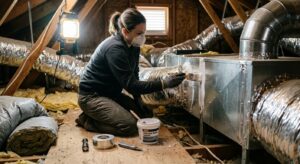
- Seal and insulate accessible ductwork in the attic or crawlspace with mastic and foil tape (not standard cloth duct tape). Leaky ducts can lose 20 to 30% of conditioned air and cause uneven cooling and short cycles.
- Add a few degrees of nighttime humidity control by running the fan setting on ‘auto’ (not ‘on’), so moisture drains off the coil instead of re-evaporating into your home.
- If your system has a variable-speed blower, ask your installer to adjust it to a lower nighttime speed for longer, gentler cycles.
- Ask for a Manual J load calculation, not a quick rule-of-thumb estimate. This tells you whether your system is truly oversized for your home’s current insulation and windows.
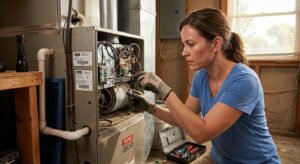
- Have the technician check refrigerant charge, superheat and subcooling, and pressure switch operation. Low charge means a leak that must be repaired, not just topped off.
- Test the capacitor, contactor, and compressor amperage. A weak capacitor ($150 to $300 installed) can cause hard starts and cycling.
- Request a duct static pressure test. High static pressure means ducts are undersized or restricted and may require modification.
- If the unit is significantly oversized and over 12 years old, discuss a variable-speed or two-stage replacement. These systems modulate output and can run 60 to 80% of the time at lower capacity, nearly eliminating short-cycling and improving efficiency by 20 to 30%.
Why It Works: The Benefits
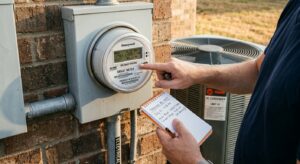
Longer, steadier run cycles avoid the energy spike of repeated startups. Fixing short-cycling typically trims cooling energy use by 10 to 20%, or roughly $15 to $40 a month during peak season for an average home.
Compressors are rated for a limited number of starts. Cutting cycles from 8 per hour to 3 per hour can add several years to the life of a $5,000 to $12,000 system.
Full cycles let the coil dehumidify. Indoor relative humidity in the 40 to 55% range feels noticeably cooler and discourages mold and dust mites.
Fewer clicks, thumps, and airflow surges mean better sleep, and steadier temperatures eliminate the cold-then-clammy swing.
Many short-cycling causes, like frozen coils and tripped pressure switches, become full breakdowns if ignored. Catching them early often avoids a $300 to $1,500 repair.
💰 Savings Impact by Action
Eliminating frequent startups and reaching steady-state efficiency can trim cooling energy use by 10 to 20%.
Raising your nighttime thermostat 2 to 3 degrees saves about 3 to 5% per degree on cooling energy.
Sealing leaky ducts can recover up to 20% of lost conditioned air, according to ENERGY STAR estimates.
Restoring proper airflow improves system efficiency by 5 to 15%, based on DOE guidance.
Replacing an oversized single-stage unit with a variable or two-stage system can cut cooling energy by 20 to 30%.
🏠 Key Concepts Explained
The Science Behind It
An air conditioner is sized for the hottest hour of the hottest day, called the design condition. At that point it might need to run 100% of the time to hold 75 degrees indoors. But your home spends the vast majority of the year, and every night, well below that peak load. When the load falls to 40 or 50% of capacity, the system satisfies the thermostat in a fraction of the time. The result is short cycles, with the compressor stopping before the system reaches steady-state efficiency.
Efficiency matters here because an AC does not hit its rated SEER performance during the first few minutes of a run. Startup involves a pressure equalization period, and the evaporator coil has not yet reached the cold surface temperature needed to condense moisture. Studies from the Florida Solar Energy Center and others have shown that short cycles can reduce effective efficiency by 10 to 30% compared with long, steady run cycles, and they sharply reduce moisture removal.
Humidity ties it together. Water vapor in the air carries latent heat, and at night people, cooking, and showers add moisture while the system fails to remove it. High indoor humidity makes 74 degrees feel like 78, which prompts you to lower the thermostat, which worsens short-cycling in a feedback loop. Breaking the loop with longer cycles and slightly higher setpoints is the core of the solution.
Frequently Asked Questions
▼ How do I know if my AC is actually short-cycling or just working normally?
A normal cycle lasts 10 to 20 minutes, and the system runs 2 to 3 times per hour on a moderately warm day. If it turns on and off in under 5 minutes, or cycles more than 6 times an hour, that is short-cycling. Use a stopwatch for an hour to confirm before calling anyone.
▼ Can renters fix short-cycling without landlord permission?
Yes, for the basics. Renters can change the filter, clear vents, adjust thermostat settings, and use ceiling fans or a standalone dehumidifier. Do not open the condenser or duct system. If cycles stay short, send your landlord your cycle log and ask them to schedule an HVAC inspection.
▼ How long before I notice savings on my bill?
Quick fixes like filter changes and setpoint adjustments show up in your next bill, typically a 5 to 10% drop. Thermostat upgrades and duct sealing show full results over a month or two, since seasonal weather affects comparisons. Compare kilowatt-hours used, not dollars, to account for rate changes.
▼ What if my AC is older than 15 years?
Older units are more likely to have low efficiency, worn capacitors, and refrigerant leaks. If a diagnostic finds a major failure, such as a bad compressor, the repair often costs more than 50% of a new unit, so replacement is smarter. Newer variable-speed systems largely eliminate short-cycling and meet current efficiency standards.
▼ Why does my AC short-cycle only at night and not during the day?
During the day, solar heat gain keeps your cooling load high enough that the system runs longer cycles. At night, the load drops sharply and an oversized or marginal system cools the thermostat area too quickly. Daytime-only normal operation usually points to oversizing rather than a broken part.
Quick Tips
- Raise your nighttime setpoint by 2 to 3 degrees. Each degree you raise the thermostat saves roughly 3 to 5% on cooling, and longer cycles reduce startups.
- Replace your filter every 1 to 3 months during cooling season, and use a MERV 8 to 11 filter unless your system is rated for higher.
- Run ceiling fans in occupied rooms at night. Moving air feels 4 degrees cooler and lets you raise the setpoint without losing comfort.
- Keep supply vents open in all rooms. Closing more than 20% of vents can raise static pressure and trigger safety shutoffs.
- Schedule a professional tune-up every spring, which typically costs $80 to $150 and catches charge and electrical issues early.
Variations for Your Situation
- Apartment/Rental: You cannot change the equipment, so focus on what you control. Replace the filter ($8 to $20), set the nighttime temperature 2 to 3 degrees higher, add a ceiling or box fan ($25 to $60), and use a smart plug thermostat or a portable dehumidifier ($150 to $250) if humidity is high. Document cycle times and email them to your property manager to support a service request.
- Tight Budget (under $50): Change the filter, clear the condenser, open all vents, raise the nighttime setpoint 2 to 3 degrees, and use ceiling or box fans. Seal visible duct gaps with foil tape (about $8 a roll). These steps cost under $30 combined and resolve a large share of short-cycling cases.
- Older Home (pre-1980): Expect leakier ducts, less insulation, and possibly a unit sized for a very different home. Prioritize attic air sealing and insulation to R-38 or higher, then duct sealing, before replacing equipment. If the AC is oversized after those upgrades, a downsized or two-stage unit may be the right replacement.