If you wake up with a scratchy throat, cracked lips, or a static shock every time you touch a doorknob, your indoor air is probably too dry. Winter heating drops indoor relative humidity to 10 to 20% in many homes, far below the 30 to 50% range most people find comfortable. So the natural reaction is to turn the humidifier all the way up and hope for the best.
That is where trouble starts. Too much moisture in a cold house leads to condensation on windows, damp wall cavities, and mold. Too little leaves you dry and tempted to raise the thermostat to compensate. And a poorly set humidifier can actually push your furnace to run longer, since evaporating water absorbs heat and moist air feels different than the dry air your system is tuned for.
This post walks through the right humidifier setting for overnight use, why the ideal number changes with the weather outside, and how to set it up with a simple quick fix or a more automated DIY upgrade. Done well, you get better sleep, a healthier home, and often the ability to lower your thermostat a degree or two without feeling chilly.
What You’ll Need
Click on an item below to shop for the recommended items for this recipe on Amazon.
As an Amazon Associate, we earn from qualifying purchases.
How to Do It
- Buy a basic digital hygrometer and place it at chest height in the bedroom, away from the humidifier itself and at least 6 feet from it so it reads the room, not the mist.
- Check the outdoor forecast low for tonight and pick your target: 30% if below 10 degrees F, 35% from 10 to 20 degrees F, 40% from 20 to 30 degrees F, and 45% above 30 degrees F.
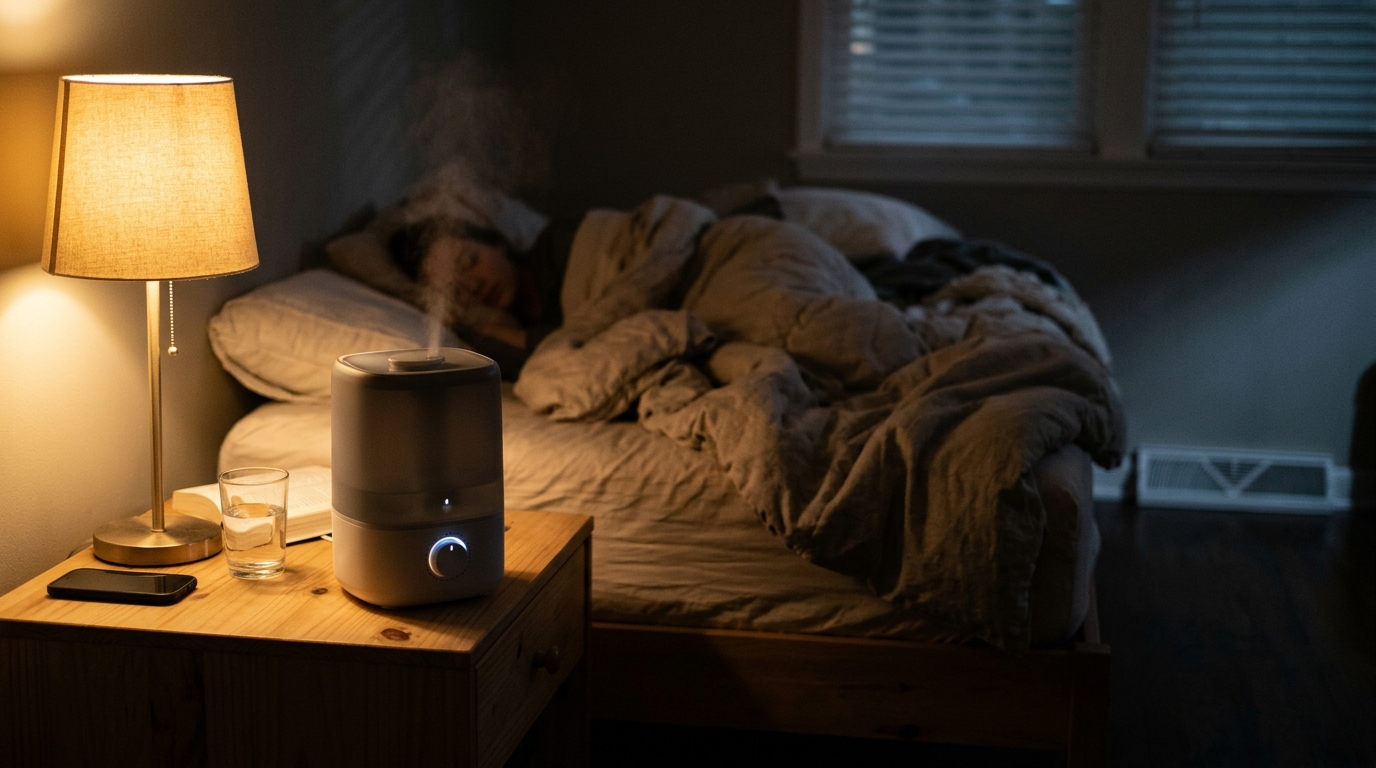
- Set the humidifier to run on its lowest or medium setting overnight rather than high, and close the bedroom door so the target is easier to hold.
- Check the hygrometer before bed and again when you wake up. If it reads more than 5 points over your target, turn the humidifier down one notch the next night.
- Look at your windows each morning. Fogging or beads of water means the setting is too high for the outdoor temperature, so drop the target 5 points.
- Install a plug-in humidistat or a smart humidity controller that cuts power to your portable humidifier when the room hits your set point, so it can never overshoot overnight.
- For a furnace-mounted humidifier, locate the humidistat control on the unit or return duct and set it to the target from the outdoor temperature chart above. If it has an automatic setting, enable it.
- Install an outdoor temperature sensor if your control supports it, so the target lowers itself as temperatures drop and you never have to adjust it by hand.
- Set the humidifier water panel or wick to a fresh one at the start of the season, since a scaled-over panel delivers less moisture and makes the controls read inaccurately.
- Confirm the bypass damper is open for winter and the humidifier water supply is on, then run a test overnight and check the hygrometer in the morning to fine-tune the set point.
Why It Works: The Benefits
Properly humidified air feels warmer, so many homeowners can lower the thermostat 2 to 3 degrees and save roughly 3 to 6% on heating costs, since each degree of setback saves about 1 to 3%.
Keeping humidity near 35 to 45% reduces dry throat, nosebleeds, and cracked skin, which are among the most common winter complaints.
Hardwood, instruments, and trim can shrink and crack when humidity stays below 25%. A steady 35 to 40% keeps gaps and splits from developing.
Static shocks become rare above about 35% relative humidity, which also helps protect sensitive electronics.
Staying under the outdoor-temperature-based ceiling prevents window fogging and damp wall cavities that can lead to mold within days.
💰 Savings Impact by Action
Comfortable humidity lets you lower the thermostat 2 to 3 degrees, saving about 3 to 6% on heating bills
Running at the right setpoint instead of maximum cuts wasted evaporation heat loss and extra furnace cycling by up to 8%
Staying below the condensation threshold virtually eliminates window and wall moisture problems that cost hundreds to repair
A clean wick and fresh water panel can improve moisture output by 10 to 15% compared with a scaled-up one
🏠 Key Concepts Explained
The Science Behind It
Humidity feels simple, but it is really a relationship between air temperature and moisture. Relative humidity measures how full the air is compared with its maximum capacity at its current temperature. Cold air holds very little moisture, so when winter air leaks into your home and gets heated to 70 degrees F, it carries almost no water and your indoor humidity plunges. That is why dry air shows up even in homes that never feel stuffy.
The limit on how much humidity you can add comes from the coldest surfaces in your house. Warm, humid indoor air that touches a cold window cools below its dew point, and the extra moisture condenses into liquid. Standard double-pane windows might have an interior surface of 40 to 50 degrees F when it is 20 degrees outside. At 45% indoor humidity and 70 degrees F, the dew point is about 49 degrees F, which means those windows will sweat. Dropping to 35% lowers the dew point to roughly 39 degrees F, and the condensation stops. This is the physics behind the outdoor temperature chart.
There is also an energy effect. Evaporating water takes heat from the air around it, so a humidifier running hard acts like a small cooler, forcing your furnace to make up the difference. Add to that the fact that very moist air in a cold house can feel clammy, while moderately humid air feels warmer on skin because it slows evaporation. Hitting the middle range delivers comfort at a lower thermostat setting, which is where the real savings come from.
Frequently Asked Questions
▼ Why is my furnace running constantly even after I set the humidifier correctly?
Check that your thermostat set point has not been raised to compensate for the dry air, and confirm your humidifier is not set above the outdoor-temperature target, since over-humidifying forces extra heating cycles. Also check your furnace filter, because a clogged filter makes the system run longer regardless of humidity. If the problem continues, have an HVAC technician inspect the system.
▼ Can renters use a humidifier safely without landlord permission?
Yes, a portable humidifier plugged into a standard outlet needs no permission and no modifications. Use a hygrometer and the outdoor temperature chart to avoid condensation, and keep it off carpet and wood surfaces to prevent water damage that could affect your deposit.
▼ How long before I notice a difference in comfort and bills?
You should feel the comfort improvement within one to two nights, as skin and throat dryness ease. Bill savings show up gradually, usually over the first full billing cycle, as you lower the thermostat 2 to 3 degrees while still feeling comfortable.
▼ My windows are fogging up even at 35%. What should I do?
Single-pane or older windows have colder inside surfaces, so they need a lower humidity target, sometimes 25 to 30% in very cold weather. Lower the setting 5 points at a time until the fogging stops, and consider adding window insulation film or storm windows, which warm the glass surface and let you run higher humidity.
▼ Is the humidity reading on my humidifier accurate?
Usually not. Built-in readouts are often off by 5 to 10 points because they sit close to the mist source. A separate hygrometer placed across the room gives a far more reliable number and is worth the $10 to $20.
Quick Tips
- Place the humidifier on a small table or stand 2 to 3 feet off the floor, away from walls, so mist disperses instead of soaking a single area.
- Use distilled or demineralized water in portable units to prevent white dust, mineral scale, and the efficiency loss that comes from a crusted wick.
- Replace or clean the wick, filter, or water panel at least once per heating season, and rinse the tank with a vinegar solution weekly.
- Bring humidity down about 5 points ahead of a forecast cold snap rather than waiting for window fog to tell you to adjust.
- Keep interior doors open in whole-house setups so moisture distributes evenly, but close the door in a bedroom with a portable unit so it can reach target faster.
Variations for Your Situation
- Apartment/Rental: Stick to a portable cool-mist or evaporative humidifier ($30 to $80) plus a $12 hygrometer, and use the outdoor temperature chart as your guide. Avoid placing it directly against painted walls or on carpet, and clean it often since apartments tend to be smaller and tighter, so humidity builds up faster.
- Tight Budget (under $50): Buy a $10 hygrometer and run any humidifier you already own on its lowest setting, adjusting by the outdoor temperature chart. For a zero-cost boost, air-dry laundry indoors on a rack overnight and leave the bathroom door open after showers, but monitor windows for condensation.
- Older Home (pre-1980): Older homes leak more air, so humidity escapes quickly and you may need a higher output to hold 30 to 35%, but single-pane windows and uninsulated walls make condensation more likely. Keep targets on the conservative end of the chart, add storm windows or plastic window film, and watch for moisture in exterior walls and attic hatches.