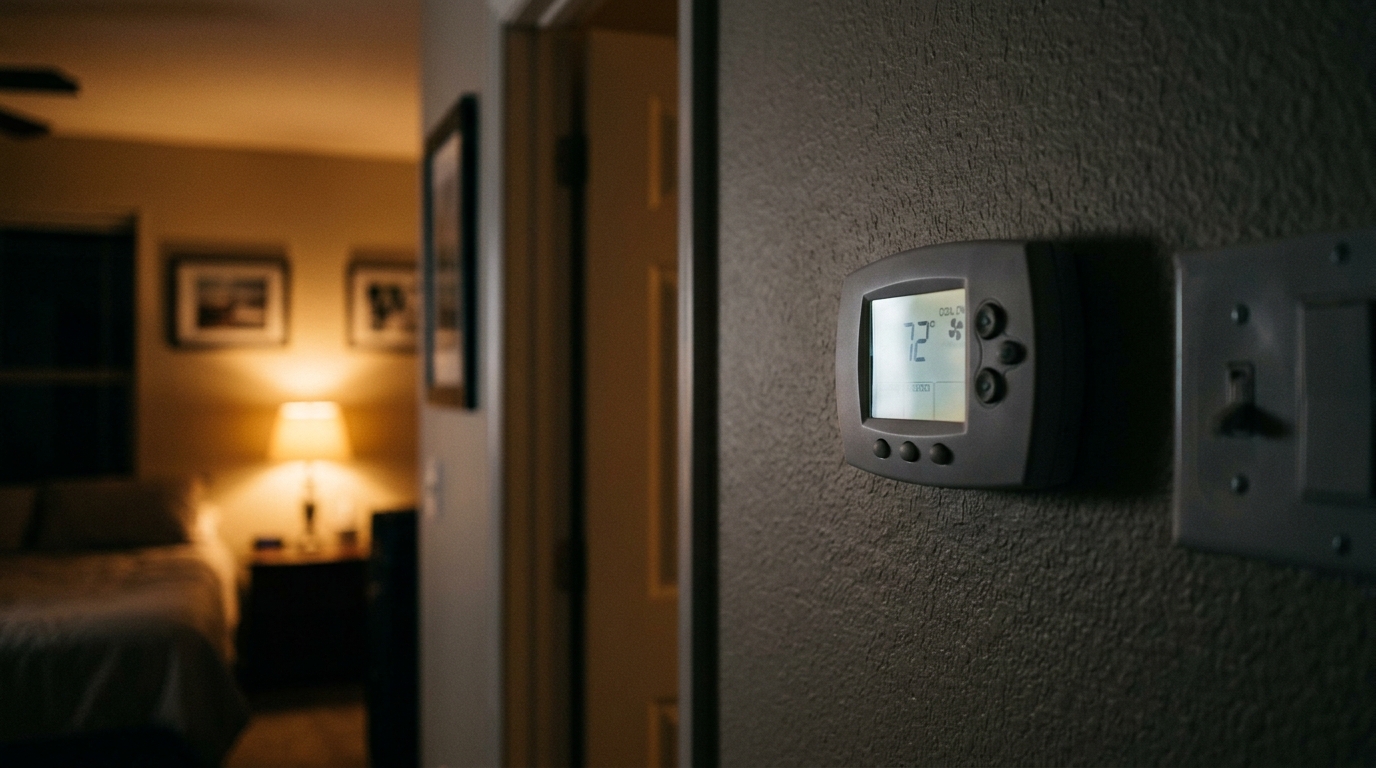
You set the thermostat to 74 and leave it alone. During the day the AC cycles on and off like clockwork. Then evening arrives, the sun goes down, and the system seems to run almost continuously. It feels backwards: the outdoor air is cooler at night, so shouldn’t the AC work less?
The answer is that your house is not a simple box of air. It is a heat battery. Roofing, attic insulation, walls, drywall, and furniture soak up solar energy all afternoon and slowly release it into your living space for hours after sunset. Add the humidity that builds when people cook, shower, and breathe in a closed-up house, plus a sleeping-hour thermostat that may be fighting you, and you get long, grinding runtimes right when you are trying to rest.
This post breaks down exactly why nighttime runtime stretches out, how to tell whether it is normal or a sign of a problem, and what to do about it. We cover a free 15-minute quick fix and a weekend DIY upgrade, with real savings numbers and payback periods so you can decide where to spend your time and money.
What You’ll Need
Click on an item below to shop for the recommended items for this recipe on Amazon.
As an Amazon Associate, we earn from qualifying purchases.
How to Do It
- Pre-cool in the afternoon: lower the setpoint 2 degrees F between 2 and 5 PM (for example 72 instead of 74), then return to 74 at dinner so the structure stores less heat entering the evening.
- Close blinds and curtains on west and south windows by early afternoon. This can cut solar heat gain by 40 to 70% through those windows.
- Shift heat-producing activities: run the oven, dryer, and dishwasher before 4 PM or after the house has cooled, and use the microwave or grill instead of the oven on hot evenings.
- Run bathroom and kitchen exhaust fans during and 15 minutes after showers and cooking so moisture leaves the house instead of loading the AC.
- Replace a dirty air filter and clear furniture or rugs from supply and return vents so the system can move air freely.
- Measure your attic insulation depth. If it is under 12 inches of fiberglass (roughly R-30), plan to top up to R-49, the DOE-recommended level for most climate zones.
- Air seal first: use caulk and expanding foam to seal gaps around wiring penetrations, plumbing stacks, recessed lights, and the attic hatch before adding insulation.
- Add blown-in or batt insulation to reach R-38 to R-49. A typical 1,200 square foot attic costs about $300 to $600 in materials for DIY blown-in.
- Seal visible duct joints in the attic with mastic or foil tape (not cloth duct tape), then wrap ducts with R-8 duct insulation if they are bare.
- Install a smart or programmable thermostat and set a gentle evening ramp: hold 74 until 10 PM, then allow a 1 to 2 degree rise or a 70 to 72 sleep target with a humidity-aware schedule if your equipment supports it.
- Check that attic vents (soffit and ridge or gable) are unblocked by insulation, using baffles at the eaves to keep airflow clear.
Why It Works: The Benefits
Trimming nighttime runtime by 15 to 30% can cut total summer cooling costs by 5 to 12%, which is roughly $60 to $180 per season for a home spending $1,000 to $1,500 on cooling.
Fixing humidity and warm bedrooms keeps indoor conditions in the 68 to 72 degree F, 40 to 50% humidity range that most people sleep best in.
Continuous multi-hour runs stress compressors and blower motors. Reducing unnecessary runtime can extend equipment life and delay a $6,000 to $12,000 replacement.
Shorter, less frequent cycles mean less compressor and fan noise during sleeping hours, especially in homes with the air handler near bedrooms.
If you are on a time-of-use plan, evening hours often carry the highest rates, sometimes 2 to 3 times the off-peak price, so shifting load earlier saves disproportionately.
💰 Savings Impact by Action
Raising attic insulation to R-38 to R-49 reduces heat flowing into living space, cutting evening cooling load by up to 20%.
Sealing and insulating ducts in unconditioned attics recovers the 20 to 30% of cooling lost in transit, saving about 15% on cooling energy.
Closing blinds or using reflective film on sun-facing windows blocks 40 to 70% of solar gain, trimming cooling load by about 12%.
Cooling the home earlier in the afternoon and coasting through the evening shifts load away from peak rates and reduces total runtime by roughly 8%.
Using exhaust fans and avoiding moisture sources cuts latent load, shortening nighttime cycles by about 7%.
🏠 Key Concepts Explained
The Science Behind It
Heat flows from hot to cold, and it takes time. During the day, solar radiation hits your roof and walls and raises their temperature well above the indoor air. Materials like drywall, wood framing, concrete slabs, and furniture have thermal mass, meaning they absorb energy and release it slowly. When the sun sets, the outdoor air cools quickly, but the stored heat in your structure keeps flowing inward because the inside surfaces are now cooler than the heated materials behind them. This lag is typically 3 to 6 hours, which is exactly why evening and early night are when your AC works hardest.
Humidity adds a second load. Air conditioners remove two kinds of heat: sensible heat (the temperature you feel on a thermometer) and latent heat (the energy locked in water vapor). Condensing one pound of water out of the air takes about 1,000 BTU. At night, occupants are home, showers and cooking add moisture, and outdoor dew points often climb as the air cools. The system may keep running to pull moisture out even after the thermostat temperature is satisfied, though it only reads temperature, so long cycles at night usually signal a high latent load.
Finally, ducts and attics tie it together. A hot attic keeps driving heat into ductwork and ceilings well past sunset. Leaky or uninsulated ducts lose cooling capacity before air reaches rooms, forcing longer runtimes. Cutting attic heat transfer with insulation and air sealing, shading windows, and managing moisture attacks all three loads at once, which is why combined fixes beat any single change.
Frequently Asked Questions
▼ Why is my AC still running all day even after I tried these fixes?
First check the basics: a clogged filter, a dirty outdoor condenser coil, or a frozen indoor coil all cause constant running. Measure the delta T across your system (it should be 16 to 22 degrees F), and if it is low or ice is visible on the refrigerant line, turn the system off and call an HVAC technician. If the outdoor temperature is above 95 degrees F, long runtimes may simply be normal capacity limits for your system.
▼ Can renters do this without landlord permission?
Yes, the quick fix is almost entirely renter-friendly. Closing blinds, using blackout or reflective window film, shifting oven use, running exhaust fans, and changing the filter all require no permanent changes. A plug-in dehumidifier or a portable temperature and humidity monitor also helps, and you can ask your landlord about attic insulation or duct sealing as a capital improvement.
▼ How long before I actually notice savings on my bill?
Behavioral changes like pre-cooling and shading show up in your next billing cycle, often as a 5 to 10% drop in cooling use. Insulation and duct upgrades reduce runtime immediately but are easiest to see by comparing the same month year over year, since weather varies. Most attic insulation projects pay back in 1 to 3 years.
▼ What if my home is older than 30 years?
Older homes usually have less attic insulation (often R-11 to R-19), leakier ducts, and more air infiltration, so nighttime heat release is stronger. Start with air sealing and attic insulation, which typically give the biggest return in homes built before 1990. Also have a technician check duct leakage, since pre-1990 duct systems often lose 25 to 40% of airflow.
▼ Is it normal for the AC to run nearly nonstop between 8 PM and midnight?
On a hot day (outdoor highs above 90 degrees F), yes, some extended running in the evening is normal because of stored heat release. If it runs nonstop on mild days, or the house still will not reach the setpoint, that points to an airflow, refrigerant, or duct problem worth a professional diagnosis.
Quick Tips
- Check runtime, not just the thermostat: many smart thermostats show daily runtime graphs, so compare 6 PM to 11 PM across a few days to see the real pattern.
- Use ceiling fans in occupied rooms only. They let you raise the setpoint 3 to 4 degrees F with the same comfort, but they cool people, not rooms, so turn them off when you leave.
- Set your fan to Auto, not On. Running the blower continuously can re-evaporate moisture from the coil back into the house, which hurts dehumidification and raises humidity at night.
- Schedule an annual HVAC tune-up in spring. A clean coil, correct refrigerant charge, and proper airflow can improve efficiency by 5 to 15% and shorten long cycles.
Variations for Your Situation
- Apartment/Rental: Focus on window treatments and behavior since you cannot modify HVAC or insulation. Install insulated blackout curtains or reflective window film ($15 to $60 per window), run a standalone dehumidifier ($150 to $250) if humidity stays above 55%, use exhaust fans, and move cooking to the microwave or outdoor grill to cut internal heat.
- Tight Budget (under $50): Pre-cool in the afternoon, close west and south blinds by 1 PM, replace the filter ($10 to $20), clean the outdoor condenser coil with a garden hose, and shift oven use and laundry to the early morning. These steps are free or nearly free and often cut nighttime runtime by 10 to 15%.
- Older Home (pre-1980): Prioritize air sealing and attic insulation before anything else, because leaky ceilings and thin insulation are the biggest drivers of evening heat gain. Have the ducts tested for leakage, check for bare ducts in an unconditioned attic, and consider whether your equipment is oversized or undersized for the actual home, since older systems are often mismatched after renovations.