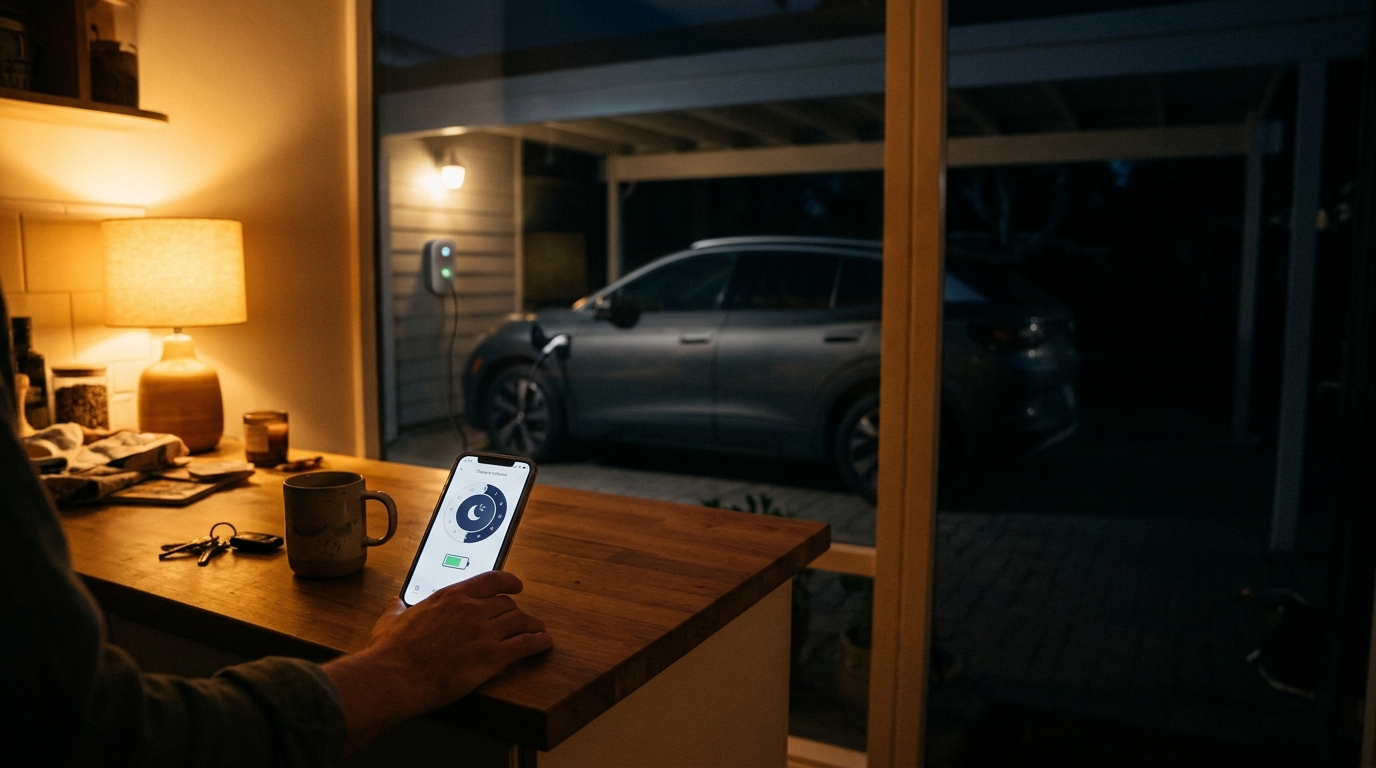
Most new EV owners do the obvious thing: they get home around 6 p.m., plug in the car, and let it charge. The trouble is that 6 p.m. to 9 p.m. is often the most expensive electricity of the day. On many time-of-use (TOU) plans, peak rates run 30 to 50 cents per kWh while overnight rates can drop to 8 to 15 cents. For a typical EV that uses about 30 kWh per 100 miles, that difference adds up fast.
Consider a driver covering 12,000 miles a year. That is roughly 3,600 kWh of charging. At a blended peak-heavy rate of 35 cents, that is about $1,260 per year. Shift nearly all of it to a 12 cent overnight rate and the bill drops to around $430. That is more than $800 a year back in your pocket, just from changing when the car charges, not how much.
This post walks through how to find your cheapest hours, how to set up a schedule using nothing but your car or charger app (free and done in 15 minutes), and how to go further with a smart charger or a dedicated EV rate plan. We will also cover the mistakes that quietly erase your savings, like peak demand charges and charging past what you actually need.
What You’ll Need
Click on an item below to shop for the recommended items for this recipe on Amazon.
As an Amazon Associate, we earn from qualifying purchases.
How to Do It
- Log into your utility account or call them to confirm you are on a time-of-use rate, and write down the exact off-peak hours (for example, 11 p.m. to 6 a.m.). If you are on a flat rate, skip to the DIY approach for switching plans.
- Open your car’s touchscreen or manufacturer app and find the charging or scheduling menu. Set a scheduled start time about 15 to 30 minutes after off-peak begins so you never overlap with the peak window.
- Set an end time or charge limit. For daily driving, choose 80 to 90% unless you need extra range for a trip. This avoids wasting energy at the slow end of the charge curve.
- Plug in every night when you get home. The car will wait to start until your scheduled time, so you can plug in at 6 p.m. without paying peak rates.
- Check your next utility bill or online usage graph after one to two weeks. You should see the charging load appear in the overnight hours instead of the evening.
- Ask your utility about a dedicated EV rate plan. These often offer overnight rates of 5 to 12 cents per kWh, sometimes with a separate meter. Compare the plan’s higher peak rates against your actual usage before switching.
- Choose a smart Level 2 charger rated at 32 to 48 amps with scheduling, energy tracking, and utility program support. Many are ENERGY STAR certified and idle at under 1 watt.
- Have a licensed electrician install a dedicated 240V circuit and mount the charger. Ask them to confirm your panel has capacity, and request a load calculation if your panel is 100 amps or older.
- Set up the charger’s app with your utility’s off-peak window, and enable the rate-aware or utility-sync feature if available. Set a maximum charge current of 32 amps if your plan has demand charges.
- Enable notifications and review the monthly energy report for the first three months. Adjust your start time and charge limit based on your actual morning departure time and battery needs.
- Hire a licensed electrician to assess your service capacity and recommend a load management device or smart panel that automatically throttles the EV charger when other big loads run.
- Install a dynamic load-balancing charger or an energy monitor that tracks whole-home draw in real time and pauses or slows charging during dryer, oven, and HVAC peaks.
- Program the system with your TOU schedule so it charges at full speed only in the cheapest hours and at reduced speed otherwise.
- If you have solar or a home battery, configure the system to charge the car from surplus solar during the day or from stored energy overnight, whichever is cheaper under your rate plan.
Why It Works: The Benefits
Charging at a 12 cent off-peak rate costs about 3.6 cents per mile for an efficient EV, versus 10 to 12 cents per mile for a gas car at $3.50 per gallon and 30 mpg.
Shifting 3,600 kWh a year from a 35 cent peak rate to a 12 cent off-peak rate saves roughly $830 with zero change to how you drive.
Overnight charging uses spare capacity and often draws from a cleaner mix of wind and baseload power, which can lower the carbon footprint of each mile.
A scheduled charge finishes right before you leave, so the battery is full and, in winter, can be preconditioned using grid power instead of battery energy.
Keeping charging out of the evening window avoids stacking the car’s load on top of cooking, laundry, and HVAC, which helps keep monthly peak-demand charges down.
💰 Savings Impact by Action
Moving charging from a 35 cent peak rate to a 15 cent off-peak rate cuts per-kWh cost by more than half.
A dedicated EV plan with a 5 to 10 cent overnight rate can save an additional 20% over a standard TOU plan.
Stopping at 80 to 90% instead of 100% trims wasted energy and slows battery wear over the years.
Faster 240V charging loses less energy as heat than slow 120V charging over the same miles.
Reducing charge current to avoid stacking loads can lower monthly demand fees on plans that use them.
🏠 Key Concepts Explained
The Science Behind It
Electricity cannot be stored cheaply at grid scale, so utilities must produce roughly as much power as customers use at any given moment. During the evening peak, when demand surges, utilities rely on fast-ramping natural gas plants that are expensive to run. Overnight, demand falls and cheaper baseload generation covers the load, so wholesale prices drop. Time-of-use rates pass those wholesale cost differences on to you, rewarding shifting flexible loads like EV charging.
An EV is an ideal flexible load because it needs a fixed amount of energy by morning but does not care when it arrives. A 60 kWh battery charged at 11 kW needs only about 5.5 hours for a full refill from near empty, and most daily commutes need far less. That flexibility is what lets you capture the lowest prices without any inconvenience.
Charging losses also matter. Home charging is about 85 to 90% efficient because of heat in the onboard charger, battery, and cooling system. Slow Level 1 charging is less efficient since the car’s computers and thermal systems consume a fixed amount of power over a longer time. Using a Level 2 charger finishes faster, so a larger share of the electricity you pay for actually ends up in the battery.
Frequently Asked Questions
▼ My car still starts charging as soon as I plug in. How do I fix that?
Check that the scheduled charging setting is enabled and that the plug-in location is not set to ‘charge immediately.’ Some vehicles override schedules unless the location is saved as home. If your car or charger app has both a schedule and an ‘immediate’ toggle, make sure the latter is off, then test by plugging in during peak hours and confirming the charge does not start.
▼ Is time-of-use pricing always cheaper for EV owners?
Not always. If your household uses lots of electricity in the evening or you cannot shift charging, a TOU plan with high peak rates can cost more than a flat rate. Compare a full month of your actual usage under both plans, or ask your utility for an EV-specific plan that keeps peak rates reasonable while offering a deep overnight discount.
▼ Can renters or apartment dwellers take advantage of off-peak charging?
Yes, if you have access to an outlet. Use the car’s built-in scheduling on a standard 120V outlet, which adds roughly 30 to 40 miles overnight, and ask your landlord about a dedicated outlet or shared Level 2 charger. If you pay a flat rate or your building controls the meter, you may not see savings, so also consider workplace or public charging with lower rates.
▼ How long before I notice savings on my bill?
Usually on the first full billing cycle after you set the schedule. Check your utility’s online hourly usage graph after a few days to confirm charging moved to the off-peak window. A driver moving 300 kWh per month from 35 cents to 12 cents will see about $69 less on that month’s bill.
▼ What if my home has an older electrical panel?
A 100-amp panel or older fuse box may not safely support a 40 to 48 amp charger on top of existing loads. Ask an electrician for a load calculation, and consider a lower-amperage charger (24 to 32 amps) or a load management device, which are often far cheaper than a panel upgrade.
Quick Tips
- Set your charge limit to 80 to 90% for daily driving and only charge to 100% right before long trips. This saves energy and reduces battery wear.
- Precondition the cabin while still plugged in on cold or hot mornings. Using grid power at off-peak rates instead of battery energy preserves range.
- Run the dishwasher, washer, and dryer in the same off-peak window to multiply your savings, but stagger them so they do not all run at once with the charger.
- Review your utility’s online usage graph monthly. If you still see charging spikes between 4 and 9 p.m., your schedule is not applying and needs to be rechecked.
Variations for Your Situation
- Apartment/Rental: Use the car’s built-in scheduling on a standard 120V outlet, which costs nothing and adds about 30 to 40 miles per night. A portable Level 2 cable that plugs into an existing dryer or RV outlet runs $250 to $500 and can be taken with you, but get your landlord’s written permission first.
- Tight Budget (under $50): Skip new hardware and schedule charging through the car’s touchscreen. Call your utility to confirm your off-peak hours, set the start time 15 to 30 minutes after they begin, and cap the charge at 80%. This captures most of the savings for free.
- Older Home (pre-1980): Have an electrician check your panel capacity and outlet condition before any long-term charging. Older wiring and 100-amp services often need a dedicated circuit and sometimes a load management device, but a 32-amp charger with a load calculation can often avoid a $2,000 to $5,000 panel upgrade.