You set the thermostat to 68 degrees before bed, yet you wake up shivering at 3 a.m. while the hallway feels fine. Or the furnace seems to run nonstop all night and the house still never quite catches up. Many homeowners assume the problem is a drafty window or an aging furnace, but the real offender is often a thin sheet of pleated paper sitting in a slot you rarely look at: the furnace filter.
A dirty filter chokes your system’s airflow. Overnight, when outdoor temperatures bottom out and your furnace runs its longest cycles, that restriction hurts the most. The furnace heats up faster than the air can carry that heat away, trips a safety limit, shuts down early, and then restarts. The result is uneven rooms, long cycles, and a house that swings several degrees from your setpoint.
This post explains exactly why a clogged filter creates those nighttime swings, how to fix it in about five minutes, and what to do if the problem is deeper than the filter. You will also find real savings numbers, a step-by-step DIY and professional path, and answers to the questions homeowners ask most.
What You’ll Need
Click on an item below to shop for the recommended items for this recipe on Amazon.
As an Amazon Associate, we earn from qualifying purchases.
How to Do It
- Turn the thermostat to Off, or switch off power to the furnace, before opening any panel or slot.
- Locate the filter. It is usually in a slot beside the furnace blower, in a return air grille on a wall or ceiling, or in a cabinet near the air handler.
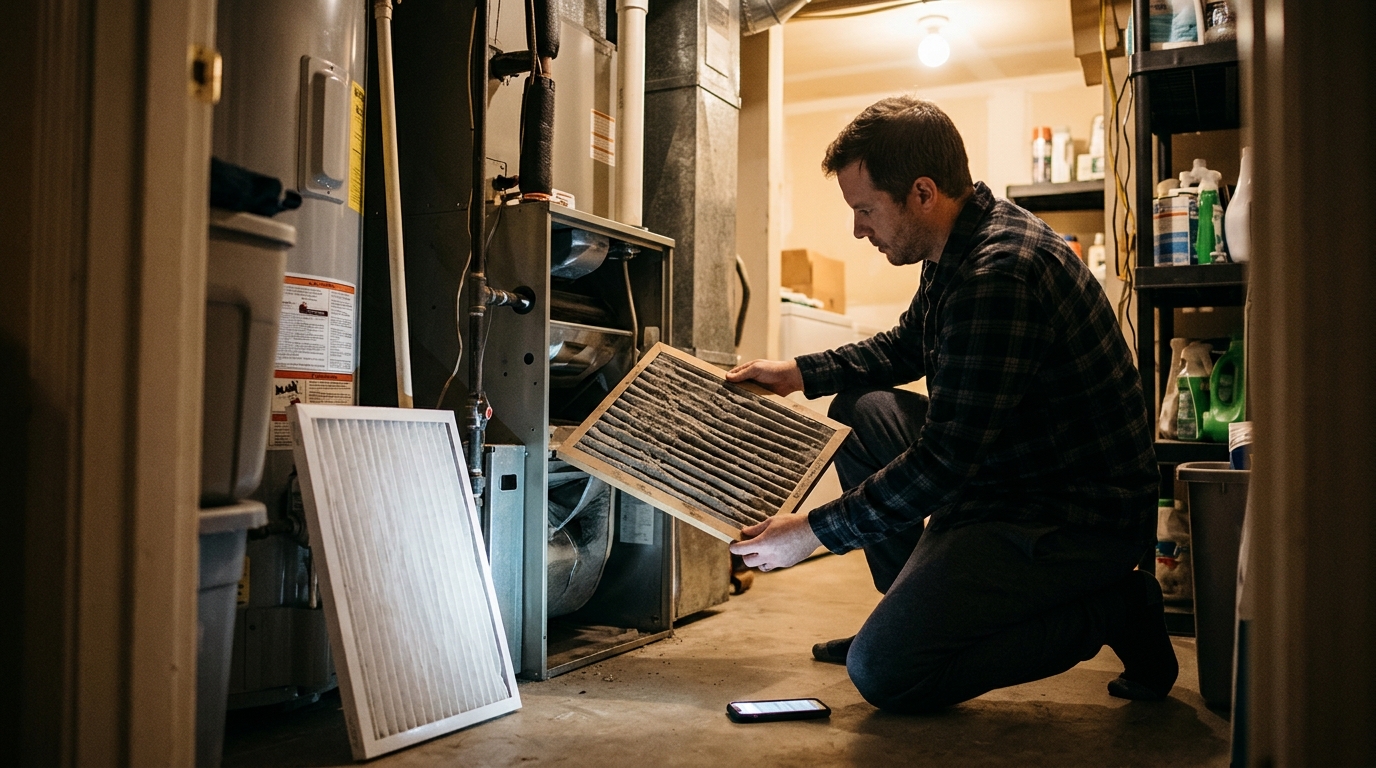
- Slide the old filter out and note the size printed on its cardboard frame, such as 16x25x1. Hold it up to a light. If you cannot see light through it, it is overdue.
- Insert a new filter of the exact same size, with the airflow arrow pointing toward the furnace and away from the return duct.
- Restore power, set the thermostat back to your normal overnight temperature, and write the install date on the filter frame with a marker.
- Check your furnace manual or the label inside the blower compartment for the recommended MERV rating. Most homes do well with MERV 8 to 11, which balances filtration and airflow.
- Avoid jumping to a high-MERV filter (13 and up) in a standard system unless the manufacturer approves it. Dense filters can restrict airflow almost as badly as a dirty one.
- Buy a multipack of the correct size so you always have a spare on hand. Buying 4 to 6 at once usually lowers the per-filter price to $4 to $10.
- Set a repeating phone reminder: every 90 days for a standard 1 inch filter, every 30 to 60 days if you have pets, allergies, or construction dust, and every 6 to 12 months for a 4 to 5 inch media filter.
- Check that the filter door or grille closes snugly. Gaps let unfiltered air bypass the media and carry dust into the blower.
- Run the fan for a full heating cycle and walk through the house. Put a hand over the supply registers in the coldest room and confirm you feel strong, steady airflow.
- Book a heating tune-up before or early in the cold season, when technicians have more availability and some companies offer discounted pricing.
- Ask the technician to measure static pressure and temperature rise across the furnace. These two numbers reveal hidden airflow problems like undersized return ducts or a failing blower.
- Have the blower wheel and evaporator coil (if you have central air) inspected and cleaned. Caked-on dust here can restrict airflow even with a perfect filter.
- Ask about the condition of the heat exchanger and flame sensor, since overheating from poor airflow is a common cause of premature wear.
- Request a duct leakage and balancing check if one or two rooms stay cold. Leaky or crushed ducts can cause the same nighttime symptoms as a dirty filter.
Why It Works: The Benefits
Restoring full airflow lets the furnace complete normal cycles instead of short cycling, which typically narrows nighttime swings from 4 to 6 degrees down to 1 to 2 degrees.
The DOE notes that replacing a dirty filter can lower an HVAC system’s energy use by 5 to 15%. On a $150 monthly winter bill, that is $7 to $22 back every month.
Restricted airflow overheats the heat exchanger and strains the blower motor. A clean filter helps avoid repairs that commonly run $300 to $1,500, and can help extend furnace life.
A fresh filter captures dust, pollen, and pet dander before it recirculates, which is helpful if you sleep with allergies or a stuffy nose.
A starved blower whistles and hums as it pulls air through a blocked filter. Fresh media usually brings the noise level back down.
💰 Savings Impact by Action
Swapping a clogged filter restores airflow and can cut heating energy use by 5 to 15% per DOE guidance.
Ending short cycling reduces wasted energy from repeated burner startups and long catch-up runs.
Lower heat exchanger stress and blower strain reduces breakdown risk and can extend furnace life by years.
Stronger airflow gets more warm air to distant rooms, reducing the need to raise the thermostat.
🏠 Key Concepts Explained
The Science Behind It
A furnace is essentially an air-moving machine that happens to have a heat source. The burners heat a metal heat exchanger, and the blower pushes house air across it and out through the ducts. For this to work safely and efficiently, the amount of air flowing across the heat exchanger has to match the amount of heat being produced. Most furnaces are designed to move roughly 400 cubic feet of air per minute for every ton of capacity, and they are tuned to deliver a specific temperature rise.
When a filter clogs, airflow drops, but the burners keep producing the same heat. The extra heat has nowhere to go, so the air leaving the furnace gets hotter than designed and the heat exchanger temperature climbs. The high-limit switch is a safety device that detects this and shuts the burners off to protect the equipment. The blower continues running until things cool, the switch resets, and the burners fire again. This pattern is called short cycling, and it is why rooms feel warm for a few minutes, then cool, then warm again.
Nighttime makes the effect more noticeable for two reasons. First, heat loss through the walls, roof, and windows is greatest when it is coldest outside, so your furnace needs longer, steadier runs to keep up. Second, most of us are asleep and still, so we feel small temperature drops that we would ignore during the day. A system losing 20 to 30% of its airflow to a dirty filter cannot deliver steady heat to distant bedrooms, so those rooms lose temperature first. Restoring airflow lets the furnace run in longer, more complete cycles, which holds the house closer to your setpoint and reduces the wasted energy of constant restarts.
Frequently Asked Questions
▼ I just changed the filter but my bedroom still gets cold at night. Now what?
Check that the supply register in that room is fully open and not blocked by furniture or curtains, then feel for airflow while the furnace is running. If airflow is weak, the cause is likely a duct issue such as a leak, a disconnected run, or a closed damper, and a technician can test static pressure and duct leakage. Also confirm the bedroom door is not closed without a return path, since that can starve the room of airflow.
▼ How often should I really change my furnace filter?
For a standard 1 inch pleated filter, every 90 days is the baseline, but plan on every 30 to 60 days if you have pets, allergies, smokers, or ongoing dust from construction. Thicker 4 to 5 inch media filters can often go 6 to 12 months. When in doubt, hold it up to a light and replace it if you cannot see through it.
▼ Can I clean and reuse a disposable filter instead of replacing it?
No. Disposable fiberglass and pleated paper filters cannot be cleaned effectively, and vacuuming or rinsing them damages the media and lets dust bypass. Only filters labeled washable or permanent are designed for cleaning, and they still must be completely dry before reinstalling.
▼ Does a dirty filter affect my air conditioner in summer too?
Yes, and often more severely. Restricted airflow across the evaporator coil can cause it to freeze, reducing cooling and risking compressor damage. The same filter, the same fix, and the same savings of 5 to 15% apply to cooling season.
▼ How long before I notice savings on my bill?
Comfort improvements often show up the very first night, with steadier temperatures and quieter operation. Bill savings appear on the next billing cycle, typically a 5 to 15% drop in heating energy if the old filter was badly clogged. Gas bills and electric blower costs both benefit.
Quick Tips
- Hold the old filter up to a light. If you cannot see light through the media, replace it regardless of how long it has been installed.
- Buy filters in multipacks and keep a spare next to the furnace so a change takes minutes, not a trip to the store.
- Check filters monthly during winter and summer when the system runs most, and after any renovation or sanding project.
- Stick with MERV 8 to 11 unless your manufacturer approves higher, since overly dense filters can restrict airflow almost as much as a dirty one.
Variations for Your Situation
- Apartment/Rental: Check your lease, since many landlords are responsible for filter changes in central systems, and ask in writing for a replacement if yours is overdue. If you control the filter, buy the exact size from a hardware store for $5 to $12 and keep the receipt. For window units or mini splits, clean the washable filter every 2 to 4 weeks with warm water and mild soap.
- Tight Budget (under $50): A basic MERV 8 pleated filter costs $4 to $8 and does the job for most homes, so skip premium brands. Buy a 4 or 6 pack to bring the unit cost down, set a free phone reminder, and use a flashlight to inspect monthly. Close vents in unused rooms only partially, if at all, since blocking too many registers raises static pressure.
- Older Home (pre-1980): Older furnaces and duct systems often have smaller returns and leakier ducts, so airflow is less forgiving of a dirty filter. Consider checking for a filter slot that is poorly sealed, and ask a technician to inspect return duct size and duct leaks during a tune-up. Skip high-MERV filters unless your system has been verified to handle the added resistance.