If you have been putting off a home efficiency upgrade because of the upfront cost, you may be sitting on a significant amount of money you have not claimed yet. Utility companies, state energy offices, and the federal government offer rebates and tax credits specifically designed to lower the cost of upgrades like heat pumps, smart thermostats, attic insulation, and energy-efficient water heaters. In many cases, these incentives stack together and can cover 30 to 50% of your total project cost before you spend a dollar out of pocket.
The challenge is that the rebate landscape is genuinely fragmented. Your electric utility might offer one rebate, your gas utility a second, your state energy office a third, and the IRS a fourth. Each program has its own income thresholds, equipment specifications, contractor requirements, and application deadlines. Missing one step, like buying the wrong equipment model or failing to get a pre-approval, can cost you the entire rebate. This post walks you through how to find, qualify for, and successfully claim every dollar available to you.
We cover the major federal programs including the Inflation Reduction Act tax credits and the High-Efficiency Electric Home Rebate Act (HEEHRA), how to layer them with state and utility programs, what documentation you need, and the exact steps to take before you buy anything. Whether you are planning a major HVAC replacement or just swapping out a water heater, this guide will help you get paid back as much as possible.
What You’ll Need
Click on an item below to shop for the recommended items for this recipe on Amazon.
As an Amazon Associate, we earn from qualifying purchases.
How to Do It
- Go to energystar.gov/rebate-finder and enter your zip code. This pulls federal, state, and many utility rebates in one place and links directly to each program’s application page.
- Visit dsireusa.org (Database of State Incentives for Renewables and Efficiency) for a comprehensive state-by-state list of all active programs including property tax exemptions and sales tax waivers on efficient equipment.
- Log in to your utility account online and search for ‘rebates’ or ‘energy efficiency programs.’ Most major utilities list their current rebate amounts, eligible equipment models, and application forms under a dedicated efficiency section.
- Create a simple spreadsheet listing each available program, the rebate amount, the minimum equipment requirements (e.g., ENERGY STAR, SEER2 rating), whether pre-approval is needed, and the application deadline.
- Cross-reference the rebate requirements against ENERGY STAR’s product finder (energystar.gov/productfinder) to confirm that any equipment you are considering qualifies before you purchase.
- Before purchasing anything, contact your utility’s energy efficiency department by phone or online chat and ask specifically whether pre-approval is required for your planned upgrade. Get the answer in writing via email or save the confirmation number.
- If pre-approval is required, submit the pre-approval application with your home address, the planned upgrade type, and the contractor’s information. Most utilities approve these within 3 to 10 business days.
- Select a contractor from your utility’s or state program’s approved installer list. Ask the contractor to provide the equipment model number and efficiency rating in writing before signing the contract so you can verify eligibility against the rebate requirements.
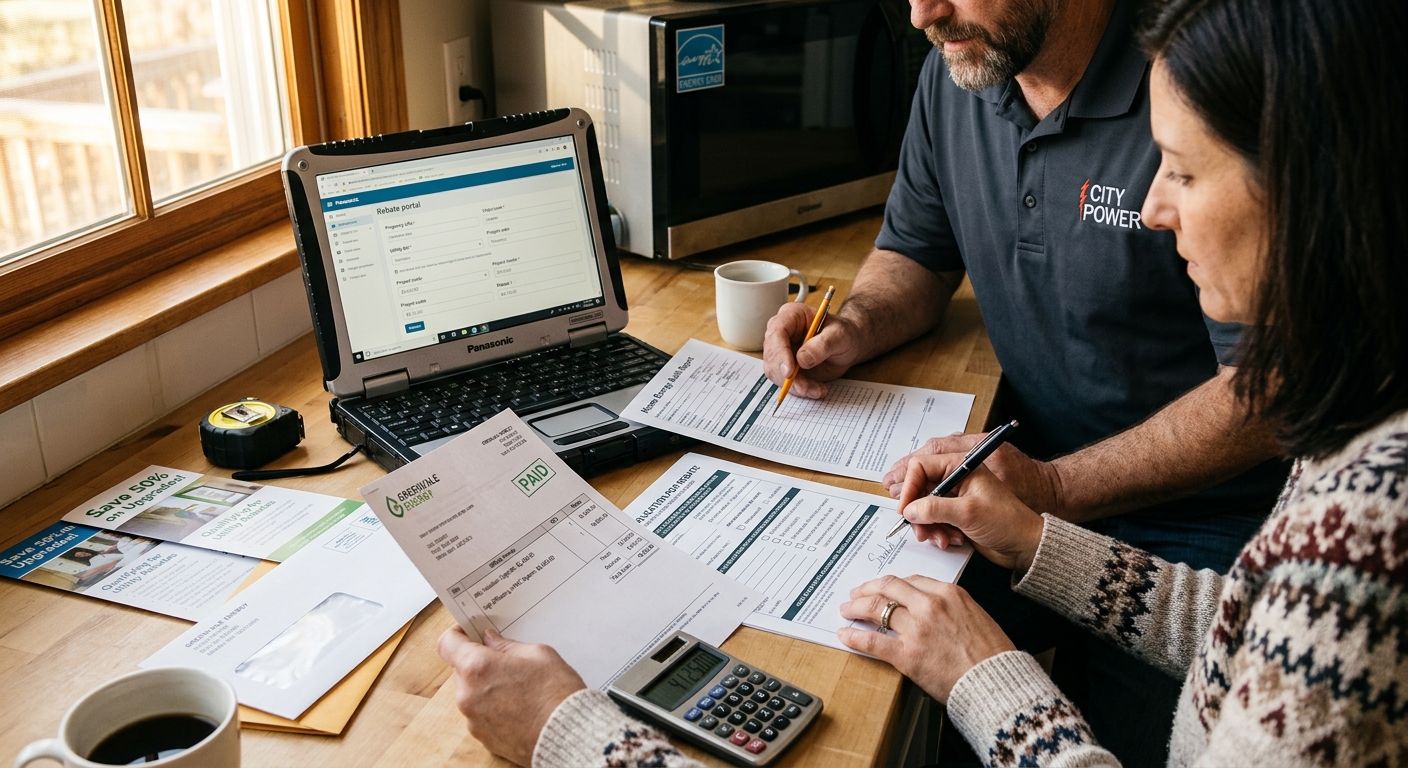
- After installation, collect all required documentation: the itemized contractor invoice showing equipment model number and installation date, the product specification sheet showing the efficiency rating, and photos of the installed equipment if the program requires them.
- Submit the rebate application within the program’s deadline window, which is typically 30 to 90 days after installation. Keep copies of everything submitted. Most utilities process rebates in 4 to 8 weeks and issue a check or bill credit.
- For the federal 25C tax credit, save all receipts and the product specification sheet. Your tax preparer or tax software will use IRS Form 5695 to claim the credit when you file. The credit reduces your tax liability dollar for dollar up to the annual limit.
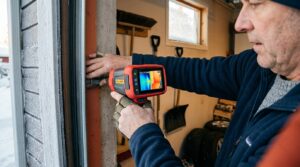
- Contact a BPI-certified (Building Performance Institute) energy auditor through bpi.org/find-a-contractor. They are trained in identifying all available incentives and can conduct a comprehensive home energy audit that often unlocks additional rebates.
- Ask the auditor to provide a written incentive summary listing every applicable rebate, tax credit, and financing program for your home and planned upgrades, including total potential value and stacking compatibility.
- Some contractors and home performance companies offer rebate management services where they handle all pre-approvals, documentation, and submissions on your behalf, typically for free as part of the installation contract or for a flat fee of $100 to $200.
- Review any Inflation Reduction Act HEEHRA rebate eligibility with the auditor. As of 2025, states are rolling out these point-of-sale rebates through authorized contractors, meaning the discount may come directly off your invoice rather than arriving as a check later.
- Request a post-project reconciliation document listing every rebate submitted, the expected amounts, and the expected timelines so you can follow up if payments are delayed beyond the stated processing window.
Why It Works: The Benefits
Stacking federal, state, and utility incentives can reduce the net cost of a qualifying heat pump installation by $2,000 to $4,500 on a typical $6,000 to $10,000 project, bringing payback periods from 8 to 12 years down to 4 to 6 years.
The Energy Efficient Home Improvement Credit (25C) under the Inflation Reduction Act offers a 30% federal tax credit, up to $3,200 per year, with no household income limit. This applies to heat pumps, insulation, windows, doors, and energy audits.
Upgrades funded by rebates, such as heat pump water heaters and air sealing, typically reduce annual energy costs by $300 to $1,200 depending on home size and climate, so you save twice: once at purchase and every month afterward.
Many utilities offer free or deeply discounted home energy audits (a $200 to $400 value) to rebate program participants. These audits identify the highest-impact upgrades and often unlock additional rebate eligibility for the work they recommend.
A heat pump water heater that costs $1,200 installed and qualifies for a $750 federal tax credit plus a $200 utility rebate has a net cost of $250. At $400 per year in energy savings versus a standard electric water heater, that is a payback period of under one year.
💰 Savings Impact by Action
The 25C Energy Efficient Home Improvement Credit returns 30% of qualifying upgrade costs directly as a tax credit, up to $3,200 per year.
Average utility rebate programs cover an additional 10 to 20% of equipment cost depending on the program and equipment type.
For households between 80 and 150% of AMI, HEEHRA rebates cover up to 50% of eligible upgrade costs at point of sale.
Combining federal credits, state rebates, and utility rebates on a single project routinely reduces net out-of-pocket cost by 40 to 50% for qualifying homeowners.
Households below 80% of Area Median Income can receive HEEHRA rebates covering up to 100% of eligible upgrade costs for qualifying equipment.
🏠 Key Concepts Explained
The Science Behind It
Rebate and tax credit programs are designed around a concept called the cost-effectiveness threshold: the point at which an energy efficiency upgrade saves enough energy over its lifetime to justify the investment from both the homeowner’s perspective and the utility’s. Utilities run rebate programs because it is cheaper for them to reduce energy demand through customer rebates than to build new power generation capacity. The avoided cost of energy production is typically $0.04 to $0.08 per kilowatt-hour, which funds the rebate pool and makes the math work for both parties.
The federal tax credits under the Inflation Reduction Act’s Section 25C are structured around measured efficiency improvements. A heat pump must meet specific SEER2, EER2, and HSPF2 thresholds because research from the Department of Energy shows that systems meeting those thresholds deliver at least a 30 to 50% reduction in heating and cooling energy compared to baseline equipment. The credit percentage mirrors the average share of the purchase price that the efficiency premium represents, meaning the credit effectively pays for the efficiency upgrade rather than the baseline system cost.
The income-tiered structure of HEEHRA rebates is based on the principle of proportional burden reduction. Lower-income households spend a higher percentage of their income on energy (often 8 to 10% versus 2 to 3% for higher-income households), so the program provides larger rebates to those households to equalize the financial barrier to adoption. Understanding this design helps homeowners recognize that the system is intentionally generous at lower income levels, and that qualifying documentation is worth gathering carefully because the potential rebate value is proportionally higher.
Frequently Asked Questions
▼ I already bought and installed the equipment. Can I still get a rebate?
For utility rebates, you may still qualify if you apply within the program’s post-installation deadline, typically 30 to 90 days after the installation date. Contact your utility immediately, gather your contractor invoice and product spec sheet, and submit as quickly as possible. For the federal 25C tax credit, you can claim it when you file your return for the tax year the installation occurred, regardless of when you learned about the credit.
▼ My contractor said they would handle the rebate but I never received anything. What do I do?
Contact your utility directly using your account number and installation address and ask whether a rebate application was submitted for your address and project date. If no application is on file, you may still be able to submit one yourself if you are within the deadline window. Going forward, always ask contractors for a rebate submission confirmation number rather than relying on a verbal promise.
▼ I was told my household income is too high for HEEHRA rebates. Are there still options?
Yes. The federal 25C Energy Efficient Home Improvement Credit has no income limit and covers 30% of costs up to $3,200 per year for qualifying upgrades including heat pumps, insulation, windows, and energy audits. Most utility rebate programs also have no income cap. HEEHRA is one layer of the stack, not the whole stack, so higher-income households can still recover 30 to 40% of project costs through other programs.
▼ How do I find out what percentage of my area’s median income my household falls under?
The HUD income limits database at huduser.gov/portal/datasets/il.html lets you look up AMI thresholds by county and household size. Your state energy office website may also have a simplified lookup tool specific to their HEEHRA rollout. You will need your gross annual household income and the number of people in your household to compare against the published thresholds.
▼ My state has not launched HEEHRA rebates yet. Should I wait before upgrading?
Waiting is a personal judgment call based on how urgently you need the upgrade and whether your current equipment is failing. The federal 25C tax credit is already fully active and can deliver $300 to $2,000 in credits now without waiting. If your upgrade is not urgent, monitor your state energy office website or sign up for their email list to be notified when HEEHRA launches, since the rebate amounts can be substantial enough to justify a short wait.
Quick Tips
- Always verify the exact equipment model number against the rebate program’s eligible product list before signing any purchase contract, not after.
- Income-qualified households (under 80% of Area Median Income) should apply for HEEHRA rebates first since those can cover 100% of upgrade costs, making other rebates less critical.
- Ask your contractor to include the equipment’s ENERGY STAR certification number and efficiency rating directly on the invoice, which satisfies documentation requirements for most programs in one step.
- File for the federal 25C tax credit even on smaller purchases like smart thermostats ($150 to $250 cost), since the 30% credit adds up across multiple qualifying purchases in the same tax year up to the annual cap.
Variations for Your Situation
- Renter or Apartment Resident: Renters cannot claim rebates on landlord-owned equipment, but they can claim the federal 25C credit for renter-purchased items like smart thermostats and window air conditioners if those items meet efficiency thresholds. Some utilities also offer appliance rebates (refrigerators, washers) that renters can claim independently. Focus your research on appliance and behavior-based programs rather than HVAC or envelope upgrades.
- Tight Budget (under $50 to spend now): Start with a free utility home energy audit if your utility offers one, since audits often unlock additional rebate eligibility and cost nothing. Then apply for any rebates on purchases you were already planning, like a water heater replacement, before spending anything new. The federal 25C credit costs nothing to claim at tax time and returns 30% of qualifying purchases you have already made in the current tax year.
- Older Home (pre-1980): Older homes typically have the highest energy bills and qualify for the largest absolute savings from efficiency upgrades, which also means the highest rebate dollar amounts. Prioritize getting a BPI-certified energy audit first since many state programs offer enhanced rebates for whole-home performance upgrades rather than single-measure replacements. Also check whether your home qualifies for weatherization assistance through the federal WAP program (Weatherization Assistance Program), which provides free air sealing and insulation for income-eligible households at any age of home.