If your top floor feels like a sauna in July and an icebox in January, your flat roof is almost certainly the culprit. Unlike pitched roofs where you can simply pile insulation into an attic, flat roofs offer almost no cavity space to work with, and the wrong approach can trap moisture, rot the deck, and cost you thousands in repairs. The stakes are real, and so is the opportunity: a properly insulated flat roof can cut heating and cooling loads by 20 to 30 percent on the top floor alone.
The mess problem is genuine. Traditional flat roof insulation jobs can involve ripping up roofing membranes, dealing with spray foam overspray, or navigating a cramped interior ceiling cavity with loose-fill insulation raining down on everything you own. But modern materials and techniques have made this far more manageable, and in many cases homeowners can complete meaningful upgrades themselves without touching the roof surface at all.
This guide walks you through the building science behind flat roof heat loss, explains when each approach is appropriate, and gives you a clear path from a simple interior fix all the way to a full above-deck insulation upgrade. Whether you are dealing with a residential addition, a flat-roofed bungalow, or a low-slope garage, you will find a practical option here that fits your budget and your skill level.
What You’ll Need
Click on an item below to shop for the recommended items for this recipe on Amazon.
As an Amazon Associate, we earn from qualifying purchases.
How to Do It
- Measure the ceiling area and confirm existing insulation depth using a probe or by removing a single ceiling tile or small inspection hole. Note whether there is any existing batt insulation between joists.
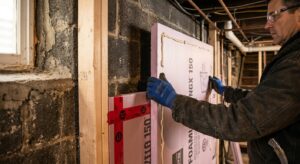
- Choose 2-inch polyisocyanurate (polyiso) rigid foam boards (R-13) for maximum R-value per inch in the limited ceiling space. Cut boards to fit tightly between furring strips using a utility knife and straightedge.
- Seal all existing ceiling penetrations (light fixtures, junction boxes, pipes) with low-expansion spray foam from inside the room before installing new insulation. This air sealing step is non-negotiable and prevents moisture from bypassing the insulation.
- Fasten 1×3 wood furring strips across the existing ceiling joists at 16-inch intervals using 2.5-inch drywall screws. These create a new plane to attach drywall and compress the foam boards firmly against the existing ceiling.
- Press pre-cut rigid foam boards into the bays between furring strips, ensuring no gaps at the edges. Tape all seams with foil HVAC tape to create a continuous air barrier layer.
- Install new drywall over the furring strips, tape, mud, and finish normally. Reconnect electrical fixtures using extension rings if needed to reach the new ceiling plane.
- Inspect the existing roof membrane and deck for rot, ponding water, or delamination. Replace any damaged decking before proceeding. This work should be done on a dry forecast window of at least 48 hours.
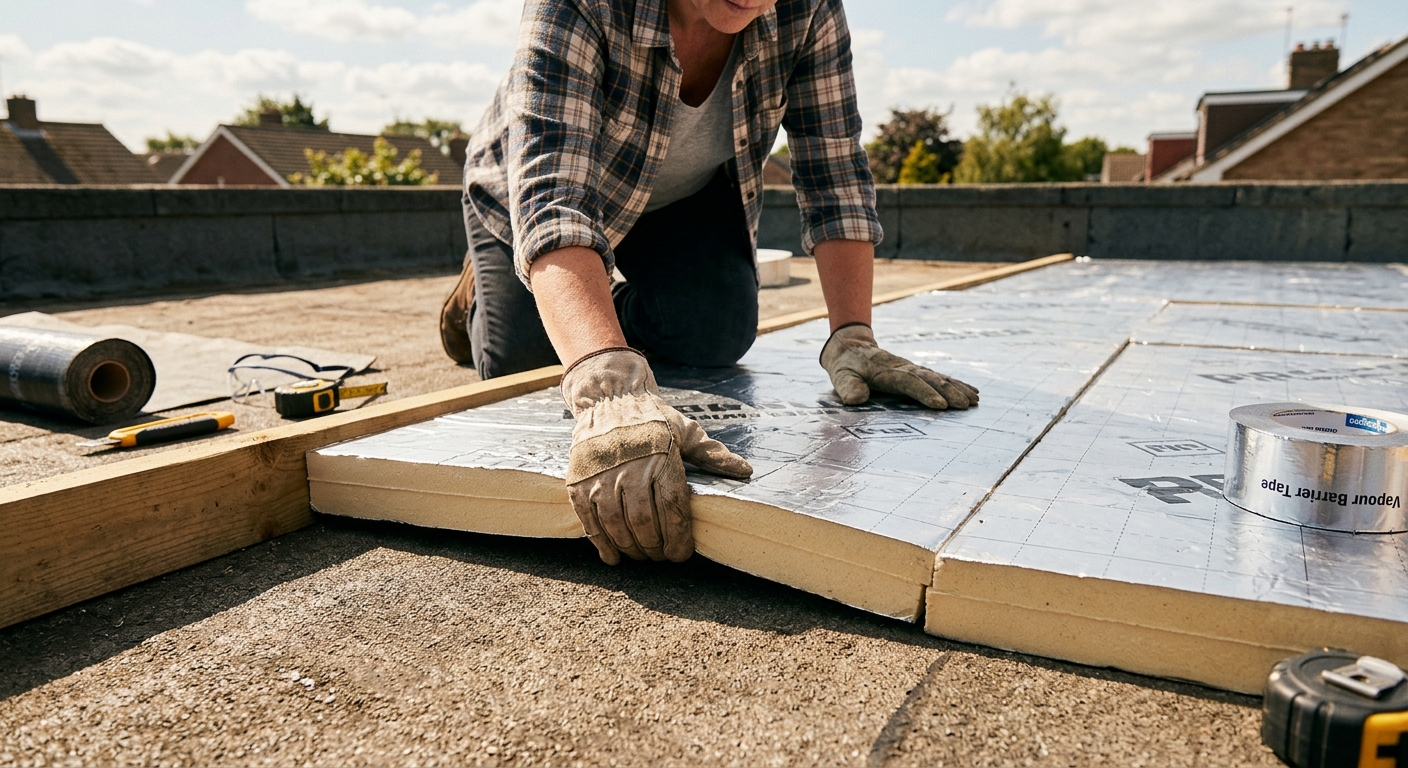
- Install 3 to 4 inches of polyisocyanurate rigid foam boards directly over the existing clean membrane surface, staggering seams in both directions like brickwork. For a Code-minimum assembly in most U.S. climate zones, target R-25 to R-30 total, which requires approximately 4 inches of polyiso (R-25).
- Tape all foam seams with self-adhering flashing tape or foil tape rated for exterior use. Pay special attention to edges, corners, and any roof penetrations such as vents or HVAC curbs, sealing each with foam backer rod and compatible sealant.
- Install a new roofing membrane over the foam layer. For DIY, a self-adhering TPO or EPDM peel-and-stick membrane is the most forgiving option. Roll it out, peel the backing in sections, and use a hand roller to press it firmly onto the foam.
- Flash all penetrations, drains, and parapet wall junctions with compatible flashing tape and membrane strips, extending at least 6 inches up any vertical surface. Proper flashing at terminations is where most flat roof failures originate.
- Inspect every seam and penetration once the membrane is fully installed. Press a garden hose along all seams for 10 minutes and check for leaks from inside before considering the job complete.
- Obtain at least three quotes from licensed spray foam roofing contractors, not general insulation contractors. Verify they carry both general liability and workers compensation insurance and ask for references from flat roof projects specifically.
- Request that the contractor specify the foam density (2-pound closed-cell is required for roofing), the target installed thickness (typically 2 to 3 inches for R-12 to R-19), and the protective elastomeric top coat thickness (minimum 20 mils).
- Prepare the roof surface by clearing all gravel, debris, and loose membrane sections. The contractor will typically perform a final cleaning and priming step before spraying, but your prep work reduces labor costs.
- During installation, stay off the roof and keep windows closed. SPF off-gassing during application requires respiratory protection and the chemicals are irritants. Re-entry is typically safe within 24 hours once the coating has fully cured.
- Inspect the finished system 30 days after installation and annually thereafter. Look for blisters, cracks in the elastomeric coat, or areas where the coating has worn thin. Touch-up coats can be applied by the homeowner with elastomeric roof coating products to extend system life every 5 to 10 years.
Why It Works: The Benefits
Adding insulation to a flat roof with little or no existing insulation can reduce top-floor energy costs by 20 to 30 percent, translating to $150 to $400 per year in savings for a typical 800-square-foot flat-roofed addition in a mixed climate.
Properly insulated flat roofs eliminate the extreme temperature swings that make top-floor rooms nearly unusable in summer. Surface temperatures on interior ceilings can drop by 15 to 25 degrees Fahrenheit, which dramatically reduces radiant discomfort even before the thermostat registers a change.
A correctly designed insulation assembly keeps the roof deck above the dew point year-round, preventing the interstitial condensation that causes decking rot, mold growth, and membrane failures. This protection can extend roof life by 10 to 20 years and prevent repair bills exceeding $10,000.
Adding 3 to 4 inches of rigid foam or spray foam to a flat roof assembly reduces rain noise and external sound transmission noticeably, improving interior acoustics in rooms directly below the roof deck.
Energy auditors and home inspectors flag uninsulated flat roofs as major deficiencies. Correcting a known flat roof insulation problem typically returns 50 to 70 percent of the project cost in appraised value and eliminates a significant buyer negotiating point during resale.
💰 Savings Impact by Action
Installing R-25 exterior rigid foam over an uninsulated flat deck reduces top-floor conditioning loads by up to 28 percent by eliminating thermal bridging and keeping the deck structure warm.
Adding R-13 interior rigid foam to a ceiling with no existing insulation reduces heat transfer through the assembly by approximately 18 percent, limited by remaining thermal bridging through joists.
Applying a white elastomeric coating over a dark membrane reflects 65 to 85 percent of solar radiation and reduces summer cooling loads by 10 to 15 percent in sun-exposed climates.
Sealing penetrations and joist bay gaps at the ceiling plane reduces conditioned air loss through the flat roof assembly by up to 12 percent, with the greatest impact in windy climates.
A closed-cell SPF roofing system simultaneously insulates, air seals, and waterproofs, combining all three benefits to reduce total roof-related energy loss by up to 30 percent compared with an uninsulated assembly.
🏠 Key Concepts Explained
The Science Behind It
Flat roofs are thermally brutal because they combine three heat transfer mechanisms in one compact assembly. Conduction moves heat through the solid materials of the deck and joists. Convection carries warm air through any gaps or open joist bays. And on sunny days, the dark membrane absorbs solar radiation and re-radiates it as heat directly down through the assembly. A well-designed insulation layer addresses all three, but getting the sequence of materials right matters as much as the total R-value.
The dew point is the hidden variable that separates a flat roof insulation job that lasts 30 years from one that rots in five. When warm, humid interior air contacts a surface cold enough to cool the air below its dew point, water vapor condenses into liquid water. In a vented pitched roof, this moisture finds its way out through ventilation. In a flat roof with no venting, it has nowhere to go. The goal of proper flat roof design is to ensure the dew point always occurs outside the roof deck structure, either above it in exterior insulation layers or prevented from reaching the deck by a vapor retarder placed correctly on the warm side. Above-deck rigid foam insulation achieves this elegantly by keeping the entire deck structure warm, which is why exterior insulation is considered the superior assembly despite its higher cost.
Thermal mass plays a smaller role in flat roofs than in walls, but it is worth understanding when planning timing of renovations. Roofing materials like concrete decks store heat absorbed during the day and release it slowly overnight, which is why a poorly insulated flat-roofed room can stay uncomfortably warm until well after midnight even after outdoor temperatures have dropped. Adding insulation does not reduce thermal mass, but it slows the transfer of that stored heat energy into your living space dramatically. In hot climates, combining insulation with a white or reflective roof membrane (which reflects 65 to 85 percent of solar energy versus 5 to 15 percent for black membranes) reduces the heat stored in the deck in the first place, providing a compounding benefit that neither strategy achieves alone.
Frequently Asked Questions
▼ Why is my flat roof leaking after I added insulation?
New leaks after insulation work are almost always caused by disturbed or improperly reinstalled flashing at penetrations, drains, or parapet walls rather than the insulation itself. Inspect every point where the roof surface meets a vertical surface or protrusion first. If the leak appears as interior condensation dripping rather than water flowing from a specific point, you may have a moisture problem within the assembly caused by incorrect vapor control, which requires professional assessment.
▼ My flat roof room is still hot in summer even after insulating the ceiling. What am I missing?
If you added interior insulation but left the original dark membrane in place, solar heat gain is likely still overwhelming the insulation. Consider adding a reflective elastomeric coating to the roof surface, which costs $200 to $600 for most residential roofs and can reduce surface temperatures by 50 to 80 degrees Fahrenheit. Also check whether the HVAC supply registers in that room are undersized for the load, as flat-roofed additions are often served by ducts sized for the original house rather than the actual heat gain of the space.
▼ How do I know if my existing flat roof already has insulation inside?
Remove an interior light fixture or drill a small probe hole in the ceiling drywall away from joists and insert a bent wire coat hanger to feel for resistance. You can also request a thermal scan from a home energy auditor, which will show insulated versus uninsulated areas as distinct temperature patterns on the ceiling. Many utility companies offer free or subsidized energy audits that include thermal imaging.
▼ Can I add rigid foam insulation to a flat roof myself if I have never done roofing before?
The interior ceiling approach is genuinely DIY-friendly and does not involve roofing work at all. Exterior rigid foam with a new membrane is a harder project but achievable for a confident DIYer comfortable working on roofs, using a garden hose test to verify waterproofing before calling it done. Spray foam roofing systems require licensed contractors regardless of skill level due to chemical hazards and equipment requirements. Start with an interior approach if you are unsure, and consult a roofing contractor for any exterior membrane work.
▼ What R-value do I actually need for a flat roof?
Current energy codes (IECC 2021) require R-30 for most flat roof assemblies in Climate Zones 4 and above, and R-20 in Zones 1 through 3. However, code minimum is not the same as cost-optimal, and the DOE’s Zip Code Insulation Program recommends R-38 to R-60 for flat roofs in colder climates when accounting for lifetime energy costs. As a practical target, aim for at least R-25 total if you are doing any exterior work, and R-13 minimum if you are limited to interior ceiling insulation.
Quick Tips
- If you are replacing the roof membrane anyway, always add exterior insulation at the same time. The membrane labor is already paid for and insulation materials add only $1 to $2 per square foot to a job that would otherwise cost $4 to $8 per square foot for the membrane alone.
- Use foil-faced polyisocyanurate foam for interior ceiling applications rather than unfaced EPS or XPS. The foil facing acts as a vapor retarder and radiant barrier simultaneously, and it reflects heat back into the room in winter.
- Stagger all rigid foam board seams in two directions, both horizontally and vertically. A continuous seam from edge to edge creates a thermal bridge and a potential air leakage pathway through the entire insulation layer.
- Check local building codes before starting. Many jurisdictions require permits for roof work and specify minimum R-values for flat roof assemblies (typically R-30 in Climate Zone 5 and above under current energy codes). A permit also protects you if you sell the home.
- Consider adding a white elastomeric roof coating over any existing dark membrane before doing interior insulation. At $0.50 to $1.50 per square foot, a cool roof coating can reduce cooling loads by 10 to 15 percent on its own and buys you time to plan a more comprehensive insulation project.
Variations for Your Situation
- Apartment or Rental with a Flat Roof Below: Renters directly below a flat roof can install interior radiant barrier panels or foil-faced rigid foam tiles that mount to the existing ceiling with adhesive clips, requiring no structural modification and leaving no permanent damage. Products like radiant barrier drop ceiling tiles cost $2 to $4 per square foot and can reduce radiant heat gain from an uninsulated deck by 25 to 40 percent. Always get written landlord approval before any ceiling work, even adhesive-mounted products.
- Tight Budget Under $500: Focus entirely on air sealing first, which costs almost nothing but delivers outsized results. Caulk every gap where ceiling meets walls, seal around all light fixtures with fire-rated caulk or foam, and use weatherstripping foam tape to seal any attic hatch or roof access panel. This alone can reduce heat loss by 10 to 15 percent at a material cost under $50. Add a single layer of foil-faced bubble wrap insulation stapled to exposed ceiling joists in a garage or utility space for another $0.30 to $0.60 per square foot.
- Older Home Pre-1980 with Original Flat Roof: Homes built before 1980 often have flat roofs with open joist bays, no existing insulation, and aging built-up gravel roofing membranes. Before insulating, test for asbestos in the membrane (required if the membrane was installed before 1980 and will be disturbed) by sending a sample to a certified lab for $25 to $50. If the membrane tests positive, do not disturb it and use the interior ceiling approach exclusively. If clear, plan for a full tear-off and re-insulation during the next membrane replacement, which brings the total system to modern performance standards in one project.