Your garbage disposal hums but nothing spins, or it’s completely silent when you flip the switch. Before you reach for the phone to call a plumber, know this: the vast majority of disposal failures are caused by a jammed grinding plate or a tripped overload protector, both of which are designed to be reset at home. No special skills required, and no service fee that typically runs $150 to $250 for a basic repair call.
Garbage disposals are built with two self-service recovery features: a manual reset button on the bottom of the unit and a hex-key socket that lets you hand-crank the grinding plate free. Manufacturers include these specifically so homeowners can fix jams themselves. Most people simply don’t know they exist. This post walks you through both fixes, from the 60-second reset to manually freeing a hard jam, so you can get back to a working kitchen the same day.
We’ll cover exactly what causes a disposal to seize, the step-by-step process for each type of fix, what tools you need, and when the problem actually does warrant calling a professional. We’ll also explain what to do if the unit trips the breaker repeatedly, which is a sign of a deeper issue worth knowing before it becomes a bigger repair bill.
What You’ll Need
Click on an item below to shop for the recommended items for this recipe on Amazon.
As an Amazon Associate, we earn from qualifying purchases.
How to Do It
- Turn the wall switch OFF and leave it off for the entire process. Never work on a disposal with power active.
- Wait 5 to 10 minutes for the motor to cool down if it was humming or running recently. The thermal overload will not reset until the motor temperature drops.
- Get down and look at the bottom center of the disposal unit under the sink. You will see a small red or black button protruding about a quarter inch. That is the overload protector.
- Press the button firmly until you feel it click and seat flush. If it immediately pops back out, the motor is still too hot. Wait another 5 minutes and try again.
- Turn the cold water on, then flip the wall switch. If the disposal runs normally, you are done. Run cold water for 30 seconds to flush any remaining debris.
- Turn the wall switch OFF and unplug the disposal from the outlet under the sink if it has a plug-in cord. If it is hardwired, flip the dedicated circuit breaker to be safe.
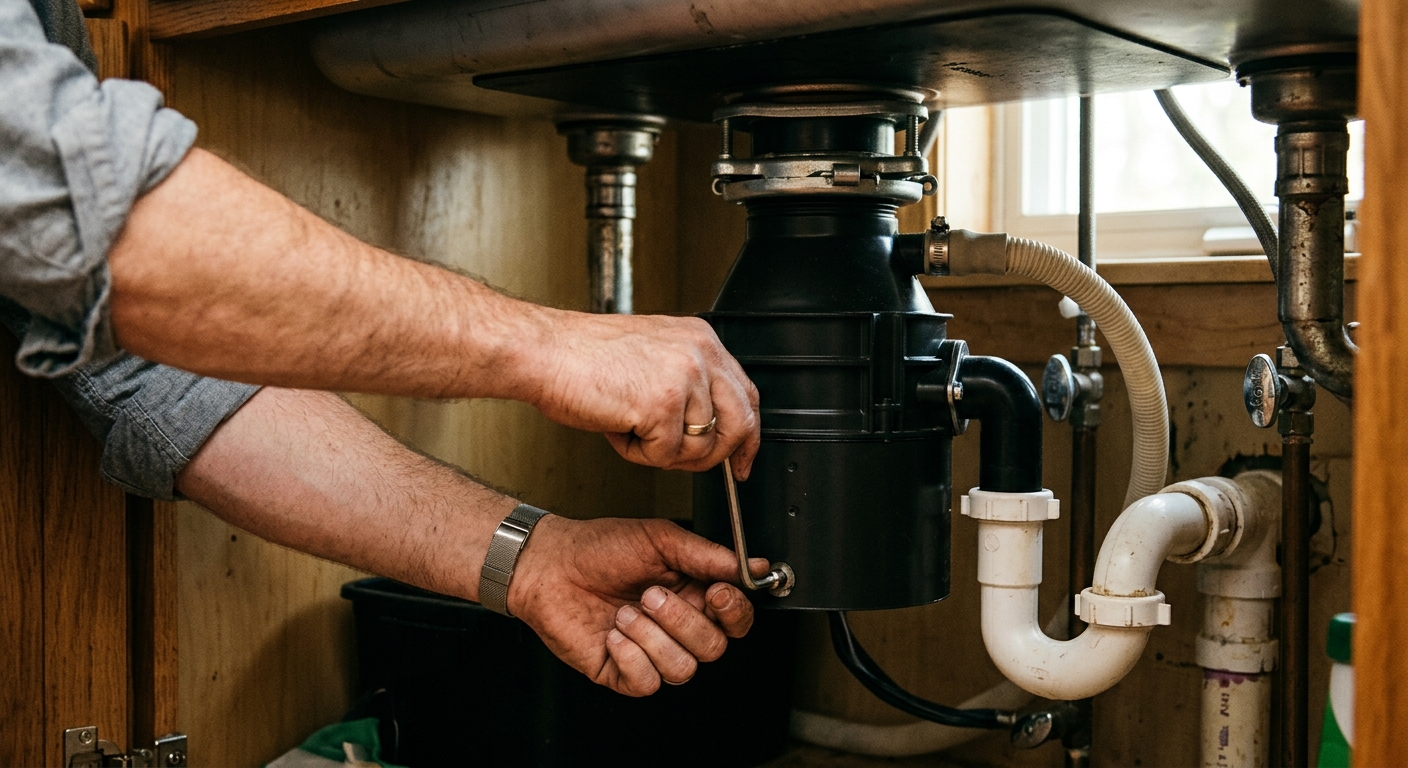
- Locate the hex socket on the very bottom center of the disposal. It is typically a 1/4-inch hex fitting. Most InSinkErator units include a small Allen wrench attached to or near the unit. If you cannot find it, a standard 1/4-inch Allen wrench from any hardware store works.
- Insert the Allen wrench into the hex socket and work it back and forth, not just in one direction. You are trying to rock the grinding plate free from whatever is wedging it. Use firm, deliberate force. This may take 30 to 60 seconds of back-and-forth motion.
- Once the wrench turns freely in both directions through a full rotation, the plate is free. Remove the Allen wrench.
- Use tongs or needle-nose pliers to reach into the drain opening and remove any debris, food chunks, or foreign objects you can feel or see. Never put your hand inside the disposal even with the power off.
- Press the reset button on the bottom if it is protruding, plug the unit back in or restore the breaker, run cold water, and turn the switch on to test. Run the disposal for 30 seconds with water to confirm smooth operation.
- Confirm the disposal needs replacement by checking for a burning smell, visible leaks from the unit body itself rather than connections, or a motor that hums even after a successful unjam and reset.
- Choose a replacement unit sized to your household. A 1/2-horsepower unit handles 1 to 2 people, 3/4 HP suits most families, and 1 HP is appropriate for heavy use or harder food waste.
- Call a licensed plumber or handyman. Get two quotes since pricing varies widely. A straightforward swap on an existing mount typically takes under an hour.
- Ask the technician to inspect the drain line and P-trap connection while they are there, as disposal failures sometimes involve slow drain buildup that should be cleared at the same time.
- After installation, run cold water and test with small soft food scraps first before resuming normal use.
Why It Works: The Benefits
A plumber or appliance technician typically charges $150 to $250 for a basic disposal service visit, often for a fix that takes them under five minutes. Doing it yourself costs nothing if you already own a hex key set.
The overload reset and manual unjam steps take 5 to 20 minutes total, meaning you are not waiting days for a service appointment while the sink is out of commission.
Correctly clearing a jam prevents the motor from burning out. A disposal that repeatedly overheats from ignored jams can fail within months, while a properly maintained unit lasts 10 to 15 years.
A new disposal costs $100 to $400 installed. Many units that appear dead are simply jammed or have a tripped overload protector, so diagnosing correctly before replacement saves significant money.
💰 Savings Impact by Action
DIY reset or unjam eliminates a $150 to $250 plumber service fee entirely for the most common disposal failures.
Correctly diagnosing a jam versus motor failure prevents unnecessary unit replacement in roughly 60% of cases where the disposal appears dead.
Promptly clearing jams before the motor overheats repeatedly can extend disposal service life by several years, delaying a $100 to $400 replacement cost.
🏠 Key Concepts Explained
The Science Behind It
A garbage disposal motor is a split-phase induction motor, the same basic type used in washing machines and power tools. It drives a spinning plate called the impeller disk at 1,725 to 2,800 RPM depending on the model. That plate uses centrifugal force to fling food particles outward against a stationary grind ring, which pulverizes them into slurry small enough to pass through the drain. Because the plate spins fast rather than using cutting blades, any hard object that wedges between the plate and the housing wall creates an instant mechanical lock that the motor cannot overcome.
When the plate locks, the motor continues trying to spin and draws what is called locked-rotor current, typically 5 to 8 times the normal running current. This massive current draw heats the motor windings rapidly. The thermal overload protector is a bimetallic strip that bends when it reaches a set temperature, physically disconnecting the circuit. This is the same principle used in a standard electrical breaker, just built directly into the appliance. That is why the reset button needs cooling time before it will latch again. Once the bimetallic strip cools and straightens, you can press it back into the closed position and restore operation.
The manual hex socket works because rotating the impeller plate even slightly in alternating directions shifts the position of the wedged object relative to the grind ring, releasing the mechanical lock. Engineers include this feature specifically for homeowner self-service because jams are a predictable, common occurrence in normal appliance use. The hex drive bypasses the motor entirely, so you are applying torque through the driveshaft directly, giving you far more mechanical advantage than the motor has under locked-rotor conditions. This is why a modest amount of hand force with a short wrench accomplishes what the motor’s full power could not.
Frequently Asked Questions
▼ My disposal hums but won’t spin even after I reset it and used the hex wrench. What now?
If the plate turns freely with the hex wrench but the motor still only hums under power, the motor’s starting capacitor or start winding has likely failed. At that point the unit is not worth repairing since capacitor replacement costs nearly as much as a new entry-level disposal. Price out a replacement 1/2 HP unit, which runs $60 to $120 at home improvement stores, and either DIY the swap using the existing mounting ring or call a plumber.
▼ The reset button keeps popping out every time I turn the disposal on. Why won’t it stay in?
If the reset trips again within seconds of turning on, either the grinding plate is still jammed or something is wrong with the motor itself. Go back to the hex wrench step and verify the plate spins freely for a full rotation in both directions before restoring power. If it is free and the overload still trips immediately, the motor windings may be partially burned, which means the unit needs replacement rather than a reset.
▼ There is water leaking under my sink after I tried to fix the disposal. Did I cause it?
Most likely not from the unjam process. Check whether the leak is from the drain connection at the side of the disposal or from the sink flange at the top where the disposal mounts to the drain opening. The sink flange connection uses plumber’s putty that dries out over time and is a common independent failure. Tighten the mounting flange bolts or re-seat the putty. If the leak is coming from the body of the disposal itself, the housing has cracked and the unit needs replacement.
▼ My disposal is completely silent when I flip the switch. No hum, nothing. Where do I start?
Complete silence means no power is reaching the motor. Start by pressing the reset button on the bottom of the unit since a severe jam or prolonged hum can cause the thermal overload to trip fully silent. If the button is already flush, check whether the outlet under the sink has power by plugging in a phone charger or lamp. If the outlet is dead, check the GFCI outlet nearby in the kitchen or utility area, as many disposal circuits run through a GFCI that may have tripped. Reset the GFCI and test again before assuming the disposal is faulty.
▼ Can I fix a garbage disposal in a rental apartment without landlord permission?
Pressing the reset button and using the hex wrench are non-invasive actions that require no modifications and leave no trace, so they are universally acceptable for renters to attempt. However, if the unit needs replacement or if there is an electrical issue, notify your landlord in writing since disposal repairs are typically the landlord’s responsibility under most lease agreements. Document the problem with a photo and timestamp before attempting any fix so you have a record if the issue escalates.
Quick Tips
- Always run cold water, not hot, when operating the disposal. Cold water solidifies grease so it gets chopped and flushed rather than coating the grind ring as liquid.
- Avoid putting fibrous foods like celery, artichoke leaves, or corn husks down the disposal. The fibers wrap around the impeller shaft and cause slow-building jams that eventually seize the unit.
- Run the disposal for 20 to 30 seconds after all food is gone with the water still running to fully flush the drain line. Stopping too early leaves debris in the pipe that builds up over time.
- If your disposal smells but is not jammed, grind a cup of ice cubes followed by a handful of kosher salt and a quartered lemon. The ice scours the grind ring and the citrus neutralizes odors without any chemicals.
Variations for Your Situation
- Apartment/Rental: Renters can safely perform the reset button and hex-key unjam steps since both are non-destructive and require no modifications. If the unit still does not work after those steps, submit a written maintenance request with photos. In most states, a broken disposal connected to the kitchen sink qualifies as a habitability repair the landlord must address within a reasonable timeframe. Do not attempt to replace the unit yourself without written landlord approval.
- Tight Budget (under $50): The reset and hex-wrench fix cost nothing if you have a basic Allen wrench set. If you need to buy one, a 9-piece metric and SAE set costs $6 to $10 at any hardware store. Even a full disposal replacement can stay under $50 if you install it yourself using the existing mounting assembly, since a basic 1/2 HP unit sells for $45 to $70. Watch the manufacturer’s installation video first since most modern disposals mount in under 30 minutes with no special tools.
- Older Home (pre-1990): Disposals in older homes may use a different mount standard or older electrical wiring that does not include a grounded outlet under the sink. Before attempting a replacement, verify the outlet is a grounded 3-prong type. If it is a 2-prong ungrounded outlet, a licensed electrician should upgrade it before installing a new disposal. Also check whether the drain connects to a septic system rather than municipal sewer, as septic-rated disposals handle waste differently and require a specific model designation.