You press the reset button on your bathroom or kitchen outlet, and within minutes or hours it trips again. It happens in cycles, leaving you with no power where you need it most. A GFCI (Ground Fault Circuit Interrupter) outlet is one of the most important safety devices in your home, designed to cut power in as little as 1/40th of a second when it detects a ground fault – a dangerous mismatch of just 4 to 6 milliamps between the hot and neutral wires. But that same sensitivity means it can trip for reasons that have nothing to do with a life-threatening fault.
The frustrating truth is that nuisance tripping costs homeowners real money and time. An appliance plugged into a dead outlet gets replaced unnecessarily. A sump pump on a tripped GFCI goes unnoticed until the basement floods. A refrigerator on a nuisance-tripping circuit loses food. Understanding why your GFCI keeps tripping puts you back in control, whether the fix takes two minutes or requires a licensed electrician.
This guide walks you through the most common causes of repeated GFCI tripping, how to isolate the problem systematically with no special equipment required, and the specific signs that tell you to stop diagnosing and call a pro. By the end, you will know exactly what is going on with your outlet and what to do next.
What You’ll Need
Click on an item below to shop for the recommended items for this recipe on Amazon.
As an Amazon Associate, we earn from qualifying purchases.
How to Do It
- Press the RESET button firmly until you feel and hear a click. If it does not stay in or immediately pops back out, the GFCI itself may be faulty or there is an active fault present.
- Unplug every appliance and device from every outlet on that circuit, including any downstream outlets in other rooms or hallways controlled by this GFCI.
- Press RESET again with nothing plugged in. If it holds, the problem is an appliance or combination of appliances on that circuit, not the wiring.
- Plug appliances back in one at a time, waiting 60 seconds between each. The trip will return when you plug in the faulty device. That appliance needs repair or replacement.
- If the GFCI trips with nothing plugged in, or if the outlet is outdoors or in a bathroom and has been exposed to moisture, allow 24 hours with the outlet cover open in a warm dry area. Moisture is the second most common cause and often resolves on its own.
- If it still trips with nothing plugged in after drying out, the fault is in the wiring or the GFCI device itself. Move to the DIY Replacement approach or call a licensed electrician.
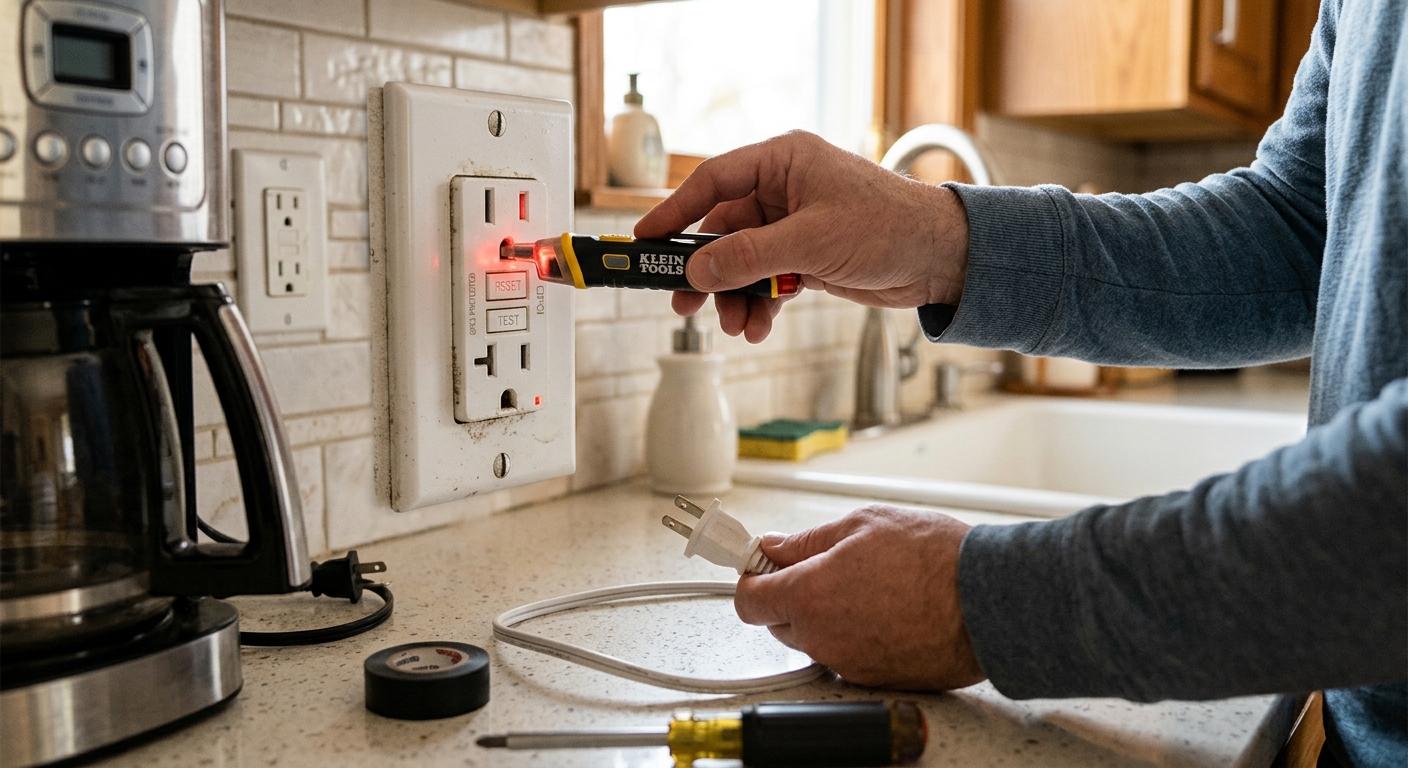
- Turn off the circuit breaker controlling the GFCI outlet. Verify power is off by pressing the TEST button (the outlet should already be dead) and confirming with a non-contact voltage tester at the outlet slots.
- Remove the outlet cover plate and unscrew the GFCI outlet from the electrical box. Carefully pull it out and photograph the existing wiring connections before disconnecting anything.
- Identify the LINE terminals (the wires coming from the panel, supplying power) and the LOAD terminals (wires going to downstream outlets). The LINE side gets the feed wires; the LOAD side is optional and only used if you are protecting downstream outlets.
- Connect the black (hot) wire to the LINE brass terminal and the white (neutral) wire to the LINE silver terminal. If there are downstream wires, connect them to the LOAD terminals the same way. Ensure no copper strands are loose or touching the box.
- Fold the wires carefully back into the box, screw the GFCI outlet in place, and attach the cover plate. Restore power at the breaker.
- Press the TEST button to verify it trips, then press RESET to verify it restores power. Plug in a lamp or phone charger to confirm the outlet is live and working correctly.
- Document the behavior before calling: note when it trips (immediately on reset, after an hour, only when it rains), which outlets downstream are affected, and how old the home and GFCI are.
- Check inside the outlet box for any visible signs of scorching, melted insulation, or a burning smell before the electrician arrives. Do not reset a GFCI if you see any of these signs.
- Request that the electrician perform a megohmmeter or insulation resistance test on the circuit wiring to check for degraded insulation that a visual inspection cannot catch.
- Ask specifically whether the circuit has a shared neutral, which is a common culprit in older homes wired before 1980 and a known cause of unexplained GFCI tripping.
- If the electrician recommends a whole-circuit replacement or panel work, get a written estimate and a second opinion if the cost exceeds $500.
Why It Works: The Benefits
Properly diagnosing the trip cause gets outlets working again without replacing functional appliances or calling an electrician for a problem you can solve yourself, saving the average $100 to $200 service call fee.
Distinguishing a nuisance trip from a real ground fault means you are not resetting an outlet that is actively dangerous. A true ground fault left unaddressed is a leading cause of electrocution and electrical fires in homes.
A GFCI controlling a sump pump, refrigerator, or freezer that trips and stays tripped can result in $500 to $10,000 in flood or food spoilage damage. Diagnosing and fixing chronic trips on critical circuits eliminates that risk.
Homeowners frequently replace a working appliance when the real problem is the GFCI outlet. Diagnosing correctly before replacing anything saves $50 to $400 per incident.
Identifying and removing the root cause – such as a leaky appliance or moisture – stops repeated mechanical stress on the GFCI trip mechanism, extending the device’s functional life closer to its rated 15-year ceiling.
💰 Savings Impact by Action
Correctly diagnosing a faulty appliance before replacing a working GFCI avoids 100% of unnecessary appliance replacement costs averaging $50 to $400.
Roughly 80% of GFCI nuisance-tripping cases are solvable through self-diagnosis and a $15 outlet replacement, avoiding a $100 to $200 electrician service call.
Identifying and fixing a chronic GFCI trip on a sump pump circuit eliminates a 95% preventable risk of basement flooding costing $2,000 to $10,000 in damage.
Removing the root cause of repeated trips reduces mechanical wear on the GFCI trip mechanism and can extend device life by up to 30% toward its rated 15-year ceiling.
🏠 Key Concepts Explained
The Science Behind It
A GFCI outlet contains a differential current transformer that continuously compares the current flowing out on the hot wire to the current returning on the neutral wire. Under normal conditions those two values are identical because all current that leaves the panel returns to it. The instant even 4 to 6 milliamps of current finds an alternate path to ground, such as through a person, through water, or through degraded wire insulation, the values diverge. The GFCI detects that divergence and fires a solenoid that physically separates the contacts in under 25 milliseconds, well before that current level can cause ventricular fibrillation in an adult.
The trip threshold of 4 to 6 milliamps is deliberately conservative. It is low enough to prevent electrocution but also low enough to be triggered by normal leakage current in long cable runs, by motor brushes in aging tools, and by moisture inside junction boxes. This is not a flaw – it is the designed behavior. The engineering trade-off is safety over convenience, which is exactly what you want near water. Understanding that the GFCI is doing its job correctly in most nuisance-trip scenarios helps you focus on finding and eliminating the small current path rather than blaming or bypassing the device.
The internal trip mechanism in a GFCI outlet is a mechanical and electronic assembly with a finite lifespan. Most manufacturers rate their devices for 10,000 trip-and-reset cycles and a service life of 10 to 15 years. As the device ages, the trip coil and reset latch wear, sometimes causing the device to trip at leakage levels even further below the rated threshold. This is why an outlet that served a household for 12 years without issue can suddenly begin nuisance tripping on appliances it previously handled without complaint. Replacing a GFCI outlet that is more than 10 years old is cheap insurance at $15 to $25 and often resolves chronic issues instantly.
Frequently Asked Questions
▼ My GFCI resets fine but trips again after a few hours or overnight. What is causing that?
This pattern almost always points to moisture accumulation or a thermal issue in an appliance. Moisture builds slowly as temperatures drop overnight and can eventually create enough of a current path to trip the GFCI. Disconnect all loads, open any outdoor outlet covers, and let the circuit dry for 24 to 48 hours. If the trip recurs with no load plugged in after drying, the wiring insulation inside the wall may be compromised and needs professional evaluation.
▼ The GFCI outlet trips immediately when I press RESET, even with nothing plugged in. Is that dangerous?
Yes, treat this as a real fault until proven otherwise. An immediate trip with no load suggests either a wiring fault in the circuit itself or a failed GFCI device. Turn the breaker off, replace the GFCI outlet with a new one, and restore power. If the new device also trips immediately with nothing plugged in, stop and call a licensed electrician because there is an active ground fault somewhere in the wiring.
▼ Can a refrigerator or large appliance cause a GFCI to trip?
Yes, and this is more common than most homeowners realize. Refrigerator compressor motors generate leakage current, and older units can produce enough to cross the 6-milliamp trip threshold on their own. The NEC does not require kitchen refrigerator circuits to be GFCI-protected in most cases precisely because of this compatibility issue. If your refrigerator keeps tripping a GFCI, consult a licensed electrician about whether that specific circuit is required to have GFCI protection under your local code before removing it.
▼ I replaced the GFCI outlet myself and it still trips. What did I miss?
The most common DIY error is connecting the supply wires to the LOAD terminals instead of the LINE terminals. Compare your connection to the wiring diagram on the new device and verify the feed wires are on LINE. The second most common cause is a downstream outlet or junction box on the same circuit that has moisture or a wiring fault – disconnect the LOAD terminal wires entirely and retest. If the GFCI holds with LOAD terminals empty, the problem is downstream.
▼ Are there GFCI outlets that are less sensitive and will not nuisance-trip as often?
Some commercial-grade GFCI outlets are designed with feed-through filtering to better ignore normal motor leakage current while still meeting the 6-milliamp trip requirement. Brands like Leviton and Hubbell offer commercial-grade models for $20 to $40 that are more robust in high-leakage environments. However, do not interpret reduced nuisance tripping as a reason to ignore what caused the original trips – always diagnose the root cause first.
Quick Tips
- Label your GFCI outlets with the installation date using a small piece of tape inside the cover plate. Replace them proactively after 10 to 12 years before nuisance tripping begins.
- If an outdoor GFCI trips repeatedly after rain, install a while-in-use weatherproof cover that keeps water off the face of the outlet even when a cord is plugged in. These cost $8 to $15 and eliminate most weather-related trips.
- Use a GFCI outlet tester (a $10 plug-in device) to verify that a replacement GFCI is correctly wired and actually trips when it should. This catches reversed-line wiring errors immediately.
- Never connect a GFCI to the LOAD terminals of another GFCI on the same circuit. Daisy-chaining two GFCIs causes interaction between their sensing circuits and leads to unexplained, difficult-to-diagnose tripping.
Variations for Your Situation
- Apartment/Rental: Renters can perform all of the no-tools diagnostic steps, including unplugging loads and pressing TEST and RESET, without landlord permission. If the outlet requires replacement or if there is a wiring issue, this is the landlord’s legal responsibility in most jurisdictions. Document the problem with photos and written notice, and request repair in writing. Do not attempt to replace GFCI outlets yourself in a rental without written authorization.
- Tight Budget (under $50): The entire quick-diagnosis approach costs nothing and solves the majority of nuisance-tripping situations. If a replacement outlet is needed, standard 15-amp GFCI outlets from brands like Leviton or Eaton cost $12 to $20 at any hardware store. A plug-in GFCI outlet tester to verify correct wiring costs $8 to $12 and is reusable across your whole home. Total investment under $35 covers diagnosis, replacement, and verification.
- Older Home (pre-1980): Homes built before 1980 often lack grounded wiring (three-prong circuits) in bathrooms and kitchens. A GFCI outlet can be legally installed on an ungrounded two-wire circuit and still provides shock protection, but the outlet must be labeled ‘No Equipment Ground’ with the sticker included in the GFCI package. Additionally, pre-1980 homes are more likely to have shared neutrals between circuits, which causes persistent GFCI tripping that cannot be fixed by outlet replacement alone. Hire an electrician familiar with older wiring to assess the panel and circuit layout before spending money on repeated outlet replacements.