Your electric bill tells a story, but most homeowners only read the last line. The total due. If you have been paying without analyzing the numbers behind them, you are almost certainly leaving real money on the table every single month. A single bill shows you what you owe. Twelve months of bills show you exactly where your energy is going and which systems are costing you the most.
The good news is that you do not need a degree in engineering or a special meter to do this analysis. Your utility account, a basic spreadsheet, and about an hour of focused work can reveal your home’s biggest waste points, whether that is an inefficient HVAC system driving up summer bills, a water heater running overtime in winter, or a phantom load quietly draining power year-round. The patterns are almost always visible once you know what to look for.
In this guide, you will learn how to pull your historical usage data, build a simple 12-month comparison, identify seasonal spikes and baseline waste, and prioritize the fixes with the fastest payback. Many homeowners who complete this exercise find one or two changes that pay back in under a year and deliver savings of $200 to $600 annually.
What You’ll Need
Click on an item below to shop for the recommended items for this recipe on Amazon.
As an Amazon Associate, we earn from qualifying purchases.
How to Do It
- Log into your utility account and download or screenshot your monthly kWh usage for the past 12 months. Record both kWh used and the dollar amount for each month.
- Open a spreadsheet (Google Sheets is free) and enter the 12 months in column A, kWh in column B, and dollar cost in column C. Add a fourth column for average cost per kWh by dividing column C by column B.
- Highlight your three highest and three lowest kWh months. Note the difference. If your peak month is more than double your lowest month, your HVAC system is your largest cost driver.
- Calculate your estimated daily baseline by looking at your lowest-usage month and dividing total kWh by 30. Multiply by 24 to get an hourly rate. If it exceeds 0.8 kWh per hour for a home under 2,500 sq ft, you have significant always-on waste.
- Compare your cost per kWh across months. If it varies significantly, your utility may use tiered or time-of-use pricing. Call your utility or check your rate schedule online to confirm, since shifting laundry and dishwasher use to off-peak hours can cut those costs by 20 to 30%.
- Write down your single biggest waste point: peak season spike, high baseline, or rising year-over-year usage. This is where to focus your first fix.
- Complete the Quick Spreadsheet Analysis first to identify which season and category (heating, cooling, or baseline) is your primary cost driver. This tells you where to point the meter.
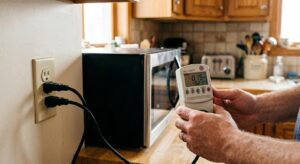
- Purchase a plug-in energy monitor such as a Kill A Watt meter. Plug each major appliance into the meter one at a time: refrigerator, chest freezer, window AC units, dehumidifier, space heaters, and any always-on device.
- For each appliance, record the wattage and run time per day. Multiply watts by daily hours, then divide by 1,000 to get kWh per day. Multiply by 30 for monthly kWh, then multiply by your cost per kWh to get monthly cost. A refrigerator older than 15 years often costs $15 to $25 per month to run alone.
- Check your water heater if it is electric. Set the meter to track overnight from 11 PM to 6 AM when no hot water is being used. Any kWh recorded during that window is standby heat loss. More than 2 kWh overnight suggests a failing element or inadequate insulation.
- Survey your entertainment center and home office equipment for phantom loads. Plug a power strip containing your TV, cable box, and streaming devices into the meter. A typical setup draws 15 to 40 watts continuously even when everything appears off, costing $15 to $35 per year just for standby power.
- Rank your findings from highest monthly cost to lowest. Use this ranked list to prioritize upgrades, starting with the device that has the fastest payback. A $600 refrigerator replacing a 15-year-old unit costing $22 per month pays back in about 27 months.
- Call your utility company or visit their website to ask about home energy audit programs. Many offer blower-door testing, thermal imaging, and a full report at no cost or for $50 to $150 as part of their efficiency programs.
- Before the auditor arrives, print or pull up your 12-month usage spreadsheet from the Quick Fix approach. Share it with the auditor so they can correlate their physical findings with your actual billing data.
- During the audit, ask the auditor to identify your top three findings by annual dollar impact, not just by energy use. This frames their recommendations in the language of payback rather than kilowatts.
- Request a blower-door test if not already included. This pressurizes your home to measure total air leakage in cubic feet per minute. Homes above 2,000 CFM50 have significant air sealing opportunities worth $150 to $300 annually in conditioning savings.
- Review the written report and ask the auditor to mark each recommendation as DIY-feasible or contractor-required. Prioritize DIY items with payback under 12 months, such as air sealing, attic insulation top-ups, and water heater blankets.
- Apply for any rebates your utility offers for the recommended improvements before starting work. Many utilities offer $50 to $500 in rebates for insulation, smart thermostats, heat pumps, and efficient water heaters.
Why It Works: The Benefits
Without data, most homeowners make changes randomly and see minimal results. Bill analysis pinpoints which system is responsible for 60 to 80% of your cost and lets you invest in the fix with the fastest payback, typically HVAC or water heating.
A compressor losing refrigerant or a failing heating element in a water heater will show up as a gradual 10 to 20% increase in monthly kWh before the equipment fails completely. Catching it early lets you repair or replace on your schedule, not in an emergency.
Homeowners who act on bill analysis findings consistently report savings of $200 to $600 per year by addressing their top one or two waste points, based on DOE and ENERGY STAR program data. Higher-consumption homes or those with older equipment often save more.
Knowing your actual baseline and peak loads prevents over-buying. Homeowners who skip this analysis often purchase HVAC systems or solar arrays that are sized for their worst-case fears rather than their actual usage, wasting thousands of dollars on oversized equipment.
Once you establish a 12-month baseline, you can compare it against the following year to confirm that your weatherstripping, thermostat upgrade, or new appliance actually delivered the savings you expected, rather than assuming it did.
💰 Savings Impact by Action
Eliminating always-on standby power from electronics and appliances reduces annual electricity use by 5 to 10% according to Lawrence Berkeley National Laboratory data.
Upgrading from a SEER 10 to a SEER 18 air conditioner reduces cooling electricity consumption by up to 30% for the same amount of cooling delivered.
Sealing major air leakage points in the building envelope reduces heating and cooling load by 10 to 20%, saving an average of $200 per year in mixed climates.
Switching from a standard electric resistance water heater to a heat pump water heater reduces water heating electricity use by up to 70%, saving 10 to 12% of total home electricity.
Programming 4-degree setbacks during sleep and away hours saves approximately 10% on annual heating and cooling costs per DOE estimates.
🏠 Key Concepts Explained
The Science Behind It
Electric bills measure energy in kilowatt-hours, where one kWh equals 1,000 watts running for one hour. The physics behind your bill is straightforward: every device in your home converts electricity into some combination of heat, light, motion, or computation. The inefficiency of that conversion determines how many kWh it consumes per task. An LED bulb converts about 90% of electricity into light. An old incandescent converted only 10%, with 90% becoming waste heat. That same principle applies to refrigerators, HVAC compressors, and water heaters at much larger scales.
The seasonal spike pattern most homeowners see is driven by thermodynamics. In summer, your air conditioner must move heat from inside your home to the outdoors against a temperature gradient. The larger that gradient, the harder the compressor works and the more electricity it draws. A home at 75 degrees Fahrenheit with outdoor temperatures of 95 degrees requires the compressor to overcome a 20-degree difference. On a 105-degree day, that difference doubles, and energy consumption rises roughly in proportion. This is why a single heat wave can add $50 to $100 to a monthly bill without any change in behavior.
Your baseline load follows a different principle: it is dominated by standby power and thermostatic cycling. Refrigerators, water heaters, and freezers cycle on and off around the clock regardless of whether anyone is home. Standby electronics draw small but constant wattages. These loads are invisible in daily life but extremely visible in your bill data as the floor below which your usage never drops. Understanding that your baseline and your peak are caused by entirely different systems, and therefore require different solutions, is the central insight that makes bill analysis so powerful. You cannot reduce your summer peak by unplugging phone chargers, and you cannot reduce your baseline by getting a more efficient air conditioner.
Frequently Asked Questions
▼ My bill is high but I cannot figure out which appliance is causing it. Where do I start?
Start with your three biggest loads statistically, which are HVAC, water heating, and refrigeration. Together these typically account for 55 to 65% of a home’s electricity use according to EIA data. Plug your refrigerator into a Kill A Watt meter for 24 hours, check your water heater’s wattage label and estimate daily run time, and review how often your HVAC thermostat is calling for heat or cooling. One of these three will almost always be the culprit.
▼ My summer bills are much higher than my neighbors’ even though our houses are similar. What is wrong?
The most common causes are an aging or low-efficiency AC unit, duct leakage sending conditioned air into unconditioned attic or crawl space, or a heavily shaded house neighbor versus a sun-exposed roof on yours. Check your AC’s SEER rating on the nameplate. A unit below SEER 13 costs roughly 30 to 40% more to operate than a modern SEER 18 unit. Duct leakage testing by an HVAC technician can reveal losses of 20 to 30% of your cooling capacity.
▼ How do I get 12 months of data if I just moved into a new home?
Call your utility and ask for the prior account holder’s historical usage for the address. Utilities typically retain this data and can provide it for efficiency purposes without disclosing personal account information. Alternatively, many utilities show whole-address consumption history in the new account portal after you set up service. This gives you a baseline for the home’s typical use before your habits come into play.
▼ My usage is flat year-round with no seasonal spike. Is that good or bad?
It depends entirely on your heating fuel. If you heat with gas or oil, a flat electric profile actually means your bill analysis is only capturing part of your total energy picture. Your biggest efficiency opportunities may be in your gas bills rather than electric ones. If you heat and cool entirely with electricity and your profile is flat, your baseline load is likely very high, suggesting significant always-on waste from older appliances, phantom loads, or an electric water heater with a failing element.
▼ I made several changes last year but my bills did not drop. How do I know if they worked?
You need to normalize for weather, since a hotter summer will erase efficiency gains in the raw numbers. Look up heating and cooling degree days for your area from NOAA or degreedays.net for both years and calculate kWh per degree day for each month. If your kWh per degree day dropped after your improvements, they worked, even if the total bill went up due to more extreme weather. If kWh per degree day stayed flat, the changes did not deliver as expected and you should revisit what was installed.
Quick Tips
- Download your utility’s app if available. Many now show daily kWh usage, which lets you identify the exact day a new appliance, behavior change, or malfunction showed up in your consumption.
- Compare your kWh per square foot to national averages. The U.S. average is about 1.2 kWh per square foot per year. If you are above 1.5 kWh per square foot, your home has above-average efficiency opportunities.
- Ask your utility for a neighbor comparison report. Many utilities now provide anonymized comparisons showing how your usage compares to similar nearby homes. Consistently using 20% or more than your neighbors in the same weather conditions points to equipment or envelope issues.
- Track your cost per kWh over time. If this number rises between similar months year over year, your utility has raised rates, and the payback math on efficiency upgrades just improved without you doing anything.
Variations for Your Situation
- Apartment or Rental: Renters often have limited access to full utility history, especially in buildings with landlord-paid utilities or sub-metered systems. Request 12 months of usage from your landlord in writing, which they are legally required to provide in many states. Focus your analysis on baseline loads and phantom power since you cannot control central HVAC. A $25 plug-in meter and smart power strips with auto-shutoff ($20 to $40 each) are renter-safe tools that can reduce your electric use by 8 to 12% with zero modifications to the unit.
- Tight Budget (under $50): Skip the energy monitor initially and rely entirely on your utility’s free online usage data. Most utilities now offer daily usage graphs at no cost. Spend your $50 on two or three smart power strips that kill phantom loads automatically, since these typically pay back in 6 to 10 months. The free bill analysis alone will point you toward behavioral changes, like thermostat setback scheduling or off-peak appliance use, that cost nothing and often save $100 to $200 annually.
- Older Home (pre-1980): Homes built before modern energy codes typically have baseline loads and peak loads that are 30 to 50% higher than similar-sized newer construction due to minimal wall insulation, single-pane windows, and poorly sealed envelopes. When you complete your analysis, expect your findings to point strongly toward air sealing and insulation rather than appliances. Prioritize a professional blower-door test since DIY efforts in older homes can miss major leakage pathways in balloon-frame walls and at the sill plate. Many state weatherization programs offer free or income-qualified services specifically for pre-1980 housing stock.