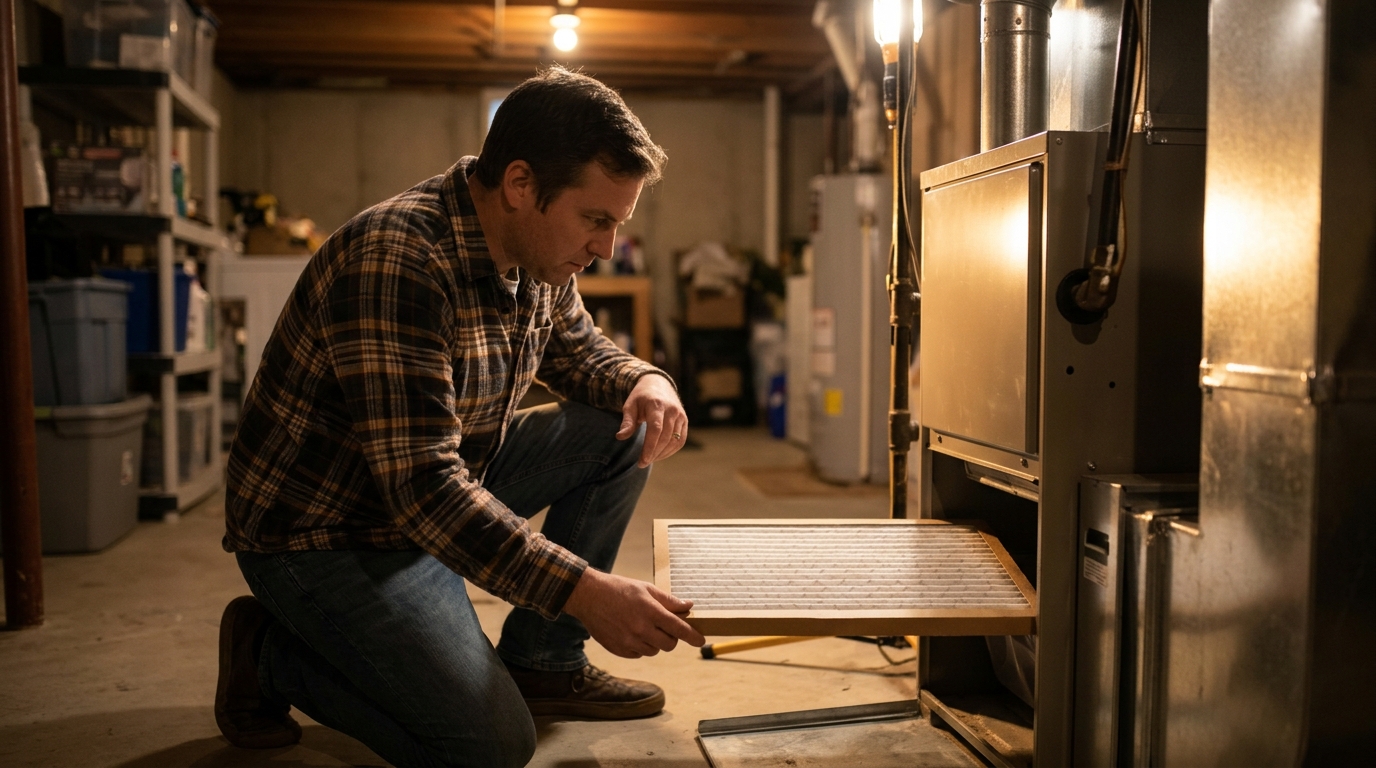
Most homeowners do not think about their furnace filter until something goes wrong: a cold room, a strange smell, or a furnace that never seems to shut off. By then, the filter has often been choked with dust, pet hair, and debris for months. When the first freezing night hits, your furnace is asked to run for hours at a stretch, and a dirty filter makes that job much harder.
The filter sits in the path of every cubic foot of air your furnace moves. When it clogs, airflow drops, the blower motor strains, and the heat exchanger can overheat and trip safety limits. The Department of Energy notes that replacing a dirty, clogged filter with a clean one can lower your system’s energy consumption by 5 to 15%. That is real money over a long heating season, and the fix costs between $5 and $25.
This post walks through why timing matters, how to check and replace your filter in minutes, when to consider a higher-grade upgrade, and what to do if problems continue after a fresh filter goes in. Do it in early fall, and you will head into winter with a system that runs efficiently and quietly.
What You’ll Need
Click on an item below to shop for the recommended items for this recipe on Amazon.
As an Amazon Associate, we earn from qualifying purchases.
How to Do It
- Turn the thermostat to Off or switch the furnace power off at the service switch near the unit so the blower will not start while you work.
- Locate the filter slot, usually at the return air duct, in a slot on the side of the furnace, or behind a return grille on a wall or ceiling.
- Slide the old filter out and note the size printed on the cardboard frame (for example 16x25x1) and the airflow arrow direction.
- Hold the filter up to a light. If you cannot see light through it, or it looks gray and matted, replace it.
- Insert a new filter of the same size with the arrow pointing toward the furnace and away from the return duct, then restore power.
- Write the date on the filter frame with a marker so you know when it is due for the next check.
- Replace the filter as described in the quick fix, then set a recurring phone reminder for every 30 to 90 days based on your household (pets, allergies, and construction dust mean shorter intervals).
- Vacuum the area around the furnace and the return air grilles to remove dust that would be pulled straight into the new filter.
- Check that supply registers and return grilles in every room are open and not blocked by furniture, rugs, or curtains.
- Inspect the area around the furnace for stored items. Keep at least 3 feet of clear space around the unit for safe operation and airflow.
- Run the furnace through a full heating cycle and listen for rattling, whistling, or repeated starting and stopping, which may signal a problem beyond the filter.
- Test your carbon monoxide detectors and replace batteries so your home is protected when the furnace runs daily.
- Book an HVAC tune-up in early fall. Many companies offer seasonal discounts or maintenance plans that include priority service.
- Ask the technician to check the heat exchanger for cracks, test the flame sensor, and inspect the igniter and burners.
- Have them measure static pressure and temperature rise to confirm your filter grade and ductwork are not restricting airflow.
- Request that they clean the blower assembly, which collects dust over time and reduces air delivery.
- Ask about the best MERV rating for your specific furnace and whether a thicker media filter would suit your system.
Why It Works: The Benefits
Restoring proper airflow can reduce furnace energy use by 5 to 15%, which is roughly $50 to $150 on a typical $1,000 seasonal heating bill.
Less strain on the blower motor and heat exchanger helps your furnace reach its 15 to 20 year expected lifespan and avoids premature repairs.
Full airflow delivers heated air evenly to every room, so far-away bedrooms and upstairs spaces stay comfortable without raising the thermostat.
A clean filter captures dust, pollen, and pet dander during the months when windows stay closed and indoor air recirculates constantly.
Overheating and short cycling are common causes of mid-winter breakdowns, when service calls cost more and wait times are longest.
💰 Savings Impact by Action
Replacing a clogged filter restores airflow and can reduce furnace energy use by 5 to 15%.
Opening blocked registers and clearing return grilles evens out heating and reduces run time by roughly 5%.
Preventing short cycling reduces wasteful start-ups and keeps the furnace operating in its efficient steady state.
A professional tune-up that cleans burners and the blower can improve efficiency by up to 10 to 15% on neglected systems.
🏠 Key Concepts Explained
The Science Behind It
Your furnace is designed to move a specific volume of air across the heat exchanger, typically around 400 cubic feet per minute for every ton of capacity. That airflow carries heat away from the metal surfaces and delivers it through your ducts. When a filter loads up with dust, the pressure drop across it climbs, and the blower can no longer move the designed volume of air.
With less air passing over the heat exchanger, the metal runs hotter than intended and the temperature of the air leaving the furnace rises. Modern furnaces have a high-limit switch that shuts the burners off when temperatures climb too high. The result is short cycling: the furnace fires, overheats, shuts down, cools, and starts again. Each start-up uses extra energy and stresses components, while the house never reaches steady, even heat.
Meanwhile, the blower motor works against higher resistance. Many older furnaces use a PSC motor that draws more current as static pressure rises, while newer ECM motors compensate by ramping up power. Either way, you pay for electricity that produces less comfort. A clean filter restores the designed pressure balance, which is why the savings and reliability gains come from such a small, cheap part.
Frequently Asked Questions
▼ Why is my furnace still running constantly even after I put in a new filter?
A constantly running furnace can be caused by thermostat settings, leaky ducts, poor insulation, or an undersized system, not just the filter. Check that registers are open, set the thermostat fan to Auto instead of On, and compare how fast the house heats to how fast it loses heat. If the problem continues, have an HVAC technician test airflow and duct leakage.
▼ Can renters change the furnace filter without landlord permission?
In most leases, replacing a standard furnace filter is considered routine maintenance and is often the tenant’s responsibility, but check your lease to be sure. If the filter is hard to reach or the unit seems damaged, notify your landlord instead of forcing it. Keep receipts in case you need to document maintenance.
▼ How long before I notice savings on my heating bill?
You may notice better airflow and quieter operation right away, but the bill savings show up over the next billing cycle or two. Because heating costs vary with weather, compare usage in therms or kilowatt-hours against similar degree-day periods. The DOE estimates 5 to 15% savings, so a $150 monthly bill could drop by $8 to $22.
▼ What if my home is older than 30 years and the furnace is original?
Older furnaces are even more sensitive to airflow restriction, and the filter slot may be a non-standard size or missing altogether. Replace the filter before winter, and have a technician inspect the heat exchanger and venting since age-related wear is a safety issue. If your furnace is more than 20 years old and 80% AFUE or less, ask about the payback of a high-efficiency replacement.
▼ Is a more expensive filter worth it?
Not always. A MERV 8 to 11 pleated filter strikes the best balance of filtration and airflow for most homes. Pay more only if you have allergies or pets, and confirm your system can handle the added resistance before going above MERV 11.
Quick Tips
- Check the filter monthly during the first heating season in a new home, then adjust the schedule based on how dirty it looks.
- Households with pets, smokers, or allergy sufferers should plan on changing filters every 30 to 60 days.
- Standard 1-inch filters generally need replacing every 1 to 3 months, while 4-inch to 5-inch media filters can last 6 to 12 months.
- Buy filters by exact size and keep a spare or two near the furnace so a change takes minutes, not a trip to the store.
- If you change the filter and the furnace still struggles, check for blocked vents and closed registers before assuming a bigger problem.
Variations for Your Situation
- Apartment/Rental: Check your lease, then locate the filter in the return grille or furnace closet and replace it yourself with a $6 to $15 filter, since this is usually the tenant’s duty. Take a photo of the old filter and the unit label in case you need to show the landlord condition or request service.
- Tight Budget (under $50): Buy a multi-pack of basic pleated MERV 8 filters for roughly $4 to $8 each and set a 60-day calendar reminder. Skip premium filters and focus on keeping registers open and the area around the furnace clean, which costs nothing.
- Older Home (pre-1980): Expect leakier ducts, dustier return paths, and possibly a nonstandard filter size, so measure carefully and consider a custom-fit option. Pair the filter change with a visual check of ductwork for gaps and disconnected joints, and schedule a professional safety inspection of the heat exchanger and venting.
- Pet Owners or Allergy Households: Change filters every 30 to 45 days during winter and consider a MERV 11 pleated filter if your furnace allows it. Vacuum return grilles weekly to keep hair and dander from overloading the filter.