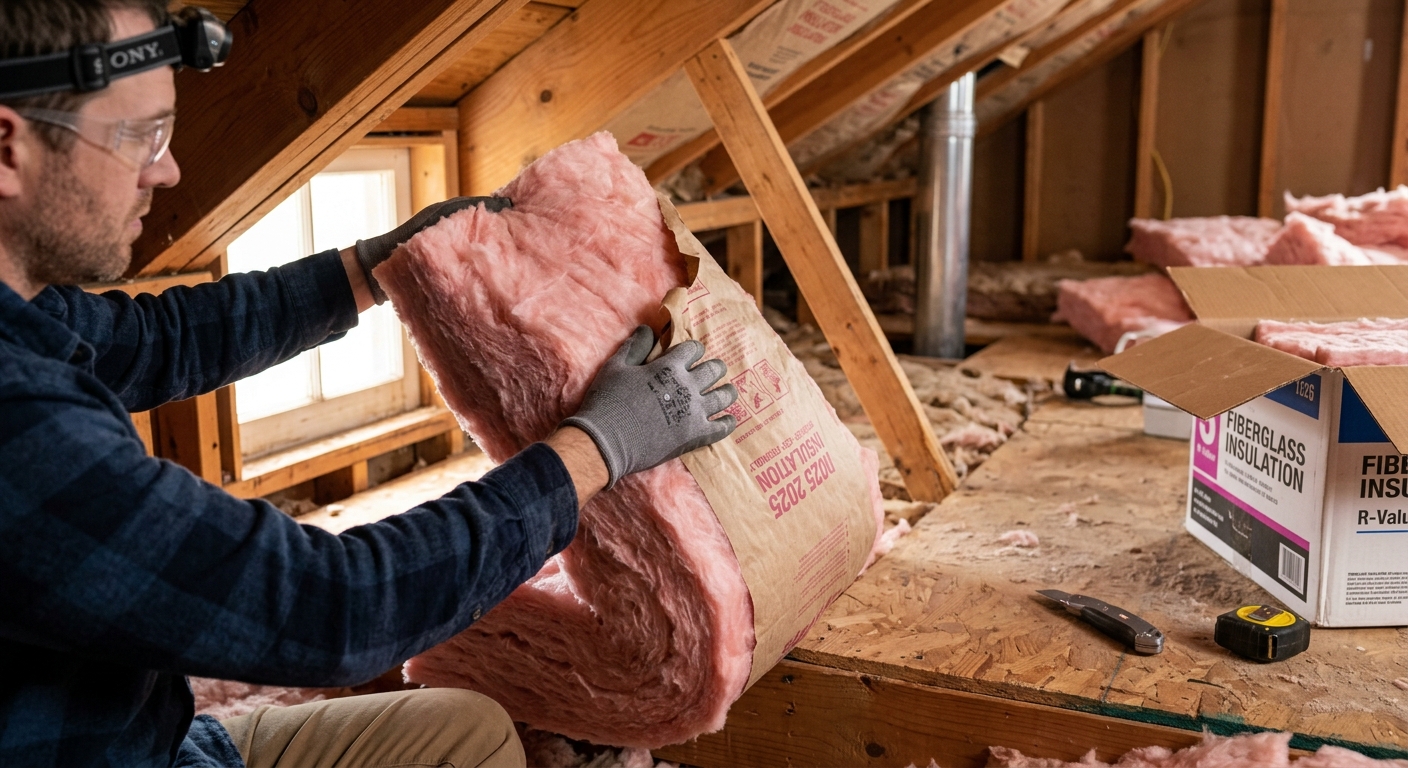
If you upgraded your insulation in 2025 or are planning to, the federal government will pay you back up to $1,200 of the cost. The Energy Efficient Home Improvement Credit, established under the Inflation Reduction Act, covers 30% of the cost of qualifying insulation materials and air sealing products installed in your primary residence. That is real money sitting on the table that most homeowners never collect simply because they do not know the process.
This post walks you through exactly how to qualify, what products are eligible, how to document everything correctly, and how to file for the credit. We will cover both the DIY approach (yes, you can install insulation yourself and still claim the credit) and the professional installation route, which often makes sense for attic or wall cavity work. Either way, the paperwork process is the same, and we will make it simple.
Beyond the tax credit, upgrading insulation is one of the highest-return home efficiency investments available. The Department of Energy estimates that proper insulation combined with air sealing can cut heating and cooling costs by 15 to 25% annually. Pair that with a $1,200 tax credit and the payback period on most insulation projects drops to under three years, sometimes under one.
What You’ll Need
Click on an item below to shop for the recommended items for this recipe on Amazon.
As an Amazon Associate, we earn from qualifying purchases.
How to Do It
- Gather all receipts for insulation or air sealing materials purchased in 2025, separating material costs from any labor charges on contractor invoices.
- Visit the manufacturer’s website for each product installed and download the Manufacturer’s Certification Statement (also called an Energy Efficiency Certification). Search the product name plus ‘tax credit certification PDF’.
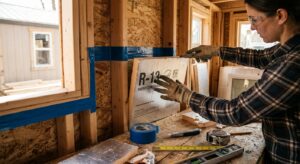
- Confirm the product meets your climate zone’s IECC requirements. The DOE’s Zone Map is free at energycodes.gov. Most U.S. homes need attic insulation at R-38 or higher to qualify.
- Add up total qualifying material costs and multiply by 0.30 to estimate your credit. If the result exceeds $1,200, your credit is capped at $1,200 for the year.
- When filing your federal tax return, complete IRS Form 5695 (Residential Energy Credits). Enter your qualifying costs on Line 19a under ‘Insulation or air sealing material or system’. Your tax software will calculate the credit automatically.
- Keep all receipts and Manufacturer’s Certification Statements for at least three years in case of audit. You do not submit them, but you must have them available.
- Start with an attic inspection. Measure existing insulation depth with a ruler. Less than 10 inches of fiberglass batts or 12 inches of blown cellulose means you almost certainly qualify for an upgrade and will see clear energy savings.
- Air seal before you insulate. Use canned spray foam ($8 to $12 per can) to seal around attic bypasses including top plates, recessed lights, plumbing chases, and the attic hatch perimeter. Air sealing materials also qualify for the 30% credit.
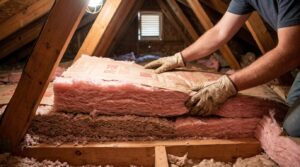
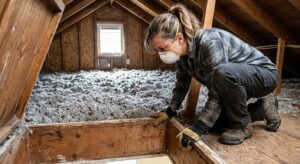
- Purchase blown-in insulation or batts rated to bring your attic to R-49 or R-60 depending on your climate zone. Home centers rent blowing machines for free when you buy 10 or more bags of blown-in insulation, typically $30 to $40 per bag.
- Install insulation to the manufacturer’s recommended depth, working from the eaves toward the center hatch. Maintain attic ventilation baffles at each rafter bay to preserve airflow.
- Insulate and weatherstrip the attic access hatch. This is one of the most overlooked heat loss points in a home. Attic stair cover kits cost $50 to $150 and the materials qualify for the credit.
- Save every receipt and download Manufacturer’s Certification Statements for each product before filing taxes. Enter total material costs on Form 5695 to claim your 30% credit.
- Get at least three quotes from insulation contractors. Ask each to itemize labor and material costs separately on their written estimate, since only materials qualify for the federal credit.
- Ask contractors specifically whether the products they use have Manufacturer’s Certification Statements available. Reputable contractors deal with this question regularly and should be able to confirm immediately.
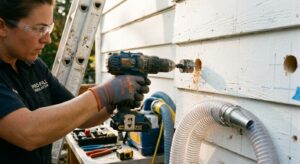
- Consider spray foam for rim joists, crawl spaces, or cathedral ceilings where DIY access is difficult. Spray foam materials qualify for the credit and professionally installed two-component spray foam can achieve R-6 to R-7 per inch.
- Request a written final invoice that clearly breaks out material costs, labor costs, and any equipment or disposal fees so your tax documentation is clean.
- If the project total exceeds $4,000 in materials (generating a theoretical credit over $1,200), discuss with your contractor whether splitting the project across two calendar years makes sense to claim the full $1,200 in each year.
- File Form 5695 with your tax return. Enter only the qualifying material cost, attach no documents but retain the contractor invoice and Manufacturer’s Certification Statements in your files.
Why It Works: The Benefits
This is a tax credit, not a deduction, which means it reduces your actual tax owed dollar for dollar. A $2,000 insulation material spend earns you $600 back, regardless of your tax bracket.
The DOE estimates proper attic insulation and air sealing cuts annual heating and cooling costs by 15 to 25%. On a $2,400 annual energy bill that is $360 to $600 in savings every year after the upgrade.
The $1,200 cap resets each January 1st, so a homeowner who phases projects across multiple years can claim the credit repeatedly. Over three years, that is potentially $3,600 in total credits.
The federal credit can be combined with state energy rebates and utility company incentive programs. In many states, stacking these programs reduces net project cost by 40 to 60% before energy savings are even factored in.
Beyond savings, proper insulation eliminates cold spots, drafts, and rooms that are 5 to 10 degrees off from the rest of the house, which is the complaint that drives most homeowners to finally act.
💰 Savings Impact by Action
Upgrading attic insulation to R-49 or higher reduces heating and cooling loads by 15 to 20% in most U.S. climate zones according to DOE data.
Sealing attic bypasses and top plates can reduce whole-home air infiltration by 20 to 40%, cutting energy bills by 10 to 15% on its own.
The IRA credit returns 30 cents for every dollar spent on qualifying insulation materials, directly reducing the net project cost before any energy savings.
Insulating and air sealing basement rim joists with spray foam can eliminate up to 15% of a home’s total air leakage in a single afternoon project.
Combining attic insulation, air sealing, and rim joist work in a single year can reduce total annual heating and cooling costs by 20 to 25% according to ENERGY STAR estimates.
🏠 Key Concepts Explained
The Science Behind It
Heat moves in three ways: conduction (direct contact), convection (air movement), and radiation (infrared energy). Insulation primarily addresses conduction by trapping still air within fibers or foam cells, slowing heat transfer through walls and ceilings. The R-value system measures resistance to conductive heat flow. Doubling R-value roughly halves conductive heat loss through that assembly, which is why upgrading an attic from R-19 to R-49 produces a significant and measurable reduction in heating and cooling loads.
Air sealing is arguably more impactful than the insulation itself in many older homes. A typical unsealed attic has dozens of small gaps where conditioned air escapes and outside air infiltrates. This stack effect, driven by temperature differences between indoors and outdoors, can be responsible for 25 to 40% of a home’s total heating and cooling load. Spray foam and caulk stop this convective bypass, which is why the IRS wisely included air sealing materials as qualifying products alongside traditional insulation.
The reason attic insulation delivers the highest return on investment compared to wall insulation comes down to geometry and heat physics. Heat rises, so in winter the attic is where the greatest temperature differential exists between conditioned living space and the outdoors. In summer, the attic absorbs intense solar radiation and can reach 150 degrees Fahrenheit, driving heat down into the home. A well-insulated and sealed attic assembly at R-49 to R-60 dramatically reduces this bidirectional heat flow, cutting cooling loads in summer by 15 to 20% and heating loads in winter by a similar margin.
Frequently Asked Questions
▼ Does the insulation tax credit apply to DIY installation or only professional work?
DIY installation fully qualifies. The credit is based on the cost of qualifying materials regardless of who installs them. Keep your store receipts, download the Manufacturer’s Certification Statements for each product, and enter your total material costs on Form 5695 when you file.
▼ My contractor didn’t separate labor and material costs on the invoice. Can I still claim the credit?
Ask your contractor to issue a revised invoice or a written breakdown of material versus labor costs. Most contractors are accustomed to this request and can provide it quickly. Without the breakdown, claiming the full invoice amount would be incorrect and could trigger questions from the IRS.
▼ I installed insulation in a rental property I own. Does it qualify?
No. The Energy Efficient Home Improvement Credit applies only to your primary residence. Rental properties and vacation homes do not qualify for this particular credit, though rental property improvements may be depreciable business expenses. Consult a tax professional for rental property guidance.
▼ What if my total insulation project costs less than $500? Is it still worth claiming?
Absolutely. There is no minimum spend to claim the credit. A $400 project generates a $120 credit, which takes about 15 minutes to add to Form 5695. If you are already filing taxes, there is no reason to leave that money unclaimed.
▼ How do I know if my insulation product qualifies? The store didn’t mention any tax credit.
Go directly to the manufacturer’s website and search for ‘tax credit certification’ or ‘Form 5695 certification’ along with the product name. Major brands like Owens Corning, Johns Manville, and CertainTeed maintain searchable databases of certified products. If you cannot find a certification statement for your specific product, contact the manufacturer’s customer service line.
Quick Tips
- Check your state’s energy office website before starting any project. Many states offer rebates that stack directly on top of the federal credit, often adding another 10 to 25% back on qualifying work.
- Photograph your attic before and after the project. Time-stamped photos showing existing insulation depth and the completed upgrade are excellent supporting documentation if questions arise later.
- Do not insulate over recessed can lights in the attic unless they are rated IC (insulation contact). Non-IC cans are a fire hazard and a major air leak. Cap them with an airtight cover before blowing insulation.
- The $1,200 cap under the Energy Efficient Home Improvement Credit is separate from the $2,000 cap for heat pumps and $600 caps for windows and doors. If you are doing multiple upgrades in 2025, you could claim all categories in the same year.
Variations for Your Situation
- Apartment/Renter: Renters cannot claim the Energy Efficient Home Improvement Credit for insulation since they do not own the primary residence. However, renters can benefit from pushing landlords to apply for the credit, which may motivate upgrades. As a renter, focus instead on portable or removable improvements like window insulator kits ($15 to $30 per window) and door draft stoppers, which reduce your heating bill without requiring landlord permission or ownership.
- Tight Budget (under $500 in materials): Start with the highest-return, lowest-cost projects: attic hatch insulation covers ($50 to $150), canned spray foam for attic bypasses ($40 to $80 total), and batt insulation for an uninsulated basement rim joist ($80 to $150 in materials). All qualify for the 30% credit, and even a $300 material spend earns you $90 back while delivering measurable energy savings. These small projects are also a good way to learn the documentation process before tackling a larger attic project.
- Older Home (pre-1980): Homes built before 1980 typically have little or no wall insulation and minimal attic insulation, meaning the efficiency gains from upgrading are even larger than average. However, older homes may also contain asbestos insulation or vermiculite, particularly in attics. Before disturbing any existing insulation in a pre-1980 home, have a certified inspector test a sample. Asbestos remediation must be done professionally and is not a qualifying insulation expense for the credit. Once cleared, the project qualifies normally and the energy savings potential is often 20 to 30% on heating bills.