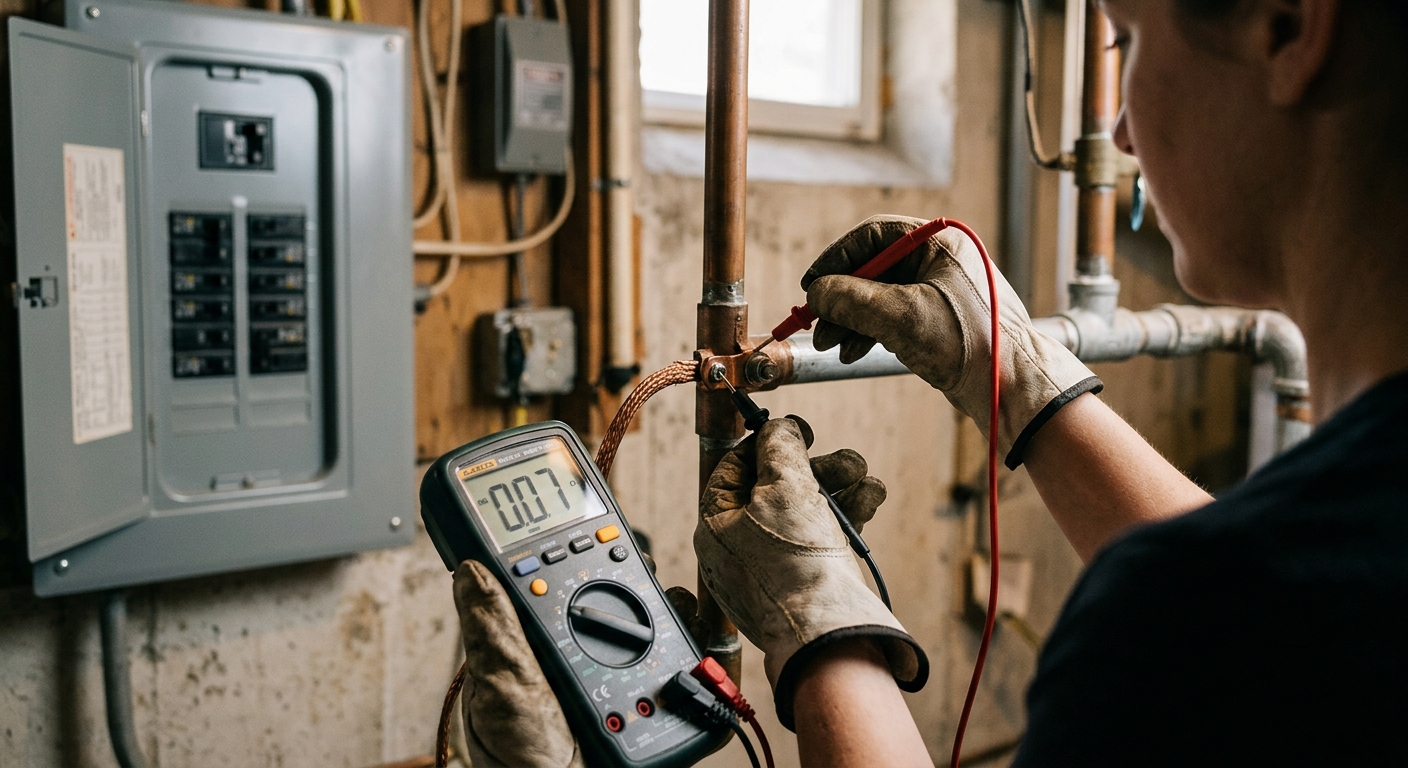
Your home’s grounding system is the silent safety net behind every outlet, appliance, and circuit breaker in your house. When everything works correctly, you never think about it. But when grounding is missing, reversed, or degraded, the consequences range from annoying flickering lights and fried electronics to house fires and lethal shocks. The U.S. Consumer Product Safety Commission estimates that electrical failures cause roughly 51,000 home fires each year, and improper grounding is a contributing factor in a significant share of those incidents.
The problem is that grounding faults are largely invisible. Your lights come on, your outlets deliver power, and nothing seems wrong until a surge takes out your $1,200 refrigerator, your smoke detector false-alarms constantly, or an appliance chassis becomes energized. Homes built before 1960 frequently have no equipment grounding at all, and even newer homes can develop grounding problems over time as connections corrode, wires loosen, or DIY renovations introduce wiring errors.
This post gives you a clear, step-by-step process for checking your home’s grounding system yourself with a simple outlet tester, understanding what the results mean, and knowing when a licensed electrician needs to take over. You do not need to open any panels or touch any wiring to do the basic checks, and the whole process takes under an hour.
What You’ll Need
Click on an item below to shop for the recommended items for this recipe on Amazon.
As an Amazon Associate, we earn from qualifying purchases.
How to Do It
- Purchase a 3-prong outlet tester (sometimes called a receptacle tester) from any hardware store for $10 to $15. Look for one that also detects bootleg grounds, such as the Sperry Instruments SX-6506 or Klein Tools RT210, which cost $18 to $25.
- Start at your electrical panel and note the locations of all circuits, then work room by room testing every 3-prong outlet in your home. Plug the tester in fully and read the indicator lights against the legend printed on the device.
- Flag every outlet that shows ‘open ground,’ ‘open neutral,’ ‘hot/ground reversed,’ or ‘hot/neutral reversed.’ These are all wiring faults requiring repair. Photograph the outlet location and the tester reading for your records.
- Test all outlets within 6 feet of water sources (kitchen counters, bathrooms, garage, outdoor) specifically for GFCI protection by pressing the TEST button on the tester if it has one, or by pressing the TEST button on the GFCI outlet itself and verifying power cuts off.
- If you find more than 2 to 3 problem outlets, or any fault on a 240V appliance outlet (dryer, range, EV charger), schedule a licensed electrician rather than attempting DIY repairs on those circuits.
- Document your findings in a simple list by room. This record is useful for insurance purposes and for briefing an electrician efficiently, potentially saving 30 to 60 minutes of diagnostic billable time.
- Turn off the circuit breaker for the outlet you are working on and verify with a non-contact voltage tester that the outlet is fully de-energized before touching any wires.
- Remove the outlet cover plate and pull the outlet from the box. Inspect the wiring: if you see only two wires (black and white, no bare copper or green wire), the outlet is ungrounded at the wiring level and you cannot simply add a ground wire without running new cable.
- Option A: Replace the ungrounded outlet with a GFCI outlet. Under NEC 406.4(D)(2), this is a fully code-legal solution. GFCI devices protect against shock without a physical ground wire. Label the outlet ‘GFCI Protected, No Equipment Ground’ using the stickers that come with every GFCI outlet. Cost per outlet is $15 to $25.
- Option B: If you need a true equipment ground for a specific location (home office with sensitive electronics, for example), a licensed electrician can run a new grounding conductor back to the panel using a ground wire routed through conduit or greenfield. This is not DIY-appropriate for most homeowners but is worth knowing as an option to discuss with your electrician.
- Once the GFCI outlet is installed and the breaker is turned back on, plug your outlet tester in to confirm the GFCI is functioning. Press the test and reset buttons to verify the protection circuit is active.
- For outlets that tested as ‘open ground’ but DO have a ground wire visible in the box, the fix is usually a loose or corroded ground screw connection. Tighten the bare copper wire firmly under the green ground screw on the outlet, replace the outlet if it is more than 25 years old, and retest.
- Hire a licensed electrician (not a handyman) and request a full grounding and bonding inspection. Ask specifically for a check of the grounding electrode system, main bonding jumper, and panel neutral-ground bond.
- Ask the electrician to verify the grounding electrode conductor (the wire connecting your panel to the ground rod outside) is intact, properly sized (typically 4 AWG copper for most residential services), and making solid contact at both ends.
- Request a whole-home AFCI and GFCI protection audit. Modern NEC code requires AFCI protection in all bedrooms and most living spaces, and GFCI in all wet locations. Bringing a home up to current code on these devices costs $400 to $800 but substantially reduces fire and shock risk.
- If your home has no grounding electrode or the existing ground rod is corroded or missing, have the electrician install a new 8-foot copper-clad ground rod and grounding electrode conductor. This costs $150 to $300 and is a straightforward job.
- Ask for a written inspection report detailing all findings and corrections. This document is valuable for your homeowner’s insurance carrier and for any future home sale.
Why It Works: The Benefits
A functioning ground ensures that if a live wire contacts a metal appliance casing, the breaker trips within milliseconds instead of the fault voltage waiting to discharge through a person. This is the primary reason grounding exists.
Proper grounding in combination with whole-home surge protection can prevent $500 to $5,000 in appliance damage from a single utility surge or lightning strike near the service line.
Homes with documented up-to-code wiring, including grounding, can qualify for 5 to 10% lower premiums with some insurers, and unresolved electrical hazards can void claims after a fire.
Flickering lights, humming outlets, devices that give mild shocks when touched, and frequently tripped GFCI outlets are often symptoms of grounding problems. Fixing them resolves these annoyances entirely.
A home inspection that flags ungrounded outlets or wiring deficiencies can reduce offers by $1,000 to $5,000 or require escrow holdbacks. Correcting grounding before listing removes a major negotiating liability.
💰 Savings Impact by Action
A properly grounded system combined with whole-home surge protection prevents up to 85% of appliance losses from lightning and utility transients.
Correcting documented wiring deficiencies can reduce homeowner’s insurance premiums by 5 to 10% with carriers that offer electrical safety discounts.
Eliminating chronic low-level voltage transients from a floating ground extends the service life of sensitive electronics by an estimated 20 to 30%.
Correcting grounding faults before listing eliminates a deficiency that inspectors flag 100% of the time and that typically costs buyers $1,000 to $5,000 in negotiated credits.
🏠 Key Concepts Explained
The Science Behind It
Electricity always seeks the path of least resistance back to its source. In a properly wired circuit, current flows from the panel through the hot wire, powers the device, and returns through the neutral wire. The ground wire is intentionally kept at zero volts and carries no current under normal operation. Its entire purpose is to provide a guaranteed low-resistance path back to the panel if something goes wrong, such as a live wire contacting a metal appliance body. When that fault occurs, the ground wire carries the fault current back to the panel fast enough to trip the breaker, typically within 1/60th of a second.
The physics here are critical: Ohm’s Law tells us that current equals voltage divided by resistance (I = V/R). A human body has a resistance of roughly 1,000 to 100,000 ohms depending on skin condition and contact. A properly sized ground wire has resistance well under 1 ohm. When a fault occurs, the ground wire wins the race for current by a factor of thousands, meaning the breaker sees a massive surge of current and trips before a dangerous amount reaches a person. A corroded, high-resistance, or missing ground wire loses this race, and the fault current finds the next available path, which may be through a person, a water pipe, or combustible material in the wall.
The grounding electrode system (the rod in the earth) serves a different but related function. It references your entire electrical system to the earth’s electrical potential, which is defined as zero volts. Without this earth reference, voltage from lightning strikes, utility switching transients, and inductive coupling from nearby power lines can build up on your home’s wiring and reach hundreds or thousands of volts above normal operating levels. These transient overvoltages are what destroy electronics, pit relay contacts, and degrade motor insulation over time. A well-connected grounding electrode system, typically a copper-clad steel rod with resistance under 25 ohms to earth per NEC requirements, gives those transients a direct path to earth before they reach your equipment.
Frequently Asked Questions
▼ My outlet tester shows ‘open ground’ but there is a ground wire in the box. What is wrong?
The most common causes are a loose ground screw at the outlet itself, a broken or disconnected ground wire somewhere in the circuit, or a corroded connection at the panel. Start by tightening the ground wire under the green screw on the outlet and retesting. If the fault persists, the break is upstream in the circuit, which requires tracing the wiring back toward the panel, a job best handled by an electrician.
▼ Can I just replace ungrounded 2-prong outlets with 3-prong outlets without adding a ground wire?
Only if you use a GFCI outlet or install GFCI protection upstream on the circuit, as permitted by NEC 406.4(D)(2). Simply swapping a 2-prong outlet for a standard 3-prong outlet without a ground wire creates a false sense of security and is a code violation. The slot is there but provides no ground protection. Always use a GFCI device and apply the ‘No Equipment Ground’ label that comes with the outlet.
▼ My outlet tester shows everything is fine, but I get a mild tingle when I touch my laptop and a water faucet at the same time. Is that a grounding problem?
Yes, this is a classic symptom of a floating ground or a high-resistance ground, and it is more serious than it feels. The tingle means your equipment chassis is sitting at a small voltage above true earth potential, which standard outlet testers may not catch. Stop using the laptop that way immediately and have an electrician check the circuit and grounding electrode system. This symptom is also common when a bootleg ground is present.
▼ My home was built in 1955 and has all 2-prong outlets. Is it safe?
It is functional but not safe by modern standards. Ungrounded wiring cannot protect you or your appliances during a fault, and insurance companies increasingly flag pre-1960 wiring during underwriting. The practical solution is to protect all outlets with GFCI devices, which is legal under current code and provides shock protection, then budget for a phased rewiring project over 5 to 10 years starting with the highest-risk areas like kitchen, bathrooms, and bedrooms.
▼ How do I know if my ground rod outside is still working after 20 or 30 years?
Visual inspection is your starting point. Locate where the grounding electrode conductor (a bare or green-insulated copper wire) exits the panel and traces to the ground rod, usually driven into the ground near the foundation. Look for obvious corrosion, broken clamps, or missing sections of wire. An electrician can test actual ground resistance with a specialized earth ground tester, and the NEC requires resistance under 25 ohms. If you cannot locate a ground rod at all, have one installed immediately.
Quick Tips
- Test your outlets after any plumbing or remodeling work. Contractors sometimes accidentally disturb wiring connections inside walls or outlet boxes.
- Replace any 3-prong outlet that has visible scorch marks, feels warm to the touch, or has loose slots where plugs fall out. These physical signs often indicate arcing, which is a fire precursor.
- Add a whole-home surge protector at your main panel for $150 to $300 installed. It works in conjunction with your grounding system and can prevent thousands of dollars in appliance damage from utility surges.
- Check that all your outdoor outlets, garage outlets, bathroom outlets, and kitchen counter outlets have functional GFCI protection by pressing the TEST button monthly. A tripped or failed GFCI that does not reset needs immediate replacement.
Variations for Your Situation
- Apartment/Rental: Renters can and should test every outlet with a $15 outlet tester without any landlord permission needed. Document any open grounds, reversed wiring, or missing GFCI protection in writing and submit it to your landlord, as these are habitability and code issues that landlords are legally required to correct in most jurisdictions. For personal electronics protection, plug sensitive devices into a quality surge protector with indicator lights showing ground status. Do not attempt any wiring repairs yourself.
- Tight Budget (under $50): A $15 outlet tester plus a $25 GFCI outlet gives you both a full safety audit and a code-legal fix for your single highest-priority ungrounded outlet, such as a bathroom or kitchen counter. Focus your first GFCI upgrade on any outlet within 6 feet of water. Defer other repairs but document all faults and address them as budget allows. Whole-house surge protection is your next best $30 spend: a basic plug-in whole-house style unit at the panel is better than nothing while you save for a hardwired unit.
- Older Home (pre-1980): Homes built before 1980 need extra scrutiny beyond a simple outlet test. Have an electrician specifically check for aluminum branch circuit wiring (common in homes built 1965 to 1973), the condition of the grounding electrode system, and whether the panel is a recalled brand such as Federal Pacific or Zinsco. Budget $500 to $1,500 for a full electrical inspection and prioritize GFCI protection throughout since rewiring a whole house typically runs $8,000 to $20,000 and is a long-term project.