Power outages are becoming longer and more frequent across the United States, with the average outage duration climbing to over 7 hours in recent years according to the EIA. For homeowners with medical equipment, a sump pump in a flood-prone basement, or simply a house full of food in the freezer, that is not an acceptable risk. The problem is that most homeowners walk into a hardware store, see wattage numbers that mean nothing to them, and either underbuy or massively overbuy.
Generator sizing is not guesswork. It is arithmetic. Every appliance in your home has a running wattage and a startup surge wattage, and your generator needs to handle both simultaneously without tripping or stalling. Get this wrong by even one large appliance, and your generator shuts down at the worst possible moment. Get it right, and you have a reliable power island that keeps your household functioning for days or even weeks.
This guide covers how to calculate your actual load, the difference between portable and standby generators, fuel considerations, and how to match generator output to your real-world needs. Whether you want a basic $500 portable unit for the essentials or a $10,000 whole-home standby system, the sizing logic is the same and this post will walk you through it step by step.
What You’ll Need
Click on an item below to shop for the recommended items for this recipe on Amazon.
As an Amazon Associate, we earn from qualifying purchases.
How to Do It
- List every appliance you want to power during an outage. For each one, find the running wattage on the nameplate label or owner’s manual. Common examples: refrigerator 150 to 200W running, window AC (10,000 BTU) 900 to 1,200W, sump pump 800W running, gas furnace blower 400 to 600W, LED lighting per circuit 100 to 200W, phone and device charging 50 to 100W.
- Identify which appliances have electric motors (refrigerators, pumps, AC units, chest freezers). Multiply each motor appliance’s running wattage by 2.5 to estimate its startup surge. For a 200W refrigerator, the surge is approximately 500W.
- Add up the running wattages of everything you plan to run at the same time. Then add the single highest surge wattage to that total. That combined number is your minimum generator size in watts. Add a 20% buffer on top of that for safe headroom.
- Choose a generator rated at or above that number in running watts, with a peak/surge rating that covers your surge total. For most households with a refrigerator, sump pump, furnace blower, and basic lighting, this lands between 5,000 and 8,000 running watts.
- Purchase a heavy-duty 10-gauge or 12-gauge outdoor-rated extension cord (25 to 50 feet) for each appliance you plan to connect directly. Use only cords rated for the amperage of the appliance. Never use indoor extension cords with generators.
- Place the generator at least 20 feet from all windows and doors and never operate it indoors, in a garage, or under an awning. Install a battery-powered carbon monoxide detector on each floor of the home before your first use.
- Calculate your whole-home load using the same wattage method above, but now include your HVAC system. A central 3-ton AC compressor draws 3,000 to 4,000 running watts with a startup surge of 6,000 to 9,000W. For most 2,000 to 3,000 square foot homes, a 14,000 to 22,000 watt (14kW to 22kW) standby generator covers everything including AC.
- Contact at least three licensed electricians who specialize in generator installation. Request quotes that include the transfer switch, all wiring, permits, inspection fees, and startup testing. Get itemized quotes so you can compare apples to apples.
- Choose your fuel source. Natural gas is the most convenient since it uses your existing utility line with no storage required. Propane requires a 250 to 500 gallon tank on your property (rental or purchase) and periodic refills. Propane delivers slightly more BTUs per unit than natural gas, so generator output is comparable.
- Select a generator brand with strong service networks in your area. Generac, Kohler, and Briggs and Stratton are the three dominant standby brands. Confirm your installer is an authorized dealer so warranty work is covered.
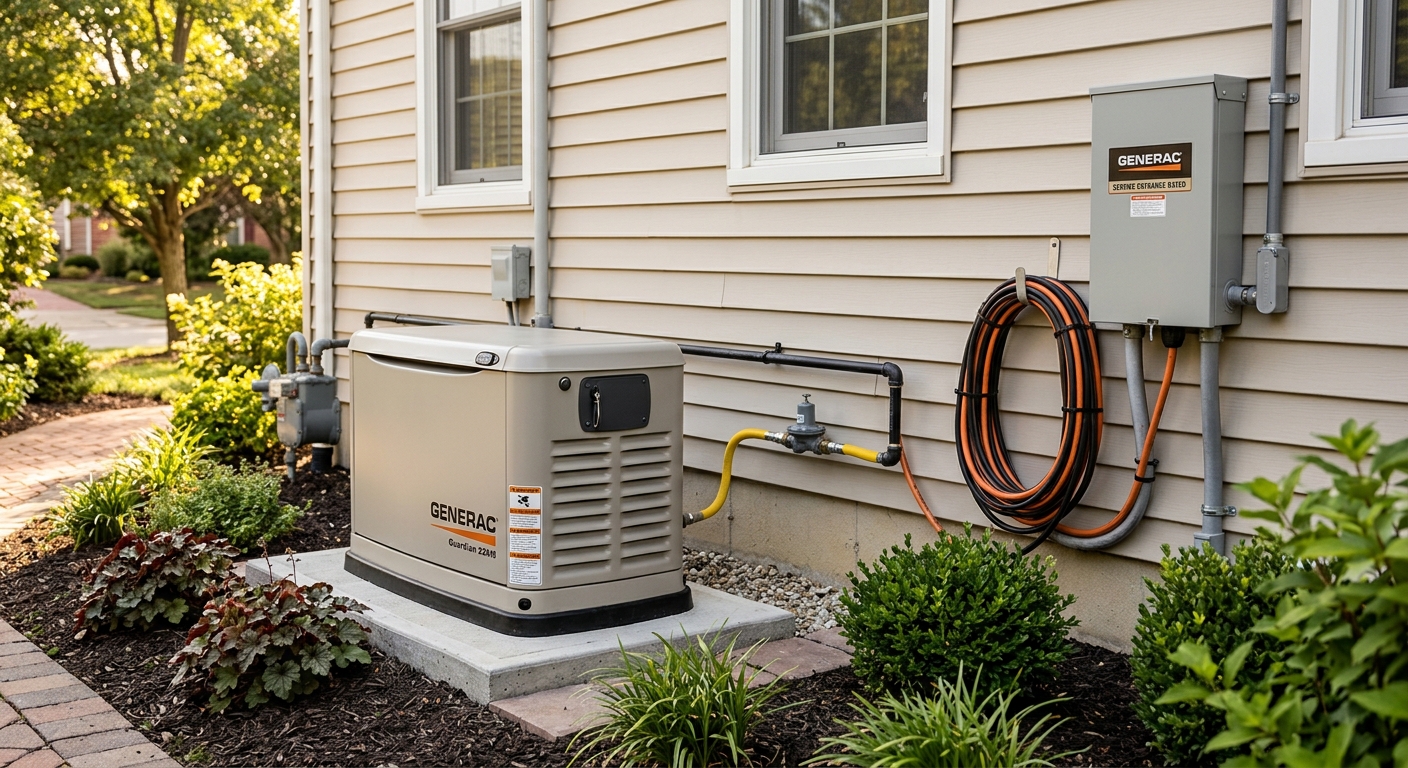
- Have the electrician install a whole-home automatic transfer switch (ATS) rated for your panel amperage, typically 100A, 150A, or 200A. The ATS detects outages within seconds and switches the home from utility to generator power automatically, then switches back when utility power is restored.
- Schedule the required permit inspection before the unit is energized. After passing inspection, run the generator through a full load test with the installer present. Confirm the automatic start feature works and that all critical circuits are on the generator side of the transfer switch.
- Set up the generator’s weekly self-test feature, typically a 10 to 20 minute automatic exercise cycle, which keeps the engine ready and alerts you to problems between outages. Register the unit with the manufacturer for warranty coverage.
- Purchase a manual transfer switch kit sized for your portable generator output. Reliance Controls and GenTran are the most common brands for DIY kits. Choose a 6-circuit or 10-circuit kit rated at 30 amps (7,500 watts) or 50 amps (12,500 watts) to match your generator’s output plug.
- Identify the circuits you want to back up on your main electrical panel. Common selections: furnace or air handler, refrigerator, sump pump, one bathroom, one lighting circuit, and one general-purpose outlet circuit. Label these clearly.
- Turn off the main breaker at your electrical panel. Verify power is off with a non-contact voltage tester before touching any wiring. Install the transfer switch subpanel in a location adjacent to your main panel with a clear path for the generator inlet cable.
- Move the selected circuit breakers from your main panel to the transfer switch subpanel following the kit instructions exactly. Connect the subpanel wiring to your main panel per the included wiring diagram. This step is where most DIYers benefit from a one-hour electrician consultation to verify the work before energizing.
- Install a weatherproof generator inlet box (a flanged inlet, sometimes called a power inlet box) on an exterior wall. Run conduit and appropriate gauge wire from the inlet box to the transfer switch. A 30-amp inlet requires 10-gauge wire, a 50-amp inlet requires 6-gauge wire.
- Restore main panel power and test each transferred circuit to confirm normal operation. Then test with the generator: start the generator outside, connect it via the generator cord to the inlet box, and flip the transfer switch levers to generator power one circuit at a time, confirming each loads up correctly.
Why It Works: The Benefits
A single extended outage can spoil $200 to $800 in refrigerated and frozen food. Basement flooding from a sump pump failure during a storm can cause $5,000 to $20,000 in water damage, making even an expensive generator pay for itself in one prevented event.
CPAP machines draw 30 to 60 watts, home oxygen concentrators draw 150 to 600 watts, and home dialysis machines can draw over 1,000 watts. Correct generator sizing ensures these devices never lose power unexpectedly.
Extended outages in winter or summer can force families into hotels at $100 to $250 per night. A properly sized generator keeps heating, cooling, and essential systems running so your home stays livable.
A gas furnace needs only 300 to 600 watts to run its blower and controls, meaning a mid-size generator easily keeps a home warm in winter. Without power, pipes can freeze in under 24 hours in cold climates, leading to thousands in repair costs.
A permanently installed standby generator adds an estimated $5,000 to $15,000 in perceived value and is a strong selling point in areas with frequent outages, according to data from the National Association of Realtors.
💰 Savings Impact by Action
A generator eliminates the near-certain $200 to $800 in refrigerated and frozen food loss that occurs during outages exceeding 4 hours.
Keeping a sump pump running during a storm outage prevents basement flooding that causes $5,000 to $20,000 in water damage in the vast majority of cases.
A properly sized generator eliminates displacement costs of $100 to $250 per night for most multi-day outage scenarios in extreme weather.
Maintaining furnace operation during winter outages prevents frozen pipe bursts, which average $5,000 in repair costs and occur within 24 hours of heating loss in climates below 20 degrees Fahrenheit.
Operating a generator at 50% of its rated load instead of 100% load reduces fuel consumption by roughly 35 to 40% while extending engine life significantly.
🏠 Key Concepts Explained
The Science Behind It
Every electrical motor, whether in your refrigerator compressor, sump pump, or furnace blower, obeys the same physics at startup. The rotor is stationary and needs to overcome its own inertia to reach operating speed, which requires a large inrush of current lasting one to two seconds. This inrush, called locked rotor amperage (LRA), can be two to three times the motor’s normal running amperage. For generator sizing purposes, this translates directly into the surge wattage requirement. If your generator cannot supply that surge, its voltage collapses momentarily, the motor either fails to start or stalls, and the generator’s overload protection shuts it down. This is why total running wattage alone is an insufficient sizing number.
Generators produce AC power at a target frequency of 60 Hz in North America, and maintaining that frequency under varying load is the core engineering challenge. When you suddenly add a large load like a motor starting up, the engine must immediately deliver more mechanical power or the generator will slow down, dropping below 60 Hz and causing sensitive electronics to malfunction. This is why quality generators include automatic voltage regulators (AVR) and engine governors. Inverter generators use a different approach: they generate raw AC power, convert it to DC, then synthesize clean 60 Hz AC electronically, which produces much cleaner power (less than 3% total harmonic distortion) that is safe for computers, televisions, and medical devices.
Fuel energy density determines how long your generator can run. A gallon of gasoline contains about 132,000 BTUs of energy. A 7,500-watt generator running at 50% load with a typical 25% conversion efficiency burns through roughly 65,000 to 70,000 BTUs per hour, translating to about 0.6 gallons per hour. Propane contains 91,500 BTUs per gallon, so you burn more volume but it stores indefinitely unlike gasoline which degrades within 30 to 60 days without a fuel stabilizer. Natural gas is piped continuously, eliminating storage entirely, which is the primary reason standby generators are almost always connected to natural gas or a large fixed propane tank rather than portable cans.
Frequently Asked Questions
▼ My generator starts fine but shuts off after a few seconds when I plug things in. What is wrong?
This is almost always an overload condition caused by startup surge from a motor-driven appliance exceeding the generator’s peak wattage rating. Disconnect all loads, start the generator, then add appliances one at a time starting with the highest surge-draw item first (typically your sump pump or refrigerator). If it still trips on a single appliance, your generator is undersized for that device’s startup surge, and you need either a larger generator or to choose a different appliance to prioritize.
▼ How much gasoline should I store for a multi-day outage?
Plan for 0.5 to 0.75 gallons per hour at typical 50% load, or 12 to 18 gallons per day for a mid-size portable generator. For a 72-hour outage, that means 36 to 54 gallons, which exceeds safe residential storage limits in many municipalities (typically 25 gallons in approved containers). The practical solution is to store 25 gallons, locate a nearby gas station with a generator, and plan to refuel every 36 to 48 hours. Always treat stored gasoline with a fuel stabilizer.
▼ Can I power my central air conditioner with a portable generator?
Most portable generators in the 5,000 to 8,000 watt range cannot start a central AC compressor, which typically surges at 6,000 to 9,000 watts even if its running draw is only 3,000 to 4,000 watts. A 12,000 to 17,500 watt generator can handle most 2-ton to 3-ton central systems, but these large portables cost $1,500 to $3,000 and burn 1 to 1.5 gallons per hour. A more practical alternative is a window AC unit (5,000 to 8,000 BTU) drawing only 500 to 900 watts to cool one room efficiently.
▼ Do I need a permit to install a generator?
For standby generators with automatic transfer switches, permits are required in virtually every U.S. jurisdiction and the work must be done by a licensed electrician in most states. For portable generators with a manual transfer switch, permit requirements vary widely by city and county. Check with your local building department before starting any transfer switch installation. Unpermitted electrical work can void your homeowner’s insurance and create liability issues when you sell the home.
▼ Why does my generator produce power but my appliances are acting strangely or my TV will not work?
Standard portable generators produce power with significant harmonic distortion (5% to 25% THD), which can cause sensitive electronics like televisions, computers, and modern variable-speed HVAC controls to malfunction or refuse to start. The solution is an inverter generator, which produces clean sine wave power under 3% THD and is safe for all electronics. Honda EU series, Yamaha EF series, and Generac IQ series are well-regarded inverter models starting around $700 for 2,200 watts.
Quick Tips
- Add a fuel stabilizer like Sta-Bil to any gasoline stored for your generator and rotate your fuel supply every 30 days to prevent gumming in the carburetor.
- Run your portable generator under load for 30 minutes every 30 days to keep seals lubricated, confirm it starts, and ensure fuel in the carburetor stays fresh.
- Keep a printed load calculation sheet in your generator’s storage case so you know exactly which appliances to connect and in what order to avoid overloading during a real outage when you are stressed.
- If you have a well pump, confirm its voltage before buying a generator. Many 1 HP and larger well pumps run on 240 volts and require a generator with a 240V outlet and appropriate wattage, which rules out many small portable units.
Variations for Your Situation
- Apartment or Renter: Renters cannot install transfer switches or standby generators, but a small 2,000 to 3,500 watt inverter generator can legally be used outdoors on a patio or balcony with long heavy-duty extension cords (check your lease and local noise ordinances first). Focus on a mini-fridge or bar-size refrigerator (100 to 150W), device charging, a CPAP machine, and LED lighting. Budget $600 to $1,000 for a quiet inverter model like the Honda EU2200i or Westinghouse iGen2500, and always keep a CO detector running.
- Tight Budget (under $1,000): Skip the transfer switch entirely and buy a 3,500 to 5,000 watt open-frame portable generator for $400 to $700. Use it with three or four 10-gauge outdoor extension cords to directly power your refrigerator, a box fan or window AC, phone chargers, and a lamp. This approach covers essentials for a 3 to 5 day outage for under $800 total including cords and CO detector. The trade-off is that your furnace, well pump, and hardwired lights will not work without a transfer switch.
- Older Home (pre-1980): Homes built before 1980 often have 100-amp service panels, fuse boxes, or ungrounded outlets that complicate generator integration. Have an electrician inspect your panel before purchasing any generator equipment. A 100-amp panel can still support a whole-home standby generator as long as your total load does not regularly exceed 80 amps, which is uncommon in smaller older homes. If your home still has a fuse box, budget an additional $1,500 to $3,000 to upgrade to a modern breaker panel before any transfer switch installation.