When a summer heat wave rolls in, kids’ bedrooms can become the most dangerous rooms in the house. Upper-floor bedrooms routinely run 8 to 15 degrees warmer than the main living level, and children are far more vulnerable to heat stress than adults. A room that feels merely warm to a parent can be genuinely risky for an infant or toddler who cannot regulate body temperature as effectively.
The good news is that you do not need to crank your central AC to maximum or buy an expensive window unit to solve this. A combination of smart ventilation, targeted shading, and a few well-chosen upgrades can bring bedroom temperatures down by 5 to 12 degrees, which makes the difference between a restless, overheated child and a safe, comfortable night of sleep.
This post walks you through exactly how heat builds up in kids’ rooms, what you can do in the next 15 minutes at zero cost, and what a weekend DIY project can accomplish. We also cover when a professional solution makes sense and what safety thresholds parents should actually monitor.
What You’ll Need
Click on an item below to shop for the recommended items for this recipe on Amazon.
As an Amazon Associate, we earn from qualifying purchases.
How to Do It
- Close all blinds, curtains, or shades on east-facing windows by 7am and west-facing windows by noon. Even basic blinds reduce solar heat gain through a window by 20 to 40%.
- Set the ceiling fan to run counterclockwise (summer mode) at medium or high speed. This pushes air down into the room and creates a wind-chill effect that makes the room feel 3 to 5 degrees cooler.
- Place a box fan in the window facing outward to exhaust hot room air in the late afternoon between 4pm and 7pm when rooms are at peak heat. Switch it to blow inward after outdoor temperatures drop below indoor temperature, typically after 10pm.
- Lower your thermostat setpoint by 2 degrees specifically during nap and bedtime windows rather than all day. This targets cooling when it matters most for children without overcooling the whole day.
- Check that vents in the child’s room are fully open and unobstructed by furniture, toys, or bedding. A blocked vent can reduce airflow by 30% or more to that room.
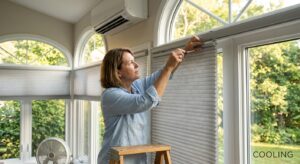
- Install solar shades or blackout cellular shades on the worst-offending windows (typically west and south facing). Cellular shades with a honeycomb cell structure provide an insulating air pocket and reduce heat gain by up to 60% compared to bare glass. Budget $30 to $80 per window.
- Apply reflective window film to single-pane windows or older double-pane windows that feel hot to the touch. A basic low-e window film ($20 to $40 per roll) can reject up to 70% of solar heat and installs with a squeegee and soapy water in 30 minutes per window.
- Add a portable tower fan or a quiet USB-powered fan near the child’s sleeping area to maintain consistent air movement without the noise of a box fan. Look for fans rated below 45 decibels for use during sleep.
- Seal gaps around window frames, electrical outlets on exterior walls, and the base of the door with weatherstripping or foam outlet gaskets. These gaps allow hot attic and wall air to infiltrate the cooled room, raising temperatures by 2 to 4 degrees. Materials cost under $20 total.
- Install a smart plug on a box fan set to run on a schedule. Program it to exhaust air from 3pm to 8pm and then reverse or turn off when the outdoor temperature sensor on a budget weather station confirms outdoor air is cooler than indoor.
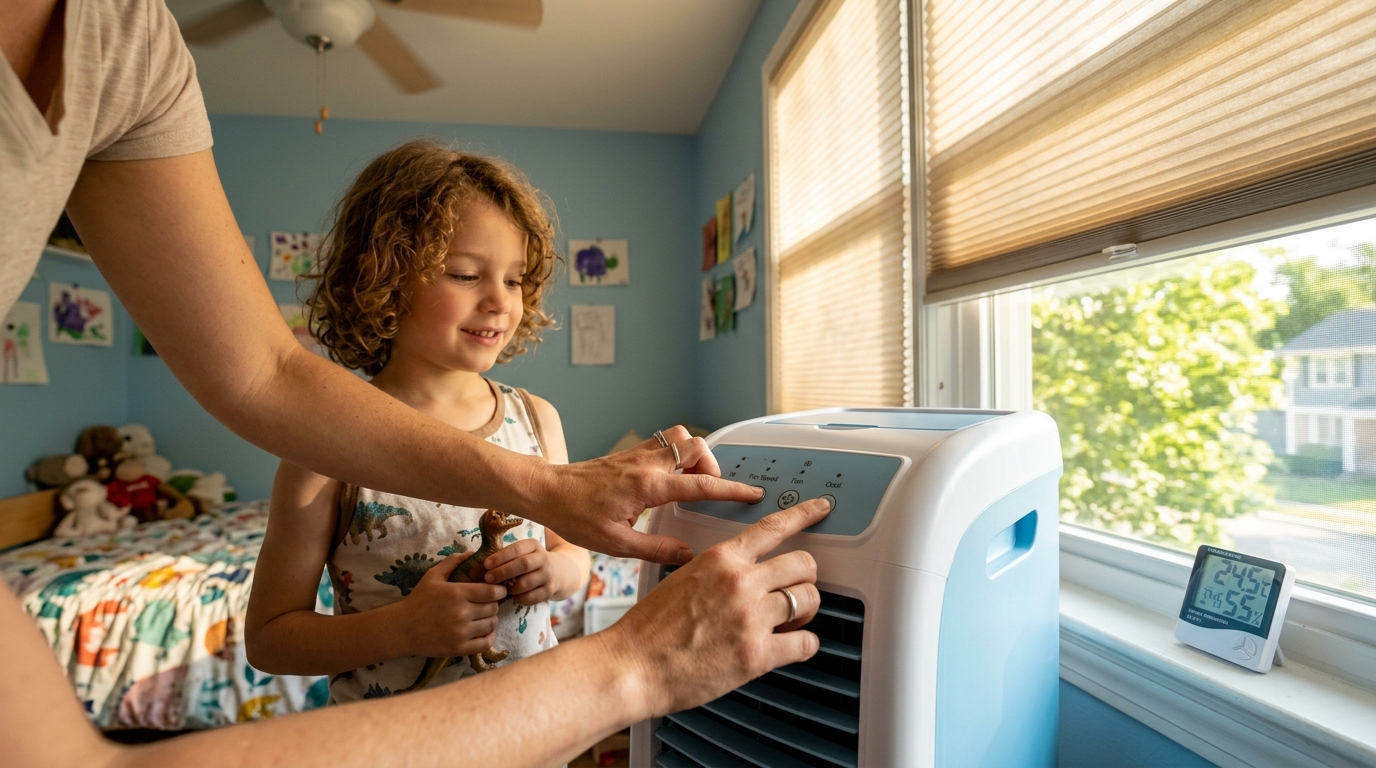
- Place a digital thermometer with a minimum and maximum memory function in the room so you can track actual peak temperatures rather than guessing. Models with a humidity display are particularly useful since humidity above 60% compounds heat stress risk significantly.
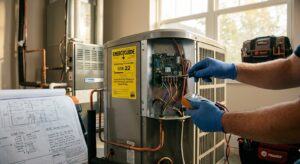
- Get two to three quotes from licensed HVAC contractors for a single-zone ductless mini-split for the problem bedroom. A 6,000 to 9,000 BTU unit is appropriate for most standard bedrooms up to 350 square feet.
- Ask each contractor to perform a Manual J load calculation for the room, not just a rule-of-thumb estimate. This ensures the unit is properly sized and prevents short-cycling, which increases humidity and reduces comfort.
- Request a unit with a sleep mode or quiet mode that reduces fan noise to 19 to 26 decibels. Major brands including Mitsubishi, Daikin, and LG all offer models in this range.
- Have the contractor inspect attic insulation above the bedroom at the same time. Adding insulation to R-38 or R-49 in the attic reduces heat gain into the room by 15 to 25% and improves the efficiency of any cooling equipment you install.
- After installation, register the unit and apply for any applicable utility rebates. Many utilities offer $100 to $500 rebates on qualifying mini-split installations, stacking on top of the federal tax credit.
Why It Works: The Benefits
Keeping kids’ rooms at or below 75 degrees Fahrenheit during sleep eliminates the primary risk factor for pediatric heat exhaustion. Even a 5-degree reduction in peak room temperature dramatically lowers physiological stress on young children.
Targeting cooling efforts to specific rooms instead of overcooling the whole house can reduce summer AC runtime by 15 to 25%, saving the average household $40 to $90 per month during peak summer months.
The body drops core temperature to initiate sleep. Rooms between 68 and 72 degrees produce measurably better sleep for children, reducing nighttime wake-ups and improving overall rest for the whole family.
Blocking solar heat gain before it enters the room means your AC unit runs shorter cycles to maintain setpoint, reducing mechanical wear and extending the lifespan of the system by years.
Sealing and shading upstairs bedrooms reduces the thermal load on your entire HVAC system, which often improves comfort on the main floor as well since the system is no longer fighting a constant heat source overhead.
💰 Savings Impact by Action
Blocking direct solar gain through west and south windows with exterior shades or blackout cellular shades reduces cooling load in that room by up to 30% on peak heat days.
Running a ceiling fan in summer mode allows thermostat setpoint to be raised by 4 degrees without perceived discomfort, saving approximately 8% on total cooling energy per degree raised.
Strategic night flush ventilation that exchanges hot indoor air for cooler outdoor air reduces overnight cooling runtime by 10 to 15% in climates where nighttime temperatures drop below 70 degrees Fahrenheit.
Upgrading attic insulation above a top-floor bedroom to R-49 reduces conductive heat gain into that room by up to 20%, lowering AC runtime throughout the entire cooling season.
Sealing gaps around windows, outlets, and door frames in a child’s bedroom prevents hot air infiltration and reduces the cooling load in that room by up to 12%.
🏠 Key Concepts Explained
The Science Behind It
The reason upstairs bedrooms overheat during heat waves comes down to two compounding physical processes. First, solar radiation hits your roof and walls all day, conducting heat through the building envelope and into interior spaces. A dark asphalt shingle roof can reach 160 degrees Fahrenheit in direct sun, and even with moderate attic insulation, that heat radiates downward into top-floor rooms throughout the afternoon and well into the evening. Second, thermal stratification means that any heat already inside the home naturally rises and collects at ceiling level and on upper floors, making those spaces the last to cool down at night.
Children’s bodies add another layer of physics to consider. Unlike adults, young children have a higher surface-area-to-body-mass ratio, which means they gain heat from hot environments faster relative to their body size. They also have less effective sweating mechanisms and rely more heavily on caregivers to manage their thermal environment. Research from pediatric medicine consistently shows that ambient room temperatures above 75 degrees Fahrenheit during sleep elevate core body temperature, disrupt sleep architecture, and increase the risk of heat-related illness in children under 6.
The solutions in this guide work because they attack the problem at each stage of the heat pathway. Exterior shading and window film intercept solar radiation before it becomes heat inside the room. Air sealing prevents hot air infiltration from walls and attic spaces. Fans exploit evaporative cooling to make existing room air feel cooler without lowering its actual temperature. And night flush ventilation takes advantage of the natural temperature drop after sunset to exchange hot indoor air for cooler outdoor air, resetting the room temperature baseline before morning heat buildup begins again.
Frequently Asked Questions
▼ The room cools down at night but is unbearably hot by 3pm. What is wrong?
This is a solar heat gain problem, not an AC problem. West or south-facing windows are almost certainly admitting direct afternoon sun and heating the room faster than your cooling system can compensate. Install exterior solar shades or interior blackout cellular shades on those windows immediately. If the ceiling is also hot to the touch by midday, your attic insulation is likely below R-30 and is conducting heat directly into the room throughout the afternoon.
▼ My AC is set to 72 but the child’s room reads 80 degrees. Why is there such a big difference?
This usually indicates one of three issues: a blocked or undersized supply vent in that room, a duct leak in the attic or wall cavity losing conditioned air before it reaches the room, or excessive solar and conductive heat gain overwhelming the delivered airflow. Start by checking that the vent is fully open and unobstructed. Then hold your hand over the vent during a cooling cycle. If airflow feels weak compared to other rooms, call an HVAC technician to inspect duct integrity in that branch of the system.
▼ Is it safe to put a window air conditioner in a child’s room?
Yes, with a few precautions. Make sure the unit is properly secured in the window frame with the manufacturer’s support bracket so it cannot tip or fall. Keep cords out of reach of children and ensure the unit does not create a gap large enough for a child to access the window opening. Set the unit to a maximum of 72 degrees and use the sleep or energy-saver mode overnight to prevent overcooling, which can cause respiratory irritation in young children.
▼ What temperature is actually dangerous for a child sleeping in a hot room?
Pediatric guidelines from the American Academy of Pediatrics recommend keeping infant sleep environments between 68 and 72 degrees Fahrenheit. Rooms above 75 degrees begin to elevate risk, and sustained exposure to temperatures above 80 degrees during sleep is considered unsafe for infants and toddlers. Monitor actual room temperature with a digital thermometer placed at mattress height, not at ceiling level, since temperature can vary by 5 to 8 degrees between floor and ceiling in a hot room.
▼ We live in a humid climate and fans do not seem to help much. What should we do?
In humid climates above 60% relative humidity, the evaporative effect of fans is significantly reduced because sweat cannot evaporate efficiently into already-saturated air. The priority in humid conditions is dehumidification, not just air movement. A portable dehumidifier in the room set to maintain 50% relative humidity can make a room feel 5 to 7 degrees cooler even without lowering air temperature. Pair it with a window AC unit or mini-split that also removes moisture as it cools for the best results.
Quick Tips
- Set a $15 smart plug to run a box fan on an exhaust schedule from 3pm to 8pm automatically every day so you never forget during the busiest part of the afternoon.
- A damp, cool washcloth placed on a child’s forehead or neck provides rapid localized cooling that can reduce perceived discomfort even when room temperature is still elevated.
- Light-colored or white bedding reflects less radiant heat than dark colors and keeps a child’s immediate sleep surface cooler by 2 to 3 degrees compared to dark bedding.
- Close interior doors between cooled and uncooled parts of the home during the day to concentrate cooling where children sleep and play, rather than letting conditioned air dilute into unused spaces.
Variations for Your Situation
- Apartment or Rental: Renters cannot install window film, exterior shades, or mini-splits without landlord approval, but there are strong no-modification options. Tension-mount cellular shades require no drilling and fit most windows for $25 to $60 each. A portable evaporative cooler works in dry climates under 30% humidity and costs $80 to $150 with no installation. A quiet tower fan with a built-in thermostat ($40 to $80) provides targeted cooling at mattress level. Document high temperatures in writing and notify your landlord, since many jurisdictions require landlords to maintain habitable temperatures in rental units.
- Tight Budget Under $50: Focus on the zero-cost steps first: close window coverings during peak sun hours, reverse ceiling fan direction, and open windows at night for cross ventilation. For spending, prioritize a digital thermometer with humidity display ($10 to $15) so you know the actual conditions in the room, a box fan for night flush ventilation ($20 to $30), and foam outlet gaskets for exterior-wall outlets ($5 for a pack of 10). These three items together can reduce peak room temperatures by 4 to 7 degrees for under $50 total.
- Older Home Pre-1980: Homes built before 1980 typically have single-pane windows, minimal wall insulation, and attic insulation well below current R-value recommendations. The heat gain through windows and the ceiling is dramatically higher than in newer construction. Prioritize attic air sealing and insulation above the child’s bedroom as the single highest-impact investment, since attic improvements can reduce heat gain into that room by 20 to 35%. Window replacement or interior storm window inserts ($75 to $200 per window) offer the next best return in older homes with original single-pane glass. Contact your utility company about weatherization assistance programs, since many utilities offer free or subsidized insulation upgrades for qualifying households.