Your air conditioner worked hard last summer, and it’s been sitting idle all winter collecting dust, debris, and potentially harboring issues that will quietly drain your wallet the moment you flip it back on. Most homeowners don’t think about their AC until it fails on a 95-degree afternoon, and that’s exactly when a $150 service call turns into a $1,500 repair. A proactive spring maintenance routine changes that equation entirely.
According to the U.S. Department of Energy, a neglected air conditioner can lose 5% of its operating efficiency every year without proper maintenance. Over a few seasons, that means a system that once cooled your home on 2 kilowatt-hours per hour might now need 2.5 or more, adding real dollars to every monthly bill. The good news is that most of that lost efficiency is recoverable with basic cleaning and inspection steps you can do yourself.
This guide walks you through a complete spring AC maintenance checklist, from the quick 15-minute tasks any homeowner can do without tools, to a thorough DIY deep-clean that takes a Saturday morning. You’ll also find guidance on when to call a professional, what to watch out for, and how to know if your system is actually performing as it should.
What You’ll Need
Click on an item below to shop for the recommended items for this recipe on Amazon.
As an Amazon Associate, we earn from qualifying purchases.
How to Do It
- Replace the air filter with a fresh MERV 8 to 11 rated filter. Check the size printed on the old filter frame and match it exactly. A clean filter at startup prevents the single most common cause of reduced efficiency.
- Go outside and visually inspect the condenser unit. Remove any debris, leaves, or cottonwood fluff from the top grille and around the sides. Clear at least 2 feet of open space around the unit on all sides.
- Check that the condensate drain line outlet (usually a white PVC pipe near the indoor air handler or exiting through the foundation) is not blocked. Pour a cup of water into the drain pan to confirm it flows freely.
- Locate the outdoor disconnect box (the gray box mounted on the wall near the condenser) and confirm the disconnect is in the ON position if it was shut off for winter. Do not turn it on until the unit has been off or in standby for at least 6 hours so the crankcase heater can warm the compressor oil.
- Set your thermostat to COOL and a temperature 3 to 5 degrees below current room temperature. Go outside and listen for smooth startup within 2 to 3 minutes. You should hear the fan and compressor humming steadily with no grinding, rattling, or hard starting.
- Turn off power completely before working. Flip the breaker in your electrical panel labeled AC or Air Handler to OFF, and pull the disconnect block from the outdoor unit’s disconnect box.
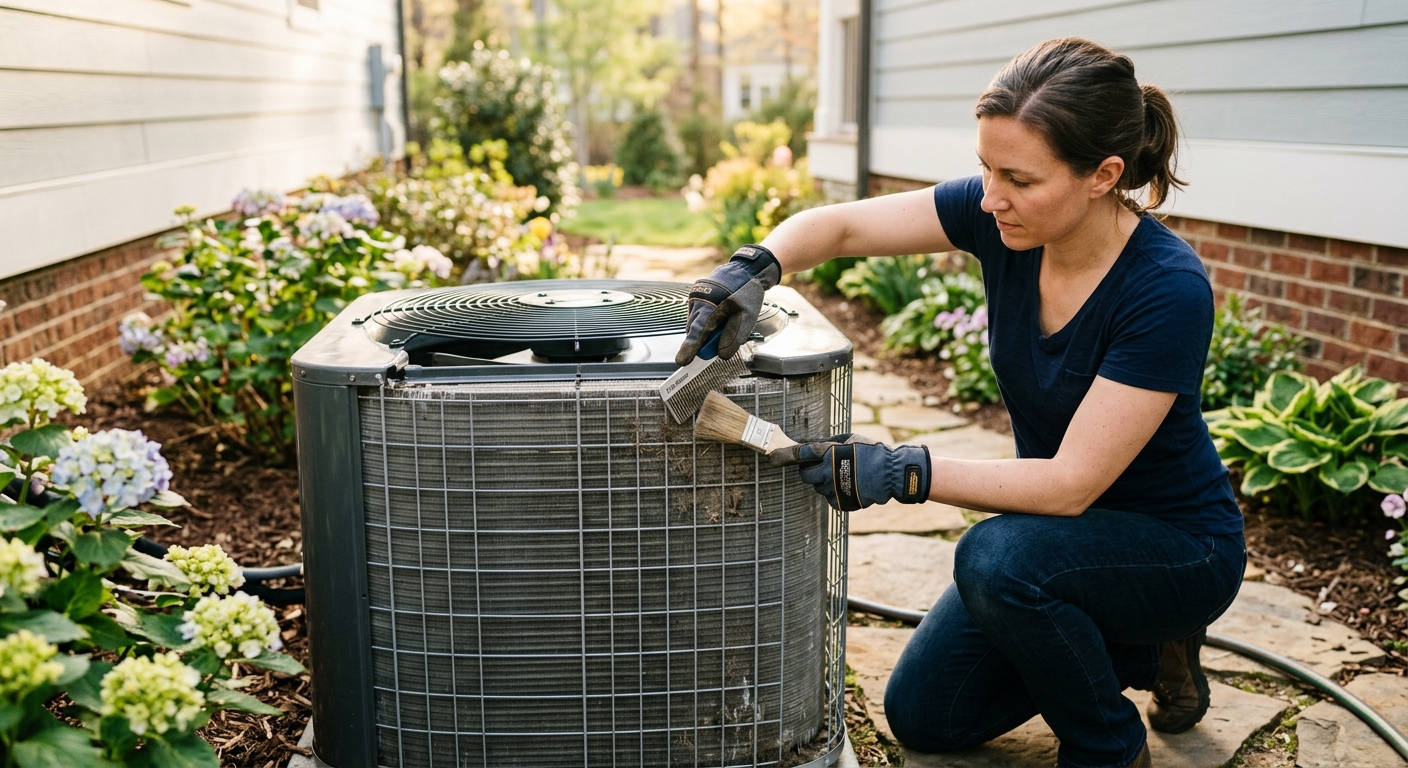
- Clean the outdoor condenser coils using a coil cleaner spray (available at hardware stores for $10 to $15). Apply from the inside out if possible, or spray gently from outside inward with a garden hose at low pressure. Bent fins can be straightened with a fin comb tool.
- Clean the indoor evaporator coil if accessible. Remove the access panel on your air handler, and use a no-rinse evaporator coil cleaner spray. The foam penetrates the coil and drains into the condensate pan, carrying dirt with it.
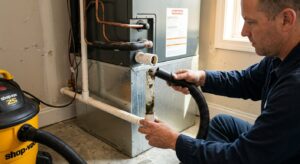
- Flush the condensate drain line by pouring a 50/50 mix of white vinegar and water (about 1 cup) into the drain pan access port. Wait 30 minutes, then flush with plain water. This prevents algae and mold buildup that causes clogs.
- Inspect all accessible ductwork connections near the air handler for gaps or separation. Seal any gaps with foil-backed tape (not standard duct tape, which fails over time). Even a small duct gap can lose 10 to 30% of conditioned air into unconditioned space.
- Restore power, allow 30 minutes for the crankcase heater to do its job if the system was fully de-energized, then run the system and measure the temperature difference between the supply and return air registers. A healthy split is 14 to 22 degrees F, confirming the system is transferring heat effectively.
- Call at least two HVAC companies for quotes. Ask specifically for a full tune-up that includes refrigerant level check, electrical connections, coil cleaning, and a system performance report. Avoid bare-bones filter-only tune-ups.
- Ask the technician to check the refrigerant charge using manifold gauges, test capacitor microfarad ratings (capacitors fail at end of life and often show degraded readings before full failure), and inspect the contactor for pitting.
- Request a written report of all findings, including any items flagged as watch or replace soon. This gives you a baseline and documentation for warranty claims or future service calls.
- Ask about a maintenance agreement if your system is more than 8 years old. Annual contracts typically run $150 to $250 per year and include priority scheduling, parts discounts, and two visits (spring cooling, fall heating).
Why It Works: The Benefits
A clean, properly maintained AC system uses 10 to 25% less electricity than a neglected one, translating to $30 to $150 in savings over a cooling season for a typical home depending on climate and system size.
More than 80% of AC failures during peak summer heat are preventable with routine maintenance. Catching a failing capacitor or dirty coil in spring costs $20 to $150 instead of the $300 to $600 emergency service call in July.
A well-maintained central AC system lasts 15 to 20 years. Neglected systems often fail within 10 to 12 years. Stretching replacement by even 3 years saves $3,000 to $6,000 on a new system installation.
A clean filter and coil remove more airborne particulates, allergens, and mold spores from circulating air, which matters especially in spring when pollen counts spike and windows stay closed.
Proper maintenance ensures even cooling throughout your home, eliminates warm spots caused by restricted airflow, and keeps humidity levels in the comfortable 40 to 50% range rather than the clammy 60%+ that a struggling system produces.
💰 Savings Impact by Action
Replacing a clogged filter restores full airflow and can recover up to 15% of lost cooling efficiency immediately.
Cleaning fouled evaporator and condenser coils can improve heat transfer efficiency by 10 to 16% according to ASHRAE research.
Sealing leaky duct connections near the air handler reduces conditioned air loss and can cut cooling energy use by up to 20% in homes with duct systems in unconditioned spaces.
Correcting a 10% refrigerant undercharge restores up to 20% of lost cooling capacity and reduces compressor runtime proportionally.
A complete spring maintenance routine combining filter, coil, drain, and electrical checks can reduce total seasonal cooling costs by 10 to 25% compared to a fully neglected system.
🏠 Key Concepts Explained
The Science Behind It
An air conditioner doesn’t actually create cold air. It moves heat from inside your home to outside using a refrigerant that cycles between liquid and gas states. The refrigerant absorbs heat from your indoor air at the evaporator coil (where it evaporates into a gas), carries that heat to the outdoor condenser coil, and releases it outside (where it condenses back into a liquid). The efficiency of this cycle depends entirely on how well heat can transfer across those two coil surfaces, and any layer of dust, debris, or biological growth between the air and the coil acts as thermal insulation that degrades that transfer.
The compressor is the heart of the system and also its most expensive component, typically $800 to $1,500 to replace. It is designed to pump refrigerant vapor, not liquid. When airflow over the evaporator coil is restricted by a dirty filter or blocked return, the coil gets too cold, refrigerant doesn’t fully evaporate, and liquid refrigerant can slug back to the compressor. This is called liquid slugging and is a leading cause of compressor failure. Maintaining proper airflow isn’t just about efficiency; it’s about protecting a $1,000-plus component.
Electrical components like capacitors and contactors degrade with each cooling season. Capacitors store and release charge to start and run the compressor and fan motors. A capacitor rated at 45 microfarads that measures only 38 microfarads is still technically working but causing the motor to draw higher amperage, run hotter, and wear out faster. Catching this in spring during a professional tune-up means a $20 to $50 capacitor replacement instead of a $600 to $1,200 motor or compressor replacement later in the season.
Frequently Asked Questions
▼ My AC runs but the house never gets cool enough. Could maintenance fix this?
Start with the basics: replace the filter, clean the condenser fins, and check that all supply vents are open and unobstructed. If the system still struggles after those steps, measure the supply-to-return temperature split. A split below 14 degrees F suggests low refrigerant or a dirty evaporator coil, both of which require a technician to diagnose and correct properly.
▼ How do I know if my AC needs refrigerant?
You cannot determine refrigerant charge by visual inspection alone. Signs that suggest low refrigerant include ice forming on the refrigerant lines or evaporator coil, a temperature split below 14 degrees F, and the system running continuously without reaching the setpoint. An HVAC technician with manifold gauges can check this in about 15 minutes. Remember that refrigerant doesn’t deplete on its own; if it’s low, there’s a leak that needs to be found and repaired.
▼ Can I skip professional maintenance if I do the DIY checklist myself?
For a system under 8 years old with no history of problems, a thorough DIY maintenance routine handles 80% of what a standard tune-up covers. However, a professional should check refrigerant charge, test capacitor ratings, and inspect electrical connections every 2 to 3 years even with diligent DIY care. Systems over 10 years old benefit from annual professional inspection since component failure risk rises significantly with age.
▼ My condensate drain line keeps clogging every summer. What can I do?
A drain line that clogs repeatedly usually has a slow-slope section that pools water, allowing algae and mold to colonize. Flush the line monthly with a vinegar-water solution during cooling season rather than just once at startup. You can also purchase condensate drain pan tablets (algaecide tablets that dissolve slowly) and drop one in the drain pan each spring, which suppress biological growth for 3 to 4 months.
▼ What if my system hasn’t been serviced in 3 or more years?
After three or more years without maintenance, start with a professional tune-up rather than DIY alone. A technician can assess the true condition of the coils, measure refrigerant charge, and catch deferred issues that compound over time. Once the system is professionally reset to a good baseline, you can take over with annual DIY maintenance and a professional visit every 2 to 3 years going forward.
Quick Tips
- Set a recurring calendar reminder for March 15 every year labeled ‘AC Spring Maintenance’ so you never skip it during busy spring months.
- Keep a spare air filter taped to the inside of the air handler cabinet door so you always have one on hand and can check the current filter’s condition at a glance.
- Trim any shrubs, ornamental grasses, or vines to maintain at least 18 inches of clearance around the condenser unit, since vegetation restricts airflow and can cut efficiency by 10% or more.
- If you have a smart thermostat, review the runtime history from last summer. If your system ran more than 16 hours per day on moderate-temperature days, it may be undersized, leaking refrigerant, or losing conditioned air through duct leaks.
Variations for Your Situation
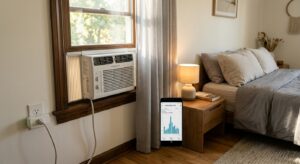
- Apartment/Rental: Renters with a central air unit managed by the landlord should still replace or request replacement of the air filter every 60 to 90 days, which is typically renter-permitted. For window or through-wall AC units, clean the removable foam filter with warm soapy water monthly, vacuum the front grille, and use a soft brush to clean the condenser coils visible from outside. These steps alone can recover 10 to 15% efficiency on a neglected window unit.
- Tight Budget (under $50): Focus on the free and near-free steps first. A $10 to $15 air filter replacement, a free garden-hose rinse of the condenser fins, and a free vinegar flush of the drain line cover the three highest-impact maintenance items. Skip the coil cleaners and professional visit for now, but track your monthly kWh usage to confirm improvement and plan a professional check within the next 1 to 2 seasons.
- Older Home (pre-1990): Homes with older duct systems are more likely to have significant duct leakage, which can waste 20 to 30% of cooled air in unconditioned crawlspaces or attics. Before investing in coil cleaning or a tune-up, do a basic duct inspection by holding your hand near duct joints in the attic or basement while the system runs. Seal obvious gaps with foil-backed tape or mastic sealant first, as this single step may deliver more savings than any other maintenance task.